Last updated: October 29, 2026
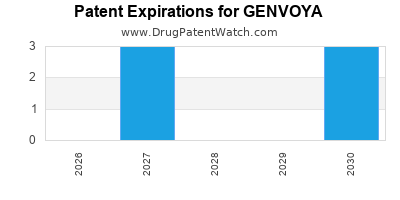
Genvoya, Gilead Sciences' once-daily single-tablet HIV regimen, generated a mature but durable revenue stream after its 2015 FDA approval. Its commercial position has weakened as patients and prescribers have shifted toward Biktarvy, Gilead's newer bictegravir-based regimen. Genvoya remains protected by a combination of formulation, active-ingredient, and method-of-use patents that extend into the early 2030s in the United States, although FDA regulatory exclusivity has expired and generic entry risk increases as patent challenges mature.
What is Genvoya and how does it work?
Genvoya combines four active ingredients:
| Component |
Function |
| Elvitegravir |
Integrase strand transfer inhibitor |
| Cobicistat |
Pharmacokinetic booster |
| Emtricitabine |
Nucleoside reverse transcriptase inhibitor |
| Tenofovir alafenamide fumarate |
Nucleotide reverse transcriptase inhibitor |
Genvoya is approved for the treatment of HIV-1 infection in adults and pediatric patients weighing at least 25 kilograms. The product is taken once daily with food and is intended as a complete antiretroviral regimen. It is not recommended for patients with severe renal impairment or for use with certain drugs that interact with cobicistat or elvitegravir [1].
Genvoya replaced Stribild for many patients because tenofovir alafenamide, or TAF, generally produces lower plasma tenofovir exposure than tenofovir disoproxil fumarate, or TDF. That profile can reduce renal and bone toxicity concerns, although TAF-based products remain subject to weight gain, lipid, renal, and drug-interaction considerations.
When did Genvoya receive FDA approval?
The FDA approved Genvoya on November 5, 2015. The approval followed Gilead's development of TAF-based HIV products and positioned Genvoya as a lower-tenofovir-exposure successor to Stribild [1].
FDA regulatory milestones
| Milestone |
Date |
| FDA approval |
November 5, 2015 |
| Initial adult indication |
2015 |
| Pediatric expansion to patients weighing at least 25 kg |
2016 |
| New chemical entity exclusivity |
Not applicable to the complete product in the same way as a wholly new molecular entity |
| Three-year clinical investigation exclusivity |
Expired |
| Current regulatory status |
Approved, marketed, no active FDA exclusivity expected to block ANDA filing |
Elvitegravir, cobicistat, and emtricitabine had prior regulatory histories in other products. That reduced the exclusivity value available for the fixed-dose combination compared with an entirely new active ingredient.
How has Genvoya revenue changed over time?
Genvoya reached peak commercial performance after broad adoption of TAF-based regimens, then entered a gradual decline as Biktarvy captured new starts and switched patients.
The following figures represent rounded annual product sales reported by Gilead or derived from Gilead's product-sales disclosures. Currency is U.S. dollars.
| Year |
Estimated Genvoya sales |
Market interpretation |
| 2016 |
Approximately $1.1 billion |
First full commercial year |
| 2017 |
Approximately $1.3 billion |
Rapid TAF adoption |
| 2018 |
Approximately $1.5 billion |
Peak-growth period |
| 2019 |
Approximately $1.6 billion |
Near peak revenue |
| 2020 |
Approximately $1.6 billion |
Resilient demand despite market disruption |
| 2021 |
Approximately $1.6 billion |
Mature product stability |
| 2022 |
Approximately $1.5 billion |
Biktarvy substitution accelerates |
| 2023 |
Approximately $1.3 billion |
Mature-brand erosion |
| 2024 |
Approximately $1.1 billion to $1.2 billion |
Continued migration to newer regimens |
Genvoya's cumulative sales since launch are likely above $13 billion. The product's revenue decline has been gradual rather than abrupt because HIV treatment is chronic, adherence-sensitive, and subject to physician and patient switching friction.
Gilead's HIV franchise remains heavily concentrated in Biktarvy, Descovy, and other branded products. Genvoya's strategic value is now measured less by growth and more by cash generation, treatment continuity, and franchise retention [2, 3].
What is driving the decline in Genvoya sales?
Biktarvy is the primary competitive threat
Biktarvy combines bictegravir, emtricitabine, and TAF in a once-daily tablet. It does not require cobicistat boosting, which simplifies drug-interaction management and improves prescribing flexibility.
Biktarvy has several commercial advantages:
- Strong efficacy in treatment-naive and treatment-experienced patients.
- No pharmacokinetic booster.
- Fewer interaction concerns than elvitegravir/cobicistat.
- Strong Gilead promotion and formulary positioning.
- High physician familiarity and rapid uptake in treatment initiation.
Genvoya remains clinically useful, but Biktarvy has become Gilead's preferred growth product in the HIV franchise. The principal economic effect is internal cannibalization rather than loss of patients to competitors.
Other competing HIV regimens
| Product |
Company |
Key differentiation |
| Biktarvy |
Gilead |
Bictegravir-based, unboosted single tablet |
| Dovato |
ViiV Healthcare |
Two-drug, dolutegravir/lamivudine regimen |
| Triumeq |
ViiV Healthcare |
Dolutegravir-based single tablet |
| Juluca |
ViiV Healthcare |
Two-drug maintenance regimen |
| Odefsey |
Gilead |
Rilpivirine/FTC/TAF single tablet |
| Symtuza |
Johnson & Johnson and Gilead |
Darunavir-based boosted single tablet |
| Cabenuva |
ViiV Healthcare |
Long-acting injectable treatment |
Cabenuva is a different delivery model but contributes to the long-term pressure on oral single-tablet regimens. It is most relevant for patients seeking reduced dosing frequency or those with adherence challenges.
What patents protect Genvoya?
Genvoya's U.S. patent estate is based on several overlapping technology categories rather than a single composition-of-matter patent for one new molecule.
Main patent categories
| Patent category |
Protected subject matter |
Commercial significance |
| TAF patents |
Tenofovir alafenamide and related prodrugs |
Protects the active ingredient used in the formulation |
| Fixed-dose combination patents |
Combinations of elvitegravir, cobicistat, emtricitabine, and TAF |
Protects the product architecture |
| Formulation patents |
Tablet composition, ratios, stability, and pharmaceutical salts |
Raises generic formulation-design hurdles |
| Pharmacokinetic patents |
Use of cobicistat to enhance elvitegravir exposure |
Protects the boosted regimen |
| Method-of-use patents |
Treatment of HIV with the combination |
Can support litigation even after formulation patents are challenged |
| Manufacturing patents |
Synthesis, crystalline forms, intermediates, and impurity control |
May complicate non-infringing generic manufacture |
The U.S. Orange Book lists Genvoya-related patents and provides the controlling public record for listed patent numbers and expiration dates [4]. The estate includes Gilead and affiliated entities as patent owners or applicants, with priority dates generally predating the 2015 approval.
The most commercially important protection is the TAF and combination-product estate. Several relevant patents extend into the early 2030s, subject to patent-term adjustment, patent-term extension, pediatric exclusivity, terminal disclaimers, and the outcome of Paragraph IV litigation.
What is the Orange Book status of Genvoya?
Genvoya has been listed in the FDA Orange Book as an approved prescription product with associated patents. FDA regulatory exclusivity has expired, so an ANDA applicant may pursue approval if it addresses the listed patents through certification or waits for patent expiry.
The practical Orange Book structure is:
- The ANDA applicant must address each relevant listed patent.
- A Paragraph IV certification asserts that a patent is invalid, unenforceable, or not infringed.
- Gilead may file an infringement action within 45 days.
- A timely lawsuit can trigger a 30-month stay of ANDA approval, subject to statutory exceptions.
- A successful challenge can accelerate generic entry before the nominal patent expiry date.
The Orange Book does not itself determine whether a patent will survive litigation. It identifies the patents that create an ANDA approval barrier [4].
When does Genvoya lose exclusivity?
Genvoya lost its principal FDA regulatory exclusivity several years after approval. Patent-based exclusivity is more important.
Expected exclusivity timeline
| Period |
Event |
| 2015 |
FDA approval and commercial launch |
| 2018 onward |
Core FDA regulatory exclusivity no longer the main barrier |
| 2020s |
Increasing likelihood of ANDA Paragraph IV activity |
| Early 2030s |
Expiration window for important Gilead patent claims, depending on patent and jurisdiction |
| After patent resolution |
Potential launch of generic fixed-dose combinations |
The earliest generic entry date cannot be determined solely from the original approval date. It depends on the specific patent claims, the ANDA filing date, litigation outcomes, settlements, and any 180-day first-filer exclusivity.
Which companies are challenging Genvoya patents?
Publicly visible generic competition is expected to come from large HIV-focused and international generic manufacturers, including Teva, Mylan/Viatris, Sandoz, Lupin, Cipla, Hetero, Aurobindo, and related applicants. The identity of an ANDA Paragraph IV filer is not always publicly available until litigation is filed or the applicant becomes identifiable through court records.
Gilead has historically used patent litigation and licensing strategies across its HIV portfolio. Patent challenges to TAF products may target:
- Validity of TAF compound claims.
- Obviousness of the fixed-dose combination.
- Written description and enablement.
- Infringement of formulation claims.
- Patent-term calculations.
- Non-infringing alternative formulations.
No single publicly established settlement should be treated as the definitive generic-entry date for Genvoya without matching the agreement to each Orange Book patent and the relevant ANDA applicant.
What formulation patents protect Genvoya?
Formulation protection is commercially important because a generic applicant must reproduce the therapeutic performance of a low-dose, fixed-dose tablet while meeting dissolution, stability, bioequivalence, and manufacturing requirements.
Genvoya formulation-related barriers may include:
- Precise active-ingredient ratios.
- TAF fumarate salt characteristics.
- Tablet excipient systems.
- Dissolution performance.
- Stability under moisture and temperature stress.
- Compatibility of the booster with the other active ingredients.
- Manufacturing processes that control degradation products.
These claims are usually weaker than a valid compound patent because generic manufacturers can redesign excipients or manufacturing steps. They still increase development cost and litigation complexity.
Is there biosimilar risk for Genvoya?
There is no biosimilar pathway for Genvoya because it is a small-molecule fixed-dose combination, not a biologic. Competitive entry would occur through the abbreviated new drug application pathway.
The relevant risks are generic substitution, authorized generic competition, patent challenges, and therapeutic switching to alternative branded HIV regimens. Biosimilar pricing dynamics do not apply.
What generic launch scenarios exist for Genvoya?
Scenario 1: Delayed entry until patent expiry
Generic competition remains limited until the early 2030s. Genvoya continues to generate declining but material revenue, supported by stable patients and international markets.
Scenario 2: At-risk launch after patent challenge
A first filer launches before final patent resolution. Gilead seeks damages and injunctive relief. The generic may be removed if Gilead prevails, or remain if the patents are invalidated or not infringed.
Scenario 3: Settlement-based entry
Gilead grants a generic company a date-certain launch license. The entry date may precede the latest patent expiry but follow the settlement terms. The agreement could include restrictions on formulation, authorized generic supply, or geographic sales.
Scenario 4: International erosion before U.S. erosion
Generic entry occurs first in countries where patents are weaker, expired, not listed, or subject to different national standards. U.S. revenue remains protected while international revenue declines.
How strong is the Genvoya patent estate?
The estate is commercially meaningful but less durable than a single, broad, uncontested compound patent.
Strengths
- Multiple patent layers cover TAF, the fixed-dose combination, and formulation.
- Gilead has substantial HIV patent-litigation experience.
- Chronic treatment creates strong brand persistence before generic substitution.
- The product is difficult to copy without resolving several technical and legal issues.
Weaknesses
- FDA exclusivity has expired.
- TAF and related technologies are shared across several Gilead products, increasing prior-art exposure.
- Formulation claims can be designed around.
- Biktarvy reduces Genvoya's strategic importance to Gilead.
- A generic can target the product after resolving only the patents that block its specific ANDA.
Overall, Genvoya has a moderate-to-strong remaining patent position but a weaker commercial growth profile. The value of the estate is primarily defensive.
What is the revenue exposure to generic entry?
A generic launch would likely produce a rapid decline in U.S. Genvoya revenue because HIV patients often remain on therapy but can be switched to lower-cost alternatives. The magnitude depends on substitution rules, payer policy, the number of approved ANDAs, and whether Gilead offers an authorized generic or discounts the branded product.
A reasonable commercial framework is:
| Event |
Likely revenue effect |
| Continued Biktarvy switching |
Gradual annual decline |
| First generic approval without broad substitution |
Moderate decline |
| Multiple generic approvals |
Steep price and volume erosion |
| Authorized generic launch |
Faster share retention for Gilead economics, lower branded revenue |
| Patent invalidation before expiry |
Abrupt U.S. erosion |
| Settlement with late entry |
Extended cash flow, lower litigation risk |
Because Genvoya sales are already declining, the larger economic issue is cumulative cash-flow erosion rather than loss of a growth franchise.
How does Genvoya compare with Biktarvy?
| Metric |
Genvoya |
Biktarvy |
| Integrase inhibitor |
Elvitegravir |
Bictegravir |
| Booster |
Cobicistat required |
No booster |
| NRTIs |
FTC/TAF |
FTC/TAF |
| FDA approval |
2015 |
2018 |
| Commercial position |
Mature, declining |
Core growth product |
| Interaction burden |
Higher |
Lower |
| Generic risk |
Earlier and more immediate |
Later, with stronger current economics |
| Strategic role |
Cash-generating legacy product |
Franchise anchor |
Biktarvy's growth directly limits Genvoya's ability to recover revenue. Gilead has a financial incentive to migrate patients toward Biktarvy before generic competition reaches Genvoya, preserving revenue within the franchise.
Key Takeaways
- Genvoya is a mature Gilead HIV product with cumulative sales likely exceeding $13 billion.
- Revenue peaked around 2018 to 2021 and has declined as Biktarvy gained share.
- The product remains clinically relevant but is no longer Gilead's primary HIV growth engine.
- FDA regulatory exclusivity has expired; patent protection remains the principal barrier to generic entry.
- The Orange Book patent estate covers TAF, the fixed-dose combination, formulation features, and related methods of use.
- Important U.S. patent protection extends into the early 2030s, subject to claim validity, term adjustments, litigation, and settlements.
- Genvoya faces generic rather than biosimilar risk.
- The primary financial risk is accelerated U.S. erosion after a successful Paragraph IV challenge or settlement-based launch.
- Gilead's strongest defensive strategy is continued conversion of patients to Biktarvy and management of generic-entry timing.
Frequently Asked Questions
Is Genvoya still a profitable drug for Gilead?
Yes. Genvoya remains a significant cash-generating product, although its revenue is declining and its strategic importance is below Biktarvy.
Can generic Genvoya be approved before 2030?
Yes, if an ANDA applicant successfully challenges relevant patents, reaches a settlement with Gilead, or obtains approval after resolving the specific patents blocking its application.
Is Genvoya interchangeable with Biktarvy?
No. Both are complete once-daily HIV regimens, but they contain different integrase inhibitors and have different interaction and clinical-use profiles. Substitution requires clinical and regulatory review.
What is the main patent risk for Genvoya?
The main risk is a successful Paragraph IV challenge against TAF, combination, or formulation patents that creates an earlier generic launch.
Does Genvoya have patent protection outside the United States?
Yes. Gilead has pursued related patent rights in major markets, but expiry dates, validity standards, supplementary protection mechanisms, and generic-entry rules differ by country.
References
- U.S. Food and Drug Administration. (2015). Genvoya prescribing information. FDA.
- Gilead Sciences, Inc. (2019). 2019 annual report.
- Gilead Sciences, Inc. (2023). 2023 annual report.
- U.S. Food and Drug Administration. (2024). Approved drug products with therapeutic equivalence evaluations: Orange Book. FDA.