Gilead Sciences Company Profile
✉ Email this page to a colleague
What is the competitive landscape for GILEAD SCIENCES
GILEAD SCIENCES has twenty-seven approved drugs.
There are eighty-seven US patents protecting GILEAD SCIENCES drugs.
Summary for Gilead Sciences
| US Patents: | 87 |
| Tradenames: | 21 |
| Ingredients: | 20 |
| NDAs: | 27 |
| Patent Litigation for Gilead Sciences: | See patent lawsuits for Gilead Sciences |
| PTAB Cases with Gilead Sciences as patent owner: | See PTAB cases with Gilead Sciences as patent owner |
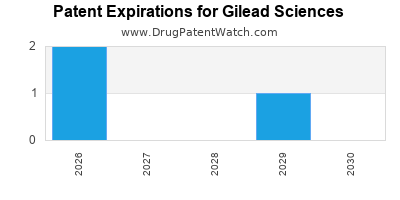
Drugs and US Patents for Gilead Sciences
| Applicant | Tradename | Generic Name | Dosage | NDA | Approval Date | TE | Type | RLD | RS | Patent No. | Patent Expiration | Product | Substance | Delist Req. | Exclusivity Expiration |
|---|---|---|---|---|---|---|---|---|---|---|---|---|---|---|---|
| Gilead Sciences Inc | HARVONI | ledipasvir; sofosbuvir | TABLET;ORAL | 205834-002 | Aug 28, 2019 | RX | Yes | No | 8,580,765*PED | ⤷ Start Trial | Y | ⤷ Start Trial | |||
| Gilead Sciences Inc | HARVONI | ledipasvir; sofosbuvir | PELLETS;ORAL | 212477-002 | Aug 28, 2019 | RX | Yes | Yes | 8,618,076*PED | ⤷ Start Trial | Y | ⤷ Start Trial | |||
| Gilead Sciences Inc | DESCOVY | emtricitabine; tenofovir alafenamide fumarate | TABLET;ORAL | 208215-002 | Jan 7, 2022 | RX | Yes | No | ⤷ Start Trial | ⤷ Start Trial | |||||
| Gilead Sciences Inc | VOSEVI | sofosbuvir; velpatasvir; voxilaprevir | TABLET;ORAL | 209195-001 | Jul 18, 2017 | RX | Yes | Yes | 8,735,372*PED | ⤷ Start Trial | Y | ⤷ Start Trial | |||
| Gilead Sciences Inc | VITEKTA | elvitegravir | TABLET;ORAL | 203093-002 | Sep 24, 2014 | DISCN | Yes | No | 8,981,103*PED | ⤷ Start Trial | Y | ⤷ Start Trial | |||
| Gilead Sciences Inc | VITEKTA | elvitegravir | TABLET;ORAL | 203093-002 | Sep 24, 2014 | DISCN | Yes | No | 7,635,704*PED | ⤷ Start Trial | Y | ⤷ Start Trial | |||
| >Applicant | >Tradename | >Generic Name | >Dosage | >NDA | >Approval Date | >TE | >Type | >RLD | >RS | >Patent No. | >Patent Expiration | >Product | >Substance | >Delist Req. | >Exclusivity Expiration |
Expired US Patents for Gilead Sciences
| Applicant | Tradename | Generic Name | Dosage | NDA | Approval Date | Patent No. | Patent Expiration |
|---|---|---|---|---|---|---|---|
| Gilead Sciences Inc | VISTIDE | cidofovir | SOLUTION;INTRAVENOUS | 020638-001 | Jun 26, 1996 | 5,142,051 | ⤷ Start Trial |
| Gilead Sciences Inc | ODEFSEY | emtricitabine; rilpivirine hydrochloride; tenofovir alafenamide fumarate | TABLET;ORAL | 208351-001 | Mar 1, 2016 | 6,838,464 | ⤷ Start Trial |
| Gilead Sciences Inc | ZYDELIG | idelalisib | TABLET;ORAL | 205858-001 | Jul 23, 2014 | 9,149,477 | ⤷ Start Trial |
| Gilead Sciences Inc | COMPLERA | emtricitabine; rilpivirine hydrochloride; tenofovir disoproxil fumarate | TABLET;ORAL | 202123-001 | Aug 10, 2011 | 8,101,629 | ⤷ Start Trial |
| Gilead Sciences Inc | VIREAD | tenofovir disoproxil fumarate | TABLET;ORAL | 021356-001 | Oct 26, 2001 | 4,808,716 | ⤷ Start Trial |
| Gilead Sciences Inc | ZYDELIG | idelalisib | TABLET;ORAL | 205858-001 | Jul 23, 2014 | 6,949,535 | ⤷ Start Trial |
| >Applicant | >Tradename | >Generic Name | >Dosage | >NDA | >Approval Date | >Patent No. | >Patent Expiration |
Paragraph IV (Patent) Challenges for GILEAD SCIENCES drugs
| Drugname | Dosage | Strength | Tradename | Submissiondate |
|---|---|---|---|---|
| ➤ Subscribe | Tablets | 150 mg, 150 mg, 200 mg, 300 mg | ➤ Subscribe | 2018-10-04 |
| ➤ Subscribe | Tablets | 300 mg | ➤ Subscribe | 2010-01-26 |
| ➤ Subscribe | Tablets | 200 mg/25 mg/300 mg | ➤ Subscribe | 2015-05-20 |
| ➤ Subscribe | Tablets | 150 mg | ➤ Subscribe | 2015-12-09 |
| ➤ Subscribe | Tablets | 600 mg/200 mg/300 mg | ➤ Subscribe | 2008-12-29 |
| ➤ Subscribe | Tablets | 150 mg, 200 mg, and 250 mg | ➤ Subscribe | 2012-05-17 |
International Patents for Gilead Sciences Drugs
| Country | Patent Number | Estimated Expiration |
|---|---|---|
| Eurasian Patent Organization | 025845 | ⤷ Start Trial |
| Japan | 5539419 | ⤷ Start Trial |
| Cyprus | 1118292 | ⤷ Start Trial |
| European Patent Office | 3067358 | ⤷ Start Trial |
| Singapore | 11201405446P | ⤷ Start Trial |
| Malaysia | 187735 | ⤷ Start Trial |
| >Country | >Patent Number | >Estimated Expiration |
Supplementary Protection Certificates for Gilead Sciences Drugs
| Patent Number | Supplementary Protection Certificate | SPC Country | SPC Expiration | SPC Description |
|---|---|---|---|---|
| 1761540 | C 2017 009 | Romania | ⤷ Start Trial | PRODUCT NAME: IDELALISIB SAU O SARE ACCEPTABILA FARMACEUTIC A ACESTUIA; NATIONAL AUTHORISATION NUMBER: EU/1/14/938; DATE OF NATIONAL AUTHORISATION: 20140918; NUMBER OF FIRST AUTHORISATION IN EUROPEAN ECONOMIC AREA (EEA): EU/1/14/938; DATE OF FIRST AUTHORISATION IN EEA: 20140918 |
| 1632232 | CA 2016 00066 | Denmark | ⤷ Start Trial | PRODUCT NAME: EN KOMBINATION AF: RILPIVIRINHYDROCHLORID ELLER EN TERAPEUTISK AEKVIVALENT FORM DERAF SOM ER BESKYTTET AF GRUNDPATENTET, EMTRICITABIN OG TENOFOVIRALAFENAMID, ELLER ET FARMACEUTISK ACCEPTABELT SALT DERAF, SAERLIGT TENOFOVIRALAFENAMIDFUMARAT; REG. NO/DATE: EU/1/16/1112/001 20160623 |
| 2487163 | 17C1000 | France | ⤷ Start Trial | PRODUCT NAME: COBICISTAT OU UN SEL PHARMACEUTIQUEMENT ACCEPTABLE ET ATAZANAVIR OU UN SEL PHARMACEUTIQUEMENT ACCEPTABLE,EN PARTICULIER LE SULFATE D'ATAZANAVIR; REGISTRATION NO/DATE: EU/1/15/1025 20150715 |
| 3347352 | 202240051 | Slovenia | ⤷ Start Trial | PRODUCT NAME: LENACAPAVIR OR A PHARMACEUTICALLY ACCEPTABLE SALT THEREOF, IN PARTICULAR LENACAPAVIR SODIUM; NATIONAL AUTHORISATION NUMBER: EU/1/22/1671; DATE OF NATIONAL AUTHORISATION: 20220817; AUTHORITY FOR NATIONAL AUTHORISATION: EU |
| 2049506 | 801 | Finland | ⤷ Start Trial | |
| 1937065 | CA 2025 00024 | Denmark | ⤷ Start Trial | PRODUCT NAME: L-LYSINSALT AF SELADELPAR, ISAER SELADELPAR-L-LYSIN-DIHYDRAT; REG. NO/DATE: EU/1/24/1898 20250221 |
| >Patent Number | >Supplementary Protection Certificate | >SPC Country | >SPC Expiration | >SPC Description |
Similar Applicant Names
Applicants may be listed under multiple names.
Here is a list of applicants with similar names.
Here is a list of applicants with similar names.
