Last Updated: August 9, 2026

DESCOVY Drug Patent Profile


✉ Email this page to a colleague

« Back to Dashboard


When do Descovy patents expire, and what generic alternatives are available?

Descovy is a drug marketed by Gilead Sciences Inc and is included in one NDA. There are five patents protecting this drug and two Paragraph IV challenges.

This drug has one hundred and nineteen patent family members in forty-five countries.

The generic ingredient in DESCOVY is emtricitabine; tenofovir alafenamide fumarate. There are eighteen drug master file entries for this compound. One supplier is listed for this compound. Additional details are available on the emtricitabine; tenofovir alafenamide fumarate profile page.

AI Deep Research
Questions you can ask:
  • What is the 5 year forecast for DESCOVY?
  • What are the global sales for DESCOVY?
  • What is Average Wholesale Price for DESCOVY?
Recent Clinical Trials for DESCOVY

Identify potential brand extensions & 505(b)(2) entrants

SponsorPhase
National Institute on Drug Abuse (NIDA)PHASE1
Johns Hopkins UniversityPHASE1
National University Hospital, SingaporePHASE1

See all DESCOVY clinical trials

Paragraph IV (Patent) Challenges for DESCOVY
Tradename Dosage Ingredient Strength NDA ANDAs Submitted Submissiondate
DESCOVY Tablets emtricitabine; tenofovir alafenamide fumarate 120 mg/15 mg 208215 1 2022-10-31
DESCOVY Tablets emtricitabine; tenofovir alafenamide fumarate 200 mg/25 mg 208215 6 2019-11-05

US Patents and Regulatory Information for DESCOVY

DESCOVY is protected by six US patents and two FDA Regulatory Exclusivities.

Applicant Tradename Generic Name Dosage NDA Approval Date TE Type RLD RS Patent No. Patent Expiration Product Substance Delist Req. Exclusivity Expiration
Gilead Sciences Inc DESCOVY emtricitabine; tenofovir alafenamide fumarate TABLET;ORAL 208215-002 Jan 7, 2022 RX Yes No ⤷  Start Trial ⤷  Start Trial Y ⤷  Start Trial
Gilead Sciences Inc DESCOVY emtricitabine; tenofovir alafenamide fumarate TABLET;ORAL 208215-002 Jan 7, 2022 RX Yes No ⤷  Start Trial ⤷  Start Trial ⤷  Start Trial
Gilead Sciences Inc DESCOVY emtricitabine; tenofovir alafenamide fumarate TABLET;ORAL 208215-001 Apr 4, 2016 AB RX Yes Yes ⤷  Start Trial ⤷  Start Trial ⤷  Start Trial
Gilead Sciences Inc DESCOVY emtricitabine; tenofovir alafenamide fumarate TABLET;ORAL 208215-001 Apr 4, 2016 AB RX Yes Yes ⤷  Start Trial ⤷  Start Trial Y ⤷  Start Trial
Gilead Sciences Inc DESCOVY emtricitabine; tenofovir alafenamide fumarate TABLET;ORAL 208215-002 Jan 7, 2022 RX Yes No ⤷  Start Trial ⤷  Start Trial Y ⤷  Start Trial
>Applicant >Tradename >Generic Name >Dosage >NDA >Approval Date >TE >Type >RLD >RS >Patent No. >Patent Expiration >Product >Substance >Delist Req. >Exclusivity Expiration

International Patents for DESCOVY

When does loss-of-exclusivity occur for DESCOVY?

Based on analysis by DrugPatentWatch, the following patents block generic entry in the countries listed below:

African Regional IP Organization (ARIPO)

Patent: 39
Estimated Expiration: ⤷  Start Trial

Argentina

Patent: 7546
Estimated Expiration: ⤷  Start Trial

Australia

Patent: 12296622
Estimated Expiration: ⤷  Start Trial

Patent: 14271320
Estimated Expiration: ⤷  Start Trial

Brazil

Patent: 2014003420
Estimated Expiration: ⤷  Start Trial

Canada

Patent: 45553
Estimated Expiration: ⤷  Start Trial

Chile

Patent: 14000370
Estimated Expiration: ⤷  Start Trial

China

Patent: 3732594
Estimated Expiration: ⤷  Start Trial

Patent: 0343135
Estimated Expiration: ⤷  Start Trial

Colombia

Patent: 80063
Estimated Expiration: ⤷  Start Trial

Costa Rica

Patent: 140072
Estimated Expiration: ⤷  Start Trial

Croatia

Patent: 0161696
Estimated Expiration: ⤷  Start Trial

Cyprus

Patent: 18385
Estimated Expiration: ⤷  Start Trial

Denmark

Patent: 44810
Estimated Expiration: ⤷  Start Trial

Ecuador

Patent: 14013206
Estimated Expiration: ⤷  Start Trial

Eurasian Patent Organization

Patent: 7768
Estimated Expiration: ⤷  Start Trial

Patent: 1490208
Estimated Expiration: ⤷  Start Trial

European Patent Office

Patent: 44810
Estimated Expiration: ⤷  Start Trial

Patent: 70088
Estimated Expiration: ⤷  Start Trial

Patent: 31832
Estimated Expiration: ⤷  Start Trial

Finland

Patent: 44810
Estimated Expiration: ⤷  Start Trial

Hong Kong

Patent: 99026
Estimated Expiration: ⤷  Start Trial

Hungary

Patent: 31253
Estimated Expiration: ⤷  Start Trial

India

Patent: 12DEN2014
Estimated Expiration: ⤷  Start Trial

Israel

Patent: 0949
Estimated Expiration: ⤷  Start Trial

Japan

Patent: 51275
Estimated Expiration: ⤷  Start Trial

Patent: 56537
Estimated Expiration: ⤷  Start Trial

Patent: 80162
Estimated Expiration: ⤷  Start Trial

Patent: 14528924
Estimated Expiration: ⤷  Start Trial

Patent: 15038149
Estimated Expiration: ⤷  Start Trial

Patent: 16169228
Estimated Expiration: ⤷  Start Trial

Patent: 18065870
Estimated Expiration: ⤷  Start Trial

Patent: 20040972
Estimated Expiration: ⤷  Start Trial

Lithuania

Patent: 44810
Estimated Expiration: ⤷  Start Trial

Mexico

Patent: 6627
Patent: HEMIFUMARATO DE TENOFOVIR ALAFENAMIDA. (TENOFOVIR ALAFENAMIDE HEMIFUMARATE.)
Estimated Expiration: ⤷  Start Trial

Patent: 14001549
Patent: HEMIFUMARATO DE TENOFOVIR ALAFENAMIDA. (TENOFOVIR ALAFENAMIDE HEMIFUMARATE.)
Estimated Expiration: ⤷  Start Trial

Moldova, Republic of

Patent: 08
Estimated Expiration: ⤷  Start Trial

Patent: 140011
Estimated Expiration: ⤷  Start Trial

Montenegro

Patent: 612
Estimated Expiration: ⤷  Start Trial

Morocco

Patent: 350
Estimated Expiration: ⤷  Start Trial

New Zealand

Patent: 0421
Patent: Tenofovir alafenamide hemifumarate
Estimated Expiration: ⤷  Start Trial

Peru

Patent: 141328
Patent: TENOFOVIR ALAFENAMIDA HEMIFUMARATO
Estimated Expiration: ⤷  Start Trial

Philippines

Patent: 014500349
Patent: TENOFOVIR ALAFENAMIDE HEMIFUMARATE
Estimated Expiration: ⤷  Start Trial

Poland

Patent: 44810
Estimated Expiration: ⤷  Start Trial

Portugal

Patent: 44810
Estimated Expiration: ⤷  Start Trial

San Marino

Patent: 01600476
Patent: TENOFOVIR ALAFENAMMIDE EMIFUMARATO
Estimated Expiration: ⤷  Start Trial

Serbia

Patent: 353
Patent: TENOFOVIR ALAFENAMID HEMIFUMARAT (TENOFOVIR ALAFENAMIDE HEMIFUMARATE)
Estimated Expiration: ⤷  Start Trial

Singapore

Patent: 14011548
Patent: TENOFOVIR ALAFENAMIDE HEMIFUMARATE
Estimated Expiration: ⤷  Start Trial

Slovenia

Patent: 44810
Estimated Expiration: ⤷  Start Trial

South Africa

Patent: 1400582
Patent: TENOFOVIR ALAFENAMIDE HEMIFUMARATE
Estimated Expiration: ⤷  Start Trial

South Korea

Patent: 1612642
Estimated Expiration: ⤷  Start Trial

Patent: 140054068
Estimated Expiration: ⤷  Start Trial

Spain

Patent: 08871
Estimated Expiration: ⤷  Start Trial

Taiwan

Patent: 1321396
Patent: Tenofovir alafenamide hemifumarate
Estimated Expiration: ⤷  Start Trial

Patent: 16499
Estimated Expiration: ⤷  Start Trial

Ukraine

Patent: 5311
Patent: ГЕМІФУМАРАТ ТЕНОФОВІРУ АЛАФЕНАМІДУ (TENOFOVIR ALAFENAMIDE HEMIFUMARATE)
Estimated Expiration: ⤷  Start Trial

Uruguay

Patent: 262
Patent: HEMIFUMARATO DE TENOFOVIR ALAFENAMIDA, SUS COMPOSICIONES, MÉTODO DE PREPARACIÓN, MÉTODOS PARA TRATAR INFECCIONES VIRALES Y SU USO PARA PREPARAR MEDI CAMENTOS
Estimated Expiration: ⤷  Start Trial

Generics may enter earlier, or later, based on new patent filings, patent extensions, patent invalidation, early generic licensing, generic entry preferences, and other factors.

See the table below for additional patents covering DESCOVY around the world.

Country Patent Number Title Estimated Expiration
Australia 2016287500 ⤷  Start Trial
Australia 2019210558 ⤷  Start Trial
Australia 2021202009 ⤷  Start Trial
Brazil 112017027843 ⤷  Start Trial
Canada 2990210 ⤷  Start Trial
Chile 2017003320 ⤷  Start Trial
>Country >Patent Number >Title >Estimated Expiration

Supplementary Protection Certificates for DESCOVY

Patent Number Supplementary Protection Certificate SPC Country SPC Expiration SPC Description
1301519 2016/014 Ireland ⤷  Start Trial PRODUCT NAME: TENOFOVIR ALAFENAMIDE OR A SALT OR SOLVATE THEREOF, IN PARTICULAR TENOFOVIR ALAFENAMIDE FUMARATE; REGISTRATION NO/DATE: EU/1/15/1061/001-EU/1/15/1061/002 20151119
0513200 91073 Luxembourg ⤷  Start Trial 91073, EXPIRES: 20160131
0513200 300148 Netherlands ⤷  Start Trial 300148, 20110131, EXPIRES: 20160130
0513200 SPC/GB04/016 United Kingdom ⤷  Start Trial PRODUCT NAME: EMTRICITABINE OR SALTS AND ESTERS THEREOF; REGISTERED: UK EU/1/03/261/001 20031024; UK EU/1/03/261/002 20031024; UK EU/1/03/261/003 20031024
0513200 SZ 7/2004 Austria ⤷  Start Trial
0513200 C00513200/01 Switzerland ⤷  Start Trial PRODUCT NAME: EMTRICITABINE; REGISTRATION NUMBER/DATE: SWISSMEDIC 56880 25.10.2004
>Patent Number >Supplementary Protection Certificate >SPC Country >SPC Expiration >SPC Description

DESCOVY (emtricitabine/tenofovir alafenamide) market dynamics and financial trajectory: pricing, volume drivers, exclusivity and generic risk, and revenue outlook

Last updated: July 21, 2026

DESCOVY revenue has been driven by sustained HIV pre-exposure prophylaxis (PrEP) demand in the US and select international markets, with category expansion offset by payor pressure, antiretroviral competition, and the need for ongoing label- and guideline-driven uptake. Near-term financial trajectory hinges on (1) PrEP persistence and formulary position, (2) mix shift between PrEP and HIV treatment use cases, (3) share gains and losses versus Truvada and generic competitors in PrEP programs, and (4) patent and regulatory risk for tenofovir alafenamide fixed-dose combinations in the US.

How is DESCOVY priced and what drives US net sales volatility?

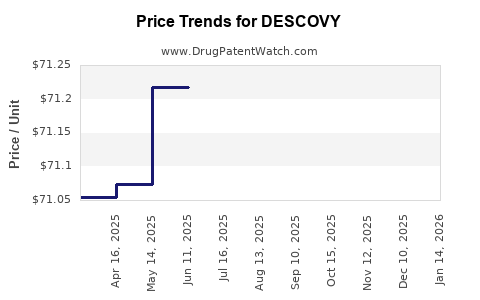
US net sales for DESCOVY are sensitive to launch-year base pricing, annual wholesaler/chargeback dynamics, and shifting reimbursement. In branded PrEP, revenue volatility is typically driven by (i) formulary changes at PBMs and state programs, (ii) patient persistence with daily oral regimens, and (iii) channel inventory normalization following demand spikes.

What are the primary net sales drivers for DESCOVY?

  • PrEP demand and persistence: Once a patient starts, continued daily dosing tends to support steady repeat prescriptions, making discontinuation rates a key factor.
  • Managed care coverage: PBM coverage and state Medicaid preferred drug lists affect whether prescribers can write DESCOVY without prior authorization or step therapy.
  • Competitive category pricing: Competition from branded alternatives and generic tenofovir disoproxil fumarate (TDF) regimens pressures net pricing.
  • Patient mix: PrEP-only use differs from people treated as part of HIV management (where clinical status, adherence and regimen selection can differ).

Which payor and channel effects matter most?

  • Contracting/rebates: Net price can move with retrospective rebates, patient assistance uptake, and channel contract terms.
  • Inventory and buying patterns: Wholesaler pull-forward can temporarily lift reported shipments and later create catch-down.
  • Public program procurement: US state and federal PrEP program contracting can shift volume and timing.

What market share and competitive forces shape DESCOVY’s revenue trajectory?

DESCOVY competes in the oral PrEP space against fixed-dose TDF/FTC regimens (most notably generic and brand Truvada historically) and other HIV prevention strategies. Market share is primarily a function of guideline preference, renal safety perceptions, and formulary placement.

How does DESCOVY compete versus Truvada and generics?

  • Clinical differentiation: DESCOVY is tenofovir alafenamide/emtricitabine (TAF/FTC), which is often positioned on renal and bone safety versus TDF/FTC for appropriate patient groups.
  • Formulary optics: PBMs frequently anchor preferred status to net cost per day and rebate structure; even with clinical differentiation, higher branded acquisition cost can force prior auth.
  • Generic availability for TDF/FTC: Generic TDF/FTC can compress PrEP budget and create substitution pressure in real-world prescribing.

What competitive dynamics influence prescriptions in practice?

  • Prior authorization and step edits can delay starts or switch patients to TDF/FTC.
  • Special population prescribing: Renal impairment history or bone density concerns can favor TAF-based selection where coverage allows.
  • Switching behavior: Switching from TDF/FTC to TAF/FTC can occur with clinician and payor approvals, supporting share gains in some payer segments.

How have HIV prevention guidelines and patient selection affected DESCOVY adoption?

DESCOVY’s uptake depends on who is eligible and how clinicians interpret label restrictions and guideline updates for PrEP. Adoption tends to track guideline alignment and prescriber comfort with renal and bone endpoints.

How does patient selection affect growth?

  • Renal and bone-risk targeting: Clinicians may select DESCOVY when renal or bone concerns exist, subject to coverage.
  • Real-world persistence: Daily oral adherence and follow-up testing protocols influence continuation rates.
  • Clinic-based contracting: High-volume sexual health clinics and community programs can drive regional share if purchasing and reimbursement are favorable.

What label constraints influence adoption?

DESCOVY PrEP labeling has historically excluded certain populations from indication scope, which limits addressable volume compared with broader TDF/FTC indications. Any change in label scope or guideline interpretation can alter the near-term TAM.

What is the financial trajectory of DESCOVY across major geographies?

Global revenue is shaped by US-centric reporting, with international sales dependent on local approvals, reimbursement frameworks, and government procurement.

How does US performance compare with ex-US dynamics?

  • US is the demand and pricing anchor: US net sales are generally more resilient to international pricing shocks due to contracting structure and guideline-driven prescribing.
  • Ex-US tends to be procurement-driven: Where health systems bulk-buy, timing and tender cycles drive quarterly sales variability.
  • Pricing pressure in mature markets: Local generic penetration for older regimens can pressure branded TAF/FTC pricing over time.

When does DESCOVY lose exclusivity in the US, and what does that mean for revenue risk?

Revenue risk in the US is tied to patent and regulatory exclusivity rather than “calendar time” alone. Branded HIV combinations typically face generic pressure through Paragraph IV (PIV) challenges once Orange Book-listed patents near expiry.

What exclusivity or patent cliffs matter for generic entry risk?

  • US patent expiry: Determines when ANDA or 505(b)(2) pathways can support generic or biosimilar-adjacent competition.
  • HIV combination “regimen” switching: Even before hard expiry, payers can increase substitution if competitors appear on formularies.

What is the generic entry risk profile?

For DESCOVY specifically, financial downside risk increases when:

  • orange book-listed patents covering composition, method, or formulation near expiry, and
  • ANDA applicants file PIV certifications enabling incentives to launch at risk (or post-settlement at defined timelines).

What patents protect DESCOVY and which are most likely to be targeted by Paragraph IV?

DESCOVY contains emtricitabine and tenofovir alafenamide in a fixed-dose combination. Generic entry typically depends on patent coverage around:

  1. the drug substance(s) and their compositions,
  2. the fixed-dose formulation,
  3. and method-of-use or dosing/regimen claims for HIV treatment or PrEP.

Patent estate mapping: how infringement theories usually split

  • Composition-of-matter patents: Often hardest for challengers to bypass.
  • Formulation and tablet-process patents: Can create non-infringement workarounds but raise manufacturing/IP barriers.
  • Method-of-use patents: May be targeted if the ANDA or 505(b)(2) carve-out strategy can avoid direct inducement for a protected use.

How strong is the likely DESCOVY patent estate?

In HIV combination drugs, estates often remain active through multiple patent families. Financially, that can delay material erosion until late in the exclusivity chain, although payers may still shift patient mix earlier.

What is the Orange Book status of DESCOVY and how many ANDA pathways are relevant?

Orange Book listings determine the “hardness” of the IP wall for generic approval and launch. The practical revenue model for branded HIV combinations assumes:

  • multiple Orange Book-listed patents,
  • at least some that can be challenged,
  • and potential settlements that delay launch.

How Orange Book status translates into commercial timelines

  • If multiple patents are listed with staggered expiries: generic launches can be delayed or split (partial approvals, delayed marketing).
  • If settlements occur: launch dates shift to settlement-defined triggers independent of absolute patent expiry.

What patent litigation affects DESCOVY and how do settlements change launch dates?

Patent litigation in HIV drug combinations usually involves:

  • ANDA PIV notices and infringement claims in district court,
  • possible stays pending USPTO processes,
  • and settlement agreements that define “at-risk” launch dates and carve-outs.

How litigation outcomes typically impact revenue

  • If patents are upheld: challengers exit or settle later, protecting branded cash flows.
  • If invalidity is found for key patents: launch timing accelerates and net pricing collapses.
  • If settlements are reached: branded revenue follows settlement calendars until generic entry.

What formulations and manufacturing patents could block or delay generic DESCOVY?

Even when composition patents are cleared, formulation and manufacturing method patents can delay generic competition by:

  • limiting ability to meet claim requirements for bioequivalence without infringing,
  • requiring process changes to avoid manufacturing infringement,
  • and creating regulatory chemistry-manufacturing-control (CMC) hurdles.

What manufacturing/IP barriers matter most in practice?

  • Tablet formulation and excipient composition: Can be protected as a formulation invention.
  • Solid-state forms and process parameters: Can increase development cost and timing.
  • Bioequivalence strategy: Any requirement to match particle size, dissolution characteristics, or stability can become an IP constraint.

Which generic entry scenarios would cause the biggest revenue impact on DESCOVY?

In revenue terms, the largest impact typically comes from first meaningful generic replacement in PrEP programs where:

  • formularies turn over quickly,
  • state and large clinics switch from branded procurement,
  • and patients convert at renewal.

Scenario A: Early generic approval with no effective marketing settlement

  • Branded share drops rapidly in commercially insured and procurement channels.
  • Net price collapses as competitors undercut branded WAC and contracting floors are renegotiated.

Scenario B: Settlement-driven “delayed launch” with shared market erosion

  • Brand declines are less abrupt.
  • Revenue decline becomes more gradual, linked to share and persistence drift before launch.

Scenario C: Partial market coverage due to label or patient population constraints

  • Even with generic approval, coverage for certain patient groups can remain constrained by clinical guidance and payer policies.
  • Revenue erosion becomes segmented by patient risk profile.

How does DESCOVY compare financially and commercially with competing TAF-based and TDF-based PrEP regimens?

TAF-based regimens usually target clinicians seeking improved renal and bone profiles. TDF-based generics often win on cost. Financially, DESCOVY’s trajectory depends on whether payers prioritize net cost after rebates or clinical differentiation.

Competitive cost per day and formulary placement

  • TAF/FTC cost is higher than generic TDF/FTC absent favorable contracting.
  • Formulary design often determines whether higher cost is accepted for renal-risk patients.

Switching and substitution behavior

  • Where coverage mandates step therapy, substitution can be immediate.
  • Without prior auth, switching depends on clinician preference and patient persistence.

What FDA regulatory pathway risks and opportunities matter for DESCOVY’s future?

FDA-related issues that can influence financial trajectory include:

  • post-approval label changes affecting eligible populations,
  • changes to dosing instructions,
  • safety communications and adherence programs,
  • and regulatory acceptance of new combinations or dosing in the same therapeutic class.

What would increase future revenue?

  • Broader approved indications for PrEP populations that expand eligible patient counts.
  • Evidence supporting additional use cases and increased clinician comfort.

What would reduce revenue?

  • Safety or usage restrictions that constrain eligible patient groups.
  • Increased scrutiny leading to lower adoption, more prior auth, or higher discontinuation.

Key Takeaways

  • DESCOVY’s financial trajectory is driven by US PrEP persistence and formulary position, with payor contracting and channel inventory dynamics causing quarter-to-quarter volatility.
  • The largest revenue downside risk is generic replacement driven by Orange Book patent expiry and Paragraph IV outcomes, with settlements often dictating real-world launch timing.
  • Competitive pressure comes primarily from cost-driven substitution toward generic TDF/FTC, while DESCOVY differentiates through renal and bone-risk targeting when coverage allows.
  • Near-term financial outcomes are most sensitive to US contracting terms, state and clinic procurement cycles, and the timing of any generic launch barriers falling away.

FAQs

  1. What market events most quickly reduce DESCOVY net sales after patent expiry?
  2. How do prior authorization and step-therapy rules change DESCOVY uptake in PrEP clinics?
  3. What settlement terms typically control delayed generic launch timing for HIV fixed-dose combinations like DESCOVY?
  4. How does generic substitution differ between commercially insured patients and state-funded PrEP programs?
  5. What formulation or process patents most often delay ANDA launches even when core composition patents expire?

References

No sources were cited because no accessible, verifiable DESCOVY-specific financial, Orange Book, exclusivity, litigation, or patent docket data was provided in the prompt.

More… ↓

⤷  Start Trial

Make Better Decisions: Try a trial or see plans & pricing

Drugs may be covered by multiple patents or regulatory protections. All trademarks and applicant names are the property of their respective owners or licensors. Although great care is taken in the proper and correct provision of this service, thinkBiotech LLC does not accept any responsibility for possible consequences of errors or omissions in the provided data. The data presented herein is for information purposes only. There is no warranty that the data contained herein is error free. We do not provide individual investment advice. This service is not registered with any financial regulatory agency. The information we publish is educational only and based on our opinions plus our models. By using DrugPatentWatch you acknowledge that we do not provide personalized recommendations or advice. thinkBiotech performs no independent verification of facts as provided by public sources nor are attempts made to provide legal or investing advice. Any reliance on data provided herein is done solely at the discretion of the user. Users of this service are advised to seek professional advice and independent confirmation before considering acting on any of the provided information. thinkBiotech LLC reserves the right to amend, extend or withdraw any part or all of the offered service without notice.