Executive Summary: A Structural Recalibration of Global Power
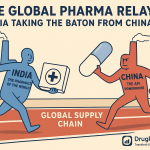
The global pharmaceutical sector is currently witnessing a definitive structural recalibration. The historical dichotomy—developed markets as innovators and emerging markets as volume-driven manufacturing hubs—has dissolved. As we move toward 2030, emerging economies are not merely consuming healthcare; they are dictating the regulatory parameters, driving digital infrastructure adoption, and increasingly originating the intellectual property that fuels global pipelines.
The data indicates a robust trajectory: the global “pharmerging” market is projected to expand from USD 1.79 trillion in 2023 to USD 4.13 trillion by 2033, growing at a Compound Annual Growth Rate (CAGR) of 8.73%.1 This growth velocity significantly outpaces mature markets, necessitating a strategic pivot for multinational corporations (MNCs) from passive export models to deeply integrated “poly-local” operations.
This report provides an exhaustive analysis of these shifts. It moves beyond aggregate GDP figures to dissect the specific regulatory disruptions—such as Indonesia’s 2026 Halal mandate, India’s 2025 Zero Liquid Discharge guidelines, and Brazil’s radical overhaul of public procurement and clinical trial frameworks—that are redefining the cost of doing business. It examines the “China for China” localization strategy adopted by AstraZeneca and Sanofi, the geopolitical weaponization of compulsory licensing in Russia, and the technological leapfrogging in African logistics.
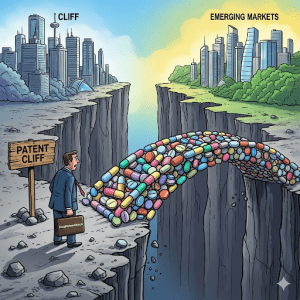
Furthermore, as the industry confronts a historic patent cliff between 2025 and 2028 involving blockbuster biologics like Keytruda and Opdivo, emerging markets are positioning themselves as the primary battleground for intellectual property (IP) disputes. Tools for competitive intelligence, such as DrugPatentWatch, are becoming essential for navigating this volatile IP terrain, where a single court ruling in New Delhi or a government decree in Moscow can realign market share overnight.
Key Takeaways
Market Bifurcation: The emerging market category has fractured into Tier 1 innovation exporters (China), Tier 2 value-chain integrators (India, Brazil), and Tier 3 high-growth consumption markets (Indonesia, Nigeria).
Regulatory Nationalism: Market access is increasingly contingent on local value addition. From Turkey’s localization requirements to Indonesia’s Halal certification and India’s Production Linked Incentive (PLI) schemes, non-tariff barriers are the new gatekeepers.
The “In China, For China” Imperative: Despite geopolitical decoupling, MNCs are deepening investment to ring-fence Chinese operations. AstraZeneca’s $2.5 billion investment in Beijing and Pfizer’s licensing of Chinese assets signal a reversal in the flow of innovation.2
IP Precedents in India: The Delhi High Court’s 2025 rulings on Semaglutide and Risdiplam reinforce a strict interpretation of anti-evergreening provisions (Section 3(d)), creating a challenging environment for lifecycle management strategies.5
Sustainability as a Gatekeeper: New environmental norms, specifically India’s draft antibiotic discharge guidelines, are forcing massive capital expenditure on Zero Liquid Discharge (ZLD) systems, fundamentally altering the unit economics of generic API production.7
Tech-Leapfrogging: Markets like Nigeria and Ghana are bypassing traditional logistics development, moving directly to autonomous drone delivery (Zipline) for medical supplies, backed by significant US foreign investment.9
1. Global Market Dynamics: The Shift South and East
1.1 The Macroeconomic Imperative
The gravitational center of the pharmaceutical industry is shifting. While North America remains the largest market by absolute revenue, accounting for approximately 43% of the global share in 2023, the growth engines are located in the Global South and East.1 The “Pharmerging” markets are projected to reach USD 4.13 trillion by 2033, driven by a convergence of expanding healthcare coverage, rising chronic disease burdens, and increasing disposable income.1
This growth is not uniform. The analysis suggests a distinct tiering of economies based on their role in the pharmaceutical value chain:
Table 1: The Tiered Taxonomy of Emerging Markets (2025–2030)
Tier
Characteristics
Key Markets
Strategic Role
Tier 1: Innovation Exporters
End-to-end R&D capabilities; originators of novel molecules (NMEs); integrated into global regulatory harmonization (ICH).
China
Source of global IP; standalone market ecosystem (“In China, For China”).
Tier 2: Value Chain Pivots
Moving from simple generics to complex biologics/biosimilars; regulatory alignment (WHO WLA, PIC/S); robust CDMO sectors.
India, Brazil
Manufacturing backbone; biosimilar development hubs; strategic nearshoring locations.
Tier 3: Volume & Access
High consumption growth; focus on primary care and infectious disease; developing regulatory frameworks; infrastructure challenges.
Indonesia, Vietnam, Nigeria, Mexico, Turkey
Volume drivers; targets for market shaping via access programs and technology transfer.
1.2 The Patent Cliff as a Catalyst
A primary driver of this market expansion is the impending “Patent Cliff.” Between 2025 and 2030, exclusivity will expire for a cohort of high-revenue biologic drugs, opening the floodgates for biosimilar competition. In Brazil alone, patents for 117 blockbuster molecules are set to expire by 2028.11
This transition creates a dual opportunity:
For Domestic Players: It enables local champions (e.g., Biocon in India, Eurofarma in Brazil, Innovent in China) to capture market share and drive revenue through biosimilars.
For MNCs: It necessitates a pivot toward innovative oncology, immunology, and rare disease portfolios to replace lost revenue, while simultaneously defending legacy assets through complex legal strategies.
Strategic Context: The erosion of monopoly rights in these markets is often accelerated by local legal frameworks that favor access. As seen in the Semaglutide cases in India and Russia, the timeline for generic entry in emerging markets often precedes that in the US or EU due to different interpretations of patent validity and compulsory licensing provisions.6
2. China: The “In China, For China” Strategic Pivot
China represents a unique category in the emerging market taxonomy. It has transcended its former status as a manufacturing outpost to become a peer competitor in innovation. For multinational corporations, the operating model has fundamentally shifted from import-driven sales to full-scale localization—a strategy termed “In China, For China.”
2.1 Localization and Supply Chain Insulation
The geopolitical decoupling between the US and China has forced MNCs to ring-fence their Chinese operations. The objective is to create a self-contained ecosystem that is resilient to external trade shocks, tariffs, and regulatory divergence.
AstraZeneca’s 2025 Investment Strategy:
AstraZeneca’s activities in 2024–2025 exemplify this approach. Despite the “Biosecure Act” debates in the US, the company doubled down on China with a $2.5 billion investment in Beijing to establish a global strategic R&D center and a vaccine joint venture with BioKangtai.2
Mechanism: This investment localizes not just manufacturing but the creation of IP. By partnering with local entities like Harbour BioMed and Syneron Bio, AstraZeneca integrates itself into the domestic innovation fabric, reducing its profile as a “foreign” entity.3
Outcome: This creates a parallel supply chain. The Beijing facility will be AstraZeneca’s first vaccine manufacturing site in China, dedicated to producing for the local market and potential export to Belt and Road Initiative (BRI) countries.13
Sanofi’s Digital Manufacturing:
Similarly, Sanofi has integrated its Chinese operations into its global digital transformation. The company’s “Digital Manufacturing & Supply Accelerator,” launched in May 2025, aims to utilize AI to shorten development timelines by 25%. This technology is being deployed across its global network, including Chinese sites, to maintain uniform quality standards while producing locally.14
2.2 Regulatory Evolution: Green Manufacturing and Insurance
China’s regulatory environment is becoming more sophisticated, using environmental standards and reimbursement lists to shape industry behavior.
The Rise of Green Manufacturing:
The Ministry of Industry and Information Technology (MIIT) released its 2024 green manufacturing list, which included 30 pharmaceutical companies in Beijing alone.15
Implication: MNCs and local firms must now compete on sustainability metrics. “Green Factory” status is becoming a prerequisite for government procurement preferences and grants. This aligns with global ESG goals but acts as a technical barrier to entry for firms with outdated infrastructure.
The 2025 NRDL and Commercial Insurance:
The National Reimbursement Drug List (NRDL) remains the primary volume driver. The 2025 update introduced 114 new drugs, including 50 Class 1 innovative drugs.16 However, a critical development is the introduction of the Commercial Insurance Innovative Drug List.
The Mechanism: This new list covers 19 high-cost innovative drugs—such as CAR-T therapies and Alzheimer’s treatments like Leqembi (lecanemab) and Kisunla (donanemab)—that are too expensive for the state-funded basic medical insurance.16
Strategic Impact: This creates a dual-track market. MNCs can negotiate for inclusion in the state NRDL for volume (at steep price discounts) or target the commercial insurance list for premium pricing. This structural change alleviates the “price vs. access” bottleneck that has historically limited the launch of cutting-edge therapies in China.
2.3 From Importer to Exporter of Innovation
China is rapidly becoming a net exporter of pharmaceutical IP. In the first half of 2025, Chinese companies accounted for approximately 32% of global biotech out-licensing deal value, a significant increase from 21% in the 2023–2024 period.4
Pfizer Deal: In May 2025, Pfizer agreed to pay up to $6 billion for global rights to a PD-1/VEGF bispecific antibody developed by a Chinese biotech, setting a record for upfront payments for a Chinese asset.4
AstraZeneca Deal: A $5 billion collaboration with CSPC Pharmaceutical leverages Chinese AI-driven drug discovery platforms.4
This trend confirms that Western big pharma is increasingly reliant on Chinese discovery engines to replenish their pipelines, reversing the historical flow of technology transfer.
3. India: The Value Chain Pivot and Regulatory Maturation
India, long established as the “Pharmacy of the World” due to its dominance in generic volume, is executing a complex pivot toward value—focusing on complex generics, biosimilars, and high-end Contract Development and Manufacturing (CDMO) services. However, this transition is occurring amidst a tightening regulatory environment focused on environmental compliance and intellectual property scrutiny.
3.1 The CDMO Transformation: Volume to Value
The Indian CDMO market is projected to expand from USD 3.5 billion in 2024 to over USD 20 billion by 2035.17 This growth is fueled by the “China+1” diversification strategy, where Western firms seek to de-risk their supply chains.
Capability Upgrade: Indian CDMOs are moving beyond simple “kilo lab” production of intermediates. They are investing in integrated discovery-to-commercial capabilities, complex chemistry, and biologics manufacturing.17
Compliance Renaissance: Following scrutiny over quality issues (e.g., cough syrups) in 2023–2024, the sector is heavily investing in digitalization and GMP compliance to meet US FDA and EMA standards. Lupin’s global supply chain head notes that “digital twins” and AI are being deployed to simulate manufacturing processes and optimize performance.18
3.2 Environmental Regulation: The ZLD Imperative
A critical disruption in 2025 is the Ministry of Environment, Forest and Climate Change (MoEFCC) and Central Pollution Control Board (CPCB) crackdown on pharmaceutical effluent, driven by the global fight against Antimicrobial Resistance (AMR).
The 2025 Draft Guidelines:
The CPCB issued draft guidelines in January 2025 aimed specifically at the pharmaceutical industry.7
Zero Liquid Discharge (ZLD): The guidelines strongly recommend ZLD systems for “Red Category” (highly polluting) industries, which includes fermentation-based bulk drug manufacturers. ZLD systems treat and recycle wastewater, eliminating discharge but costing 4–5 times more than conventional treatment.8
Solvent Recovery: A mandate to recover 95% of spent solvents and limit solvent loss to 5% aims to reduce Volatile Organic Compounds (VOCs).19
AMR Focus: While explicit antibiotic residue limits remain contentious, the guidelines push for bio-assay tests and advanced filtration to mitigate the release of active pharmaceutical ingredients (APIs) into water bodies.20
Industry Impact:
For large players like Sun Pharma or Dr. Reddy’s, this is a manageable capex. For the thousands of Small and Medium Enterprises (SMEs) that form the backbone of India’s API supply chain, the cost of ZLD compliance is existential. This is likely to drive consolidation in the sector, potentially raising the floor price of Indian APIs globally.
3.3 Intellectual Property: The Delhi High Court Precedents (2025)
The legal environment in India remains a critical variable for global strategy. In 2025, two landmark rulings by the Delhi High Court highlighted the judiciary’s nuanced stance on patent evergreening and innovation.
Case Study 1: Novo Nordisk vs. Dr. Reddy’s (Semaglutide)
Context: Novo Nordisk sought an interim injunction to stop Dr. Reddy’s from manufacturing generic Semaglutide (Ozempic/Wegovy).
Ruling: The court rejected the injunction, allowing Dr. Reddy’s to manufacture and export the drug.
Rationale: The court cited potential “evergreening”—the attempt to extend monopoly through minor modifications (formulation patents) after the base molecule patent has expired. This ruling reinforces Section 3(d) of the Indian Patents Act, which sets a high bar for the patentability of incremental innovations.6
Implication: This opens the door for Indian generics to supply Semaglutide to markets where the base patent has expired, even if formulation patents remain active in India.
Case Study 2: Roche vs. Natco (Risdiplam)
Context: Roche sued Natco for infringing its patent on Risdiplam, a spinal muscular atrophy drug.
Ruling: The court refused an interim injunction, finding credible grounds for invalidity based on “prior art.” Specifically, the court accepted the argument that Risdiplam was covered under the broad “Markush structure” of an earlier, expired genus patent.5
Implication: This decision lowers the threshold for Indian generics to challenge “species” patents (specific compounds) that fall within the scope of previously expired “genus” patents, complicating lifecycle management for originators.
3.4 Clinical Trials: A Resurgence
After a period of regulatory uncertainty, India is reclaiming its status as a premier clinical trial hub. The New Drugs and Clinical Trials Rules (2019) have matured, and 2025 updates have streamlined approvals further.
Cost Advantage: Trials in India cost 30–50% less than in the US/EU.24
Ethical Oversight: New mandates for audio-visual recording of informed consent and strict compensation rules for trial-related injuries are improving ethical standards, although challenges in implementation remain.24
4. Latin America: The Nearshoring & Regulatory Frontier
Latin America is capitalizing on the “nearshoring” trend, with Mexico and Brazil positioning themselves as reliable alternatives to Asian supply chains for the North American market.
4.1 Brazil: The New Clinical Research Paradigm
Brazil has historically been hampered by slow regulatory timelines for clinical trials. The enactment of Law No. 14.874 (2024) and its regulating Decree No. 12.651 (October 2025) has fundamentally altered this ecosystem.25
Key Regulatory Changes:
Timeline Reduction: The new framework caps the ethical review by CEPs (Research Ethics Committees) at 30 days and the regulatory review by ANVISA at 90 days. For “strategic” products (e.g., those for the Unified Health System/SUS) or emergencies, the review is expedited to just 15 business days.26
Single Platform: A centralized electronic platform now manages submissions, eliminating parallel and redundant reviews.
Impact: These changes make Brazil highly competitive against Eastern Europe and Asia for global clinical trial allocation, offering access to a diverse, treatment-naive population with FDA-aligned regulatory oversight.
Public Procurement Modernization:
Brazil’s Law No. 14.133 (New Public Procurement Law) has fully replaced the old framework. It introduces “Competitive Dialogue” as a tender modality, allowing the government to co-create solutions with private companies for complex needs. Crucially, it mandates “Integrity Programs” (compliance systems) for large contracts (over BRL 200 million), forcing pharma companies to maintain robust anti-corruption controls to participate in the lucrative public market.27
Investment Response:
Leveraging this stability, Novo Nordisk announced a massive BRL 8 billion (~USD 1.1 billion) investment in Montes Claros in 2025 to expand insulin and GLP-1 manufacturing. This is one of the largest pharmaceutical investments in Brazil’s history, signaling deep confidence in the market’s long-term trajectory.29
4.2 Mexico: Regulatory Reliance and Growth
Mexico is projected to be the fastest-growing major pharmaceutical market in Latin America through 2030.31 A key driver is the modernization of COFEPRIS (the health regulator).
Regulatory Reliance: COFEPRIS has formally adopted mechanisms to recognize approvals from “Reference Regulatory Authorities” (FDA, EMA, Health Canada, etc.). This “reliance pathway” drastically cuts approval times for innovative drugs that have already cleared major global regulators.32
Supply Chain: Mexico’s proximity to the US makes it a prime location for “nearshoring” manufacturing capacity, particularly for sterile injectables and medical devices, as companies seek to shorten supply lines to the North American market.
5. Southeast Asia: Non-Tariff Barriers & Digital Health
Southeast Asia offers high growth potential but presents unique “non-tariff barriers” that demand hyper-local strategies. The region is moving toward regulatory harmonization but retains distinct national requirements.
5.1 Indonesia: The Halal Mandate (2026)
Indonesia, the world’s most populous Muslim-majority nation, is enforcing a strict Halal mandate for pharmaceuticals.
The Regulation: Under Law No. 33 of 2014 and subsequent decrees (e.g., BPJPH Decree No. 221/2025), pharmaceutical products must be Halal-certified by October 2026. Products containing non-Halal ingredients (like porcine gelatin) must be explicitly labeled as such.34
HS Code Precision: The Halal Product Assurance Agency (BPJPH) has released definitive lists of HS Codes for mandatory certification, covering raw materials, additives, and finished dosage forms.35
Supply Chain Implication: Compliance requires strict segregation of Halal and non-Halal materials throughout the supply chain (warehousing, transport). This is forcing MNCs to audit their entire upstream supply network.
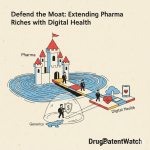
Strategic Opportunity: Companies that move first to certify (often local firms or agile MNCs) create a competitive moat. For example, certified Halal vaccines or gelatin-free capsules become preferred products in public procurement.
5.2 E-Pharmacy and Digital Regulation
Indonesia’s BPOM (National Agency of Drug and Food Control) issued Regulation No. 30 of 2025, amending oversight on online drug distribution.36
Marketplace Liability: The regulation places stricter liability on “Electronic System Providers” (e-commerce platforms). They must verify seller permits and display valid Marketing Authorization numbers.
Restricted Goods: “Hard Drugs” (Obat Keras) are restricted to authorized Electronic Pharmacy Systems (e-prescription platforms) and cannot be sold on open marketplaces.
Impact: This regulation legitimizes and consolidates the e-pharmacy sector, favoring compliant platforms like Halodoc and Alodokter while eliminating the gray market of unregulated sellers. It creates a safer, more transparent channel for MNCs to reach patients directly.
6. Eastern Europe & Eurasia: Geopolitics of Pharma
The ongoing geopolitical tensions involving Russia have turned the pharmaceutical sector into a strategic lever.
6.1 Russia: The Weaponization of IP
Russia provides a stark case study in the risks of doing business in sanctioned markets. Following the withdrawal of Western supplies of Ozempic (Semaglutide), the Russian government invoked Article 1360 of the Civil Code, which allows for compulsory licensing in cases of “extreme necessity” or national security.
The Action: The government granted compulsory licenses to local firms PSK Pharma and Promomed to manufacture generic semaglutide without the consent of the patent holder, Novo Nordisk.12
Legal Precedent: The Russian Supreme Court upheld this decision in 2025, rejecting Novo Nordisk’s appeal. This sets a precedent: IP rights for “unfriendly” nations’ assets can be nullified if supply is deemed unstable or insufficient.12
Market Status: While over 500 foreign companies have fully exited Russia by early 2026, nearly 2,300 remain, often operating under humanitarian exemptions for food and medicine. However, the operational environment is increasingly hostile, with high exit taxes and asset seizure risks.39
6.2 Turkey: Pricing Controls and Localization
Turkey continues to battle hyperinflation, which complicates pharmaceutical pricing. The government controls drug prices via a fixed Euro exchange rate, which is often set significantly below the market rate.
Pricing Update: For 2026, the fixed Euro rate for pharma pricing was raised by ~17% to 25.33 TL (up from ~21.67 TL in 2025).41 While this adjustment provides some relief, it still lags behind real-world inflation, squeezing margins for importers.
Localization Requirement: Turkey enforces a policy where drugs that can be produced locally must be, or they lose reimbursement status. This forces MNCs into technology transfer agreements with local Turkish manufacturers (CMOs) to maintain market access.42
7. Africa: Technology Leapfrogging
Africa is overcoming its infrastructure deficits not by replicating the linear development path of the West, but by adopting advanced technology to “leapfrog” traditional barriers.
7.1 Autonomous Logistics: The Zipline Model
In a landmark deal in late 2025, the US State Department committed $150 million to expand Zipline’s drone delivery network across Nigeria, Ghana, Kenya, and Côte d’Ivoire.9
Scale: The initiative aims to triple the network’s reach, serving up to 15,000 health facilities.
Mechanism: African governments will pay up to $400 million in service fees, creating a sustainable public-private partnership model rather than traditional aid.
Impact: This system bypasses the “last mile” challenge of poor road infrastructure. Drones deliver temperature-sensitive vaccines, blood products, and essential medicines on-demand, reducing stockouts by up to 60%.10 This represents a shift in global health strategy towards investing in high-tech, permanent infrastructure.
7.2 MPharma and Regional Integration
mPharma, a Ghanaian health-tech company, received strategic investment from Growth Investment Partners (GIP) in 2025 to expand into Francophone West Africa (Togo, Benin).43
Model: mPharma uses a vendor-managed inventory system and a franchise pharmacy model (“mutti”) to aggregate demand and lower drug costs.
Significance: This creates a unified, data-driven supply chain across fragmented markets, allowing for better negotiation with global manufacturers and ensuring consistent supply of quality-assured medicines.
8. The Biologic Patent Cliff & Biosimilar Tsunami (2025–2030)
The pharmaceutical industry is approaching a “Patent Cliff” of unprecedented magnitude. Between 2025 and 2030, exclusivity will be lost on some of the world’s highest-revenue biologic drugs. This is the single largest commercial opportunity for emerging market players.
Table 2: Major Biologic Patent Expiries & Risks (2025–2029)
Drug Name (Active)
Originator
Key Expiry / Risk Date
2023/24 Sales (Est.)
Strategic Impact
Keytruda (Pembrolizumab)
Merck
2028
~$25B
The “crown jewel” of oncology. Biosimilars are in advanced development in China (bio-thera, etc.) and India.
Opdivo (Nivolumab)
BMS
2028
~$9B
Major IO asset. Competing with Keytruda biosimilars for market share.
Immunology blockbuster. Settlements have delayed some US entry, but emerging markets may see earlier launches.
Ozempic (Semaglutide)
Novo Nordisk
2026 (varies)
High Growth
Already under compulsory license in Russia. Subject to fierce litigation in India (Dr. Reddy’s case) and China.
Eylea (Aflibercept)
Regeneron/Bayer
2027–2028
~$6B
Ophthalmology standard. High-concentration formulations attempting to extend lifecycle.
Sources: 44
Strategic Implications:
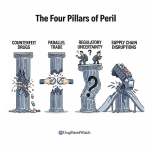
Litigation Intensity: Originators are deploying “patent thickets”—filing dozens of secondary patents on formulations, devices, and manufacturing processes—to delay entry. Tools like DrugPatentWatch are essential for tracking these filings and identifying “Paragraph IV” challenges.48
Emerging Market Lead: In markets like India and China, local patent offices often take a stricter view of these secondary patents (as seen in the Semaglutide Delhi High Court ruling), allowing biosimilars to launch domestically years before they enter the US or EU.
9. Supply Chain 4.0 in Emerging Markets
The “last mile” remains the most significant logistical hurdle in emerging markets, but solutions are maturing rapidly.
9.1 Cold Chain Innovation
In rural India and Sub-Saharan Africa, maintaining the 2°C–8°C cold chain for vaccines is critical.
Logistimo (India): Using mobile-web platforms to optimize inventory in low-resource settings, achieving 99% vaccine availability in rural Karnataka. This data-driven approach is now a case study for supply chain resilience.49
Maersk: Hosting master classes at LogiPharma 2025 on “Air to Sea” conversion, Maersk is expanding cold storage infrastructure in key hubs to support the pharmaceutical trade, reducing carbon footprints while ensuring integrity.50
9.2 Blockchain for Anti-Counterfeiting
Counterfeit drugs remain a scourge, particularly in Africa.
Blockchain Pilots: In South Africa and Nigeria, platforms like MediLedger and others are being piloted to track drugs from manufacturer to patient. By creating an immutable ledger of transactions, these systems validate authenticity and prevent the infiltration of falsified medicines.51
Regulatory Backing: South Africa’s “National Digital Health Strategy” and Nigeria’s NAFDAC are actively exploring these technologies to secure the supply chain.51
10. Conclusion: The Era of “Poly-Local” Strategy
The pharmaceutical industry in 2025–2030 is defined by the end of the “one-size-fits-all” global strategy. Emerging markets are no longer a homogeneous block of “growth opportunities.” They are complex, distinct ecosystems requiring a “poly-local” approach.
In China, success requires deep localization (“In China, For China”) to navigate regulatory nationalism and tap into the domestic innovation engine.
In India, success demands navigating a litigious IP environment while leveraging the country’s manufacturing prowess and adapting to new environmental costs.
In Indonesia, success hinges on cultural compliance (Halal certification) and navigating the digital health landscape.
In Brazil, success requires agility to leverage new clinical trial speeds and compliance with rigorous public procurement integrity rules.
In Africa, success means partnering with tech-forward logistics providers like Zipline and mPharma to bypass infrastructure bottlenecks.
For pharmaceutical executives, the “emerging market” label is obsolete. These are Strategic Growth Markets—where the risks are higher, the regulations are tougher, but the future of the industry is actively being written.
Frequently Asked Questions (FAQ)
Q: How does the “China+1” strategy impact Indian pharmaceutical manufacturers?
A: The “China+1” strategy is a significant tailwind for India. As global pharma companies seek to diversify supply chains away from sole reliance on China, Indian CDMOs are receiving increased inquiries and contracts. To capture this volume, Indian firms are upgrading infrastructure (e.g., implementing ZLD, digitalization) to meet Western quality standards. The sector is moving from simple API manufacturing to complex intermediates and finished dosages.17
Q: What are the specific implications of Indonesia’s Halal mandate for foreign pharma companies?
A: By October 2026, pharmaceutical products imported into Indonesia must be Halal-certified or clearly labeled as “non-Halal.” This requires strict segregation of materials (especially animal-derived ones like gelatin) throughout the supply chain (warehousing, transport). Non-compliance could lead to market exclusion or significant consumer backlash in the world’s largest Muslim-majority market.34
Q: What legal basis did Russia use to issue compulsory licenses for Ozempic?
A: The Russian government invoked Article 1360 of the Civil Code, which allows the government to authorize the use of an invention without the patent holder’s consent in the interests of “defense and security” or “extreme necessity” (interpreted here as health security). This was upheld by the Supreme Court, neutralizing Novo Nordisk’s patent rights in Russia for this drug.12
Q: How are environmental regulations affecting the cost of API production in India?
A: The 2025 draft CPCB guidelines recommend Zero Liquid Discharge (ZLD) systems for highly polluting pharma units. ZLD systems are expensive to install and operate (energy-intensive), potentially increasing the cost of production by 15-20% or more. This squeezes margins for smaller players and may drive consolidation, leaving only larger, compliant firms to supply the global market.8
Q: Why is Brazil’s new clinical trial regulation considered a game-changer?
A: Brazil’s new framework (Decree 12.651) mandates strict timelines: 30 days for ethical review and 90 days for regulatory (ANVISA) review. For strategic public health products, this is cut to 15 days. Previously, approvals could take nearly a year. This speed, combined with a centralized electronic submission platform, makes Brazil competitive with Eastern Europe and Asia for global clinical trial sites.26
80 Companies Exit Russia in 2025 as Forced Seizures of Foreign Assets Intensify – KSE – Kyiv Post, accessed January 22, 2026, https://www.kyivpost.com/post/68438