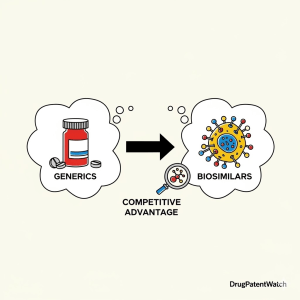
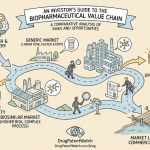
For seasoned professionals in intellectual property (IP), research and development (R&D), and business development, the simple question, “What is the difference between a generic and a biosimilar?” is just the beginning. The true value lies in a deeper, more nuanced understanding of how these differences—spanning molecular science, regulatory pathways, and market dynamics—create entirely distinct competitive landscapes. This report serves as a definitive blueprint for navigating this new era, providing the intelligence required to forecast market shifts, identify high-value opportunities, and transform patent data into a decisive strategic asset. It is an exploration of two parallel, yet fundamentally different, worlds of post-exclusivity competition.
The Molecules of Medicine: A Foundational Comparison
At its core, the distinction between a generic drug and a biosimilar is rooted in a fundamental difference in their molecular structure, origin, and method of production. This scientific dichotomy is the primary driver for all subsequent differences in regulation, law, and commercial strategy.
Generic Drugs: The Art of the Identical Copy
A generic drug is a chemically synthesized pharmaceutical drug that is, by definition, an exact duplicate of a brand-name drug.2 These are often referred to as “small molecules” due to their low molecular weight and simple, well-defined chemical structure.4 Think of familiar medicines like aspirin or ibuprofen. The manufacturing process for these drugs relies on chemical synthesis, a predictable and reproducible method that ensures the active ingredient is identical across every manufactured lot.5
The regulatory cornerstone for generic drugs is the concept of bioequivalence.6 To gain approval, a generic manufacturer must demonstrate that their product delivers the same amount of the active ingredient to the bloodstream at the same rate and extent as the reference drug.8 This is typically accomplished through pharmacokinetic studies that measure parameters such as the area under the curve (AUC), which indicates total drug exposure, and the maximum concentration (Cmax), which provides information on the rate of absorption.7 These parameters must fall within a narrow and specific range—typically a 90% confidence interval of 80% to 125% of the reference product’s values—to prove that the generic is therapeutically equivalent and will produce the same clinical effect.7
Biosimilars: The Symphony of “Highly Similar”
In stark contrast, a biosimilar is a biologic drug, a large, complex molecule derived not from chemical synthesis but from living organisms, such as yeast, bacteria, or animal cells.4 Examples include insulin, antibodies, and growth hormones, used to treat a wide range of chronic and life-threatening conditions from rheumatoid arthritis to cancer.10 The sheer size and intricate three-dimensional structure of these molecules make them fundamentally different from small-molecule drugs.11
The key challenge—and the scientific reality—is that a biologic cannot be perfectly replicated.12 The final structure of a biologic, including critical post-translational modifications like glycosylation, is a direct consequence of the unique, proprietary manufacturing process of the living cell used to produce it.12 This process naturally introduces “inherent variation” within and between lots of the same product, a phenomenon true for both the originator and the biosimilar.5 Therefore, instead of being “identical,” a biosimilar is a biologic that is “highly similar” to its reference product, with no “clinically meaningful differences” in terms of safety, purity, and potency.11 This is a fundamentally different, and far more complex, scientific standard than the identical-copy requirement for generics.
Consider this metaphor: a generic drug is like a perfect photocopy of a musical score. Every note is in the exact same place, and the final performance is a predictable result. A biosimilar, however, is more akin to a masterful replica of a Stradivarius violin. It is a new instrument, made by a different artisan using a different process, yet its sound and performance characteristics are so “highly similar” to the original that a trained ear cannot distinguish them. The underlying materials and processes are different, but the final, clinically meaningful outcome is the same. This analogy perfectly captures why a biosimilar cannot be considered a “generic” version of a biologic; it is a related but distinct product that requires a separate and more rigorous regulatory framework.
A Tale of Two Pathways: The Regulatory Labyrinth
Because of their profound scientific differences, generic drugs and biosimilars are approved and regulated through entirely distinct legal frameworks. For any business professional seeking to enter these markets, understanding the unique pathways, their incentives, and their legal complexities is not optional; it is a strategic imperative.
The Hatch-Waxman Act: Paving the Way for Generics
The modern generic drug industry was born with the enactment of the “Drug Price Competition and Patent Term Restoration Act of 1984,” commonly known as the Hatch-Waxman Act.16 This landmark legislation created the Abbreviated New Drug Application (ANDA) pathway, which allows generic manufacturers to bypass the extensive, multi-year clinical trials required for new drugs by instead demonstrating bioequivalence to an already-approved brand-name drug.8 This provision dramatically reduced development time and cost, paving the way for a competitive, high-volume generic market.
The ANDA process is inextricably linked to the FDA’s “Approved Drug Products with Therapeutic Equivalence Evaluations,” a publication more famously known as the “Orange Book”.18 The Orange Book lists approved small-molecule drugs and their associated patents, providing a roadmap for generic drug developers. To file an ANDA, a manufacturer must make a certification regarding these patents. The most powerful of these is a Paragraph IV certification, which states that a listed patent is either invalid or will not be infringed by the proposed generic.9
The Paragraph IV challenge is a cornerstone of generic market entry. Congress included a powerful incentive for this costly and risky endeavor: the first generic company to file a successful Paragraph IV challenge is rewarded with 180 days of market exclusivity.20 During this period, the FDA is precluded from approving any subsequent generic applications for that same drug. This incentive, which can be worth hundreds of millions of dollars for a blockbuster drug, has proven to be a highly effective mechanism for accelerating the entry of lower-cost generics.18
The BPCIA: A New Framework for Biologics
With the increasing number of blockbuster biologics nearing patent expiration, Congress recognized the need for a separate pathway. The “Biologics Price Competition and Innovation Act” (BPCIA), enacted in 2010, established the 351(k) abbreviated biologics license application (aBLA) pathway.15 This framework was designed to facilitate the approval of biosimilars without requiring a full duplication of the expensive clinical trials conducted by the innovator.15
The aBLA pathway requires a “totality-of-the-evidence approach” to demonstrate that a biosimilar is “highly similar” to its reference product.15 This includes a comprehensive battery of comparative studies: structural and functional analyses, nonclinical assessments, and comparative clinical studies to confirm similar pharmacokinetics, pharmacodynamics, and immunogenicity.11 The BPCIA also provides a period of exclusivity for the innovator, granting a 12-year window during which other companies are unable to obtain approval and market a biosimilar to that biologic, thereby encouraging ongoing innovation.24
The most unique and legally intricate provision of the BPCIA is the “patent dance,” a structured, optional legal framework for resolving patent disputes between a biosimilar applicant and a reference product sponsor.25 This process, which can take up to eight months, involves a confidential exchange of information to identify patents that could be litigated in the future.26
The non-mandatory nature of the patent dance was confirmed by the Federal Circuit’s pivotal decision in Amgen Inc. v. Sandoz Inc..26 This ruling had a profound effect, giving biosimilar applicants the strategic option to forgo the dance, which in turn shifts control over the timing and scope of litigation to the reference product sponsor.26 For a reference product sponsor, this optionality can make the patent dispute resolution process more complex, costly, and inefficient, creating a different kind of legal battleground than the ANDA pathway.27
The Economics of Entry: Cost, Competition, and ROI
The fundamental differences in molecule type and regulatory pathways create two entirely distinct economic profiles for generic and biosimilar market entry. For business leaders, these profiles dictate everything from investment strategy to pricing models.
The Generic Calculus: A Race to the Bottom
Generic drug development is a relatively low-cost affair, typically requiring an investment of just $1 million to $4 million.27 This low barrier to entry, coupled with the streamlined ANDA pathway, leads to a rapid influx of competitors as soon as a brand-name drug’s patents expire.29
The market response to generic entry is a textbook case of competitive economics: a rapid and severe price war. The first generic to launch typically enters the market at a price point roughly 30% to 40% below the brand’s price.29 The arrival of a second competitor triggers a further significant drop, with prices often falling to around 50% of the original price. Once six or more generic competitors are on the market, prices can plummet by more than 95%.20 This aggressive price erosion, while a boon for healthcare systems and patients—the generic launch of atorvastatin alone was associated with $11.9 billion in annual savings for the U.S.—results in “razor-thin profit margins” for manufacturers.29 The strategic logic in this market is one of high-volume, low-margin operational efficiency.
The Biosimilar Equation: A Different Kind of Investment
By contrast, developing a biosimilar is a significantly more expensive and time-consuming undertaking. The cost can range from $100 million to $250 million, and the timeline from development to approval typically spans seven to eight years.4 This substantial financial and temporal barrier to entry is a direct result of the complex science and rigorous comparative studies required by the BPCIA.15
This higher barrier fundamentally alters the competitive landscape. With a limited number of players, the price erosion is not as steep or as rapid as in the generic market.28 Biosimilars typically launch at a more moderate discount, ranging from 15% to 35% below the reference drug’s price.28 This less aggressive pricing strategy is a direct consequence of the higher upfront investment and the need for a more sustainable return on investment. The return on a biosimilar is a different equation, trading the rapid, high-volume payoff of a successful generic launch for the potential of more moderate but enduring profit margins.
The following table provides a clear, side-by-side comparison of the key strategic and economic parameters of these two distinct markets, offering a quantitative basis for informed decision-making.
Parameter
Generic Drugs
Biosimilars
Molecule Type
Small Molecule
Large Molecule
Development Cost
$1-4 million
$100-250 million
Development Timeline
2-5 years
7-8 years
Regulatory Pathway
ANDA (Hatch-Waxman)
aBLA (BPCIA)
FDA Standard
Bioequivalence (identical)
Highly Similar
Innovator Exclusivity
Varies by patent, can be extended
12 years of data exclusivity 24
Competitor Exclusivity
180-day for first-to-file 20
None, but first-mover advantage 32
Typical Launch Price Discount
30-40% below brand 29
15-35% below reference 28
Price Erosion Intensity
Rapid and severe (>95%) 20
Moderate and sustained 28
The Strategic Battlefield: Case Studies in Post-Exclusivity Competition
The theoretical differences between generics and biosimilars are best understood through the lens of real-world case studies. The legal and commercial sagas of Lipitor and Humira provide perfect blueprints for the strategies and challenges that define each market.
The Lipitor Legacy: A Masterclass in Generic Market Entry
The expiration of Pfizer’s patent on Lipitor (atorvastatin) in 2011 was a watershed moment that exemplified the full force of generic market entry. As one of the best-selling drugs in history, with over $130 billion in lifetime sales, Lipitor’s patent cliff was a high-stakes event.33 Pfizer mounted a vigorous defensive strategy, employing legal delays, launching an authorized generic, and offering patient co-pay programs to soften the blow.34
Despite these tactics, the market response to the generic launch was both swift and dramatic. The introduction of generic atorvastatin led to a massive shift in market share and staggering cost savings for patients and the U.S. healthcare system. A study found that the end of market exclusivity for statins was associated with $925.60 in annual savings per individual and a total of $11.9 billion in savings for the U.S..31 The Lipitor case perfectly illustrates the power of the Hatch-Waxman framework to rapidly drive down costs and democratize access to essential therapies.
The Humira Saga: A Blueprint for Biosimilar Litigation and Market Fragmentation
AbbVie’s Humira (adalimumab), the world’s best-selling medicine for many years, has been the subject of a far more complex and protracted legal battle.36 Rather than rely on a single patent, AbbVie created a sophisticated “patent thicket” of over 100 patents to protect its asset.37 This strategy, along with the lack of mandatory participation in the patent dance, led to a series of private, global patent settlements with nearly every major biosimilar developer.38 These settlements effectively delayed U.S. market entry for years, preserving AbbVie’s revenue streams for a significant period beyond the expiration of its primary patents.
The result of this litigation and commercial maneuvering was a slower, more fragmented market entry. Despite a flood of adalimumab biosimilars launching in 2023, initial market penetration was sluggish. As of late 2024, adalimumab biosimilars had only captured 22% of the market share, a stark contrast to the rapid uptake seen in oncology biosimilars.39 The Humira saga provides a cautionary tale for those entering the biosimilar market, demonstrating that legal and regulatory approval is just one piece of a much larger, and more complex, puzzle. It is a world where a well-executed legal strategy can be a more powerful competitive tool than a low price point.
The Unseen Hurdles: Adoption, Perception, and Politics
The journey from regulatory approval to widespread market adoption is fraught with a unique set of challenges that are far less prevalent in the generic drug market. For biosimilars, success depends not only on scientific rigor and legal maneuvering but on overcoming the unseen hurdles of perception, policy, and market dynamics.
Patient and Physician Skepticism
A significant barrier to biosimilar adoption is a lack of provider and patient confidence.40 Despite the FDA’s rigorous approval standards and the scientific evidence demonstrating that biosimilars have no “clinically meaningful differences” in safety or efficacy, misconceptions persist.42 These concerns often stem from worries about side effects, a lack of familiarity with the products, or confusion over switching between a reference product and a biosimilar during treatment.40 For a business development professional, this isn’t a scientific problem to be solved in the lab; it’s an educational and marketing challenge that requires a concerted effort to build trust and address a perception gap.
The “Interchangeability” Hurdle
One of the most critical distinctions in the biosimilar market is the “interchangeable” designation.44 While all biosimilars are approved for prescription in place of a reference product, an interchangeable biosimilar meets additional requirements and can be substituted by a pharmacist at the pharmacy level without a new prescription from the physician, much like a generic drug.28
For a biosimilar manufacturer, this designation is a powerful lever for driving adoption. The lack of interchangeability for early biosimilars meant that a physician had to write a new prescription by name, a logistical hurdle that can slow uptake.41 In contrast, the approval of interchangeable adalimumab biosimilars, such as Pfizer’s Abrilada, signals a new phase of competition that could accelerate market penetration by enabling pharmacy-level substitution.47 This is why manufacturers are increasingly pursuing this designation, and why the FDA is working to streamline the requirements for its approval.43
The Role of Pharmacy Benefit Managers (PBMs)
In the U.S. healthcare system, Pharmacy Benefit Managers (PBMs) act as powerful gatekeepers that can make or break a biosimilar’s commercial success. The Humira case highlights this perfectly. Even with multiple approved biosimilars, initial market uptake was slow because many PBMs, due to lucrative rebate agreements with AbbVie, chose to prioritize the reference product on their formularies.39 This created situations where biosimilars were placed at parity with Humira, offering little financial incentive to switch.41
The decision by a major PBM like CVS Caremark to remove brand-name Humira in favor of its own lower-cost biosimilar demonstrates the immense power of this leverage. It is a clear indication that a successful market entry strategy must go beyond regulatory and legal hurdles to include a concerted effort to secure favorable formulary positioning.41
“Although this potential for cost savings exists, physicians have historically been hesitant to prescribe them due to the lack of knowledge on these products and their effects,” reports the American Journal of Managed Care.40
Turning Data into Advantage: A Strategic Framework
The lessons from the generic and biosimilar markets are clear: success in the post-exclusivity landscape is not about reacting to patent expiration but about proactively using data to inform a long-term strategic plan.
Leveraging Patent Intelligence
The modern pharmaceutical professional cannot operate without comprehensive patent intelligence. Tools like DrugPatentWatch are indispensable for forecasting market entry, analyzing a reference product’s patent estate, and identifying high-value opportunities.9 An in-depth analysis of a biologic’s “patent thicket,” for example, can reveal the likely complexity and duration of a legal battle before a single dollar is invested in development, allowing a company to manage risk proactively and inform their portfolio strategy.37 The shift from the simple
bioequivalence check for generics to the totality of evidence for biosimilars mirrors a similar shift in commercial strategy, where the most valuable asset is not just the molecule but the data and analytics that prove its commercial viability.
Identifying Opportunities
The future of the generic industry is bifurcating. On one side are the high-volume, low-margin players who dominate the commodity market. On the other is a strategic pivot towards more complex, technically demanding products.29 The market growth projections are clear: while the generic market is expected to see steady growth, the biosimilar market is projected to grow at a staggering 24.1% CAGR 48, making it a primary growth engine for the entire industry. For a sophisticated player, the key is to use patent data to identify drugs with weaker patent estates, fewer potential competitors, or a clearer pathway to interchangeability to secure a larger portion of the market share and a higher ROI.
Risk Management
A robust strategy for either market must account for a multi-dimensional risk profile. This includes legal risks, such as protracted litigation over patent thickets; scientific risks, like the challenge of replicating the complex manufacturing process of a biologic; and commercial risks, such as a lack of physician adoption or unfavorable formulary positioning. A successful player will integrate all these factors into a cohesive, long-term plan that balances high-stakes investment with the potential for significant, sustainable returns.
The Road Ahead: Future Trends Shaping the Landscape
The biopharmaceutical industry is undergoing a fundamental transformation driven by technological innovation and evolving policy. The very processes of drug discovery and development are being reshaped.
The integration of artificial intelligence (AI) and machine learning is poised to accelerate drug discovery and development at an unprecedented pace. It is estimated that AI could drive 30% of new drug discoveries by 2025, streamlining everything from target identification to optimizing clinical trial design and reducing timelines and costs by as much as 25-50% in preclinical stages.49 This trend could democratize access to drug development, allowing smaller, more nimble players to compete with established giants.
On the policy front, new legislation like the Inflation Reduction Act is empowering federal agencies to negotiate drug prices for Medicare, creating new opportunities for biosimilar adoption and cost containment.49 As the focus shifts from a purely product-driven model to a more patient-centric approach, companies that can balance innovation, regulatory compliance, and a patient-focused strategy—all while leveraging advanced analytics and AI—will be best positioned to navigate the challenges and capitalize on the opportunities that lie ahead.
Key Takeaways
A Fundamental Dichotomy: Generic drugs are identical, small-molecule copies manufactured through chemical synthesis, while biosimilars are “highly similar,” large-molecule products derived from living organisms. This fundamental difference drives all other distinctions.
Two Distinct Regulatory Frameworks: The Hatch-Waxman Act’s ANDA pathway for generics is focused on proving bioequivalence and has strong incentives like the 180-day exclusivity. In contrast, the BPCIA’s aBLA pathway for biosimilars requires a “totality of evidence” to demonstrate high similarity and features a complex legal framework, exemplified by the “patent dance.”
Different Economic Profiles: Generics have low development costs and a “race to the bottom” price erosion curve, leading to razor-thin margins. Biosimilars require a much higher investment with more sustained, moderate price erosion, offering a different return-on-investment profile.
Beyond the Molecule: Successful market entry for biosimilars depends not just on scientific and legal approval but on overcoming hurdles of physician and patient perception, securing interchangeability status, and navigating complex Pharmacy Benefit Manager (PBM) formulary decisions.
The Strategic Imperative: For professionals in the field, the key is to use sophisticated tools like DrugPatentWatch to analyze patent data and proactively forecast market opportunities. This data-driven approach is essential for identifying risks, informing portfolio strategy, and capitalizing on the significant and growing high-value biosimilar market.
Frequently Asked Questions (FAQ)
Q1: Why are biosimilars not called “generic biologics”?
A biosimilar is not called a “generic biologic” because, unlike a generic small-molecule drug, it is not an identical copy of its reference product. Due to their complex, large-molecule structure and the inherent variability of production in living cells, it is scientifically impossible to create a perfect replica.13 The regulatory standard for biosimilars is therefore “highly similar” with “no clinically meaningful differences,” which is distinct from the “identical” requirement for generics.11
Q2: What is the significance of the “interchangeable” designation for biosimilars, and is it a mandatory requirement for market entry?
The “interchangeable” designation is a powerful additional status that a biosimilar manufacturer can seek.44 It is not a mandatory requirement for market entry; a physician can prescribe any approved biosimilar.52 However, the designation allows a pharmacist to substitute the biosimilar for the reference product at the pharmacy level without a new prescription from the physician, which is a major driver of market uptake.45 This status can bypass the “unseen hurdles” of physician and patient skepticism, significantly accelerating market penetration.
Q3: How does the “patent dance” for biosimilars differ from the Paragraph IV challenge for generics, and what are the strategic implications for each?
The Paragraph IV challenge for generics is a unilateral action by a generic manufacturer that triggers a dispute and, if successful, can lead to 180 days of market exclusivity.20 The “patent dance” for biosimilars, by contrast, is an optional, confidential information-exchange process between the biosimilar applicant and the innovator, designed to streamline litigation.26 The non-mandatory nature of the dance, affirmed by the Supreme Court, shifts the power dynamic, allowing a biosimilar applicant to opt out and cede control over the timing of litigation to the innovator.26
Q4: Given the higher development costs and complexities, why are companies increasingly investing in biosimilars over conventional generics?
Companies are shifting towards biosimilars because the traditional generic market for simple oral dosage forms has become a “race to the bottom” with razor-thin profit margins.29 Biosimilars, with their high development costs and scientific complexities, create significant barriers to entry that limit the number of competitors.28 This leads to more sustainable, albeit smaller, profit margins and a more predictable competitive landscape, making them an attractive long-term investment. The biosimilar market is projected to be a primary growth engine for the industry, with a staggering CAGR of 24.1%.48
Q5: Beyond price, what are the primary challenges to the broader adoption of biosimilars in the healthcare system?
While price is a major benefit, the adoption of biosimilars faces several non-price challenges. These include a lack of provider and patient confidence in their safety and efficacy, a knowledge gap about their differences from generics, and the logistical hurdles posed by the lack of an “interchangeable” designation.40 Additionally, the influence of Pharmacy Benefit Managers (PBMs) and their formulary decisions can create misaligned incentives that discourage the use of lower-cost biosimilars in favor of brand-name products with more lucrative rebates.41
A Systematic Review of U.S. Biosimilar Approvals: What Evidence Does the FDA Require and How Are Manufacturers Responding?, accessed September 1, 2025, https://pmc.ncbi.nlm.nih.gov/articles/PMC10398206/
Trends in Use and Expenditures for Brand-name Statins After Introduction of Generic Statins in the US, 2002-2018 – PMC, accessed September 1, 2025, https://pmc.ncbi.nlm.nih.gov/articles/PMC8609409/