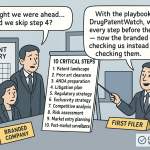
Navigating the Intersection of IPR and Hatch-Waxman Litigation: Strategic Coordination for Patent Challenges Balancing inter partes review (IPR) proceedings with Hatch-Waxman Paragraph IV litigation requires a nuanced understanding of timing, procedural overlaps, and evolving USPTO policies. Below, we explore the strategic considerations, recent legal developments, and practical recommendations for managing these parallel challenges effectively.
Overview of IPR and Hatch-Waxman Litigation
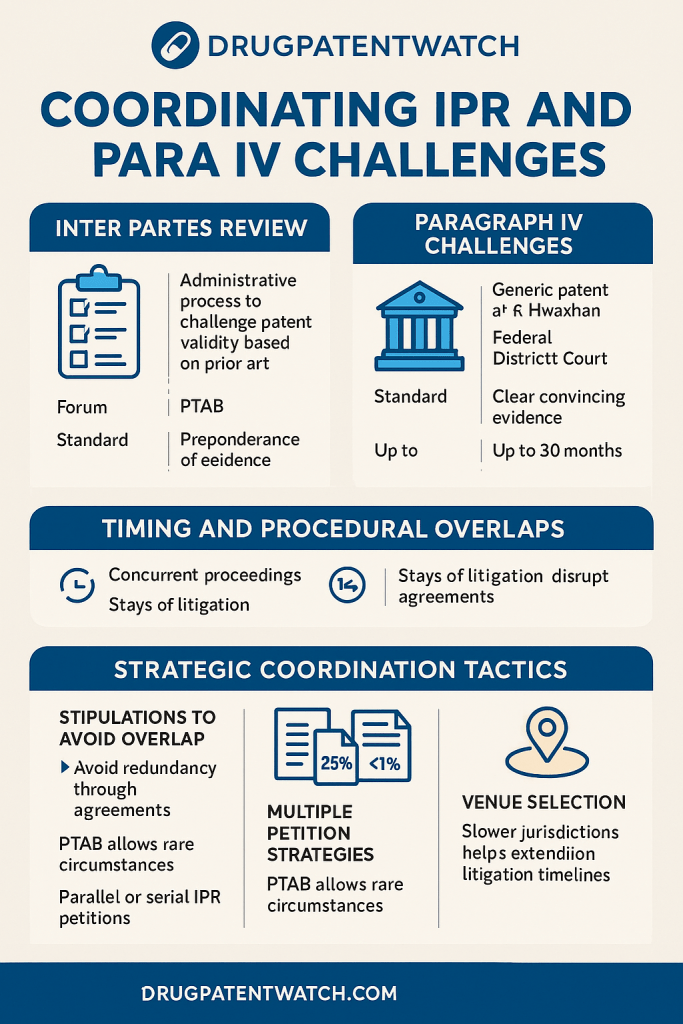
Inter Partes Review (IPR) A cost-effective administrative proceeding at the PTAB that allows third parties to challenge patent validity based on prior art. IPRs are particularly attractive in pharmaceutical litigation due to their lower burden of proof (preponderance of evidence) compared to district court’s clear-and-convincing standard[8][12].
Paragraph IV Challenges Under the Hatch-Waxman Act, generic manufacturers can file Abbreviated New Drug Applications (ANDAs) to contest innovator patents. Successful challenges grant 180-day exclusivity to the first generic filer[8][12]. These cases often involve parallel IPRs to strengthen invalidity arguments.
Timing and Procedural Overlaps
Key Timing Conflicts
District Court Deadlines: Hatch-Waxman litigation typically concludes within 30 months, while IPRs last 18 months plus appeals[2][4].
Stays of Litigation: Courts rarely stay Hatch-Waxman cases for IPRs, limiting the PTAB’s ability to influence trial outcomes[2][6].
NHK Spring/Fintiv Factors
The PTAB may deny IPR institution based on six factors, including: 1. Proximity of district court trial dates to PTAB deadlines 2. Overlap between IPR and litigation arguments 3. Investment in parallel proceedings by courts/parties[1][6].
“Overlapping grounds do not guarantee denial… petitioners may disclaim using the same prior art in court to avoid discretionary denial.” —White & Case LLP analysis of Sotera Wireless case[1]
Recent USPTO guidance clarifies that these factors do not apply to ITC investigations, making parallel IPR/ITC strategies more viable[6][14].
Strategic Coordination Tactics
1. Stipulations to Avoid Overlap
Petitioners can stipulate to: – Not assert identical invalidity grounds in court – Limit claim scope in PTAB proceedings
This reduces redundancy and avoids Fintiv-based denials[1][14].
2. Multiple Petition Strategies
The PTAB permits parallel/serial IPR petitions only under rare circumstances:
Scenario
Institution Rate
Example
Large claim sets
25%
Masimo Corp. v. Apple Inc. (denied due to claim overlap)[7]
Priority disputes
<1%
Square, Inc. v. 4361423 Canada Inc. (required clear justification)[13]
Per 2023 USPTO data, only 0.6% of serial petitions result in institution[9].
Pending rules aim to formalize restrictions on multiple petitions: – Parallel Petitions: Require “good cause” showing (e.g., complex priority dates) – Serial Petitions: Face stricter scrutiny under modified General Plastic factors[7][9].
“The NPR indicates the PTAB’s intention to continue taking a tougher stance on multiple petitions.” —Finnegan analysis of 2024 rulemaking[7]
Key Takeaways
Early Coordination: File IPRs within 12 months of Paragraph IV notice to align timelines[4][15].
Avoid Redundancy: Use stipulations to differentiate PTAB and litigation arguments[1][14].
Monitor Reforms: Adapt strategies to evolving USPTO policies on discretionary denials[6][9].
FAQs Q: Can IPRs invalidate patents faster than Hatch-Waxman litigation? A: Not typically—30-month litigation deadlines often outpace 18-month IPRs[2][4].
Q: Do courts consider PTAB decisions binding? A: No, but 90.4% of Orange Book patents face both challenges, creating persuasive precedent[8].
Q: How does the Fintiv rule impact ANDA litigants? A: Requires careful ground differentiation; 74% of institutions occur when petitioners avoid overlapping arguments[1][9].
Q: Can multiple defendants file joint IPRs? A: Yes, joinder rules allow co-defendants to consolidate challenges, as in Samsung v. Rovi[10].
Q: Are PTAB decisions appealable during litigation? A: Yes, but Federal Circuit deference to PTAB creates higher invalidation risks for patentees[4][12].
This strategic interplay between administrative and judicial proceedings will remain critical as 90.4% of Orange Book patents continue facing dual challenges[8]. Stakeholders must prioritize coordinated filings, USPTO policy awareness, and adaptive petition strategies to navigate this complex landscape.