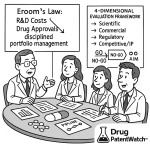
The pharmaceutical industry currently stands at a precarious intersection of unprecedented scientific capability and deteriorating economic sustainability. We are operating in an era defined by a fundamental paradox: while our understanding of biology has deepened exponentially—allowing us to target disease mechanisms with genetic precision—the efficiency of converting that knowledge into approved, profitable medicines has plummeted. This phenomenon, grimly noted by industry observers as “Eroom’s Law” (the reverse of Moore’s Law), suggests that drug discovery is becoming slower and more expensive over time, despite technological improvements.
The financial stakes are staggering. The average cost to bring a single asset to market has climbed to $2.23 billion as of 2024.1 Meanwhile, the “hit rate” remains punishingly low; for every 10,000 molecules that enter the discovery funnel, only one typically emerges as an FDA-approved medicine.2 This winner-take-all dynamic forces portfolio managers to place billion-dollar bets based on data that is often fragmented, static, and lagging. The result? A fragile recovery in the Internal Rate of Return (IRR) for top biopharma companies to just 5.9% in 2024, a figure that barely exceeds the cost of capital for many firms.1
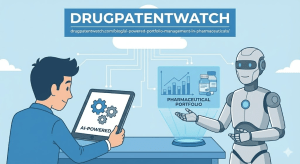
However, a paradigm shift is underway. We are witnessing the transition from portfolio administration—managing spreadsheets and slide decks—to algorithmic portfolio engineering. Artificial Intelligence (AI) and Machine Learning (ML) are no longer just experimental tools for drug discovery; they are becoming the central nervous system of strategic decision-making. By integrating vast, disparate datasets—from granular patent intelligence provided by platforms like DrugPatentWatch to real-world evidence (RWE) and competitive clinical trial signals—AI enables a move from deterministic to probabilistic management.
This report is not about the hype of generative AI writing marketing copy. It is a deep dive into the financial and strategic utility of AI. We explore how machine learning models are outperforming human intuition in predicting clinical trial outcomes, how “digital twins” of portfolios allow for real-time risk adjustment, and how generative agents are revolutionizing competitive wargaming. We analyze the cultural resistance, the “black box” regulatory risks, and the quantifiable ROI that early adopters like AbbVie, Sanofi, and Johnson & Johnson are already realizing.
Industry Insight: “After more than a decade of declining returns on pharmaceutical research and development (R&D), the tide is turning… However, rising R&D costs, which reached an average of US$2.23 billion per asset in 2024, present a continuing challenge to sustainable R&D.” — Deloitte, Measuring the Return from Pharmaceutical Innovation 2024.1
Why Is the Traditional Pharmaceutical Portfolio Model Broken?
The “Eroom’s Law” Conundrum
To understand the urgency of AI adoption, one must first confront the broken economics of the status quo. For decades, the industry relied on a “shots on goal” strategy: fill the pipeline with enough molecules, and statistics will eventually yield a blockbuster. But as research complexity increases, this volume-based approach is failing. The cost of failure has become too high to bear.
The decline in R&D productivity is not merely a scientific problem; it is a decision-making problem. Traditional portfolio management relies on “stage-gate” reviews that occur quarterly or annually. These meetings are often theater—highly political events where project champions present optimistic data to protect their budgets. Cognitive biases run rampant, particularly the sunk cost fallacy, where teams continue to fund failing assets because “we’ve already spent $50 million.”
The Data Silo Problem
In a typical large pharma organization, critical data lives in fortified silos. Clinical trial data sits in the R&D division; patent expiration and litigation data sit with Legal; market access and payer sentiment data sit with Commercial.
The Disconnect: A clinical team might push an asset forward based on strong Phase II efficacy data, unaware that the Legal team has identified a “freedom to operate” (FTO) issue due to a competitor’s “patent thicket,” or that the Commercial team sees the therapeutic area becoming saturated by the time of launch.3
The Consequence: Assets progress deep into Phase III trials—the most expensive phase—before being terminated for reasons that were knowable years earlier.
The Static Valuation Trap
Valuation in biopharma is uniquely difficult. The standard financial metric, Risk-Adjusted Net Present Value (rNPV), is the industry gold standard. However, in its traditional application, rNPV is deeply flawed because it relies on static assumptions.
Input Sensitivity: A minor adjustment in the Probability of Success (PoS) or the anticipated peak sales window can swing a valuation by hundreds of millions of dollars.
The “Average” Fallacy: Traditional models use industry benchmarks (e.g., “Phase I oncology has a 5% success rate”). This treats a novel mechanism of action with robust biomarkers the same as a “me-too” drug. It ignores the specific biological and competitive context of the asset.4
The industry needs a system that is dynamic, integrated, and predictive. This is where AI enters the equation.
How Does AI Transform Asset Valuation and Net Present Value (rNPV)?
Moving Beyond Static Spreadsheets
The integration of AI into financial modeling marks the transition from static, deterministic models to dynamic, stochastic simulations. Traditional rNPV models are “snapshots” in time. In contrast, AI-driven systems operate as “digital twins” of the portfolio, updating valuations in near real-time as new external data—competitor trial results, regulatory changes, patent filings—becomes available.5
$P(S_t)$ = Cumulative Probability of Success at time $t$
$r$ = Discount Rate (WACC)
AI fundamentally changes the inputs for $P(S_t)$ and $E(CF_t)$, moving them from “guesses” to “predictions.”
AI vs. Traditional Monte Carlo Simulations
Monte Carlo simulations have long been used to model risk by running thousands of scenarios. However, they suffer from the “Garbage In, Garbage Out” principle. If the probability distributions fed into the simulation are based on human guesswork, the output is merely a sophisticated guess.6
AI enhances this process by replacing subjective assumptions with data-derived distributions:
Probability of Success (PoS) Refinement: Machine learning models analyze historical trial data (clinical endpoints, patient recruitment rates, site performance) to predict the specific likelihood of a trial passing. Recent studies indicate that AI models can achieve 70-89% accuracy in predicting trial outcomes, compared to a baseline of 56-70% for historical averages.8
Mechanism: The AI doesn’t just look at the phase; it looks at the molecule structure, the trial design, the patient inclusion/exclusion criteria, and even the historical performance of the specific clinical sites selected.
Market Uptake Curves: Instead of using a standard “S-curve” for product launch, AI analyzes real-world sales data of analog products. It adjusts for competitor intensity, payer sentiment, and even social media trends to forecast revenue ramp-up more accurately.11
Table 1: The Evolution of Portfolio Valuation
Feature
Traditional Portfolio Management
AI-Powered Portfolio Management
Data Source
Internal spreadsheets, static reports
Integrated data lakes (Internal + External APIs)
Update Frequency
Quarterly/Annually
Real-time / On-demand
Risk Assessment
Subjective, consensus-based
Probabilistic, data-driven
Valuation Model
Static rNPV
Dynamic rNPV + Monte Carlo + AI
Bias Mitigation
Low (prone to sunk cost fallacy)
High (algorithmic objectivity)
Probability Inputs
Industry Averages (Benchmarks)
Asset-Specific Predictions (ML-derived)
Algorithmic Alpha in Asset Selection
Investment firms and corporate business development (BD) teams are using these tools to identify undervalued assets—generating “Algorithmic Alpha.”
Case Study:Intelligencia AI demonstrated that an AI-curated portfolio of early-stage biotech companies significantly outperformed the market. Their AI-selected portfolio achieved a 60% return with a Sharpe Ratio of 1.83, compared to a 17% return for the biotech benchmark index (XBI-ETF) over the same period.12
The Insight: The AI was able to identify assets where the market perceived high risk (low valuation), but the underlying data suggested a higher probability of success.
What Role Does Patent Intelligence Play in the AI Stack?
The Patent as a Financial Instrument
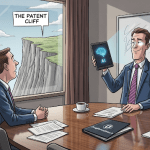
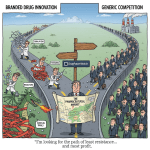
In the pharmaceutical industry, a patent is not merely a legal right; it is the fundamental unit of commercial value. It is the “moat” that protects the billion-dollar R&D investment. The “Patent Cliff”—the sudden, sheer drop in revenue following the loss of exclusivity (LOE)—is the single most critical event in a drug’s lifecycle.13 Effectively managing a portfolio requires precise prediction of these dates, which is complicated by patent term extensions, pediatric exclusivities, and litigation.
Integrating DrugPatentWatch for Strategic Foresight
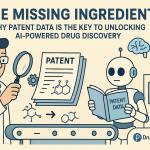
To build a robust AI model, one must feed it high-fidelity intellectual property data. General legal databases are often too broad or unstructured for precise financial modeling. Specialized platforms like DrugPatentWatch provide the granular, curated data necessary to model the “exclusivity stack” of a drug.14
By integrating API feeds from DrugPatentWatch, portfolio managers can track and model:
Composition of Matter Patents: The “crown jewel” protection for the active pharmaceutical ingredient (API) itself.13
Method of Use Patents: Secondary patents protecting specific indications. These are critical for lifecycle management, allowing a company to extend protection by finding new uses for an old drug.13
Formulation Patents: Protection for specific delivery mechanisms (e.g., extended-release tablets, transdermal patches). These are key to defensive strategies against generics.13
Litigation Status: Real-time tracking of Paragraph IV challenges and settlements. This data allows the AI to predict “at-risk” generic launches before they happen.15
Detecting “White Space” and Freedom to Operate (FTO)
AI uses Natural Language Processing (NLP) to digest thousands of patent claims and specifications, which are written in dense “legalese.” By mapping the semantic relationships between patents, AI can identify:
Patent Thickets: Dense clusters of patents held by competitors that make entry difficult.
White Spaces: Areas with little IP activity that represent untrodden ground for R&D.16
Strategic Scenario: A company exploring a new formulation for an oncology drug can use AI to scan global patent registries via DrugPatentWatch. If the AI detects that a competitor has already filed a broad “Markush structure” claim that encompasses the proposed molecule, the project can be killed or pivoted before millions are spent on wet-lab synthesis.16
The Formulation Switch Strategy
AI coupled with patent data can identify opportunities for Lifecycle Management (LCM). By analyzing patent expiration dates alongside clinical data, AI can flag drugs approaching the patent cliff that are suitable for reformulation.
The Play: Switching a drug from an immediate-release (IR) to an extended-release (ER) dosage form. This improves patient compliance and creates a new patentable asset that extends the revenue tail.17
Execution:DrugPatentWatch facilitates this by monitoring formulation patents and 505(b)(2) filings, alerting strategists to competitor moves in the reformulation space and identifying excipient technologies that are open for use.17
Can Generative AI Revolutionize Competitive Intelligence and Wargaming?
From Static Workshops to Generative Simulation
Traditional competitive wargaming is a manual, labor-intensive process. Executives assemble in a hotel conference room for two days to role-play competitors. While valuable for team building, these exercises are expensive, infrequent, and biased by the participants’ own internal views. They are “snapshots” of the competitive landscape.
Generative AI (GenAI) and Large Language Models (LLMs) are transforming this into a continuous, always-on capability. Labs like the “GenWar” facility at Johns Hopkins Applied Physics Laboratory are pioneering the use of LLMs to create autonomous agents that simulate competitor behavior.18
In a pharma context, a “Red Team” AI agent can be programmed with a competitor’s entire public footprint:
Financial reports (10-Ks, 10-Qs)
Pipeline data and clinical trial registries
CEO statements and earnings call transcripts
Patent filings and litigation history
“Making the Third Move First”
The strategic value lies in second- and third-order thinking. If Company A launches a new diabetes drug, how will Company B respond? Will they drop price? Initiate a patent lawsuit? Launch a comparative head-to-head trial?
Simulation Power: AI agents can run thousands of iterations of these scenarios, exploring the “game tree” of possible moves and counter-moves.
Outcome: This allows strategists to identify non-obvious risks. For example, an AI simulation might reveal that an aggressive pricing strategy could trigger a “scorched earth” rebate war with a competitor, destroying value for both, whereas a value-based contracting strategy would lead to a stable duopoly.20
Deep Research and “Launch Rooms”
GenAI is also replacing the “War Room” with the “Launch Room.” Instead of static dashboards, launch teams use AI to synthesize real-time data on physician sentiment, prescription trends, and payer coverage.
Real-World Impact: A top-10 pharma company utilized AI-driven segmentation during a product launch. By analyzing Electronic Medical Records (EMR) and prescription data, the AI identified a specific subset of physicians—previously ignored by the sales force—who showed high potential based on referral patterns.
Result: The company reallocated 40% of its sales calls to this new segment, resulting in a 60% increase in new prescriptions.21
Where Are the Real-World Success Stories?
The adoption of AI in portfolio management is not theoretical; major industry players are already realizing significant ROI. The “hype” phase is ending; the “deployment” phase has begun.
AbbVie: The R&D Convergence Hub (ARCH)
AbbVie has developed the AbbVie R&D Convergence Hub (ARCH), an industry-leading platform that centralizes and connects data from more than 200 internal and external sources. This “knowledge graph” allows scientists and strategists to mine disparate data—genetics, clinical trials, molecular interactions—to identify new indications for existing assets and, crucially, to kill unviable projects early. The platform acts as a central nervous system for the portfolio, ensuring that decisions are based on the totality of available evidence rather than siloed views.22
Sanofi and J&J: Asset Prioritization
Johnson & Johnson (J&J) is utilizing deep learning algorithms to prescreen tissue samples and identify patients for clinical trials. By using AI to match patients to trials more accurately, they are effectively “de-risking” the enrollment process—one of the biggest causes of trial delays and failures.23
Similarly, Sanofi and other majors are using AI to “prune” their pipelines more aggressively. Between 2018 and 2024, top biopharma companies discontinued an average of 21-22% of their programs annually. Notably, AI is helping shift these discontinuations earlier in the lifecycle. Approximately 50% of discontinued assets are now in Phase I. This is a massive win for efficiency; killing a drug in Phase I costs ~$30 million, whereas killing it in Phase III can cost hundreds of millions.24
Case Study: Oncology Asset Selection
In a specific case involving a global pharmaceutical company targeting the Chinese market, Intelligencia AI partnered with ZS Associates to screen over 1,000 oncology assets. The AI assessed the Probability of Technical and Regulatory Success (PTRS) for each asset based on clinical and biological data.
Speed: The list was narrowed to 20 high-priority targets in just eight weeks—a process that typically takes months of manual due diligence.
Strategic Advantage: This speed is a competitive weapon. It allows Business Development (BD) teams to bid on assets before competitors complete their due diligence, securing a “first-mover” advantage in deal-making.12
Manufacturing Cost Reduction
AI’s impact extends beyond R&D into the P&L of manufacturing. AI-driven predictive maintenance and process optimization have shown dramatic results.
Yield Uplift: A global sterile site reported a 15% yield uplift using AI-driven real-time controls.25
Throughput: A North American Contract Manufacturing Organization (CMO) achieved a 30-60% gain in downstream throughput.25
Cost Savings: Overall, AI implementations in production have slashed costs by up to 31% in visual inspection and other labor-intensive areas.25
How Does AI Mitigate the “Sunk Cost Fallacy” in Early Termination?
The Economics of “Failing Fast”
The most valuable decision in portfolio management is often the decision to stop. The cost of developing a drug grows exponentially as it moves from discovery to market.
Discovery/Preclinical: ~$5-10 million
Phase I: ~$30 million
Phase II: ~$100 million
Phase III: ~$300 million – $1 billion+
If an asset is destined to fail, identifying that failure in Phase I rather than Phase III saves the organization hundreds of millions of dollars that can be reinvested in winning assets.
AI as the Objective Arbiter
Human decision-makers are emotionally and politically invested in their projects. A scientist who has spent five years on a molecule, or a VP who championed its acquisition, has a strong psychological incentive to ignore warning signs. AI provides an objective, data-driven “second opinion.”
Real-World Example:
In one documented case, an internal pharma team rated a potential acquisition target with a 45% PTRS (Probability of Technical and Regulatory Success). They were bullish on the deal. The company then ran an independent AI assessment using Intelligencia AI’s model, which was trained on thousands of similar historical cases. The AI rated the asset at only 8% PTRS—placing it in the bottom quartile.
The Decision: The company paused to reconsider. Ultimately, they decided to abandon the pursuit.
The Validation: The target asset subsequently failed in clinical trials and did not receive FDA approval. The company avoided a multimillion-dollar write-off by trusting the AI’s skepticism over their internal optimism.12
Quantifiable Industry Savings
The broader adoption of AI in these decision workflows is projected to save the industry $25-54 billion annually in R&D costs.26 This is not just about doing things faster; it is about doing the right things and stopping the wrong things.
Key Statistic: “The McKinsey Global Institute estimated that AI solutions applied in the pharma industry could bring almost $100 billion annually.”.27
What Are the Hidden Risks of Algorithmic Decision-Making?
Despite the promise, the “Black Box” nature of AI introduces new strategic risks that portfolio managers must navigate.
The “Black Box” and Explainability (XAI)
Regulators and executives are wary of decisions they cannot understand. If an AI model recommends killing a flagship project, the R&D head needs to know why. “Black box” deep learning models often fail to provide this rationale.
The Risk: Without explainability, trust erodes. If an AI makes a correct prediction 90% of the time but cannot explain its reasoning, stakeholders will hesitate to pull the trigger on a billion-dollar decision.
The Solution: The industry is increasingly moving toward Explainable AI (XAI). These models provide “feature importance” scores—showing, for example, that the model predicts failure because of “high liver toxicity signals in similar chemical structures” or “poor historical recruitment rates at the selected trial sites”.28
Algorithmic Bias
AI models are only as good as the data they are trained on. Historical clinical trial data is heavily skewed toward white, male populations.
The Consequence: An AI model trained on this data might incorrectly predict that a drug will fail in a diverse real-world population (false negative), or conversely, predict success where there are hidden safety risks for specific demographic groups (false positive).28
Mitigation: Companies must actively audit their training datasets for bias and use techniques like federated learning to access more diverse data pools without compromising patient privacy.30
Generative Hallucinations in Clinical Contexts
While Generative AI is powerful, it is prone to “hallucinations”—confidently stating false information. In a clinical or portfolio context, this can be disastrous.
Example: In a test of generative AI models, one system reviewed a patient’s chart and concluded that “drinking two glasses of wine per week” counted as “physical activity”.31
Clinical Note Interpretation: Generic AI models struggle with medical shorthand (e.g., interpreting “AS” as “aortic stenosis” rather than the word “as”). Purpose-built, domain-specific models are required to avoid these errors.31
Regulatory Uncertainty
The FDA is actively developing frameworks for AI in drug development, but the landscape is fluid. There is a risk that data generated by “generative” methods (e.g., synthetic control arms) might face skepticism during regulatory review if the validation is not rigorous. The FDA’s recent discussion papers emphasize the need for “human-in-the-loop” validation to ensure credibility.32
Why Do Cultural Barriers Persist Against AI Adoption?
The “Art vs. Science” Divide
Pharmaceutical R&D has traditionally been viewed as an art form driven by the intuition of experienced “drug hunters.” There is significant cultural resistance to ceding this authority to algorithms. Scientists may view AI as a threat to their expertise or as a tool that misses the nuance of biological complexity. This is the classic “Innovator’s Dilemma”—successful companies fail to adopt disruptive technologies because they are focused on protecting their existing models.32
The “Organ Rejection” of Innovation
Just as the body rejects a foreign organ, organizations often reject new technologies that disrupt established power structures. Successful implementation requires “change management” as much as technology management.
The Talent Gap: There is a “war for talent.” Tech firms act as magnets for AI experts, offering compensation packages that pharma often struggles to match.
The Solution: Companies must cultivate “T-shaped” professionals—experts who have deep domain knowledge (the vertical bar) but also broad literacy in data and AI (the horizontal bar). It is often easier to teach a biologist data science than to teach a data scientist biology.33
Data Silos and Dirty Data
The biggest technical hurdle is often not the AI model itself, but the data infrastructure. Data in pharma is “dirty”—inconsistent formats, handwritten notes, legacy databases. AI requires a unified, clean data layer. Breaking down these silos is a political challenge as much as a technical one, as different departments hoard their data as a source of power.3
Conclusion: The Convergence Advantage
The future of pharmaceutical portfolio management lies in “Convergence.” It is the integration of the Scientific (clinical data, biological mechanism), the Legal (patent expiration, FTO, DrugPatentWatch intelligence), and the Commercial (market access, competitor wargaming) into a single, unified intelligence engine.
AI is the loom that weaves these threads together. It allows companies to move from a defensive posture—reacting to trial failures and patent cliffs—to an offensive one. By simulating the future with high-fidelity data, pharma companies can construct portfolios that are resilient to volatility, optimized for return, and, ultimately, more effective at delivering life-saving therapies to patients.
The math is clear: in an industry where 90% of attempts fail, the ability to predict failure 10% better is not just an efficiency gain—it is the difference between solvency and bankruptcy. The winners of the next decade will be those who treat AI not as a tool, but as a competitor they must internalize—building the “algorithmic edge” before their rivals do.
Key Takeaways
Dynamic Valuation is Essential: AI shifts portfolio valuation from static, annual rNPV updates to real-time “digital twins” that adjust instantly to market and clinical events, mitigating the risks of the “average” fallacy.
Patent Intelligence Must Be Granular: You cannot model a drug’s value without precise, real-time data on patent cliffs, formulation switches, and litigation risks. Integrating APIs like DrugPatentWatch is critical for this fidelity.
Kill Projects Earlier: The highest ROI from AI comes from “negative selection”—identifying and terminating weak assets in Phase I (~$30M cost) before they consume Phase III resources (~$300M+ cost).
Wargaming 2.0: Generative AI enables continuous simulation of competitor behavior (“Red Teaming”). This allows companies to test strategies against thousands of potential market scenarios, moving from reactive to proactive strategy.
Culture Eats Strategy: The biggest barrier to AI adoption is not technical but cultural. Success requires bridging the gap between data scientists and traditional “drug hunters” through explainable AI (XAI) and the cultivation of “T-shaped” talent.
Frequently Asked Questions (FAQ)
Q1: How does AI specifically improve the accuracy of Net Present Value (NPV) calculations compared to standard Excel models?
A: Standard Excel models rely on static inputs for risk (e.g., a flat 10% Probability of Success for Phase I). AI models utilize machine learning to analyze thousands of historical trials, assigning a specific, dynamic PoS based on the drug’s mechanism, trial design, and recruitment data. Furthermore, AI models generate probability distributions for commercial uptake rather than single-point estimates, providing a “risk-adjusted” view that accounts for market volatility and competitive intensity.
Q2: Can AI really predict legal outcomes like patent litigation or Paragraph IV challenges?
A: While AI cannot predict a judge’s ruling with certainty, it can quantify risk. By analyzing thousands of past patent cases, AI can identify patterns—such as the success rates of specific law firms, the outcomes in specific district courts, and the correlation between claim language and invalidation. This allows companies to assign a probability score to litigation outcomes (e.g., “65% chance of settlement entry in 2028”) which feeds directly into the rNPV model.
Q3: What is “Synthetic Data” in the context of portfolio management, and is it reliable?
A: Synthetic data involves creating artificial datasets that mimic real-world data properties without containing sensitive private information. In portfolio management, this often takes the form of “Synthetic Control Arms” for clinical trials—using historical patient data to model a control group. This is increasingly accepted by regulators for rare diseases but requires rigorous validation. It is reliable for scenario planning and “what-if” modeling but is used cautiously for regulatory submissions.
Q4: How does DrugPatentWatch data integrate into an AI portfolio management system?
A: DrugPatentWatch offers an API that feeds structured patent data directly into a company’s data lake. An AI model can query this data to update the “Loss of Exclusivity” (LOE) date for every asset in the portfolio automatically. For example, if a competitor files a new formulation patent, the API triggers an alert, and the AI model recalculates the projected revenue tail, potentially flagging a need for a strategic pivot.
Q5: Is AI replacing the role of the Portfolio Manager or Business Development Executive?
A: No, it is augmenting them. The volume of data—scientific, legal, and commercial—has exceeded human cognitive capacity. AI handles the data synthesis, pattern recognition, and scenario generation. The human role shifts to high-level strategy, ethical judgment, and relationship management. The “human-in-the-loop” remains essential for interpreting the “why” behind the AI’s “what,” especially when making billion-dollar decisions that impact patient lives.
The use of machine learning models to predict progression-free survival and overall survival outcomes from waterfall plots in randomized clinical trials (MAP-OUTCOMES) – NIH, accessed November 26, 2025, https://pmc.ncbi.nlm.nih.gov/articles/PMC12281959/