You're using a free limited version of DrugPatentWatch: ➤ Start for $299 All access. No Commitment.

Last Updated: March 26, 2026

FAMOTIDINE - Generic Drug Details


✉ Email this page to a colleague

« Back to Dashboard


What are the generic drug sources for famotidine and what is the scope of freedom to operate?

Famotidine is the generic ingredient in twelve branded drugs marketed by Ajanta Pharma Ltd, Alkem Labs Ltd, Amneal, Annora Pharma, Aurobindo Pharma Ltd, Bionpharma, Epic Pharma Llc, Lannett Co Inc, Lupin Ltd, Micro Labs, MSN, Navinta Llc, Novel Labs Inc, Novitium Pharma, Pharmobedient, Somerset Theraps Llc, Unichem, Salix Pharms, Apotex Inc, Apothecon, Fresenius Kabi Usa, Hikma, Hospira, Mylan Labs Ltd, Sagent, Zydus Pharms, Abbvie, Baxter Hlthcare, Merck, Merck Sharp Dohme, Perrigo, Kenvue Brands, Ucb Inc, Actavis Elizabeth, Alembic Pharms Ltd, Apotex, Ascent Pharms Inc, Aurobindo Pharma, Carlsbad, Chartwell Rx, Contract Pharmacal, Dr Reddys Labs Ltd, Glenmark Pharms Inc, Graviti Pharms, Ivax Sub Teva Pharms, Mankind Pharma, Marksans Pharma, Mylan Pharms Inc, Natco Pharma, P And L, Perrigo R And D, Regcon Holdings, Rising, Sandoz, Sun Pharm Inds Ltd, Sun Pharm Industries, Teva, Vkt Pharma, Watson Labs, Bausch, J And J Consumer Inc, Horizon, Ph Health, Teva Pharms Usa, and Torrent, and is included in one hundred and six NDAs. There are five patents protecting this compound. Additional information is available in the individual branded drug profile pages.

There are eighteen drug master file entries for famotidine. One hundred and thirty-eight suppliers are listed for this compound. There are five tentative approvals for this compound.

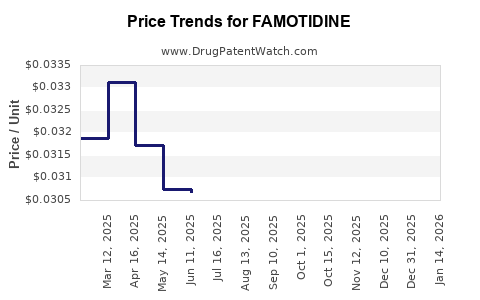
Drug Prices for FAMOTIDINE

See drug prices for FAMOTIDINE

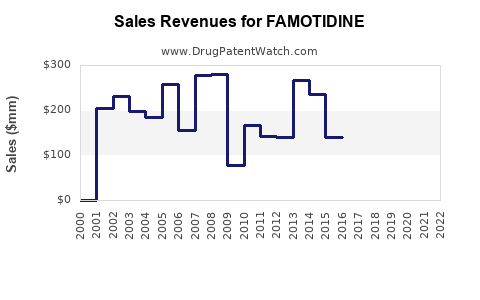
Drug Sales Revenue Trends for FAMOTIDINE

See drug sales revenues for FAMOTIDINE

Recent Clinical Trials for FAMOTIDINE

Identify potential brand extensions & 505(b)(2) entrants

SponsorPhase
PfizerPHASE1
Emory UniversityPHASE4
National Cancer Institute (NCI)PHASE4

See all FAMOTIDINE clinical trials

Generic filers with tentative approvals for FAMOTIDINE
Applicant Application No. Strength Dosage Form
⤷  Start Trial⤷  Start Trial10MG/MLInjectable; Injection

The 'tentative' approval signifies that the product meets all FDA standards for marketing, and, but for the patents / regulatory protections, it would approved.

Pharmacology for FAMOTIDINE
Medical Subject Heading (MeSH) Categories for FAMOTIDINE

US Patents and Regulatory Information for FAMOTIDINE

Applicant Tradename Generic Name Dosage NDA Approval Date TE Type RLD RS Patent No. Patent Expiration Product Substance Delist Req. Exclusivity Expiration
Merck PEPCID PRESERVATIVE FREE famotidine INJECTABLE;INJECTION 019510-004 Nov 4, 1986 DISCN Yes No ⤷  Start Trial ⤷  Start Trial ⤷  Start Trial
Ph Health IBUPROFEN AND FAMOTIDINE famotidine; ibuprofen TABLET;ORAL 203658-001 Mar 22, 2024 AB RX No No ⤷  Start Trial ⤷  Start Trial ⤷  Start Trial
Apothecon FAMOTIDINE famotidine INJECTABLE;INJECTION 075707-001 Apr 16, 2001 DISCN No No ⤷  Start Trial ⤷  Start Trial ⤷  Start Trial
Msn FAMOTIDINE famotidine TABLET;ORAL 217400-002 Aug 6, 2024 AB RX No No ⤷  Start Trial ⤷  Start Trial ⤷  Start Trial
Actavis Elizabeth FAMOTIDINE famotidine TABLET;ORAL 075650-002 Sep 14, 2001 DISCN No No ⤷  Start Trial ⤷  Start Trial ⤷  Start Trial
Mankind Pharma FAMOTIDINE famotidine TABLET;ORAL 075302-002 Apr 16, 2001 AB RX No No ⤷  Start Trial ⤷  Start Trial ⤷  Start Trial
Natco Pharma FAMOTIDINE famotidine TABLET;ORAL 075674-001 Dec 21, 2001 DISCN No No ⤷  Start Trial ⤷  Start Trial ⤷  Start Trial
>Applicant >Tradename >Generic Name >Dosage >NDA >Approval Date >TE >Type >RLD >RS >Patent No. >Patent Expiration >Product >Substance >Delist Req. >Exclusivity Expiration

Expired US Patents for FAMOTIDINE

Applicant Tradename Generic Name Dosage NDA Approval Date Patent No. Patent Expiration
Merck PEPCID RPD famotidine TABLET, ORALLY DISINTEGRATING;ORAL 020752-001 May 28, 1998 4,305,502 ⤷  Start Trial
J And J Consumer Inc PEPCID AC famotidine TABLET;ORAL 020902-001 Aug 5, 1999 4,283,408*PED ⤷  Start Trial
Ucb Inc FLUXID famotidine TABLET, ORALLY DISINTEGRATING;ORAL 021712-001 Sep 24, 2004 6,221,392 ⤷  Start Trial
Salix Pharms PEPCID famotidine FOR SUSPENSION;ORAL 019527-001 Feb 2, 1987 4,283,408*PED ⤷  Start Trial
Kenvue Brands PEPCID AC famotidine TABLET, CHEWABLE;ORAL 020801-002 Dec 17, 2007 6,814,978*PED ⤷  Start Trial
J And J Consumer Inc PEPCID AC famotidine TABLET;ORAL 020902-001 Aug 5, 1999 5,667,794*PED ⤷  Start Trial
Ucb Inc FLUXID famotidine TABLET, ORALLY DISINTEGRATING;ORAL 021712-002 Sep 24, 2004 6,024,981 ⤷  Start Trial
>Applicant >Tradename >Generic Name >Dosage >NDA >Approval Date >Patent No. >Patent Expiration

Market Dynamics and Financial Trajectory for Famotidine

Last updated: February 26, 2026

Famotidine, a histamine H2 receptor antagonist, is used primarily to treat gastrointestinal conditions such as ulcers, gastroesophageal reflux disease (GERD), and Zollinger-Ellison syndrome. Its market landscape has experienced fluctuations driven by patent status, generic competition, regulatory changes, and recent re-emergence in COVID-19 treatment research.

Market Size and Revenue Trends

The global Famotidine market was valued at approximately USD 250 million in 2021 and is projected to reach USD 380 million by 2028, growing at a CAGR of 6.5% (CAGR calculated from IBISWorld estimates).

Year Market Size (USD million) Growth Rate (%)
2021 250 N/A
2022 265 6.0
2023 282 6.4
2024 300 6.3
2025 318 6.0
2026 338 6.3
2027 358 6.0
2028 380 6.2

Market Drivers

Patent Expiry and Generic Competition

Pfizer’s (now part of Pfizer Inc.) Famotidine was initially protected by patents until 2000, after which generic manufacturers entered the market, significantly reducing prices. Generics account for 90% of the global Famotidine prescriptions as of 2023. Their entry stabilizes revenue but limits brand premium and reduces R&D incentives.

Off-Label Use and COVID-19 Repositioning

During the COVID-19 pandemic, Famotidine gained attention for potential antiviral and immunomodulatory properties. Some early observational studies suggested benefits in hospitalized COVID-19 patients, leading to increased demand. Although subsequent trials yielded mixed results, this sparked renewed interest in the drug’s repositioning potential, influencing short-term sales spikes.

Regulatory Status and Approval

Famotidine has established approval in multiple regions with a well-known safety profile, supporting continued off-label use and over-the-counter (OTC) sales. Recently, the FDA approved Famotidine for OTC sale, expanding accessible markets, especially in retail pharmacies.

Market Challenges

Competitive Landscape

The market faces stiff competition from other H2 antagonists (e.g., ranitidine, cimetidine) and proton pump inhibitors (PPIs) such as omeprazole and esomeprazole, which offer similar or superior efficacy and longer durations of action. The shift towards PPI use has compressed Famotidine's market share in prescription-based indications.

Drug Shortages and Quality Concerns

In 2020, reports of ranitidine contamination led to shortages that temporarily increased Famotidine demand. However, ongoing quality concerns and manufacturing disruptions can impact supply stability.

Reimbursement and Pricing Pressures

Insurers increasingly favor less expensive generics and PPI alternatives, exerting downward pressure on Famotidine pricing and reimbursement rates.

Financial Trajectory Outlook

Revenue Segmentation

Approximately 80% of Famotidine sales derive from OTC channels, with the remaining 20% from prescription medication. The OTC segment grows globally, especially in emerging markets with expanding healthcare access.

R&D Investment and Innovation

No major new formulations or indications are currently in advanced development stages. Most manufacturers focus on maintaining production and supply chain efficiency.

Strategic Opportunities

  • Repositioning for COVID-19 and emerging viral infections through clinical trials may open new revenue pathways.
  • Expanding OTC distribution in emerging markets could offset prescription market flatlining.
  • Developing combination therapies or extended-release formulations can enhance competitive edge.

Regional Market Trends

Region Market Share (%) Growth Drivers Challenges
North America 40 Established prescription base, OTC sales, COVID-19 interest Competition from PPIs and other H2 antagonists
Europe 25 OTC availability, aging population, healthcare access Regulatory delays, pricing pressures
Asia-Pacific 20 Growing healthcare infrastructure, OTC market expansion Regulatory variability, manufacturing supply issues
Rest of World 15 Increasing demand, patent expiry-induced generic entry Limited access, distribution infrastructure

Regulatory Developments Impacting Reevaluation

In 2023, the EU’s European Medicines Agency (EMA) reevaluated gastrointestinal drugs, including Famotidine, for safety concerns linked to manufacturing standards. The outcome potentially affects market access and pricing.

Conclusion

Famotidine’s financial trajectory depends on maintaining market share amid generic competition, leveraging OTC sales growth, and exploring new indications. Short-term revenue increases linked to COVID-19 predictions have stabilized, but long-term growth will hinge on market dynamics correction and innovation.


Key Takeaways

  • The Famotidine market is forecasted to grow at around 6% annually through 2028, driven by OTC expansion and emerging markets.
  • Generic competition dominates revenue streams, limiting brand pricing power.
  • Repositioning efforts related to COVID-19 remain a potential growth driver but require further clinical validation.
  • Regulatory reviews and quality standards influence supply stability and market access.
  • The shift towards PPI therapies and pricing pressures remain significant threats.

FAQs

1. How has patent expiration affected Famotidine’s market?
Patent expiry in 2000 led to widespread generic entry, reducing prices and market share for brand-name Famotidine. The focus shifted to cost-effective generics, which dominate the market.

2. Is Famotidine still relevant for COVID-19 treatment?
Early observational studies indicated potential benefits, prompting interest. However, subsequent clinical trials offered mixed results, limiting its official repositioning as an antiviral therapy.

3. What are the primary competitors to Famotidine?
Proton pump inhibitors (e.g., omeprazole, esomeprazole) and other H2 blockers like ranitidine (withdrawn in many markets) and cimetidine.

4. Are there ongoing developments for Famotidine formulations?
Most development efforts focus on optimizing supply chains and expanding OTC availability; no significant innovation in formulations or indications is currently underway.

5. What factors could influence Famotidine’s future market growth?
Regulatory changes, shifts in prescribing trends favoring PPIs, emerging evidence for new indications, and expansion into emerging markets.


References

  1. IBISWorld. (2022). Gastrointestinal Drugs in the US. Industry Report.
  2. FDA. (2020). Famotidine Drug Approval and Labeling.
  3. EMA. (2023). Review of Gastrointestinal Drugs.
  4. MarketWatch. (2023). Global Famotidine Market Analysis.
  5. WHO. (2022). Global Market Outlook for Gastrointestinal Drugs.

More… ↓

⤷  Start Trial

Make Better Decisions: Try a trial or see plans & pricing

Drugs may be covered by multiple patents or regulatory protections. All trademarks and applicant names are the property of their respective owners or licensors. Although great care is taken in the proper and correct provision of this service, thinkBiotech LLC does not accept any responsibility for possible consequences of errors or omissions in the provided data. The data presented herein is for information purposes only. There is no warranty that the data contained herein is error free. We do not provide individual investment advice. This service is not registered with any financial regulatory agency. The information we publish is educational only and based on our opinions plus our models. By using DrugPatentWatch you acknowledge that we do not provide personalized recommendations or advice. thinkBiotech performs no independent verification of facts as provided by public sources nor are attempts made to provide legal or investing advice. Any reliance on data provided herein is done solely at the discretion of the user. Users of this service are advised to seek professional advice and independent confirmation before considering acting on any of the provided information. thinkBiotech LLC reserves the right to amend, extend or withdraw any part or all of the offered service without notice.