Salix Pharms Company Profile
✉ Email this page to a colleague
What is the competitive landscape for SALIX PHARMS
SALIX PHARMS has nine approved drugs.
There are twenty-seven US patents protecting SALIX PHARMS drugs.
Summary for Salix Pharms
| US Patents: | 27 |
| Tradenames: | 9 |
| Ingredients: | 8 |
| NDAs: | 9 |
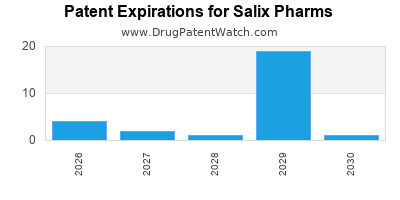
Drugs and US Patents for Salix Pharms
| Applicant | Tradename | Generic Name | Dosage | NDA | Approval Date | TE | Type | RLD | RS | Patent No. | Patent Expiration | Product | Substance | Delist Req. | Exclusivity Expiration |
|---|---|---|---|---|---|---|---|---|---|---|---|---|---|---|---|
| Salix Pharms | XIFAXAN | rifaximin | TABLET;ORAL | 021361-002 | Mar 24, 2010 | AB | RX | Yes | Yes | 8,193,196 | ⤷ Start Trial | Y | Y | ⤷ Start Trial | |
| Salix Pharms | XIFAXAN | rifaximin | TABLET;ORAL | 021361-002 | Mar 24, 2010 | AB | RX | Yes | Yes | 10,765,667 | ⤷ Start Trial | ⤷ Start Trial | |||
| Salix Pharms | XIFAXAN | rifaximin | TABLET;ORAL | 021361-001 | May 25, 2004 | RX | Yes | Yes | 10,703,763 | ⤷ Start Trial | ⤷ Start Trial | ||||
| Salix Pharms | XIFAXAN | rifaximin | TABLET;ORAL | 021361-002 | Mar 24, 2010 | AB | RX | Yes | Yes | 8,642,573 | ⤷ Start Trial | ⤷ Start Trial | |||
| >Applicant | >Tradename | >Generic Name | >Dosage | >NDA | >Approval Date | >TE | >Type | >RLD | >RS | >Patent No. | >Patent Expiration | >Product | >Substance | >Delist Req. | >Exclusivity Expiration |
Expired US Patents for Salix Pharms
| Applicant | Tradename | Generic Name | Dosage | NDA | Approval Date | Patent No. | Patent Expiration |
|---|---|---|---|---|---|---|---|
| Salix Pharms | RELISTOR | methylnaltrexone bromide | SOLUTION;SUBCUTANEOUS | 021964-003 | Sep 27, 2010 | 9,669,096 | ⤷ Start Trial |
| Salix Pharms | XIFAXAN | rifaximin | TABLET;ORAL | 021361-002 | Mar 24, 2010 | 7,902,206 | ⤷ Start Trial |
| Salix Pharms | XIFAXAN | rifaximin | TABLET;ORAL | 021361-001 | May 25, 2004 | 8,518,949 | ⤷ Start Trial |
| Salix Pharms | XIFAXAN | rifaximin | TABLET;ORAL | 021361-001 | May 25, 2004 | 8,741,904 | ⤷ Start Trial |
| >Applicant | >Tradename | >Generic Name | >Dosage | >NDA | >Approval Date | >Patent No. | >Patent Expiration |
Paragraph IV (Patent) Challenges for SALIX PHARMS drugs
| Drugname | Dosage | Strength | Tradename | Submissiondate |
|---|---|---|---|---|
| ➤ Subscribe | Tablets | 550 mg | ➤ Subscribe | 2015-12-18 |
| ➤ Subscribe | Injection | 12 mg/0.6 mL | ➤ Subscribe | 2015-07-22 |
| ➤ Subscribe | Tablets | 150 mg | ➤ Subscribe | 2016-09-06 |
| ➤ Subscribe | Tablets | 1.102 g and 0.398 g | ➤ Subscribe | 2008-04-09 |
| ➤ Subscribe | Tablets | 200 mg | ➤ Subscribe | 2019-01-28 |
| ➤ Subscribe | For Oral Solution | 100 g, 7.5 g, 2.691 g, 1.015 g, 5.9 g and 4.7 g per pouch | ➤ Subscribe | 2007-11-27 |
| ➤ Subscribe | Injection | 8 mg/0.4 mL | ➤ Subscribe | 2015-09-08 |
| ➤ Subscribe | Orally Disintegrating Tablets | 5 mg and 10 mg | ➤ Subscribe | 2010-08-24 |
International Patents for Salix Pharms Drugs
| Country | Patent Number | Estimated Expiration |
|---|---|---|
| Poland | 1682098 | ⤷ Start Trial |
| Japan | 6947713 | ⤷ Start Trial |
| Canada | 2594789 | ⤷ Start Trial |
| Brazil | 122014001142 | ⤷ Start Trial |
| >Country | >Patent Number | >Estimated Expiration |
Supplementary Protection Certificates for Salix Pharms Drugs
| Patent Number | Supplementary Protection Certificate | SPC Country | SPC Expiration | SPC Description |
|---|---|---|---|---|
| 1856135 | CR 2020 00018 | Denmark | ⤷ Start Trial | PRODUCT NAME: FOSTAMATINIB OR A PHARMACEUTICALLY ACCEPTABLE SALT OF FOSTAMATINIB, OR A HYDRATE, SOLVATE OR N-OXIDE OF FOSTAMATINIB OR THE PHARMACEUTICALLY ACCEPTABLE SALT OF FOSTAMATINIB, ESPECIALLY FOSTAMATINIB DISODIUM, OPTIONALLY IN FORM OF A HYDRATE; REG. NO/DATE: EU/1/19/1405 20200113 |
| 0565634 | 06C0030 | France | ⤷ Start Trial | PRODUCT NAME: EPROSARTAN MESYLATE; HYDROCHLOROTHIAZIDE; NAT. REGISTRATION NO/DATE: NL 32075 20060623; FIRST REGISTRATION: LI - 55783 01 20020607 |
| 2673237 | 201940014 | Slovenia | ⤷ Start Trial | PRODUCT NAME: SODIUM ZIRCONIUM CYCLOSILICATE; NATIONAL AUTHORISATION NUMBER: EU/1/17/1173; DATE OF NATIONAL AUTHORISATION: 20180322; AUTHORITY FOR NATIONAL AUTHORISATION: EU |
| 0733366 | SPC/GB98/031 | United Kingdom | ⤷ Start Trial | PRODUCT NAME: 2-BUTYL-4-CHLORO-1-((2'-(1H-TETRAZOL-5-YL) BIPHENYL-4-YL)-METHYL)-5-(HYDROXYMETHYL)IMIDAZOLE (LOSARTAN),OPTIONALLY IN THE FORM OF A PHARMACEUTICALLY ACCEPTABLE SALT, IN PARTICULAR A POTASSIUM SALT( LOSARTAN POTASSIUM) AND HYDROCHLOROTHIAZIDE,; REGISTERED: FR 338520.7 19950215; FR 558453.7 19950215; UK 00025/0338 19960412 |
| >Patent Number | >Supplementary Protection Certificate | >SPC Country | >SPC Expiration | >SPC Description |
Similar Applicant Names
Applicants may be listed under multiple names.
Here is a list of applicants with similar names.
Here is a list of applicants with similar names.
