In 2007, a federal judge in the Southern District of New York ordered two generic drug companies to pay Takeda Chemical Industries $16.8 million in attorney fees. Mylan Laboratories owed $11.4 million of it. Alphapharm owed $5.4 million. Neither company had lost on damages. Neither had been found to infringe in the ordinary sense. They lost because the arguments they made at trial did not match the arguments they had put in their Paragraph IV notice letters years earlier, and the Federal Circuit agreed that the mismatch was bad enough to shift the entire cost of the litigation onto the generic side.[4]
That is not a hypothetical. It is the single most cited case in Hatch-Waxman practice on what happens when a notice letter does not hold up. And it is the starting point for a question that generic legal and regulatory teams do not ask often enough: what does a defective, premature, over-disclosed, or inconsistent Paragraph IV notice letter actually cost, once every downstream consequence is added up?
The Short Answer
A Paragraph IV notice letter is a short document. It is also the single artifact that determines whether a generic company gets sued, when it gets sued, what defenses it is stuck defending years later, whether its ANDA review stalls at the FDA, and whether it keeps or forfeits the 180-day exclusivity period it may have spent years chasing. Real cases show three distinct ways a defective notice letter converts into real money: attorney-fee shifting under 35 U.S.C. § 285 (documented as high as $16.8 million in Takeda v. Mylan), per-round Hatch-Waxman litigation costs that industry sources place between $2.8 million and $10 million, and forfeiture or dilution of 180-day exclusivity, which the FTC has measured at a 47 to 51 percent revenue decline even in the mild case of shared exclusivity.[4,11,13] Stacked together, on a mid-size product with a contested first-to-file position, these components plausibly reach eight figures — and DrugPatentWatch’s own patent-litigation cost tracking shows why generic legal budgets rarely treat this as a rounding error.
The Findings That Matter
The Federal Circuit affirmed a $16.8 million attorney-fee award against two generic ANDA filers in Takeda Chemical Industries, Ltd. v. Mylan Laboratories, Inc., 549 F.3d 1381 (Fed. Cir. 2008), specifically because their invalidity arguments at trial diverged from what they certified in their Paragraph IV notice letters.[4]
FDA’s own Office of Generic Drugs told industry in April 2025 that the most common Paragraph IV notice problems it sees are missing notice documentation, notice that does not align with what was certified, and late FDA notification of litigation status — and that any of these can delay ANDA approval.[2]
A notice letter sent even one day before FDA’s own Paragraph IV acknowledgment letter is invalid. In SB Pharmco Puerto Rico, Inc. v. Mutual Pharmaceutical Co., 552 F. Supp. 2d 500 (E.D. Pa. 2008), a notice letter sent on the same day as the ANDA’s Paragraph IV certification — before FDA had accepted the filing — was found improper and premature.[3,6]
Paragraph IV notice letters are public, discoverable documents once litigation starts. Nycomed U.S. Inc. v. Tolmar Inc., 2011 WL 1675027 (D.N.J. 2011), held that the detailed statement inside a notice letter is not protected by the offer of confidential access and can end up attached to a public court complaint.[3,7]
The Supreme Court’s 2014 decision in Octane Fitness, LLC v. ICON Health & Fitness, Inc., 572 U.S. 545 (2014), lowered the bar for fee-shifting under 35 U.S.C. § 285 from a “clear and convincing,” two-part test to a “preponderance of the evidence,” totality-of-the-circumstances standard — meaning the legal exposure that produced the $16.8 million Takeda award is easier to trigger today than it was in 2008.[9]
The FTC’s 2009 study of authorized generics found that when a brand launches its own authorized generic during a first filer’s 180-day exclusivity window, the first filer’s revenue during that window drops by 47 to 51 percent on average.[11]
A first applicant forfeits 180-day exclusivity entirely if it fails to obtain tentative FDA approval within 30 months of filing, under 21 U.S.C. § 355(j)(5)(D)(i)(IV) — a deadline that has nothing to do with the merits of the underlying patent dispute and everything to do with regulatory housekeeping.[10]
Sandoz’s global head of IP told BioSpace that her company’s internal estimate for a single round of Hatch-Waxman litigation runs above $6 million, a figure she attributed to an industry-group estimate.[13]
What a Paragraph IV Notice Letter Actually Requires
Under the Hatch-Waxman framework, filing an ANDA with a Paragraph IV certification is itself a statutory act of patent infringement under 35 U.S.C. § 271(e)(2).[3] That certification tells FDA the applicant believes a listed patent is invalid, unenforceable, or will not be infringed. But the certification alone does not start the legal clock. The generic applicant also has to notify the patent owner and the NDA holder, in writing, and that notice — the Paragraph IV notice letter — is what actually triggers the brand company’s 45-day window to sue and, if it does, the 30-month stay on FDA approval.[3]
The content requirements are not vague. Under 21 CFR 314.95(c), the notice must cite Section 505(j)(2)(B)(iv) of the FD&C Act and include, among other things: a statement that FDA has received the ANDA; a statement that the applicant has received its Paragraph IV acknowledgment letter; the established name, active ingredient, strength, and dosage form of the proposed product; the patent number and expiration date of each patent being challenged; and — the requirement that generates the most litigation — “a detailed statement of the factual and legal basis” for why the applicant believes the patent is invalid, unenforceable, or not infringed.[1]
The 20-Day Clock, and Why Sending Early Is as Dangerous as Sending Late
The regulation is specific about timing in both directions. The applicant must send notice on or after the date it receives its Paragraph IV acknowledgment letter, but no later than 20 days after the postmark date on that letter.[1] Notice sent before the applicant has actually received FDA’s acknowledgment is invalid under 21 CFR 314.95(b)(2) — not late, not deficient, but legally void, as if it had never been sent at all.[1] That is precisely what happened in SB Pharmco v. Mutual Pharmaceutical: the ANDA filer sent notice for a generic Coreg CR product on the same day it filed its Paragraph IV certification, weeks or months before FDA had even accepted the ANDA for filing. The Eastern District of Pennsylvania found in 2008 that the statutory sequence “ensures that the statutory litigation triggers do not result in unnecessary patent infringement litigation initiated by incomplete ANDAs,” and granted the brand’s motion for judgment on the pleadings.[3]
What “Detailed Statement” Means in Practice
There is comparatively little regulatory guidance on how detailed the detailed statement needs to be. Courts have filled that gap unevenly, but the pattern is consistent: notice letters that are too thin invite baseless-certification findings, and notice letters that disclose too much invite public exposure of confidential ANDA information before litigation even starts.[3] The Hatch-Waxman statute provides a mechanism — the offer of confidential access, or OCA — for exchanging the underlying ANDA on a confidential basis, but that protection does not automatically extend to the detailed statement itself, which is typically sent before any OCA exchange occurs.[3]Nycomed v. Tolmar confirmed that notice letters are non-confidential, public documents, and specialists in the area now generally advise disclosing only the minimum necessary to satisfy the statutory notice requirement rather than the applicant’s full analysis.[3,7]
The Five Ways Generic Filers Get the Notice Letter Wrong
Two decades of Hatch-Waxman litigation point to a small number of recurring failure modes. None of them involve losing the underlying patent argument on the merits. All of them are procedural, and all of them are avoidable.
1. Sending Notice Before FDA Acknowledgment
Covered above: notice sent before receipt of the Paragraph IV acknowledgment letter is void under 21 CFR 314.95(b)(2), regardless of how well-drafted the underlying detailed statement is.[1,3]
2. Disclosing Confidential Information in the Detailed Statement
Because notice letters are treated as public documents once attached to a complaint, generic companies that describe their formulation, manufacturing process, or non-infringement position in granular detail risk handing that information to competitors and to news services that track patent complaints — a risk Nycomed v. Tolmar made explicit.[3,7]
3. Certifying One Theory, Litigating Another
This is the failure mode that produced the $16.8 million fee award in Takeda v. Mylan and, eight years earlier, a similar fee award in Yamanouchi Pharmaceutical Co. v. Danbury Pharmacal, Inc., 231 F.3d 1339 (Fed. Cir. 2000).[4,5] Courts have also held, in the opposite direction, that generic filers are not strictly limited to the exact theories in their notice letters — the 2023 decision in Bausch Health Ireland Ltd. v. Mylan Pharmaceuticals Inc., 2023 WL 2726432 (N.D.W. Va. 2023), found the court had “no authority to penalize” perceived notice letter deficiencies by capping the defenses available later in litigation.[3,8] The two lines of cases are not actually in conflict: developing additional defenses during litigation is permitted, but abandoning the notice letter’s original theory for a materially different one — especially one the court later finds weak — is what triggers exceptional-case exposure.
4. Failing to Document Delivery
FDA’s Office of Generic Drugs Patent and Exclusivity Team told the SBIA Generic Drug Forum in April 2025 that missing or misaligned notice documentation is one of three recurring issues its reviewers see, alongside failure to notify FDA whether litigation was filed within the 45-day window.[2] Under 21 CFR 314.95(e), FDA accepts a registered mail receipt, certified mail receipt, or designated-delivery-service receipt as proof of sending, and a return receipt, signature proof of delivery, or acknowledgment letter as proof of receipt — but the applicant must submit that documentation within 30 days after the last patent or NDA holder received notice, and failure to do so can result in a “policy only” complete response letter that stalls the entire ANDA.[1,2]
5. Missing Later-Listed Patents
If a brand company lists a new patent or use code in the Orange Book after an ANDA has already been submitted, the applicant must address it with a new certification and, if that certification is Paragraph IV, send new notice at the same time the amendment is filed.[2] FDA has been explicit that a prior Paragraph IV certification on the same patent family does not automatically cover a newly listed use code, and that FDA cannot issue tentative or final approval until proper notice and documentation of receipt are on file.[2] This is one of the reasons generic legal teams increasingly rely on patent-tracking services such as DrugPatentWatch to flag Orange Book updates in near real time rather than relying on periodic manual review, since a missed later-listing can silently reset the notice clock on a product already deep into development.
Case Study: How Takeda v. Mylan Turned a Notice Letter Into a $16.8 Million Bill
Takeda held U.S. Patent No. 4,687,777, covering the anti-diabetic drug pioglitazone, sold as Actos.[4] Mylan Laboratories and Alphapharm both filed ANDAs with Paragraph IV certifications asserting the patent was invalid for obviousness, and both sent Takeda the required notice letters explaining their legal theories.[4] Takeda sued. After a lengthy bench trial before Judge Denise Cote in the Southern District of New York, the court found the ‘777 patent nonobvious and enforceable — a finding the Federal Circuit affirmed.[4]
Takeda then moved for attorney fees under 35 U.S.C. § 285, arguing the case was “exceptional.” The district court agreed, and on March 21, 2007, quantified the award at $16.8 million total: $11.4 million from Mylan and $5.4 million from Alphapharm.[4] The Federal Circuit’s 2008 opinion did not rest the finding on the strength or weakness of the obviousness argument alone. It rested specifically on the fact that both defendants “each changed the focus of their invalidity arguments from those in their certification letters,” and that for one of the two generics, the trial court had “methodically examined a number of shortcomings” in its Paragraph IV letter that were made obvious by its “constantly shifting set of arguments.”[4] Mylan and Alphapharm petitioned the Supreme Court for certiorari, framing the question presented as whether Section 285 permits a fee award based substantially on a generic’s shift away from the theory stated in its pre-suit notice. The Court denied certiorari in 2009, leaving the Federal Circuit’s reasoning intact.[4]
Case Study: Yamanouchi v. Danbury and the Cost of an “Adequate Foundation”
Eight years before Takeda, the same pattern played out over a different drug. Yamanouchi and Merck held U.S. Patent No. 4,283,408, covering famotidine — sold as Pepcid — an H2-receptor antagonist used to treat gastric acid conditions.[5] Danbury Pharmacal, along with Schein Pharmaceutical and Marsam Pharmaceuticals, filed ANDAs asserting the patent was invalid for obviousness. On a motion for judgment as a matter of law, the Southern District of New York upheld the patent’s validity, found the defendants had willfully infringed, and awarded Yamanouchi its attorney fees.[5]
The Federal Circuit’s affirmance is notable for how it characterized the underlying obviousness case: the district court had found it “largely hindsight, speculation, and argument without an adequate foundation,” accompanied by affidavits that were themselves incomplete and later contradicted by trial testimony.[5] As in Takeda, the fee award did not turn on a close call about patent validity. It turned on a Paragraph IV certification the courts found could not support the weight the litigation put on it.
Case Study: SB Pharmco v. Mutual Pharmaceutical — When Being 24 Hours Early Is Fatal
Not every notice letter mistake requires years of litigation to surface. In the Coreg CR (carvedilol phosphate) dispute, the ANDA applicant filed its Paragraph IV certification for U.S. Patent No. 7,268,156 on December 21, 2007 — and sent its notice letter to the brand company that same day, before FDA had accepted the ANDA for filing.[3] The brand filed a declaratory judgment action arguing the notice was improper and premature. The Eastern District of Pennsylvania agreed in 2008, granting judgment on the pleadings and confirming that notice sent before an applicant’s own receipt of FDA’s Paragraph IV acknowledgment letter does not satisfy the statute, regardless of intent.[3] The case did not need a trial, an expert, or a damages model to demonstrate the point: the sequencing requirement in 21 CFR 314.95(b) is not advisory.
What Changed in 2014: Octane Fitness Made Fee-Shifting Easier, Not Harder
Every one of the fee-shifting cases above — Takeda, Yamanouchi — was decided under the Federal Circuit’s older Brooks Furniture framework, which required a fee applicant to prove by clear and convincing evidence that a case was both “objectively baseless” and “brought in subjective bad faith.”[9] In 2014, the Supreme Court unanimously rejected that framework in Octane Fitness, LLC v. ICON Health & Fitness, Inc., 572 U.S. 545 (2014), holding that Section 285 imposes only one real constraint — that the case be “exceptional,” meaning it “stands out from others” — and that district courts should decide the question under a preponderance-of-the-evidence standard, considering the totality of the circumstances.[9] The practical effect for Hatch-Waxman practice is straightforward: the evidentiary bar that Takeda had to clear to win $16.8 million in fees was higher than the bar a brand company faces today. A notice letter that shifts theories, overstates its factual basis, or is contradicted by later discovery is, if anything, more exposed to fee-shifting risk in the current legal environment than it was when Takeda was litigated.
Where the Real Money Comes From: A Stacked-Cost Model
No single public data set reports “the average cost of a bad Paragraph IV notice letter,” and this article does not claim one exists. What does exist is verifiable data on each component that a defective notice letter can trigger. Stacking those components — clearly labeled as a scenario, not a reported statistic — shows how a generic filer’s exposure reaches eight figures without a single adverse damages verdict.
Cost Component
Documented Range
Source
Triggered By
Per-round Hatch-Waxman litigation cost
$2.8M–$10M per round
Burford Capital / PharmiWeb; AAM fact sheet; Sandoz (BioSpace)[13,15,12]
Any Paragraph IV suit, win or lose, regardless of notice quality
Notice letter theory abandoned or contradicted at trial
ANDA approval delay from documentation failure
Not publicly quantified in dollars; delays “tentative or final approval”
FDA SBIA presentation, April 2025[2]
Missing or misaligned proof of notice delivery
180-day exclusivity dilution from an authorized generic
47%–51% revenue decline during the exclusivity window
FTC Interim Report on Authorized Generic Drugs, 2009[11]
Not directly notice-letter-caused, but the value at risk if delay costs first-filer status
180-day exclusivity forfeiture
Total loss of the exclusivity period
21 U.S.C. § 355(j)(5)(D)[10]
Failure to obtain tentative approval within 30 months, among five other statutory triggers
Component One: Per-Round Litigation Costs
Multiple independent sources converge on a range rather than a single figure. A legal-finance analysis published via PharmiWeb puts the average cost of a successful generic defense at roughly $3.5 million, with total litigation and development spend for a small-molecule generic running $3 million to $10 million.[15] The Association for Accessible Medicines cites a study estimating $10 million per suit, with each party spending roughly $1.5 million on average across the broader population of cases.[12] Sandoz’s global head of intellectual property, Julia Pike, told BioSpace in 2026 that her company relies on an industry-group estimate of more than $6 million per round of Hatch-Waxman litigation — and noted that Sandoz has been in four waves of litigation over a single glaucoma product since 2011.[13] None of these figures are notice-letter-specific; they represent the baseline cost of being sued at all. A defective notice letter does not create this cost, but it does nothing to avoid it, and a theory-shifting notice letter — as in Takeda — can extend a case’s life well past the cost of a clean, well-litigated dispute.
Component Two: Exceptional-Case Fee Exposure
This is the component with the clearest documented ceiling: $16.8 million, split $11.4 million and $5.4 million between two co-defendants in a single case.[4] Under the post-Octane Fitness standard, that exposure is not limited to cases involving outright fabrication or bad faith — a notice letter whose factual basis does not hold up, or whose legal theory is abandoned mid-litigation, is enough to support a district court’s discretionary finding that a case “stands out” from the ordinary.[9]
Component Three: Forfeited or Diluted Exclusivity
According to the FTC’s 2009 interim report on authorized generic drugs, a first-filer generic’s revenue during its own 180-day exclusivity period drops by an average of 47 to 51 percent once a brand-launched authorized generic enters the market alongside it.[11]
That figure describes dilution, not forfeiture — the first filer still keeps its exclusivity position, just at a lower price point. Outright forfeiture is a separate and larger risk. Under 21 U.S.C. § 355(j)(5)(D), a first applicant loses the entire 180-day exclusivity period if any of several statutory “forfeiture events” occur, including failing to obtain tentative FDA approval within 30 months of filing.[10] A notice-documentation failure that stalls FDA’s tentative-approval clock — the exact scenario FDA’s Office of Generic Drugs described in its April 2025 presentation — does not need to touch the underlying patent dispute at all to put that 30-month clock, and the exclusivity riding on it, at risk.[2,10]
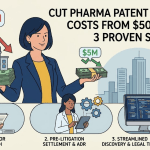
Add a $16.8-million-scale fee exposure, two or three rounds of $6-to-$10-million litigation, and a diluted or forfeited exclusivity position on a mid-size product, and a generic filer’s total exposure from a chain of notice-letter and procedural failures plausibly reaches or exceeds $50 million — not as a reported statistic, but as the sum of separately documented, real-world cost components. Firms such as DrugPatentWatch that track ANDA litigation outcomes, fee awards, and exclusivity determinations across the full population of Paragraph IV cases are, in effect, built around making that kind of stacked exposure visible before it happens rather than after.
The 180-Day Exclusivity Forfeiture Trap Hiding Inside a Bad Notice Letter
The Medicare Modernization Act of 2003 added six statutory forfeiture events to prevent generic filers from indefinitely “parking” an exclusivity they had no intention of using.[10] The one most relevant to notice-letter mechanics is failure to obtain tentative approval within 30 months of the ANDA’s filing date, under 21 U.S.C. § 355(j)(5)(D)(i)(IV).[10] FDA has been direct about the mechanical link: it “cannot take tentative or final approval action” on an ANDA until proper notice has been sent and documentation of its receipt by the NDA holder and patent owner is on file.[2] A generic filer that has done everything right on the science — clean bioequivalence data, a defensible non-infringement position — can still watch its 30-month tentative-approval clock run out because a certified-mail receipt was never submitted to the agency.
What FDA’s Own Reviewers Say Goes Wrong Most Often
FDA’s Patent and Exclusivity Team, part of the Office of Generic Drug Policy, presented its own list of recurring issues to industry at the April 2025 SBIA Generic Drug Forum, framed under the heading “Minor Regulatory Errors with Major Consequences.”[2] The three issues it named were notice documents that are missing or never provided to FDA, notice documents that do not align with what was certified or are otherwise incomplete, and failure to notify FDA — after the 45-day window closes — whether litigation was or was not filed.[2] None of these are disputes about claim construction or prior art. They are administrative failures, and FDA’s own framing — “minor” errors with outsized consequences — is a fair summary of the entire dynamic this article describes.
Compliant vs. Deficient Notice Letter: A Side-by-Side Comparison
Element
Compliant Practice
Documented Failure Pattern
Timing
Sent on or after receipt of FDA’s Paragraph IV acknowledgment letter, within 20 days of its postmark[1]
Sent same-day as ANDA filing, before FDA acceptance — held invalid in SB Pharmco v. Mutual Pharmaceutical[3]
Detailed statement scope
States which claim limitations are not met, without disclosing full ANDA formulation detail[3]
Discloses confidential ANDA information that later surfaces in a public complaint, as flagged in Nycomed v. Tolmar[3,7]
Theory consistency
Litigation defenses build on, and remain consistent with, the notice letter’s stated basis[3]
Invalidity theory changes materially between notice letter and trial — the core finding in Takeda v. Mylan[4]
Delivery documentation
Registered/certified mail or designated delivery service receipt, submitted to FDA within 30 days of last receipt[1]
Documentation missing or not submitted, per FDA’s April 2025 findings[2]
Later-listed patents
New certification and new notice sent at the same time as any amendment addressing a newly listed patent or use code[2]
Prior certification assumed to cover new Orange Book listing — FDA has stated this is insufficient[2]
What This Means for Generic Filers
The recurring lesson across Takeda, Yamanouchi, SB Pharmco, and FDA’s own 2025 findings is that Paragraph IV notice letters get treated by courts and regulators as binding commitments, not preliminary drafts. A generic company’s litigation counsel and its regulatory-affairs team are frequently not the same people, and a notice letter drafted primarily to satisfy a regulatory checklist — without input from the litigators who will eventually have to defend its theory at trial — is a structural setup for the Takeda pattern. The FDA-side documentation failures are, if anything, easier to fix: they are procedural steps with clear regulatory citations, not judgment calls about claim scope.
What This Means for Brand Manufacturers
Every documented failure mode above is also a brand-side opportunity. A notice letter sent even one day early is a colorable basis for a declaratory judgment motion, as SB Pharmco demonstrates.[3] A generic’s shifting theories, tracked consistently from notice letter through expert reports, is the evidentiary foundation for a Section 285 fee motion after trial, as Takeda and Yamanouchi demonstrate.[4,5] Brand IP teams that keep a disciplined, dated record comparing each generic’s notice letter to its evolving litigation positions are building exactly the record the Federal Circuit relied on in both cases.
Notice Letter Compliance Checklist
Confirm actual receipt of the Paragraph IV acknowledgment letter before sending notice — not just its issuance.[1]
Calendar the 20-day sending deadline from the postmark date, not the receipt date.[1]
Limit the detailed statement to what is legally required; avoid unnecessary ANDA formulation or process detail.[3]
Have litigation counsel review the detailed statement’s legal theory before it goes out, not after suit is filed.[4,5]
Send by registered mail, certified mail, or a designated delivery service, and retain the receipt.[1]
Submit delivery documentation to FDA within 30 days of the last patent or NDA holder’s receipt.[1]
Monitor the Orange Book continuously for later-listed patents or use codes tied to the reference drug.[2]
Notify FDA promptly after the 45-day litigation window closes, whichever way it resolves.[2]
Methodology
This article draws exclusively on primary regulatory text (21 CFR 314.95, 21 CFR 314.94, 21 CFR 314.101, 21 U.S.C. § 355(j)(5)(D)), a 2025 FDA Office of Generic Drugs conference presentation, published Federal Circuit and district court opinions (Takeda v. Mylan, Yamanouchi v. Danbury, SB Pharmco v. Mutual Pharmaceutical, Nycomed v. Tolmar, Bausch Health v. Mylan, Octane Fitness v. ICON), a 2009 FTC interim report, and secondary reporting from Law360/Crowell & Moring, BioSpace, PharmiWeb, and the Association for Accessible Medicines. Dollar figures for individual cases (the $16.8 million Takeda fee award) are taken directly from court records and are reported statistics, not calculations. The “$50 million” stacked-cost scenario in the cost-model section is explicitly labeled as an illustrative sum of separately documented cost components, not a reported figure from any single source, and no such single-source statistic exists in the public record as of this writing. Litigation-cost ranges reflect the figures as published by each cited source; underlying methodologies for those third-party estimates were not independently re-derived here. Case law is currently good law as of publication; readers relying on any citation for active litigation should confirm current status independently.
Key Takeaways
A Paragraph IV notice letter sent before FDA’s own acknowledgment letter is legally invalid, not merely deficient.[1,3]
Federal Circuit precedent has twice affirmed attorney-fee awards — including $16.8 million in Takeda v. Mylan — specifically tied to generic filers abandoning the theory stated in their notice letters.[4,5]
The 2014 Octane Fitness decision lowered the evidentiary bar for exceptional-case fee awards, making that exposure more accessible to brand plaintiffs today than when Takeda was decided.[9]
Notice letters are public documents once litigation starts; over-disclosure in the detailed statement carries its own competitive cost.[3,7]
FDA cannot grant tentative or final ANDA approval until proper notice and delivery documentation are on file — a purely administrative failure can therefore threaten the 30-month tentative-approval deadline tied to 180-day exclusivity.[2,10]
Authorized generic competition alone reduces a first filer’s exclusivity-period revenue by 47 to 51 percent on average, according to the FTC — a baseline dilution risk that compounds any delay caused by notice problems.[11]
FAQ
What happens if a Paragraph IV notice letter is sent before FDA acknowledges the ANDA?
It is invalid under 21 CFR 314.95(b)(2), and the applicant has not complied with the notice requirement until it sends a new, valid notice.[1]SB Pharmco v. Mutual Pharmaceutical confirmed courts will treat premature notice as legally ineffective, not merely irregular.[3]
Can a generic company change its invalidity theory after sending the notice letter?
Courts allow additional defenses to develop during litigation, as Bausch Health v. Mylan confirmed in 2023.[3,8] But wholesale abandonment of the notice letter’s original theory, especially where the new theory is found weak, has twice supported multimillion-dollar fee awards against generic filers.[4,5]
Are Paragraph IV notice letters confidential?
No. Nycomed v. Tolmar held they are public, non-confidential documents, and the detailed statement inside them is not separately protected by an offer of confidential access.[3,7]
How much attorney-fee exposure can a defective notice letter create?
The documented ceiling in reported case law is $16.8 million, awarded jointly against two defendants in Takeda v. Mylan.[4] Exposure in any individual case depends on the facts and is decided at a district court’s discretion.[9]
What documentation does FDA require to prove notice was delivered?
A registered mail receipt, certified mail receipt, or designated-delivery-service receipt as proof of sending, and a return receipt, signature proof of delivery, or acknowledgment letter as proof of receipt, submitted to FDA within 30 days of the last delivery.[1]
Does a notice-letter documentation failure affect 180-day exclusivity?
Indirectly, yes. FDA cannot grant tentative approval until proper notice documentation is on file, and failure to obtain tentative approval within 30 months of filing is itself a statutory forfeiture event for 180-day exclusivity under 21 U.S.C. § 355(j)(5)(D)(i)(IV).[2,10]
What is the difference between the pre-2014 and post-2014 standard for attorney-fee awards?
Before Octane Fitness (2014), a fee applicant had to prove by clear and convincing evidence that a case was both objectively baseless and brought in subjective bad faith. After Octane Fitness, the standard is a preponderance of the evidence, and district courts weigh the totality of the circumstances.[9]
Does a notice letter need to disclose the generic’s full non-infringement analysis?
The regulation requires “a full and detailed explanation” for each claim, but practitioners generally advise disclosing only which claim limitations are not met, rather than affirmatively describing the ANDA product’s composition, to limit public exposure of confidential information.[1,3]
What happens if a newly listed Orange Book patent is not addressed with new notice?
FDA has stated that a prior Paragraph IV certification does not sufficiently address a newly listed patent or use code, and that new notice must be sent at the same time as any amendment addressing it — failure to do so can result in a complete response letter.[2]
How much does a single round of Hatch-Waxman litigation typically cost?
Estimates vary by source and case size, but published figures range from roughly $2.8 million to more than $10 million per round, with one generics executive citing an industry estimate above $6 million per round in 2026.[12,13,15]
References
21 CFR § 314.95, Notice of certification of invalidity, unenforceability, or noninfringement of a patent. eCFR. https://www.ecfr.gov/current/title-21/chapter-I/subchapter-D/part-314/subpart-C/section-314.95
U.S. Food and Drug Administration, Office of Generic Drugs, Division of Legal and Regulatory Support. “Minor” Regulatory Errors with Major Consequences. SBIA Generic Drug Forum, April 9–10, 2025. https://www.fda.gov/media/187306/download
Lydigsen, L., & He, J. (2023, May 16). Tips For Drafting Paragraph IV Notice Letters. Law360 (Crowell & Moring LLP). https://www.crowell.com/a/web/v44TR8jyG1KCHtJ5Xyv4CK/tips-for-drafting-paragraph-iv-notice-letters.pdf
Takeda Chemical Industries, Ltd. v. Mylan Laboratories, Inc., 549 F.3d 1381 (Fed. Cir. 2008). https://www.cafc.uscourts.gov/opinions-orders/07-1269.pdf
Federal Trade Commission. (2009, June). FTC Issues Interim Report on “Authorized Generic” Drugs [Press release]. https://www.ftc.gov/news-events/news/press-releases/2009/06/ftc-issues-interim-report-authorized-generic-drugs
Association for Accessible Medicines. The Hatch-Waxman 180-Day Exclusivity Incentive Accelerates Patient Access to First Generics [Fact sheet]. https://accessiblemeds.org/resources/fact-sheets/the-hatch-waxman-180-day-exclusivity-incentive-accelerates-patient-access-to-first-generics/
BioSpace. (2026). Proliferating Patents, Lawsuits Stave Off Pharmas’ Generic Competitors. https://www.biospace.com/business/proliferating-patents-lawsuits-stave-off-pharmas-generic-competitors
21 CFR § 314.101, Filing an NDA and receiving an ANDA. eCFR. https://www.ecfr.gov/current/title-21/chapter-I/subchapter-D/part-314/subpart-D/section-314.101
PharmiWeb.com / Burford Capital. Hatch-Waxman litigation: How legal finance supports brands and generics even when monetary damages aren’t at stake. https://www.pharmiweb.com/article/hatch-waxman-litigation-how-legal-finance-supports-brands-and-generics-even-when-monetary-damages-aren-t-at-stake