Last updated: August 18, 2026
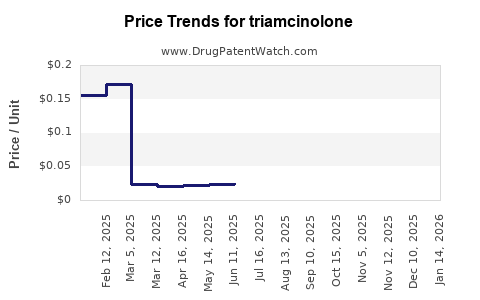
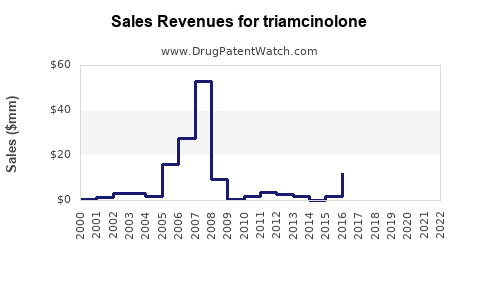
Triamcinolone is a mature, genericized corticosteroid rather than a single commercial product. Its market includes triamcinolone acetonide creams, ointments, lotions, dental pastes, nasal sprays, injectable suspensions, and combination products. Patent-driven pricing power is minimal. Revenue is fragmented across manufacturers and dosage forms, while demand remains supported by dermatology, allergic rhinitis, oral inflammatory disease, and intra-articular corticosteroid use.
What is triamcinolone and which products generate demand?
Triamcinolone is a synthetic glucocorticoid. The most commercially important active ingredient is triamcinolone acetonide, which is used in topical, nasal, oral mucosal, and injectable products.
| Product segment |
Common dosage forms |
Main indications |
Commercial profile |
| Topical dermatology |
Cream, ointment, lotion, spray |
Dermatitis, eczema, psoriasis, inflammatory skin disease |
High-volume generic market |
| Dental |
Oral paste |
Aphthous ulcers and oral inflammatory lesions |
Small branded and generic niche |
| Nasal |
Spray or aerosol |
Allergic rhinitis |
OTC and generic competition |
| Injectable |
Suspension or solution |
Intra-articular, intramuscular, and soft-tissue corticosteroid use |
Hospital, clinic, and physician-office demand |
| Ophthalmic or combination products |
Drops and combinations |
Selected inflammatory eye conditions |
Product-specific competition |
The best-known historical brands include Kenalog, Nasacort, and Oralone. Most commercial products now compete primarily on price, availability, formulation, packaging, and distribution rather than on patent exclusivity.
How large is the triamcinolone market?
No authoritative public source reports a consolidated global revenue figure for “triamcinolone.” The ingredient is distributed across multiple FDA-approved products, nonprescription products, private-label products, hospital purchases, physician-office channels, and international formulations. Public company filings generally do not disclose triamcinolone sales separately.
The addressable market is best understood as several separate markets:
- High-volume topical generic prescriptions.
- OTC nasal corticosteroid products.
- Injectable corticosteroids used in outpatient clinics and hospitals.
- Dental and specialty formulations.
- International products with different regulatory and brand structures.
Prescription claims databases may report product-level volume, but those data are not equivalent to manufacturer revenue. OTC sales are particularly difficult to attribute because retailers and brand owners often report nasal corticosteroid sales by broader category rather than by active ingredient.
What drives triamcinolone demand?
Demand is linked to:
- Chronic and recurrent inflammatory skin conditions.
- Seasonal and perennial allergic rhinitis.
- Office-based joint and soft-tissue injection procedures.
- Dental and oral mucosal inflammation.
- Physician preference for established corticosteroid formulations.
- Generic substitution and formulary placement.
- Availability of sterile injectable products.
Topical demand is relatively resilient because many indications are chronic or recurrent. Injectable demand is more exposed to procedure volumes, office utilization, hospital purchasing contracts, and sterile-product supply interruptions.
When did triamcinolone lose exclusivity?
Triamcinolone’s principal product-level exclusivity periods expired decades ago. The active ingredient and established dosage forms are mature generic products. Current commercial competition is therefore not based on a single surviving composition-of-matter patent.
| Exclusivity category |
Current position |
| Active-ingredient exclusivity |
Expired |
| Original product patents |
Expired or commercially immaterial for most legacy products |
| FDA new-drug exclusivity |
Expired for legacy triamcinolone products |
| Generic competition |
Established across topical and injectable forms |
| OTC competition |
Established in nasal formulations |
| Biosimilar exposure |
Not applicable |
The FDA Orange Book lists patents and exclusivity for individual approved products, not for an ingredient as a whole. A specific product can have formulation, device, or method-of-use listings even when the active ingredient is fully genericized. [1]
What patents protect triamcinolone products?
The core triamcinolone molecule is not a meaningful source of current U.S. patent protection. Legacy patents covering triamcinolone acetonide and early formulations have expired.
Current patent risk, where it exists, is more likely to involve:
- A proprietary delivery device.
- A reformulated suspension.
- Particle-size control.
- Extended-release injection technology.
- A combination product.
- A manufacturing process with commercial value.
- A specific method of treating a narrow patient population.
These rights generally protect a particular product rather than triamcinolone broadly. A generic manufacturer may avoid infringement by using a different formulation, device, concentration, excipient system, or manufacturing process.
What formulations are protected by triamcinolone patents?
The commercially important formulation categories are mature:
- Creams and ointments have extensive generic competition.
- Nasal formulations have both generic and OTC competition.
- Dental paste products have narrower competition but limited market size.
- Injectable suspensions can have more complex manufacturing and regulatory barriers.
- Extended-release injectable formulations may carry more relevant formulation or device IP than conventional triamcinolone products.
The practical barrier in injectables is often manufacturing capability and FDA approval timing rather than patent duration. Sterility, particle-size control, suspension uniformity, container closure, preservative performance, and stability data can delay entry even where patent protection is weak.
What is the Orange Book status of triamcinolone?
There is no single Orange Book status for triamcinolone. Status depends on the NDA or ANDA, dosage form, strength, and product owner.
Legacy products such as Kenalog-40 and Nasacort were approved under individual NDAs. Generic triamcinolone products are generally approved through ANDAs and rely on reference-listed drugs. The Orange Book should be reviewed at the product level for:
- Reference-listed drug designation.
- Listed patents.
- Pediatric exclusivity.
- Therapeutic equivalence rating.
- Withdrawal status.
- Approved strength and route.
For mature topical products, patent listings generally have little effect on launch timing. For injectable products, an ANDA applicant still must address any listed patent certifications and satisfy product-specific requirements under the Hatch-Waxman framework. [1, 2]
Are Paragraph IV challenges affecting triamcinolone?
Paragraph IV litigation is unlikely to be a central market driver for conventional triamcinolone creams, ointments, or long-established injectable suspensions because the relevant products have long been genericized.
Potential Paragraph IV activity would be more relevant for:
- A newly approved extended-release triamcinolone injection.
- A proprietary nasal delivery platform.
- A combination product with active patent listings.
- A reformulated product with differentiated pharmacokinetics.
- A drug-device product with a protected delivery system.
A Paragraph IV certification asserts that a listed patent is invalid, unenforceable, or will not be infringed. For conventional triamcinolone products, the commercial value of litigation is limited because multiple generic manufacturers already compete in the category. [2]
Which companies compete in the triamcinolone market?
Competition varies by formulation and jurisdiction. The market includes generic manufacturers, specialty pharmaceutical companies, OTC marketers, contract manufacturers, and hospital suppliers.
Relevant competitive groups include:
- Large generic companies selling topical corticosteroids.
- Injectable manufacturers supplying physician offices and hospitals.
- OTC companies marketing nasal corticosteroid sprays.
- Specialty companies selling dental or dermatology formulations.
- Regional manufacturers in Europe, Asia, and Latin America.
- Private-label suppliers serving pharmacies and retailers.
Brand identity remains more relevant in OTC nasal products and selected dental products. In prescription topical products, pharmacy benefit design and generic substitution tend to dominate brand choice.
How does triamcinolone compare with competing corticosteroids?
Triamcinolone competes with hydrocortisone, desonide, betamethasone, fluocinonide, mometasone, fluticasone, dexamethasone, methylprednisolone, and other corticosteroids.
| Factor |
Triamcinolone |
Hydrocortisone |
Potent topical steroids |
Injectable corticosteroids |
| Market maturity |
Very mature |
Very mature |
Mature |
Mature but supply-sensitive |
| Typical pricing power |
Low |
Low |
Low to moderate by formulation |
Moderate at product level |
| Generic competition |
Extensive |
Extensive |
Extensive |
Extensive but less uniform |
| Differentiation |
Strength, vehicle, route |
Low potency and OTC access |
Potency and vehicle |
Particle profile, duration, supply |
| Patent opportunity |
Limited |
Limited |
Formulation-specific |
Greater for extended-release products |
| Biosimilar risk |
None |
None |
None |
None |
Triamcinolone has a middle position in topical potency, which supports continued use in dermatology. It is not interchangeable clinically with every corticosteroid because potency, vehicle, route, dosing frequency, and site of administration differ.
What is the financial trajectory for triamcinolone?
The financial trajectory is mature and fragmented:
Branded revenue
Legacy branded revenue has generally declined as generic products and OTC alternatives expanded. Original brands retain value in selected channels through physician familiarity, retail recognition, supply reliability, or formulation-specific positioning. The revenue base is unlikely to resemble that of a protected specialty medicine.
Generic revenue
Generic manufacturers compete on volume and cost. Gross margins depend on:
- Manufacturing scale.
- API sourcing.
- Retail and wholesaler contracts.
- Product shortage conditions.
- Competition within each strength and package size.
- Regulatory compliance costs.
- Ability to supply sterile injectable products.
Topical products usually have lower technical barriers and heavier price competition. Injectable products can produce stronger short-term pricing when supply is constrained, but those returns attract additional manufacturers and can erode over time.
OTC revenue
OTC nasal products can generate more durable brand-level revenue than prescription topical products because consumer recognition and retail placement influence purchasing. The market remains competitive, with triamcinolone competing against fluticasone, budesonide, mometasone, and antihistamine products.
Company-level revenue exposure
Public filings generally aggregate triamcinolone within broader generic, consumer-health, hospital, or specialty portfolios. There is no reliable public basis for attributing a precise percentage of major-company revenue to triamcinolone. Any estimate based solely on corporate filings would risk overstating accuracy.
What generic entry risks exist for triamcinolone?
Generic entry risk is high for conventional products and more moderate for differentiated delivery systems.
| Product type |
Generic entry risk |
Main commercial barrier |
| Triamcinolone cream or ointment |
High |
Low differentiation and price competition |
| Triamcinolone dental paste |
High to moderate |
Limited market size and formulation requirements |
| Conventional nasal spray |
High |
Device equivalence and OTC competition |
| Injectable suspension |
Moderate |
Sterile manufacturing and supply reliability |
| Extended-release injection |
Moderate |
Clinical, formulation, device, and patent issues |
| Combination product |
Product-specific |
Combination approval and patent scope |
A new generic entrant can gain share quickly if it secures pharmacy, wholesaler, or group-purchasing access. The principal risk to incumbent manufacturers is usually price erosion and loss of contract volume rather than a single patent-triggered cliff.
What manufacturing and intellectual-property barriers affect the market?
Manufacturing barriers differ sharply by dosage form.
Topical products
Topical products require control of:
- Active-ingredient uniformity.
- Particle size and dispersion.
- Viscosity and rheology.
- Microbial limits.
- Preservative performance.
- Container compatibility.
- Stability across storage conditions.
These requirements are manageable for experienced generic manufacturers and rarely create durable market exclusivity.
Injectable products
Injectable triamcinolone products face higher barriers:
- Sterile manufacturing capacity.
- Aseptic processing or validated sterilization.
- Suspension homogeneity.
- Injectable particle-size distribution.
- Dose uniformity.
- Container closure integrity.
- Endotoxin and particulate controls.
- Stability and preservative requirements.
These constraints can create temporary supply advantages even without strong patent protection. FDA drug-shortage records and manufacturing compliance actions can have greater commercial impact than expired patents. [3]
What litigation and settlement agreements affect triamcinolone?
No single, ingredient-wide litigation or settlement framework governs triamcinolone. Litigation is product-specific and may involve:
- ANDA patent disputes.
- Formulation patents.
- Device patents for nasal products.
- Trade-secret claims involving manufacturing.
- Product-liability litigation.
- FDA approval or labeling disputes.
For conventional generic triamcinolone, litigation risk is generally lower than for recently launched specialty drugs. Any settlement agreement would need to be evaluated against the specific NDA, patent number, formulation, and market segment. A historical dispute involving one triamcinolone product would not necessarily affect other formulations.
What is the geographic coverage of triamcinolone?
Triamcinolone is sold in major pharmaceutical markets, but the product mix varies:
- The United States has extensive generic prescription competition and OTC nasal access.
- Europe has national reimbursement and pharmacy-substitution systems.
- Asia-Pacific markets include broad generic manufacturing and local brands.
- Latin America and other emerging markets rely heavily on branded generics.
- Regulatory approval, concentration, route, and labeling differ by jurisdiction.
U.S. patent expiry does not determine global entry. A company may face separate formulation, trademark, regulatory, data-exclusivity, or manufacturing issues in each market. The active ingredient’s maturity generally supports broad international availability, but pricing and market access remain country-specific.
How strong is the triamcinolone patent estate?
The patent estate is weak for conventional triamcinolone products and potentially stronger for differentiated delivery technologies.
| Estate component |
Strength |
| Core molecule |
Very weak or expired |
| Conventional topical formulation |
Weak |
| Conventional nasal spray |
Weak to moderate, depending on device |
| Conventional injectable suspension |
Weak on composition; moderate on manufacturing execution |
| Extended-release injection |
Moderate to potentially strong |
| Combination or device product |
Product-specific |
| Manufacturing know-how |
Commercially relevant but difficult to value publicly |
The principal investment thesis is therefore operational rather than patent-driven. Competitive advantage is more likely to come from reliable supply, low cost of goods, regulatory execution, channel access, and differentiated delivery than from broad exclusionary rights.
What FDA regulatory status applies to triamcinolone?
Triamcinolone products are regulated according to dosage form and route. FDA-approved prescription products include topical and injectable formulations, while certain nasal products are available over the counter. Approval requires product-specific evidence of quality, safety, efficacy, labeling, and, for generics, bioequivalence or other applicable equivalence standards. [1, 4]
Regulatory risk is highest when a manufacturer changes:
- Strength.
- Route of administration.
- Delivery device.
- Release profile.
- Preservative system.
- Indication or labeling.
- Manufacturing site.
A product can have low patent risk but still face regulatory risk from manufacturing observations, failed inspections, stability problems, or inability to demonstrate equivalence.
Key Takeaways
- Triamcinolone is a mature corticosteroid market spanning several distinct dosage-form markets.
- Core molecule and legacy product exclusivity have expired.
- Conventional topical and nasal products face high generic and OTC competition.
- Injectable products have greater manufacturing and supply barriers than topical products.
- No consolidated public revenue figure exists for triamcinolone across all manufacturers and formulations.
- Branded revenue has limited growth potential; generic revenue depends on volume, contracts, and supply reliability.
- Paragraph IV litigation is unlikely to materially affect conventional triamcinolone products.
- The strongest future IP opportunities are in extended-release injections, delivery devices, combinations, and proprietary manufacturing.
- Biosimilar risk does not apply because triamcinolone is a small-molecule corticosteroid.
- Commercial value is driven more by manufacturing execution and distribution than by patent exclusivity.
FAQs
Is triamcinolone still patent protected?
The core triamcinolone molecule and conventional legacy formulations are not protected by meaningful current U.S. exclusivity. Specific reformulations, devices, combinations, or extended-release products may have separate patents.
Is triamcinolone a high-revenue pharmaceutical product?
It is a high-volume, mature generic ingredient, but not a separately reported high-revenue branded franchise. Sales are fragmented across manufacturers, dosage forms, OTC channels, hospitals, and pharmacies.
Can a company launch a generic triamcinolone cream without a Paragraph IV challenge?
An applicant must follow the applicable FDA abbreviated approval pathway and address any listed patents for the selected reference product. For many mature topical products, patent barriers are limited, but regulatory equivalence requirements remain.
Why can triamcinolone injections have supply problems after patent expiry?
Sterile manufacturing capacity, suspension uniformity, quality-control requirements, and limited approved suppliers can constrain supply even when patents are expired.
Does triamcinolone have biosimilar competition?
No. Biosimilars apply to biological products. Triamcinolone is a chemically synthesized small-molecule corticosteroid and competes through generic-drug pathways.
References
-
U.S. Food and Drug Administration. (n.d.). Approved drug products with therapeutic equivalence evaluations. FDA Orange Book.
-
U.S. Food and Drug Administration. (n.d.). Hatch-Waxman amendments and ANDA patent certifications. FDA.
-
U.S. Food and Drug Administration. (n.d.). Drug shortages. FDA.
-
U.S. Food and Drug Administration. (n.d.). Drugs@FDA: FDA-approved drugs. FDA.
-
National Library of Medicine. (n.d.). DailyMed: Current medication labeling. U.S. National Library of Medicine.