Last updated: September 7, 2026
Alprazolam is a mature, heavily genericized benzodiazepine marketed primarily under the Xanax brand and multiple generic labels. Its core composition-of-matter and original product protections expired decades ago. Commercial value now comes from prescription volume, manufacturing scale, controlled-substance distribution, and niche dosage forms rather than patent exclusivity. Brand-owner revenue is limited, while generic manufacturers compete in a low-price, high-volume market regulated by the FDA and DEA.
What is the current market position of alprazolam?
Alprazolam is an oral benzodiazepine approved for generalized anxiety disorder and panic disorder. The FDA-approved immediate-release products include tablets in 0.25 mg, 0.5 mg, 1 mg, and 2 mg strengths. Extended-release tablets are also approved for panic disorder.[1]
The market has four principal segments:
| Segment |
Commercial position |
Main participants |
| Immediate-release tablets |
Large generic market with low unit prices |
Teva, Sandoz, Viatris, Amneal, Rising Pharma, Solco and other ANDA holders |
| Extended-release tablets |
Smaller, technically more differentiated generic market |
Multiple generic manufacturers and authorized-label channels |
| Orally disintegrating tablets |
Niche dosage-form segment |
Generic and specialty manufacturers |
| Branded Xanax products |
Limited residual brand demand |
Viatris and authorized-label or legacy channels |
Alprazolam remains commercially relevant because of its longstanding use, low manufacturing cost, broad prescriber familiarity, and high prescription turnover. The product is also subject to tighter dispensing controls than ordinary chronic therapies because alprazolam is a Schedule IV controlled substance under the federal Controlled Substances Act.[2]
When did alprazolam lose exclusivity?
Alprazolam lost effective U.S. market exclusivity in the 1980s and 1990s.
| Milestone |
Approximate date |
Commercial effect |
| Original U.S. approval of Xanax |
1981 |
Established the branded alprazolam market |
| New chemical entity exclusivity |
Early-to-mid 1980s |
Delayed ANDA approval for the statutory exclusivity period |
| Original compound patent expiration |
Early 1990s |
Removed the principal composition-of-matter barrier |
| Generic competition |
Late 1980s onward, expanding in the 1990s |
Shifted volume from brand to generic products |
| Extended-release and specialty formulations |
2000s |
Created limited formulation-specific differentiation |
| Current market |
2020s |
Mature generic market with minimal patent-driven pricing power |
The original alprazolam patent estate was associated with Upjohn, the predecessor to Pfizer’s Upjohn operations. The principal historical patent commonly associated with alprazolam is U.S. Patent No. 3,987,052, covering triazolobenzodiazepine compounds.[3] Its term expired long before the current commercial period.
The exact market-entry timing of individual generic products depended on FDA approval dates, Paragraph IV certifications, regulatory settlements, and dosage form. Those factors no longer create a material barrier for standard immediate-release alprazolam tablets.
What patents protect alprazolam today?
No live composition-of-matter patent is known to protect standard immediate-release alprazolam tablets in the United States.
The historical patent estate covered the active pharmaceutical ingredient and related triazolobenzodiazepine chemistry. Those rights are expired. Later patents could cover specific delivery technologies, manufacturing processes, excipients, dosage forms, or extended-release profiles, but they do not restore exclusivity for the basic immediate-release molecule.
What formulations are protected by alprazolam patents?
Potentially relevant formulation categories have included:
- Extended-release tablets
- Orally disintegrating tablets
- Modified-release matrices
- Taste-masked products
- Manufacturing processes and solid-state forms
Formulation patents generally have narrower commercial scope than a compound patent. A patent covering an extended-release tablet does not block generic immediate-release tablets. A process patent may be avoidable through an alternative manufacturing route. A dosage-form patent can affect only products that practice the claimed formulation.
The Orange Book remains the controlling commercial reference for FDA-listed patents tied to approved products.[4] For alprazolam, the practical issue is whether any listed patent covers a specific formulation or method of use, not whether the active ingredient itself remains protected.
What is the Orange Book status of alprazolam?
The original Xanax immediate-release product is a legacy, off-patent drug. Generic alprazolam products are approved through abbreviated new drug applications and are therapeutically equivalent to the relevant reference-listed drug when assigned an FDA therapeutic-equivalence code.
Orange Book issues can differ by dosage form:
| Product type |
Patent risk profile |
| Immediate-release tablets |
Essentially no composition-of-matter patent risk |
| Extended-release tablets |
Possible formulation or release-profile patents, depending on product and listing |
| Orally disintegrating tablets |
Possible dosage-form or formulation claims, generally narrow |
| Method-of-use claims |
Limited impact where the approved indication is already genericized |
The main legal risk for a new generic entrant is therefore regulatory approval, bioequivalence, controlled-substance compliance, and manufacturing economics rather than a fundamental active-ingredient patent.
Are there Paragraph IV challenges involving alprazolam?
Historical Paragraph IV activity was more commercially relevant during the initial genericization of branded Xanax and later branded formulations. Paragraph IV certifications allow an ANDA applicant to assert that an Orange Book-listed patent is invalid, unenforceable, or will not be infringed.
For standard immediate-release alprazolam, the original patent barrier has expired. A current Paragraph IV challenge would have commercial significance only if directed to a later formulation patent or another product-specific listing.
No current, high-value Paragraph IV dispute involving the core immediate-release alprazolam market is publicly central to the drug’s commercial outlook. The market has already moved from patent litigation to price competition.
What patent litigation affects alprazolam?
The historical litigation risk centered on generic entry against branded products and on later dosage forms. Current litigation exposure is low relative to newer small-molecule drugs.
Key distinctions are:
- A dispute over immediate-release tablets would have limited strategic value because the compound is long off patent.
- A dispute over extended-release tablets could affect a defined product segment but would not protect the broader alprazolam market.
- A dispute over an ANDA manufacturer’s process or labeling would normally affect one applicant rather than all generic competitors.
- Controlled-substance distribution investigations can create material commercial exposure without involving patent law.
The greater current legal risks relate to federal and state opioid-and-controlled-substance enforcement, diversion controls, marketing practices, manufacturing quality, and product liability. Alprazolam is not an opioid, but it is subject to controlled-substance monitoring and heightened scrutiny because of dependence, misuse, and overdose risks, especially when combined with opioids or alcohol.[1,2]
Which companies compete in the alprazolam market?
The generic market includes large global manufacturers and lower-cost domestic suppliers. Major participants have included Teva Pharmaceuticals, Sandoz, Viatris, Amneal Pharmaceuticals, Rising Pharmaceuticals, Solco Healthcare, and other ANDA sponsors. Product availability can change because of manufacturing decisions, supply disruptions, DEA quota considerations, and FDA compliance actions.
The competitive structure is fragmented but not evenly balanced. Large manufacturers have advantages in:
- Controlled-substance compliance infrastructure
- National wholesaler access
- Manufacturing redundancy
- Quality-system resources
- Ability to supply multiple strengths and dosage forms
Smaller suppliers can compete through lower overhead and contract manufacturing, but they may have less resilience during inspections, shortages, or distributor restrictions.
Brand Xanax has residual commercial value through physician recognition and patient familiarity. Its pricing power is constrained by generic substitution, payer formularies, and the availability of therapeutically equivalent tablets.
How does alprazolam compare with other anxiety drugs?
Alprazolam competes with other benzodiazepines and with non-benzodiazepine treatments for anxiety and panic disorder.
| Drug |
Primary commercial distinction |
Patent position |
| Alprazolam |
Rapid-onset benzodiazepine for anxiety and panic disorder |
Long off patent |
| Clonazepam |
Longer half-life and panic-disorder use |
Long off patent |
| Lorazepam |
Anxiety, sedation, and hospital use |
Long off patent |
| Diazepam |
Anxiety, muscle spasm, seizures, alcohol withdrawal |
Long off patent |
| Buspirone |
Non-benzodiazepine anxiolytic |
Long off patent |
| SSRIs/SNRIs |
Chronic anxiety and panic treatment |
Mostly generic, with some branded products |
| Hydroxyzine |
Non-controlled symptomatic treatment |
Generic |
Alprazolam’s commercial advantage is rapid symptomatic relief. Its commercial disadvantages are dependence risk, withdrawal concerns, controlled-substance restrictions, and pressure from guideline-driven use of antidepressants or psychotherapy for long-term management.
What is the financial trajectory for alprazolam?
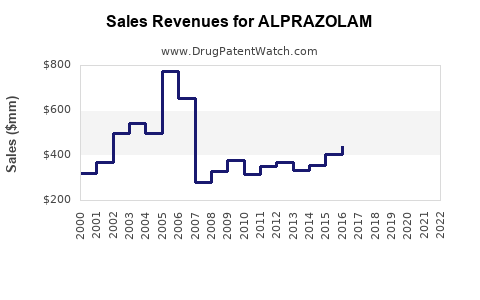
Alprazolam’s financial trajectory has followed the standard lifecycle of a successful small-molecule drug:
1980s: branded expansion
Xanax benefited from broad adoption in anxiety and panic disorder. Revenue was concentrated in the branded product and supported by physician familiarity, product availability, and the absence of generic competition during the exclusivity period.
1990s: generic erosion
Generic entry sharply reduced branded pricing and market share. As multiple manufacturers entered, pharmacy substitution converted alprazolam into a commodity product. The active ingredient remained commercially important, but economic value shifted from the innovator to manufacturing scale and distribution.
2000s: dosage-form segmentation
Extended-release and orally disintegrating formulations created limited opportunities for product differentiation. These products could support higher unit economics than standard tablets, but their addressable markets remained smaller and formulation claims did not protect the underlying immediate-release market.
2010s: volume with regulatory pressure
Alprazolam continued to generate substantial prescription activity, but controlled-substance scrutiny increased. Prescribing restrictions, prescription-drug-monitoring programs, and concerns over benzodiazepine dependence affected long-term growth.
2020s: mature, low-margin generic market
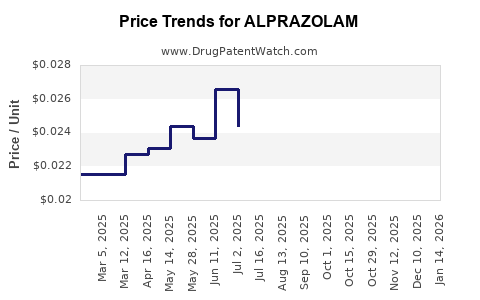
The current market is defined by stable clinical demand, low generic prices, and limited patent leverage. No publicly reported standalone revenue stream for alprazolam is generally disclosed by the major manufacturers. Companies report it within broader generic portfolios, making product-level revenue estimates unreliable.
The financial model is therefore volume-based:
| Value driver |
Current impact |
| Prescription volume |
Supports recurring demand |
| Unit price |
Low because of generic competition |
| Number of suppliers |
Compresses margins |
| Product availability |
Can temporarily improve pricing during shortages |
| Dosage-form complexity |
Supports better margins for selected products |
| Controlled-substance compliance |
Raises operating cost |
| Regulatory scrutiny |
Increases legal and commercial risk |
| Patent exclusivity |
Provides little or no current value |
What generic entry risks exist for alprazolam?
For a new manufacturer, generic entry risk is operational rather than patent-led.
The main risks are:
- Failure to demonstrate bioequivalence
- FDA inspection findings
- Controlled-substance recordkeeping violations
- Inability to obtain adequate DEA quota
- Supply interruption for active pharmaceutical ingredient
- Price erosion after multiple approvals
- Wholesaler and pharmacy substitution pressure
- Product liability related to misuse or withdrawal
- Competition from established suppliers with lower costs
The most attractive entry opportunities are generally not basic 0.25 mg or 0.5 mg immediate-release tablets. Those products face intense price competition. More defensible opportunities may involve difficult-to-manufacture strengths, extended-release products, specialty packaging, reliable supply, or underserved channels.
How strong is the alprazolam patent estate?
The patent estate is weak for standard immediate-release products and potentially moderate only for narrowly defined formulations.
| Patent category |
Current strength |
| Original compound patent |
Expired |
| Original use patents |
Expired or commercially immaterial |
| Immediate-release tablet patents |
No meaningful barrier expected |
| Extended-release formulation patents |
Product-specific and potentially narrow |
| Orally disintegrating formulation patents |
Product-specific and potentially narrow |
| Manufacturing patents |
Avoidable if alternative processes exist |
| Trade secrets and know-how |
More relevant than patents for mature products |
The strongest remaining competitive barriers are manufacturing reliability, regulatory compliance, distribution access, and product quality. Those barriers can support market share but do not create durable monopoly pricing.
Is there biosimilar risk for alprazolam?
No. Alprazolam is a chemically synthesized small molecule, not a biologic. It is regulated through the generic drug pathway under section 505(j) of the Federal Food, Drug, and Cosmetic Act rather than the biosimilar pathway under section 351(k) of the Public Health Service Act.[5]
The relevant competitive threat is generic substitution, not biosimilar entry.
Are there licensing deals involving alprazolam?
Alprazolam has been associated with historical brand, distribution, and authorized-generic arrangements, but licensing is not a major current value driver. The product’s age, generic competition, and low unit pricing reduce the economic rationale for large strategic licensing transactions.
Any commercially meaningful arrangement today would more likely involve:
- Authorized distribution
- Contract manufacturing
- Portfolio acquisition
- Regional commercialization
- Supply agreements
- Controlled-substance compliance infrastructure
The original innovator economics are no longer supported by patent exclusivity.
What is the outlook for alprazolam revenue?
Alprazolam revenue is likely to remain stable in aggregate but weak on a per-unit basis. The market should be viewed as mature rather than growth-oriented.
Near-term revenue depends on:
- Prescription persistence in anxiety and panic disorder
- Generic supplier exits or shortages
- Regulatory restrictions on benzodiazepines
- Substitution toward SSRIs, SNRIs, buspirone, and psychotherapy
- Continued demand for rapid-onset treatment
- Pricing discipline among major generic manufacturers
The most likely scenario is a flat-to-declining mature market with intermittent price increases during supply disruptions. Sustained revenue growth would require a new formulation, a differentiated delivery system, a major supply shortage, or a new clinical use, none of which is currently a central feature of the alprazolam market.
Key Takeaways
- Alprazolam is a mature generic drug with no meaningful active-ingredient patent protection.
- The original Xanax exclusivity period ended decades ago.
- Immediate-release tablets are commodity products with low prices and limited patent risk.
- Extended-release and orally disintegrating formulations may have narrower product-specific protection.
- Alprazolam is a Schedule IV controlled substance, making compliance and distribution important commercial barriers.
- Generic substitution, not biosimilar competition, determines market dynamics.
- Major manufacturers gain advantage through scale, supply reliability, and controlled-substance infrastructure.
- Product-level alprazolam revenue is generally not separately disclosed by manufacturers.
- Future financial performance is likely to be volume-driven, with limited pricing power and occasional shortage-related upside.
- The strongest remaining barriers are operational and regulatory rather than patent-based.
FAQs
Does Xanax still have patent protection?
The original Xanax immediate-release product does not have meaningful active-ingredient patent protection. Any remaining patent issue would be product-specific and could relate to a later dosage form or formulation.
Can a company launch a generic alprazolam tablet without a Paragraph IV challenge?
Yes. A generic applicant can rely on an expired patent landscape, certify that no relevant patent is listed, or use another applicable certification pathway. A Paragraph IV challenge is not necessary when no unexpired relevant patent blocks approval.
Is alprazolam a high-revenue generic drug?
It can be a high-volume product, but its low unit prices and intense competition limit margin potential. Revenue depends on portfolio scale, supply reliability, and distribution reach.
Which alprazolam formulation has the greatest commercial differentiation?
Extended-release and orally disintegrating products offer more differentiation than standard immediate-release tablets. Their commercial opportunity is smaller and may depend on formulation-specific regulatory and patent conditions.
Does FDA approval guarantee commercial success for a new alprazolam generic?
No. Approval permits market entry but does not ensure attractive economics. The entrant must compete on cost, supply continuity, quality, controlled-substance compliance, and wholesaler access.
References
- U.S. Food and Drug Administration. (2020). Xanax prescribing information: Alprazolam tablets and extended-release tablets.
- U.S. Drug Enforcement Administration. (2024). Drug scheduling.
- U.S. Patent and Trademark Office. (1976). U.S. Patent No. 3,987,052: Triazolobenzodiazepine compounds.
- U.S. Food and Drug Administration. (2024). Approved drug products with therapeutic equivalence evaluations: Orange Book.
- U.S. Food and Drug Administration. (2024). Abbreviated new drug application and biosimilar biological product pathways.