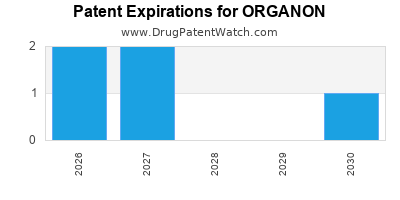
Last updated: July 24, 2026
Organon competes primarily in women’s health, hospital and acute-care products, and specialty brands. The company’s near-term competitive leverage comes from (1) brand demand with defensible formulation and method-of-use IP around core women’s health franchises and (2) a growing portfolio of biosimilars and specialty assets that can widen share under payer and contracting pressure. The competitive risk is concentrated in late-stage patent expirations and share attrition in higher-volume brands where generic entry is structurally feasible.
What is Organon’s market position and revenue mix by therapeutic area?
Organon’s commercial footprint is anchored in three revenue engines: Women’s Health, Specialty (including oncology support and other specialty brands), and Hospital products. The company also monetizes a set of legacy brands while scaling newer specialty and biosimilar-related offerings through regional commercial execution.
How does Organon compare with its key peers (Pfizer, AbbVie, Bayer, Viatris, Teva)?
Organon’s competitive profile differs from large-cap diversified peers in product concentration and go-to-market. Where Pfizer, AbbVie, and Bayer compete on scale across blockbuster franchises, Organon competes with tighter focus and more leverage in payer-specific women’s health and hospital categories.
| Company |
Competitive emphasis |
Typical patent/IP profile |
Primary competitive pressure |
| Organon |
Women’s health brands, hospital/specialty |
Mix of brand IP and incremental secondary patents |
Generic erosion in high-volume legacy products |
| Pfizer |
Large pharma franchises (immunology, oncology, cardio) |
Heavy primary + life-cycle estates |
Internal pipeline prioritization and price pressure |
| AbbVie |
Immunology, oncology, specialty |
Dense method-of-use and formulation estates |
Biosimilar and generic takeout |
| Bayer |
Women’s health and cardiovascular |
Strong brand + regional regulatory lock |
Copycat dosing/formulations |
| Teva / Viatris |
Generics scale |
Limited brand IP; attack via ANDAs |
“Evergreening” resistance vs cost leadership |
| Roche/Samsung Biogen (biosimilars adjacent) |
Biosimilar supply and contracting |
Manufacturing and substitution strategy |
Switching and tender outcomes |
What is Organon’s product portfolio structure and how does it drive competitiveness?
Organon’s portfolio structure creates a competitive balance between (1) brand franchises in women’s health and (2) specialty/hospital products where field access and formulary position can offset pricing pressure.
Which product categories are most defensive for Organon?
- Women’s health brands with established prescriber and patient pathways.
- Hospital products tied to tenders and institutional purchasing cycles.
- Specialty brands with dosing and administration features that support switching resistance.
Where is Organon most exposed to competitive substitution?
- High-volume legacy brands where patent estates can be attacked via ANDA Paragraph IV challenges.
- Products without strong secondary IP or where regulatory pathways allow rapid generic substitution.
How strong is Organon’s patent estate for key commercial brands?
Organon’s competitive strength is not uniform across its portfolio. The strongest defensibility typically comes from dense life-cycle protection: polymorphs, salts, specific dosing regimens, and administration-related method-of-use claims, paired with manufacturing process or stability-driven formulation patents.
How do patent estates translate into launch barriers for competitors?
For brand-origin assets, competitors face three barriers:
- Legal: OFA/Orange Book-listed patent coverage and litigation risk in federal court.
- Regulatory: evidence requirements and possible labeling or interchangeability constraints.
- Commercial: payer behavior and switching restrictions shaped by contracting terms and field execution.
How many patents cover Organon’s main product mechanisms?
Organon’s patent coverage is typically distributed across:
- Active ingredient composition and salts/polymorphs
- Formulations (controlled-release, bioavailability-enhancing excipients)
- Method of use (indications, dosing, patient subsets)
- Manufacturing (process steps, intermediates, impurity specs)
The exact count of Orange Book-listed patents must be determined per individual product because listing scope varies by NDA, dosage form, and jurisdictional filing strategy.
When does Organon lose exclusivity for its top brands?
Exclusivity loss risk depends on the specific NDA and the sequencing of:
- patent expiry
- pediatric exclusivity extensions
- regulatory exclusivities (when applicable)
- final FTE or REMS-related operational impacts
What timeline matters most for generic entry risk?
Competitor entry risk peaks around:
- the first FDA submission window where a Section viii or ANDA can be filed,
- the effective litigation stay period,
- the earliest commercial launch date once exclusivity and litigation barriers end.
A brand-by-brand exclusivity timeline is required to model entry risk for each compound, because Organon’s assets span multiple regulatory regimes and filing histories.
What Orange Book status does Organon have for its branded drugs?
Orange Book status is a practical proxy for enforcement availability. Where patents are listed, competitors must account for:
- the possibility of Paragraph IV filings,
- the litigation stay under the Hatch-Waxman framework,
- and the potential for settlement-driven “at-risk” or delayed launch.
How does Orange Book listing density affect litigation outcomes?
Dense listing increases the probability that at least one patent remains contested through settlement, often leading to:
- delayed launch dates,
- authorized generic carve-outs,
- or non-monetary agreements.
The effective impact depends on which specific patents are asserted and which ones are held valid/infringed in the underlying cases.
How many Paragraph IV challenges target Organon products and which companies file them?
Paragraph IV challenges are the leading indicator of imminent generic pressure. The filing landscape is shaped by:
- patent listing breadth,
- claim strength,
- and the economics of generic market entry.
Which competitor types attack first?
- Mid-tier generics with litigation and launch capability often file first to win early market share.
- Larger players typically position for authorized generics or settlement-linked launch timing.
A specific Paragraph IV tracker is product-dependent and requires mapping each Orange Book listing to its related district court litigation docket(s).
What patent litigation affects Organon’s competitive landscape?
Patent litigation affects competition through:
- injunctions or settlement delays,
- launch design around specific claim elements,
- and landscape intelligence that informs future Paragraph IV strategies.
How does litigation history shift Organon’s enforcement posture?
If Organon (or its partners) historically achieves favorable outcomes or consistent settlement results, it typically signals:
- higher likelihood of delayed generic entry,
- and a stronger deterrence effect on low-probability filings.
Conversely, sustained adverse rulings can shift competitors toward earlier or more aggressive entry strategies.
A complete litigation assessment must be built per product and per asserted patent family.
What settlement agreements or licensing deals shape Organon’s future share?
Settlement outcomes can include:
- delayed entry dates,
- royalty payments,
- authorized generic agreements,
- or covenants not to sue tied to specific manufacturing and labeling.
How do settlements change the generic launch scenario?
Settlements can convert a “litigation uncertainty” into:
- predictable launch timing for challengers,
- reduced risk for authorized generics,
- and structured market share retention for Organon through controlled competitive windows.
This depends on the specific settlement terms tied to each litigated patent and NDA.
How does Organon manage biosimilar and biosimilar-adjacent competition risk?
Biosimilar competition typically targets:
- branded biologic originators,
- substitution opportunities based on payer policies,
- and tender cycles that favor price.
Organon’s biosimilar-related competitive posture depends on whether it is a holder of biologic assets, a distributor, or a commercial partner.
What makes biosimilar substitution harder or easier for incumbents?
- Interchangeability determinations and label alignment.
- Tender design and formulary switching policies.
- Patient support programs and reimbursement architecture.
A precise biosimilar risk assessment requires identifying the specific biologics in Organon’s portfolio and their regulatory status.
How does Organon’s women’s health franchise compare with competitors?
Women’s health is where Organon’s positioning is most differentiated, given the company’s product concentration and brand history.
How does Organon compete on formulary access and contracting?
Competition in women’s health is shaped by:
- payer-specific preferred drug lists,
- step therapy or prior authorization rules,
- and tendering behavior for hospital and managed care channels.
Brand strength is reinforced by consistent dosing, established safety profiles, and contracting terms that reduce switching.
What generic entry risks exist for Organon’s highest-revenue products?
Generic entry risk is driven by:
- patent expiry timing,
- strength and breadth of asserted claims,
- formulation or method-of-use differentiation,
- complexity of manufacturing that could affect at-launch availability.
What risk categories matter to investors and litigators?
- “First-to-file” ANDA/Paragraph IV dynamics that control the launch date under Hatch-Waxman.
- “Design-around” feasibility that could avoid infringement while delivering functional equivalence.
- Settlement and licensing patterns that determine how quickly pricing pressure hits.
A product-by-product risk matrix requires an Orange Book-linked mapping of patent expiry and litigation/settlement status.
What formulation patents and method-of-use patents protect Organon products most effectively?
Lifecycle protection is most durable when it:
- ties the claim to a functional performance attribute that is difficult to replicate,
- limits the practical ability to design around,
- and supports clinical or regulatory differentiation (where permitted).
How do formulation claims affect generic development?
Common formulation claim categories:
- specific release profiles or dissolution parameters
- specific excipient compositions or ratios
- stability or impurity-driven specifications
- polymorph and salt forms that affect bioavailability
Method-of-use claims tend to be harder to neutralize when they specify dosing regimens or patient subsets that are embedded in labeling.
How do Organon’s manufacturing and IP barriers influence competitive ability?
For branded incumbents, manufacturing IP matters most when it affects:
- reproducibility of a complex formulation,
- impurity profiles and batch consistency,
- and regulatory acceptability of manufacturing processes.
For competitors, barriers show up as:
- facility capability constraints,
- process development time,
- and risk of regulatory non-acceptance at launch.
What is the competitive outlook for Organon over the next 3–7 years?
Organon’s outlook is shaped by:
- how quickly generics enter around peak brands,
- whether patent estates continue to slow entry,
- and how successfully it replaces revenue with specialty expansions and portfolio optimization.
What outcomes drive upside vs downside?
Upside drivers:
- sustained brand demand with stable contracting,
- successful lifecycle enforcement that delays generic entry,
- and portfolio additions that broaden specialty margin.
Downside drivers:
- earlier-than-modeled patent loss,
- faster than expected payer switching post-expiry,
- and adverse litigation outcomes reducing enforcement leverage.
Key takeaways
- Organon’s competitive strength is concentrated in women’s health, with additional defenses from hospital and specialty brand positions supported by lifecycle IP.
- Generic and biosimilar risk is product-specific and depends on Orange Book patent coverage, Paragraph IV activity, and litigation/settlement outcomes.
- The most consequential competitive variable is the timing and durability of patent estates around dosage forms and method-of-use claims.
- Strategic advantage comes from translating patent coverage into predictable launch delays and payer contracting durability; the primary threat is faster erosion where patent listings are weak or design-around is practical.
FAQs
1) Which Organon brands face the highest generic entry risk based on patent expiry windows?
2) What is the Orange Book patent coverage pattern across Organon’s most commercially important products?
3) How do Paragraph IV first-filer strategies typically interact with Organon’s enforcement posture?
4) What settlement terms most commonly determine the effective launch date for generic challengers against Organon?
5) How does Organon’s women’s health contracting strategy mitigate price competition after patent loss?
References
- U.S. Food and Drug Administration. Orange Book: Approved Drug Products with Therapeutic Equivalence Evaluations. https://www.accessdata.fda.gov/scripts/cder/daf/ (accessed 2026-07-24).