Last updated: September 12, 2026
Executive summary: Remeron, the branded form of mirtazapine, is a mature antidepressant with no meaningful U.S. exclusivity moat. Its patent and regulatory exclusivity periods have ended, generic mirtazapine is widely available, and the brand has limited leverage over pricing. The commercial trajectory shifted from originator growth before generic entry to long-term erosion, with value concentrated in low-cost generic supply, residual brand prescriptions, and niche orally disintegrating-tablet demand.
Remeron Market Dynamics, Patent Expiration, Generic Competition, and Financial Trajectory
What is Remeron and how is it used?
Remeron is the U.S. brand name for mirtazapine, a noradrenergic and specific serotonergic antidepressant marketed for major depressive disorder in adults. The product is available as conventional tablets and Remeron SolTab orally disintegrating tablets.
| Attribute |
Remeron |
| Active ingredient |
Mirtazapine |
| Therapeutic class |
Tetracyclic antidepressant; NaSSA |
| U.S. originator |
Organon, formerly associated with Akzo Nobel, Schering-Plough and Merck structures |
| U.S. NDA |
NDA 020415 |
| Initial U.S. approval |
1996 |
| Main dosage forms |
Immediate-release tablets; orally disintegrating tablets |
| Primary indication |
Major depressive disorder |
| Current competitive status |
Mature branded product with extensive generic competition |
| Biosimilar exposure |
Not applicable; mirtazapine is a small molecule |
| Prescription channel |
Retail, mail order, specialty and institutional pharmacies |
Mirtazapine has a differentiated pharmacology within antidepressants. It is often selected when insomnia, appetite loss or weight loss are treatment considerations. Those clinical attributes support continued demand, but they do not provide meaningful commercial exclusivity.
When did Remeron lose exclusivity?
Remeron lost practical U.S. market exclusivity after generic mirtazapine entered the market. The product no longer has regulatory exclusivity that would prevent abbreviated new drug applications, and its foundational patent protection has expired.
The core mirtazapine patent estate is historical rather than commercially active. U.S. Patent No. 4,062,848, associated with the mirtazapine compound class, is expired. Any later protection related to orally disintegrating formulations or manufacturing processes does not create a blocking position against ordinary generic mirtazapine tablets.
| Exclusivity category |
Remeron status |
| New chemical entity exclusivity |
Expired |
| Core compound patent |
Expired |
| Pediatric exclusivity |
Expired |
| FDA orphan exclusivity |
Not applicable |
| Current blocking formulation exclusivity |
None identified for standard generic tablets |
| Biosimilar reference-product exclusivity |
Not applicable |
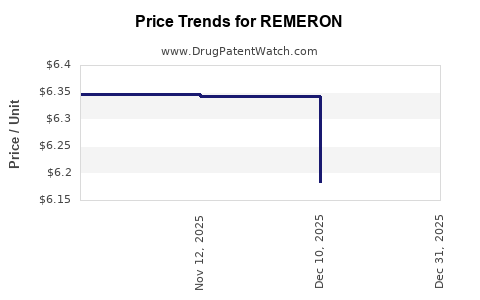
The commercial consequence is substantial. Once generic tablets became available, pharmacies and payers gained a lower-cost substitute with the same active ingredient and dosage strengths. The branded product’s pricing power declined rapidly.
What patents protect Remeron?
The historical patent estate centered on mirtazapine chemistry and dosage-form protection. It does not currently provide a material barrier to generic entry.
Core compound protection
U.S. Patent No. 4,062,848 covered substituted piperazinoazepine compounds associated with mirtazapine. The patent is expired and cannot be used to block current ANDA-based competition.
Formulation patents
Remeron SolTab introduced an orally disintegrating dosage form. Formulation and manufacturing patents may have covered tablet composition, disintegration characteristics, taste masking, compression or production methods. Those rights are no longer sufficient to protect the broader mirtazapine market because:
- Generic manufacturers can market conventional tablets without reproducing the SolTab formulation.
- A generic SolTab competitor can design around expired or narrow formulation claims.
- Prescribers and payers can substitute conventional generic tablets for many patients.
The remaining commercial value of a formulation patent would depend on claim scope, expiration, Orange Book listing status and whether the claim covers a commercially important dosage form. For Remeron, those factors do not create a current market-wide barrier.
Method-of-use patents
Remeron’s principal indication, major depressive disorder, is an established use. No active method-of-use patent appears to provide a meaningful barrier to ordinary generic mirtazapine prescribing. Generic labels may use carve-outs for protected indications where applicable, but the broad antidepressant market is no longer protected by an enforceable exclusivity position.
What is the Orange Book status of Remeron?
The FDA Orange Book identifies approved drug products and, where applicable, listed patents and exclusivity information. Remeron’s commercial position is that of an approved reference product in a mature category, not a protected originator product with live market exclusivity.
The Orange Book has continuing regulatory value because it identifies the reference listed drug against which generic applicants establish bioequivalence. It does not, by itself, imply that the brand retains active patent protection.
| Orange Book issue |
Commercial implication |
| Reference listed drug status |
Supports generic ANDA development |
| Active NCE exclusivity |
None |
| Active compound patent barrier |
None |
| Generic substitution |
Broadly available |
| SolTab-specific competition |
Depends on dosage-form approval and supply |
| Brand-only prescribing leverage |
Limited |
Which companies challenge Remeron with generic mirtazapine?
Generic mirtazapine has been marketed by multiple U.S. and international manufacturers. The competitive field has included large generic companies and contract manufacturers supplying retail pharmacies, wholesalers and institutional buyers.
Typical competitors in the mirtazapine category include:
- Teva Pharmaceuticals
- Mylan, now part of Viatris
- Sandoz
- Dr. Reddy’s Laboratories
- Zydus Pharmaceuticals
- Torrent Pharmaceuticals
- Aurobindo Pharma
- Lupin
- Apotex
- Various private-label and authorized-distributor suppliers
Supplier participation can change by dosage strength, tablet type, manufacturing site and contracting cycle. The category is therefore more exposed to price competition and supply interruptions than to patent litigation.
Are there Paragraph IV challenges involving Remeron?
Paragraph IV challenges were commercially relevant during the transition from branded Remeron to generic mirtazapine. At present, the principal issue is not an active patent dispute but the absence of a meaningful patent barrier.
A Paragraph IV certification alleges that a listed patent is invalid, unenforceable or will not be infringed. For an old product such as Remeron, historical Paragraph IV activity may have involved compound, formulation or dosage-form patents. Once relevant patents expire, new Paragraph IV litigation generally loses economic significance unless a later-listed patent presents a legitimate blocking claim.
| Litigation factor |
Remeron assessment |
| Historical ANDA challenge risk |
Material during generic launch period |
| Current Paragraph IV leverage |
Low |
| Active core patent dispute |
No material current barrier identified |
| Settlement-driven delayed entry |
Historical issue, not a current market constraint |
| Launch-at-risk exposure |
Low for ordinary mirtazapine tablets |
What is the FDA regulatory status of Remeron?
FDA approved Remeron for major depressive disorder in adults. The product remains an approved prescription antidepressant, subject to the labeling, warnings and postmarketing obligations in its approved prescribing information.
Mirtazapine’s regulatory profile includes class-related antidepressant warnings and product-specific issues such as somnolence, increased appetite, weight gain and rare severe adverse reactions. These characteristics affect prescribing patterns and competitive positioning but do not provide patent protection.
Remeron SolTab has a separate commercial role because orally disintegrating tablets may be useful for patients with difficulty swallowing conventional tablets. The dosage form can support brand persistence, but it does not restore the economic position held before generic entry.
How has Remeron’s market changed since generic entry?
Remeron’s market followed the standard lifecycle for an off-patent small molecule.
1. Originator expansion
Before generic competition, Merck and its predecessor organizations benefited from branded pricing, formulary access and physician familiarity. Demand was supported by the drug’s use in depression and its sedating and appetite-stimulating profile.
2. Generic conversion
After generic mirtazapine became available, payers and pharmacies shifted prescriptions toward lower-cost alternatives. Brand volume declined as automatic substitution and formulary preference expanded.
3. Mature generic market
The current category is driven by:
- Price and reimbursement
- Manufacturer supply reliability
- Wholesaler contracts
- Pharmacy substitution
- Tablet strength availability
- Patient adherence and tolerability
- Demand for orally disintegrating formulations
Brand equity can preserve a small residual segment, particularly among patients stabilized on Remeron or Remeron SolTab. That segment is insufficient to support originator-level revenue.
What is Remeron’s financial trajectory?
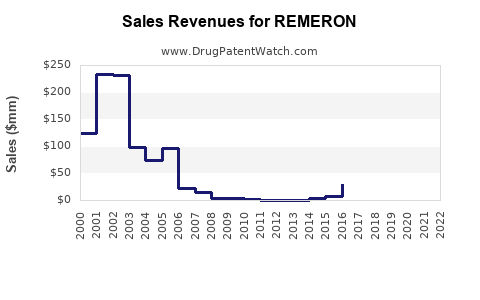
Public company filings do not generally disclose current Remeron revenue as a standalone line item. The product’s financial trajectory must therefore be assessed through its lifecycle, generic-entry timing and portfolio reporting rather than through a current audited Remeron revenue series.
| Period |
Financial profile |
| 1990s to early 2000s |
Branded growth and high gross-margin originator economics |
| Generic-entry period |
Rapid volume and price erosion |
| Post-exclusivity period |
Declining brand sales; expanding generic substitution |
| Mature market |
Low-margin generic economics and limited residual brand revenue |
| Current outlook |
Stable category demand but weak brand growth and limited pricing power |
Revenue exposure is now more relevant to generic manufacturers than to the originator. For generic suppliers, mirtazapine can contribute recurring volume but is unlikely to provide strong margin expansion unless a company has a supply advantage, limited competition in a dosage form or temporary market shortage.
A brand owner’s remaining revenue is exposed to:
- Pharmacy benefit manager substitution
- Reimbursement exclusions
- Low-cost generic switching
- Reduced physician incentive to prescribe the brand
- Limited ability to raise price without losing volume
- Competition from other antidepressants
How strong is the Remeron patent estate?
The patent estate is weak from a current commercial-protection perspective.
| Patent-strength factor |
Assessment |
| Core molecule protection |
Expired |
| Regulatory exclusivity |
Expired |
| Standard tablet protection |
No effective blocking position |
| SolTab differentiation |
Narrow commercial protection at most |
| Method-of-use protection |
No broad active barrier identified |
| Manufacturing barrier |
Low to moderate; chemistry is established |
| Litigation deterrence |
Low |
| Generic launch risk |
High |
Mirtazapine is a chemically defined small molecule with established manufacturing routes and broad generic familiarity. Manufacturing complexity is lower than for biologics, sterile injectables or complex controlled-release systems. The main barriers are regulatory compliance, bioequivalence, facility qualification, quality systems and commercial scale.
What generic launch scenarios exist for Remeron?
Three scenarios define the remaining market risk.
Conventional tablet substitution
This is the dominant scenario. Generic mirtazapine tablets remain widely available, and pharmacy substitution limits branded tablet demand.
Orally disintegrating tablet competition
Remeron SolTab may retain a narrower patient segment if generic orally disintegrating alternatives have limited availability or formulary coverage. That advantage depends on actual supplier participation and payer policy rather than on broad patent protection.
Supply-driven price volatility
Because many generic antidepressants operate on thin margins, manufacturers may reduce participation after pricing declines. A production interruption can temporarily increase prices or create shortages, but it does not restore durable exclusivity.
How does Remeron compare with competing antidepressants?
Remeron competes with selective serotonin reuptake inhibitors, serotonin-norepinephrine reuptake inhibitors, bupropion and other generic antidepressants.
| Drug |
Generic status |
Commercial distinction |
| Remeron / mirtazapine |
Generic and off-patent |
Sedation, appetite and weight effects; SolTab option |
| Prozac / fluoxetine |
Generic and off-patent |
Long half-life and extensive generic use |
| Zoloft / sertraline |
Generic and off-patent |
Broad first-line use |
| Lexapro / escitalopram |
Generic and off-patent |
Large primary-care prescribing base |
| Wellbutrin / bupropion |
Generic and off-patent |
Lower sedation and different adverse-effect profile |
| Cymbalta / duloxetine |
Generic and off-patent |
Depression plus pain indications |
Mirtazapine’s competitive position is clinical rather than proprietary. It can remain relevant where its adverse-effect profile is acceptable or useful, but clinicians can prescribe therapeutically substitutable alternatives at generic prices.
What patent litigation and settlement agreements affect Remeron?
No current settlement agreement appears to create a meaningful delay to ordinary generic mirtazapine access. Historical litigation would have been tied to ANDA filings and patent certifications during the original generic-entry period.
The litigation profile differs from newer branded drugs because:
- The core patents are expired.
- Generic approval pathways are established.
- The product has no active biologic interchangeability dispute.
- The commercial prize is too small to support extensive current patent litigation.
- Any dispute over a narrow SolTab formulation would not block standard tablets.
What licensing deals involve Remeron?
Remeron’s commercial history reflects corporate ownership transfers and portfolio transactions involving Organon, Schering-Plough and Merck-related businesses. These transactions changed brand ownership and commercial responsibility but did not extend mirtazapine exclusivity.
No current licensing arrangement is known to create a material barrier to generic mirtazapine. The principal commercial rights are distribution and supply rights rather than high-value innovation licenses.
What is the geographic coverage of Remeron protection?
Patent protection has expired in the major markets where mirtazapine was commercialized. The competitive structure is global, with generic suppliers operating across the United States, Europe, Japan and other regulated markets.
Country-specific differences remain in:
- Product approvals
- Tablet strengths
- Orally disintegrating formulations
- Reimbursement
- Substitution rules
- Local manufacturing requirements
- Shortage reporting
- Brand retention
Those differences affect pricing and supply but do not change the global conclusion that Remeron is an off-patent product.
Key Takeaways
- Remeron is the branded version of mirtazapine, approved in the U.S. in 1996.
- Core compound and regulatory exclusivity have expired.
- Generic mirtazapine has materially reduced brand volume and pricing power.
- Remeron SolTab can preserve limited niche demand but does not protect the overall mirtazapine market.
- No active patent estate creates a broad barrier to generic tablets.
- Current financial exposure is not separately disclosed in most public filings.
- The market is driven by generic pricing, pharmacy substitution, supply reliability and clinical preference.
- Biosimilar risk is not relevant because mirtazapine is a small-molecule drug.
- Current litigation and Paragraph IV risk are low compared with the period surrounding initial generic entry.
- The commercial outlook is stable for the molecule but weak for the branded product.
FAQs about Remeron patents, generics, and market value
Is Remeron still under patent?
No. The core mirtazapine patent protection has expired, and generic manufacturers can compete in the market.
Is mirtazapine the same as Remeron?
Yes. Remeron is the originator brand, while mirtazapine is the active ingredient and generic name.
Does Remeron SolTab have stronger protection than regular Remeron?
The orally disintegrating formulation may have had separate formulation protection, but it does not provide broad protection against conventional generic mirtazapine tablets.
Can a generic manufacturer launch mirtazapine without copying Remeron SolTab?
Yes. A manufacturer can market conventional mirtazapine tablets through the ANDA pathway without reproducing the orally disintegrating formulation.
Why does Remeron remain prescribed after generic entry?
Mirtazapine has clinical characteristics that can be useful for patients with depression accompanied by insomnia, reduced appetite or weight loss. Those attributes support use despite the absence of patent protection.
References
-
U.S. Food and Drug Administration. (1996). Remeron (mirtazapine) prescribing information. FDA Drugs@FDA.
-
U.S. Food and Drug Administration. (2024). Approved drug products with therapeutic equivalence evaluations: Orange Book. U.S. Department of Health and Human Services.
-
U.S. Patent and Trademark Office. (1977). U.S. Patent No. 4,062,848: Piperazinoazepine derivatives. U.S. Department of Commerce.
-
Organon & Co. (2024). Annual report 2023. Organon & Co.
-
Merck & Co., Inc. (2010). Annual report 2009. Merck & Co., Inc.