Last updated: October 8, 2026
Mometasone furoate is a mature corticosteroid with broad generic availability in topical, nasal, and inhaled formulations. Its commercial value has shifted from the original branded products, including Nasonex, Elocon, and Asmanex, toward low-cost generics, private-label allergy products, combination inhalers, and contract-manufactured topical medicines. The active ingredient has no biosimilar exposure because it is a synthetic small molecule. The principal commercial risks are generic price erosion, limited differentiation between formulations, and dependence on device, regulatory, and manufacturing capabilities rather than composition-of-matter exclusivity.
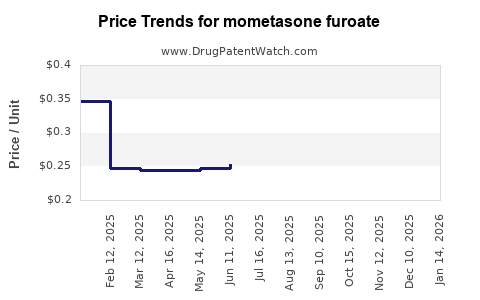
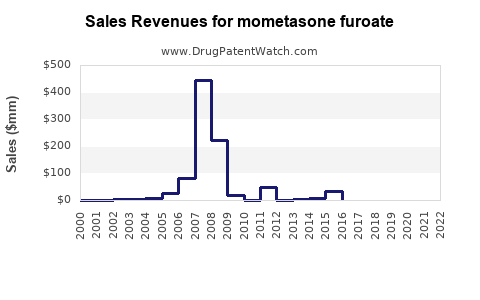
Standalone global revenue for mometasone furoate is not publicly reported by most manufacturers. Public company filings generally aggregate sales by therapeutic franchise or product group. The financial trajectory is therefore best assessed through product status, generic penetration, formulation complexity, distribution channels, and the performance of combination products such as mometasone/formoterol.
What is mometasone furoate and which products contain it?
Mometasone furoate is a synthetic glucocorticoid used in dermatology, allergic rhinitis, asthma, and related inflammatory conditions. It is administered through multiple delivery systems:
| Product or formulation |
Main use |
Representative brand |
Market status |
| Nasal spray |
Allergic rhinitis and nasal polyps |
Nasonex |
Branded and generic |
| Topical cream, ointment, and lotion |
Atopic dermatitis and corticosteroid-responsive dermatoses |
Elocon |
Generic-dominated |
| Inhalation powder |
Asthma maintenance |
Asmanex Twisthaler |
Brand and generic competition varies by market |
| Inhalation aerosol |
Asthma maintenance |
Asmanex HFA |
Brand and generic competition varies by market |
| Mometasone/formoterol inhaler |
Asthma maintenance |
Dulera |
Combination-product market |
| Mometasone/indacaterol inhaler |
Asthma and COPD markets in selected jurisdictions |
Various regional brands |
Geographic availability varies |
The U.S. Food and Drug Administration approved Nasonex nasal spray in 1997, Asmanex Twisthaler in 2000, and Asmanex HFA in 2014. Mometasone furoate topical products entered the U.S. market earlier and have long faced generic competition.[1-3]
How large is the mometasone furoate market?
The market is fragmented across prescription, over-the-counter, hospital, retail, and private-label channels. No authoritative public source reports a single global revenue figure for all mometasone furoate products.
A practical market segmentation is:
- Topical mometasone furoate, where generic competition is intense.
- Nasal mometasone furoate, where branded and store-brand allergy products compete.
- Inhaled mometasone furoate, where device and formulation barriers can preserve value.
- Combination inhalers, where patent, device, and regulatory complexity can delay substitution.
The highest unit volumes are likely in topical and nasal products because these products address large patient populations and are relatively inexpensive to manufacture. The highest revenue per patient is more likely in inhaled products, particularly combination inhalers, because inhaler devices, dose-counting mechanisms, formulation engineering, and regulatory comparability create greater development barriers.
Which formulations have the strongest commercial economics?
Topical products have the weakest long-term pricing power. Generic creams, ointments, and lotions are widely available, and switching costs are low. Retailers and pharmacy benefit managers can substitute among manufacturers with limited clinical disruption.
Nasal sprays have better commercial durability because the device, suspension characteristics, spray performance, preservative system, and dose uniformity must be demonstrated. Those factors do not prevent generic entry, but they can slow entry and create room for branded or private-label products.
Inhaled products have the most complex economics. The active ingredient is old, but the delivery system is technically demanding. Product developers must address aerodynamic particle size, emitted dose, device resistance, dose counter performance, stability, and patient-use characteristics. These factors can create a longer commercial tail than the underlying molecule would suggest.
When did mometasone furoate lose exclusivity?
Mometasone furoate lost meaningful composition-of-matter exclusivity many years ago. The commercial protection for major products has depended on formulation, device, method-of-use, and regulatory exclusivity rather than a live basic compound patent.
| Product |
FDA approval period |
Principal exclusivity issue |
Current commercial position |
| Nasonex nasal spray |
1997 |
Expired brand and formulation protections; generic nasal spray entry |
Generic and private-label market |
| Asmanex Twisthaler |
2000 |
Device and inhaled formulation protections |
Generic competition varies by jurisdiction |
| Elocon topical products |
Pre-1990s U.S. commercialization |
Long-expired core protection |
Generic-dominated |
| Asmanex HFA |
2014 |
Formulation, device, and product-specific protections |
Brand and generic competition varies |
| Dulera |
2010 |
Combination inhaler patents and regulatory exclusivity |
Combination-product competition |
The timing of generic entry differs by dosage form and jurisdiction. A product can have expired active-ingredient patents while still facing device or formulation patents. Conversely, a listed patent may not prevent launch if a generic applicant certifies that the patent is invalid, unenforceable, or not infringed.
What patents protect mometasone furoate products?
The historical patent estate includes several layers:
- Composition-of-matter patents for steroid compounds and related intermediates.
- Formulation patents covering suspensions, propellants, particle-size distributions, and excipients.
- Device patents covering inhalers, dose counters, and delivery mechanisms.
- Method-of-use patents covering treatment of allergic rhinitis, asthma, and inflammatory skin conditions.
- Combination patents covering mometasone with formoterol or other bronchodilators.
- Manufacturing patents covering crystallization, micronization, particle engineering, and filling processes.
For mature single-agent products, the fundamental patent estate is no longer the main source of value. The remaining barriers are generally product-specific and technical. The U.S. FDA Orange Book identifies patent and exclusivity information for approved drug products, but listings must be assessed against the specific NDA, dosage form, strength, and proposed generic product.[4]
What formulation patents are most relevant?
For nasal mometasone, relevant patent categories include:
- Aqueous suspension stability.
- Uniform delivery across the labeled shelf life.
- Spray-pattern and plume geometry.
- Preservative and excipient systems.
- Micronized active-ingredient particle size.
For inhaled mometasone, relevant categories include:
- Dry-powder blending and dispersion.
- Metered-dose aerosol suspension.
- Propellant systems.
- Device resistance and dose delivery.
- Dose-counter mechanisms.
- Container-closure and moisture protection.
For topical products, formulation claims may cover vehicle composition, emulsion stability, penetration characteristics, and manufacturing processes. These claims are commercially less durable because competing formulations can often be developed without reproducing the branded product exactly.
What is the Orange Book status of Nasonex, Asmanex, Elocon, and Dulera?
The Orange Book status differs by product and NDA. The principal regulatory distinction is between a single-agent product and a combination or device-dependent product.
Nasonex is a mature nasal-spray product with abbreviated new drug application competition. Generic mometasone furoate nasal sprays have been approved in the U.S., creating substantial price pressure on the prescription channel. The product also competes with fluticasone propionate, fluticasone furoate, budesonide, triamcinolone acetonide, and nonsteroidal allergy products.
Elocon topical products are subject to extensive generic competition. The brand retains limited pricing power except where physicians, patients, or payers prefer a specific vehicle, strength, or manufacturer.
Asmanex products have faced a more complex competitive environment because inhaler devices are integral to product performance. FDA-approved products may not be clinically interchangeable solely because they contain the same active ingredient. Device design, formulation, and labeling remain relevant.
Dulera contains mometasone furoate and formoterol fumarate. Its competitive position is determined by combination-product patents, inhaler design, regulatory requirements, and the availability of alternative inhaled corticosteroid/long-acting bronchodilator combinations.
Which companies compete in the mometasone furoate market?
Competition is divided among originators, generic pharmaceutical companies, respiratory-device specialists, and consumer-health manufacturers.
| Competitive group |
Representative participants |
Competitive advantage |
| Originator and legacy rights holders |
Merck and Organon-related product franchises |
Regulatory history, physician familiarity, brand recognition |
| Generic manufacturers |
Teva, Viatris, Sandoz, Glenmark, Cipla, Hikma, and regional suppliers |
Lower cost, pharmacy access, broad generic distribution |
| Consumer-health companies |
Private-label retailers and contract manufacturers |
Retail placement, price, allergy-season marketing |
| Respiratory specialists |
Companies with inhaler-device capabilities |
Device development, manufacturing, regulatory expertise |
| Combination-product developers |
Large respiratory pharmaceutical companies |
Portfolio leverage across asthma and COPD |
Corporate ownership has changed over time. Merck acquired Schering-Plough in 2009, bringing the Schering respiratory and allergy portfolio into Merck. Organon became an independent public company in 2021 after separation from Merck, although product rights and regional commercialization arrangements must be evaluated product by product.[5-6]
Which companies are challenging the branded products?
Generic challenges have been strongest against topical and nasal products. Abbreviated new drug application applicants can rely on established safety and efficacy findings while demonstrating pharmaceutical equivalence and bioequivalence or product-specific equivalence.
For inhaled products, challenges are more difficult because applicants must establish equivalence for complex drug-device combinations. The FDA has issued product-specific guidance for several inhaled corticosteroid products, reflecting the technical requirements for generic development.[7]
Paragraph IV litigation risk is historically more important for complex inhalers and combination products than for topical creams. A Paragraph IV certification alleges that an Orange Book-listed patent is invalid, unenforceable, or not infringed. A patent-holder lawsuit can trigger a 30-month stay of FDA approval under the Hatch-Waxman framework, subject to statutory limitations and litigation outcomes.[8]
What is the litigation and settlement outlook?
Mometasone furoate has passed the period when large-scale composition-of-matter litigation would normally determine market value. Current litigation risk is concentrated in:
- Inhaler-device patents.
- Combination inhaler patents.
- Formulation patents.
- Labeling and method-of-use claims.
- Manufacturing-process patents.
- Regulatory disputes over substitutability and equivalence.
Settlement agreements can delay generic entry, permit a licensed launch before patent expiration, or impose launch conditions tied to manufacturing capacity and regulatory approval. The commercial impact depends on whether the agreement gives the generic applicant a meaningful period of exclusivity before other challengers enter.
Publicly available product-level litigation data should be reviewed through FDA Orange Book records, federal court dockets, and company securities filings. Merck and Organon filings generally report material litigation and major product risks at a portfolio level rather than disclosing a complete financial history for every mometasone furoate product.[5-6]
How does mometasone furoate compare with competing corticosteroids?
| Active ingredient |
Main strengths |
Generic pressure |
Commercial differentiation |
| Mometasone furoate |
Broad use across topical, nasal, and inhaled formats; potent corticosteroid |
High for topical and nasal products |
Device, formulation, and brand recognition |
| Fluticasone propionate |
Large allergy and asthma installed base |
High |
Strong retail and respiratory presence |
| Fluticasone furoate |
Once-daily nasal and inhaled applications in selected products |
Moderate to high |
Dosing convenience and branded combinations |
| Budesonide |
Broad inhaled, nasal, and nebulized use |
High |
Extensive generic availability and hospital familiarity |
| Triamcinolone acetonide |
Established nasal and topical use |
High |
Low-cost retail positioning |
| Beclomethasone dipropionate |
Long respiratory history |
High |
Generic and device-based competition |
Mometasone’s principal advantage is portfolio breadth. The same active ingredient supports dermatology, allergy, and respiratory products. Its disadvantage is the absence of durable molecule-level exclusivity and the availability of clinically familiar alternatives.
What is the financial trajectory for mometasone furoate?
The financial trajectory is mature-to-declining for legacy single-agent brands and more stable for technically complex or combination formulations.
Legacy single-agent products
Nasonex and Elocon have undergone the standard branded-product cycle:
- Initial premium pricing after approval.
- Growth through physician adoption and expanded indications.
- Patent-expiration exposure.
- Generic and private-label substitution.
- Lower net prices and fragmented manufacturer share.
The prescription revenue pool declines after generic entry, even if total patient use remains stable or increases. Retail allergy products may preserve unit demand, but that demand does not translate into originator-level revenue once OTC and private-label competition intensifies.
Inhaled products
Asmanex and related products have a more durable revenue profile because inhaler products require specialized manufacturing and regulatory work. The value of the franchise depends on:
- Number of approved generic competitors.
- Ability of payers to require substitution.
- Device availability and manufacturing capacity.
- Patient preference and inhaler technique.
- Whether the product is used as part of a broader asthma portfolio.
- Patent or regulatory barriers surrounding the device.
Combination products such as Dulera may retain higher value than single-agent nasal or topical products, but they remain exposed to therapeutic substitution by Advair, Breo Ellipta, Symbicort, generic budesonide/formoterol, and other inhaled corticosteroid/bronchodilator products.
Financial disclosure limitations
Manufacturers generally do not disclose revenue for “mometasone furoate” as a single global line item. Reported figures may combine:
- Multiple strengths and dosage forms.
- Several geographic markets.
- Brand and generic businesses.
- Single-agent and combination products.
- Prescription and consumer-health channels.
As a result, a precise global revenue trajectory cannot be derived from public annual reports without proprietary market data. The defensible conclusion is directional: unit demand remains substantial, while originator economics have weakened sharply in mature single-agent products. Inhaled and combination formulations retain the strongest opportunity for revenue preservation.
What generic launch scenarios exist for mometasone furoate?
Scenario 1: Immediate price erosion in topical products
Topical generic entry is typically followed by rapid price compression. Multiple manufacturers can enter with conventional creams, ointments, and lotions. Brand retention depends on prescribing habits, payer coverage, and retail availability.
Scenario 2: Moderate erosion in nasal products
Nasal sprays face greater development and manufacturing requirements than creams. Generic entry still reduces prices, but branded and private-label products can retain shelf space through packaging, seasonal promotion, and retailer relationships.
Scenario 3: Delayed erosion in inhaled products
Inhaled products may experience a slower decline because device development and regulatory equivalence requirements limit the number of competitors. Once several approved competitors are available, payer-driven substitution can accelerate the decline.
Scenario 4: Combination-product substitution
Mometasone/formoterol products face both direct generic competition and substitution from other inhaled corticosteroid/long-acting bronchodilator combinations. A generic entrant does not need to capture the entire therapeutic class to pressure pricing; formulary changes can move substantial volume quickly.
What manufacturing and intellectual-property barriers remain?
The active ingredient itself is relatively accessible to qualified manufacturers. Remaining barriers include:
- Micronization and particle-size control.
- Suspension uniformity.
- Nasal-spray pump calibration.
- Inhaler dose delivery.
- Device assembly and testing.
- Stability and moisture control.
- Sterile or controlled manufacturing environments where applicable.
- Regulatory validation of complex drug-device products.
- Reliable supply of actuators, canisters, valves, and dose counters.
These barriers create operational rather than fundamental patent value. A company with established inhaler manufacturing can compete more effectively than a company with only an active pharmaceutical ingredient supply chain.
What geographic markets offer the strongest opportunity?
The U.S. offers the largest commercial opportunity but also the strongest generic and payer pressure. Europe has mature generic markets, national pricing controls, and country-specific reimbursement dynamics. Japan and other regulated markets may offer more durable branded pricing in selected formulations, but local approval and distribution requirements are significant.
Emerging markets can support volume growth through topical and nasal products, but revenue per unit is lower and competition from local manufacturers is intense. Inhaled products offer better pricing potential, although device registration, local manufacturing, and medical education requirements increase market-entry costs.
How strong is the mometasone furoate patent estate?
The estate is weak for the active ingredient and mature single-agent products. It is stronger for selected inhaled formulations, devices, and combinations, but those rights are narrower and more vulnerable to design-around strategies.
| Patent layer |
Current strength |
| Core active-ingredient protection |
Low or expired |
| Topical formulation protection |
Low to moderate |
| Nasal-spray formulation protection |
Moderate where product-specific claims remain |
| Inhaler formulation protection |
Moderate |
| Device patents |
Moderate to strong, depending on claim scope |
| Combination inhaler patents |
Moderate to strong before expiration |
| Manufacturing-process patents |
Variable; often difficult to enforce commercially |
The commercial conclusion is clear: mometasone furoate is a scale and execution market, not a molecule-exclusivity market.
Key Takeaways
- Mometasone furoate is a mature corticosteroid with broad use in topical, nasal, and inhaled products.
- Elocon and Nasonex have extensive generic and private-label competition.
- Inhaled products and combination inhalers retain the strongest potential for price stability.
- The molecule has no biosimilar risk because it is a synthetic small molecule.
- Remaining patent value is concentrated in formulations, devices, combinations, and manufacturing methods.
- Public companies do not generally disclose standalone mometasone furoate revenue.
- The long-term financial trajectory is declining for legacy single-agent brands and more resilient for complex inhaled products.
- Generic launch risk is highest for topical products, substantial for nasal sprays, and more timing-sensitive for inhalers.
- Geographic growth is more likely to come from volume expansion and private-label distribution than from premium branded pricing.
FAQs
Is mometasone furoate still under patent?
The core active-ingredient protection and principal legacy product protections have expired or lost practical blocking value in major markets. Some formulation, device, combination, and manufacturing patents may remain relevant for specific products and jurisdictions.
Is Nasonex still a profitable product?
Nasonex has a mature commercial profile. Generic and private-label nasal sprays limit pricing power, but brand recognition, retail distribution, and seasonal allergy demand can support residual sales.
Can mometasone furoate be substituted with fluticasone?
Substitution depends on the indication, dosage form, payer rules, prescriber judgment, and local regulatory requirements. Mometasone and fluticasone products are therapeutically related but are not automatically interchangeable in every formulation.
Are there generic versions of Asmanex?
Generic availability depends on the specific Asmanex product, device, strength, and country. Inhaled products face more complex equivalence requirements than topical or nasal products.
Does mometasone furoate have biosimilar competition?
No. Mometasone furoate is a chemically synthesized small molecule, so competition occurs through generic-drug pathways rather than biosimilar regulation.
References
- U.S. Food and Drug Administration. (1997). Nasonex (mometasone furoate) nasal spray prescribing information.
- U.S. Food and Drug Administration. (2000). Asmanex Twisthaler (mometasone furoate inhalation powder) prescribing information.
- U.S. Food and Drug Administration. (2014). Asmanex HFA (mometasone furoate inhalation aerosol) prescribing information.
- U.S. Food and Drug Administration. (2024). Approved drug products with therapeutic equivalence evaluations: Orange Book.
- Organon & Co. (2024). Annual report on Form 10-K. U.S. Securities and Exchange Commission.
- Merck & Co., Inc. (2024). Annual report on Form 10-K. U.S. Securities and Exchange Commission.
- U.S. Food and Drug Administration. (2024). Product-specific guidances for generic drug development.
- U.S. Congress. (1984). Drug Price Competition and Patent Term Restoration Act of 1984, Pub. L. No. 98-417.