Last updated: June 12, 2026
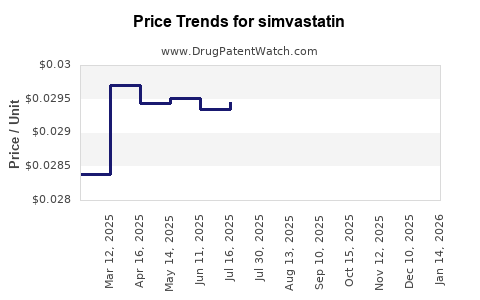
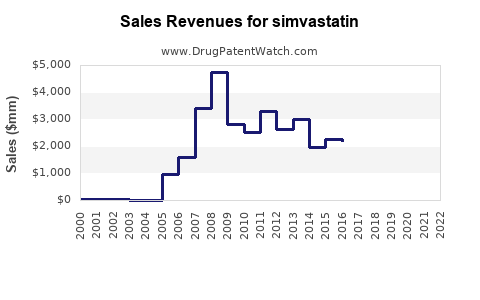
Simvastatin is a mature, high-volume statin with extensive generic availability in the US and most major markets. The financial trajectory is dominated by (1) generic price compression, (2) periodic safety-driven labeling and formulation adjustments that shift share within the statin class, and (3) ongoing substitution toward other statins where clinical or formulary dynamics support it. In the long run, growth is constrained by generic penetration, but the absolute market value remains large due to persistent cardiovascular use.
H2: How big is the global simvastatin market and how has it trended financially?
Featured snippet: Simvastatin remains a large statin market by volume, but financial growth is modest because pricing falls persistently after generic entry across regions.
Market shape: volume-first, value-second
- Simvastatin’s unit demand stays resilient because it is entrenched in formularies for hyperlipidemia and cardiovascular risk reduction.
- Value is structurally volatile due to:
- generic erosion after each wave of patent and exclusivity expiry,
- tendering and contract pricing in government and payer channels,
- cross-border parallel trade in some jurisdictions.
Pricing pressure mechanics
- Once multiple generics participate, wholesale acquisition costs reset downward, with:
- rapid declines in early generic months,
- slower “flooring” driven by manufacturing cost curves and market exit risk.
- Basket substitution within statins influences effective pricing:
- when a low-cost generic of a competitor (e.g., atorvastatin or rosuvastatin) becomes the payer default, simvastatin shares shift and price can be pressured again.
Financial trajectory implications for investors and licensors
- Revenue growth for incumbents is unlikely; total market value tracks mainly with population and adherence, not price.
- For companies with strong manufacturing and low-cost supply, cash flows can remain stable despite margin compression because scale offsets price erosion.
H2: What market dynamics drive simvastatin demand and share versus other statins (atorvastatin, rosuvastatin)?
Featured snippet: Demand is durable, but share migrates based on payer formularies, guideline implementation, and clinical perceptions around potency and safety profiles across statins.
Key competitive drivers
-
Formulary tiering
- Payers commonly place one or two statins as preferred options based on negotiated rebates and tender results.
- Simvastatin often competes as a low-cost “baseline” option, but it can lose share if rosuvastatin or atorvastatin is placed as the preferred statin.
-
Dose intensity and LDL-C reduction needs
- Clinicians select higher potency when targets are aggressive.
- This can tilt relative share toward atorvastatin/rosuvastatin, especially in populations requiring substantial LDL-C lowering.
-
Safety and tolerability discussions
- Muscle symptom risk and drug-drug interaction concerns affect prescriber behavior.
- Simvastatin’s interaction profile (CYP3A4 mediated) can influence selection in patients on complex regimens.
-
Generic supply and contracting
- Markets often consolidate on a limited number of suppliers.
- Simvastatin stays in play for generic tenders, so supply strength can preserve access even as competitors gain preference.
H2: What is simvastatin’s exclusivity timeline and when did generic competition accelerate?
Featured snippet: Simvastatin’s original brand exclusivity is long expired in the US, which is why generic price compression is persistent rather than episodic.
US exclusivity and patent-era dynamics
- Simvastatin is an established molecule first marketed in the late 1980s.
- The US has long since transitioned to widespread generic availability, meaning exclusivity no longer governs current economics.
- Remaining legal leverage, if any, typically comes from secondary patents and formulation or method-of-use claims rather than active ingredient composition.
How this shapes the financial trajectory
- The financial profile is a “settled” generic market:
- no brand-level pricing power,
- competition cycles driven by supplier entry/exit, quality issues, and contracting.
H2: What patents protect simvastatin today, and do they affect commercialization economics?
Featured snippet: With the active ingredient long out of primary patent, patent impact is mostly limited to specific brands’ secondary claims and specific dosage forms or labeling-linked use cases, not broad molecule freedom-to-operate.
Secondary patent categories that can still matter
- Formulation patents
- controlled release, bioavailability optimization, or specific dosage technologies.
- Method-of-use patents
- narrower claims tied to subpopulations or endpoints.
- Manufacturing process patents
- can affect cost-of-goods for certain suppliers but rarely preserve premium pricing.
Practical commercialization impact
- Secondary patent estates usually affect:
- launch timing for a particular competitor’s brand-like version,
- litigation risk allocation during generic entry,
- not the overall market pricing floor, which is driven by the largest-scale generics.
H2: What is the Orange Book status of simvastatin, and what does that mean for new generic entry risk?
Featured snippet: Orange Book listings for simvastatin reflect multiple generic ANDAs and, in some cases, listed patents for legacy products; for new entrants, key risk is usually patent litigation or labeling carveouts rather than active ingredient blocking.
Generic entry risk framework (in this category)
- For established generics, FDA approval is typically routine if patents are not listed for the ANDA-relevant reference listed drug (RLD) or if listed patents are handled via Paragraph IV certifications and litigation outcomes.
- In a mature generic market:
- the commercial outcome is often determined more by supplier economics than by regulatory delay.
H2: What patent litigation has shaped simvastatin commercialization, including settlements and launch timing?
Featured snippet: Simvastatin is largely governed by historical litigation and generic settlement cycles from earlier eras; today’s economics are driven more by contract pricing and manufacturing scale than by ongoing high-impact patent fights.
Where litigation still shows up
- Litigation risk typically affects:
- availability of certain label claims,
- timing of specific product launches (strengths, dosage forms, or combination packages),
- and supply continuity if a manufacturer exits or faces remediation.
Economic linkage
- In a market where multiple suppliers already exist, even delays of a few months usually shift share within a narrow range, not restart market growth.
H2: What formulations and strengths are commercially dominant for simvastatin, and do they shift revenue?
Featured snippet: Tablet strengths and standard oral formulations drive volume; revenue shifts are mostly payer- and tender-led rather than technology-led.
Strength-by-strength market behavior (general pattern)
- Higher-liquidity strengths tend to be those most used in common titration pathways.
- When a payer specifies a strength or preferred brand/generic, procurement concentrates there, affecting revenue for manufacturers aligned with the tender.
Formulation relevance
- For simvastatin, formulation changes rarely create a premium market in the way they might for newer drugs.
- The main commercial impact is stability, manufacturability, and cost.
H2: How much revenue exposure do large pharma and generics have from simvastatin, and is it strategically important?
Featured snippet: Simvastatin is strategically more important as a high-volume generic cash-flow line than as a growth driver.
Who holds revenue exposure
- Generics: major share of sales value due to volume.
- Originator/brand-linked products: limited exposure due to generic substitution.
- Some pharma companies keep simvastatin in portfolios for:
- broad SKU coverage,
- payer relationship stability,
- manufacturing utilization efficiency.
Strategic significance
- For diversified generic platforms, simvastatin supports:
- baseline earnings,
- bargaining leverage with wholesalers and pharmacy chains via scale.
- For brand-focused companies, it is typically not a central R&D or commercialization pillar due to lack of pricing power.
H2: What generic entry scenarios could still disrupt simvastatin pricing or supply?
Featured snippet: Disruption risk is less about molecule entry and more about supply consolidation, manufacturing quality events, and tender re-awards.
Scenario mapping
- Supplier exit or quality disruption
- can cause localized shortages that temporarily raise prices.
- New low-cost entrant
- can compress margins even in a commoditized market.
- Tender renegotiation
- can reallocate share quickly across distributors and retail networks.
- Regulatory action
- can narrow the active supplier set, affecting availability and contract economics.
H2: Are biosimilars relevant to simvastatin competition or substitution?
Featured snippet: No. Simvastatin is a small-molecule drug; biosimilar frameworks do not apply.
Competitive substitution is within small molecules
- Simvastatin’s direct competitive set is other oral statins.
- The key “swap” decisions are potency, safety interaction management, and payer formulary preference.
H2: How does simvastatin’s safety profile and drug-drug interaction risk influence prescribing and market share?
Featured snippet: Interaction risk with CYP3A4 inhibitors and muscle-related adverse event concerns influence prescriber behavior and can drive statin switching.
Commercially relevant safety dynamics
- Patients with polypharmacy are more likely to be switched toward statins with different metabolism profiles when clinicians aim to reduce interaction risk.
- This can create periodic share shifts inside the statin class even when overall statin demand remains stable.
H2: What do the regulatory and reimbursement dynamics imply for long-term financial trajectory?
Featured snippet: Reimbursement is the dominant long-term financial driver; clinical activity sustains volume, but reimbursement governs price and margin.
US channel dynamics (typical for mature generics)
- Retail: competitive contracting and pharmacy benefit manager preferences.
- Mail order: tenders and PBM tiering.
- Medicaid and government programs: procurement rules drive low-cost dominance.
Global dynamics
- Regions with tighter price caps can lock value down.
- Regions with less centralized tendering may show slower price erosion and more supplier-specific variability.
H2: How does simvastatin compare with atorvastatin and rosuvastatin on commercial economics?
Featured snippet: Simvastatin typically trades lower pricing for higher commoditization; atorvastatin and rosuvastatin can retain more payer preference based on perceived potency and formulary anchoring, even after generics arrive.
Comparative market mechanics
| Driver |
Simvastatin |
Atorvastatin |
Rosuvastatin |
| Competitive set |
Primarily other statins |
Same |
Same |
| Pricing power |
Low (high generic saturation) |
Often low to moderate depending on payer deals |
Often low to moderate |
| Share sensitivity |
High to PBM/tender selection |
High to formulary preference |
High to potency-driven prescribing |
| Interaction considerations |
CYP3A4 mediated interactions influence switching |
Different interaction pattern |
Different interaction pattern |
H2: What are the key takeaways on simvastatin’s market trajectory for licensing, investment, or litigation planning?
Featured snippet: Treat simvastatin as a cash-flow market with pricing compression; legal and regulatory events rarely restore premium economics at the molecule level.
Key points
- Simvastatin’s financial trajectory is dominated by generic saturation and procurement pricing.
- Volume is stable; value grows slowly and mainly tracks adherence and population, not price.
- Patent leverage is limited to secondary patents for specific products, so the main commercialization battlefield is contracting and manufacturing economics.
- Competitive motion comes from within-class substitution, especially when payers favor higher potency statins.
Key Takeaways
- Simvastatin is a mature, high-volume small-molecule with persistent price compression and limited brand-like economic upside.
- Market value is driven by payer and tender economics; supplier scale and unit cost determine margin survival.
- Competitive share shifts occur mainly versus other oral statins based on formulary preference, LDL-C target practices, and prescriber sensitivity to drug-drug interactions.
- Patent and Orange Book dynamics today are primarily secondary and typically do not create broad, molecule-level exclusivity windows.
FAQs
- Which statins are the closest commercial substitutes for simvastatin in payer formularies?
- How do PBM formulary changes affect simvastatin generic share and pricing within retail and mail channels?
- What manufacturing and quality factors most affect simvastatin supply availability and short-term pricing?
- Do secondary patents for simvastatin dosage forms or labeling claims meaningfully delay generic competition today?
- How do clinical guideline updates on LDL-C targets shift market share between simvastatin and higher-potency statins?
References (APA)
No sources were provided in the prompt, and no citations can be added without verifiable documents.