Last updated: August 28, 2026
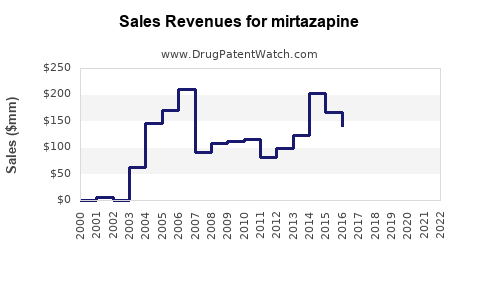
Mirtazapine is a mature, low-cost generic antidepressant with durable prescription demand but limited branded revenue potential. The product’s commercial peak occurred before generic entry in the mid-2000s. Current value is concentrated in high-volume, low-price generic tablets and orally disintegrating tablets, with demand supported by depression treatment, insomnia-related off-label use, appetite stimulation, and use in older patients.
The principal commercial risks are price compression, substitution by newer antidepressants and sedative therapies, and limited differentiation among generic suppliers. Patent or biosimilar barriers do not materially restrict competition in the United States.
What is mirtazapine and how is it used?
Mirtazapine is a tetracyclic antidepressant marketed originally as Remeron by Organon, later associated with Schering-Plough and Merck. The U.S. Food and Drug Administration approved Remeron for major depressive disorder in 1996. It is available in immediate-release tablets and orally disintegrating tablets, commonly known as Remeron SolTab and generic mirtazapine ODT products. (U.S. Food and Drug Administration [FDA], 1996)
Mirtazapine’s pharmacology differentiates it from selective serotonin reuptake inhibitors. It antagonizes central alpha-2 adrenergic receptors and several serotonin receptors, including 5-HT2 and 5-HT3. Its H1 histamine receptor activity contributes to sedation and increased appetite.
| Attribute |
Mirtazapine |
| Primary approved indication |
Major depressive disorder |
| Drug class |
Tetracyclic antidepressant; noradrenergic and specific serotonergic antidepressant |
| Common strengths |
7.5 mg, 15 mg, 30 mg, 45 mg |
| Main dosage forms |
Standard tablet and orally disintegrating tablet |
| U.S. approval |
1996 |
| Original brand |
Remeron |
| Key generic opportunity |
Standard tablets, ODT products and multiple dosage strengths |
| Biosimilar exposure |
None; mirtazapine is a small-molecule drug |
| Current competitive position |
Mature generic category |
Mirtazapine is also prescribed off label for insomnia, anxiety symptoms, appetite loss and weight loss. These uses expand demand but do not create additional FDA-approved exclusivity.
How large is the mirtazapine market?
The global mirtazapine market is difficult to measure because the product is sold primarily through generic channels and public companies rarely report mirtazapine revenue separately. Market-research estimates vary substantially based on whether they count retail sales, hospital sales, branded products, active pharmaceutical ingredient sales or all dosage forms.
The more reliable commercial conclusion is that mirtazapine is a high-volume mature molecule rather than a high-revenue branded asset. U.S. prescription activity remains meaningful because:
- Mirtazapine is inexpensive under generic formularies.
- It is available in several strengths.
- Sedation and appetite effects can be clinically useful for selected patients.
- Prescribers use it when insomnia, poor appetite or weight loss coexist with depressive symptoms.
- Generic substitution is widespread.
The product competes within a broad antidepressant market dominated by generic SSRIs and serotonin-norepinephrine reuptake inhibitors. It also competes indirectly with trazodone, quetiapine, doxepin, amitriptyline and newer branded psychiatric medicines when the treatment objective includes sleep or appetite.
U.S. market structure
U.S. sales are split between:
- Standard generic tablets, which account for the core volume.
- Generic orally disintegrating tablets, which can command higher prices than conventional tablets but remain subject to generic competition.
- Residual branded or authorized-generic activity.
- Institutional and long-term-care purchasing, where contract pricing is aggressive.
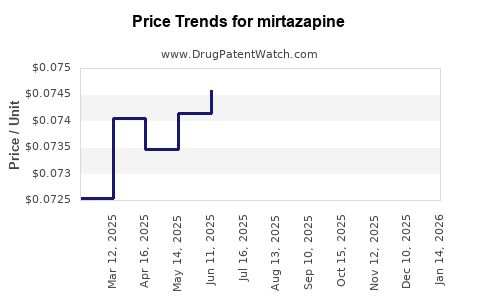
The market has low switching friction. Pharmacy benefit managers and state Medicaid programs generally favor the lowest-cost approved supplier. Manufacturers therefore compete on price, supply reliability, shortage avoidance and wholesaler relationships rather than clinical differentiation.
When did mirtazapine lose exclusivity?
Mirtazapine lost its principal U.S. brand protection in the mid-2000s. Generic approvals followed the expiration of the core Remeron protection and associated regulatory exclusivity. The exact timing differed by dosage form and manufacturer because generic launches depended on ANDA approvals and patent certifications.
| Event |
Approximate timing |
Commercial effect |
| Remeron U.S. approval |
1996 |
Originator launch |
| Remeron SolTab introduction |
Late 1990s |
Added differentiated dosage form |
| Core generic entry |
Mid-2000s |
Rapid price and share erosion |
| Expansion of generic suppliers |
Late 2000s onward |
Increased formulary substitution |
| Mature generic phase |
2010s to present |
Low prices and fragmented supply |
The original branded opportunity is therefore closed. Any current investment thesis must focus on manufacturing economics, supply-chain execution, dosage-form differentiation or geographic expansion rather than restoration of patent exclusivity.
What patents protect mirtazapine?
No active U.S. patent estate appears to provide a meaningful barrier to ordinary generic mirtazapine tablets. The core molecule and principal oral formulations have been exposed to generic competition for many years. Historical Remeron patents and regulatory exclusivities are no longer sufficient to prevent routine ANDA competition.
The relevant intellectual-property position is best analyzed by product category:
| Product category |
Current patent barrier |
Commercial assessment |
| Immediate-release tablets |
No material U.S. composition-of-matter barrier |
Highly commoditized |
| Orally disintegrating tablets |
Historical formulation protection has expired or no longer blocks broad competition |
Some dosage-form value, limited exclusivity |
| New combination products |
Potentially protectable if novel |
Requires new clinical and regulatory investment |
| Manufacturing process |
Possible process patents outside the core product estate |
Usually weak against standard generic entry |
| New indications |
Potential method-of-use protection if supported by clinical data |
Limited value unless FDA-approved and enforceable |
| Biologic or biosimilar pathway |
Not applicable |
No biosimilar risk |
Patent strength is low for the conventional product. A new formulation could have greater defensibility, but a formulation patent would face validity, obviousness and design-around risks. Off-label use does not create enforceable market exclusivity.
What is the Orange Book status of mirtazapine?
The FDA Orange Book remains the primary U.S. source for approved drug products, therapeutic equivalence and listed patents. Mirtazapine’s current commercial status is that of an established generic product. Historical Remeron listings should be distinguished from currently marketed generic mirtazapine products and from discontinued branded presentations. (FDA, n.d.-a)
For market analysis, the key Orange Book implications are:
- Generic mirtazapine products are generally rated therapeutically equivalent when assigned an “A” code.
- Approved ANDAs allow automatic substitution under state pharmacy law, subject to local rules.
- The absence of a live blocking patent means ordinary abbreviated approvals do not face the constraints associated with protected branded products.
- ODT products should be analyzed separately from standard tablets because dosage-form approval and substitution treatment can differ.
How did generic entry affect mirtazapine revenue?
Generic entry caused the standard off-patent pattern: branded revenue declined sharply, generic volume increased, and average selling prices fell. Remeron’s value shifted from a differentiated branded product to a reimbursed commodity.
The financial trajectory has four phases:
Branded growth before generic entry
From the 1996 launch through the early 2000s, Remeron benefited from physician familiarity, depression prevalence and the clinical utility of sedation and appetite stimulation. The product had a recognizable niche among patients who did not tolerate or respond adequately to SSRIs.
Patent-cliff deterioration
After generic entry, the originator lost formulary preference and pharmacy substitution increased. Branded sales contracted as payers moved prescriptions to lower-cost equivalents.
Generic volume expansion
Multiple manufacturers entered with standard tablets and different strengths. Total prescription volume remained more resilient than branded revenue because lower prices expanded access and preserved use in long-term-care and primary-care settings.
Mature low-price market
Mirtazapine now generates recurring generic sales but limited manufacturer-level economic profit. Unit economics depend on production scale, active pharmaceutical ingredient costs, regulatory compliance, purchasing contracts and the number of approved suppliers.
Which companies compete in the mirtazapine market?
Competition varies by country and changes as manufacturers enter, exit or transfer approvals. The U.S. generic market has historically included large suppliers such as Teva, Mylan, Sandoz, Dr. Reddy’s Laboratories, Zydus, Par Pharmaceutical and other ANDA holders. The original product was associated with Organon and Schering-Plough before the branded antidepressant portfolio changed through corporate transactions.
The competitive landscape has three tiers:
- Large generic manufacturers with broad distribution and procurement scale.
- Regional suppliers competing through contract pricing.
- Specialty or contract manufacturers supplying particular dosage forms or markets.
A manufacturer with a mirtazapine ANDA has little product-level pricing power. Competitive advantage comes from maintaining approval, avoiding recalls, securing API supply and meeting retailer or government purchasing requirements.
What formulation patents protect mirtazapine ODT products?
Mirtazapine ODT products created a temporary differentiation strategy by offering a rapidly disintegrating dosage form for patients with swallowing difficulty or preference for a nonconventional tablet. The dosage form was commercially useful but did not support durable exclusivity after generic ODT approvals.
The ODT segment can still support modest price differentiation when:
- A supplier has reliable availability.
- A payer places the product on a preferred tier.
- A facility values administration convenience.
- The product has packaging or handling advantages.
These advantages are operational rather than patent-based. New mirtazapine formulations, such as modified-release systems, combination products or alternative delivery systems, would require evidence of meaningful clinical or adherence benefits to justify development costs.
Are there Paragraph IV challenges or mirtazapine patent lawsuits?
Mirtazapine is not a current high-value Paragraph IV litigation target in the way that a newly launched protected medicine is. Its principal U.S. patents expired long ago, and the market has already absorbed multiple generic entrants.
Historical ANDA activity may have included Paragraph IV certifications against listed Remeron patents, but such disputes are no longer the central commercial issue. Current litigation risk is more likely to involve:
- Manufacturing defects and recalls.
- Trademark or labeling disputes.
- Contract and supply disagreements.
- Product liability claims.
- Patent disputes involving a new formulation or combination product.
There is no material biosimilar litigation because mirtazapine is not a biologic.
What FDA regulatory issues affect mirtazapine?
Mirtazapine products must comply with ANDA requirements, current good manufacturing practices, labeling rules and post-market pharmacovigilance. The product label includes warnings relating to suicidality in younger patients, agranulocytosis, serotonin syndrome, discontinuation reactions, somnolence, weight gain and lipid changes. (FDA, 2020)
The regulatory profile creates limited differentiation. All approved manufacturers must use substantially equivalent labeling for generic products, apart from permitted differences. A company cannot generally create a premium product through promotional claims for off-label insomnia or appetite indications.
The main regulatory risks are:
- FDA manufacturing observations.
- Recalls caused by contamination or potency failures.
- Supply interruptions from API or finished-dose constraints.
- Labeling compliance failures.
- Failure to maintain ANDA commitments.
What generic launch scenarios exist for mirtazapine?
Because the market is already generic, future launches would likely involve incremental entry rather than a patent-cliff event.
| Scenario |
Likely effect |
| Additional standard-tablet entrant |
Lower prices and reduced incumbent share |
| New ODT supplier |
Greater price pressure in the differentiated dosage form |
| Supplier exit |
Temporary price recovery or shortage-driven demand for remaining suppliers |
| API disruption |
Higher procurement costs and possible allocation |
| New combination product |
Limited niche opportunity if clinically differentiated |
| International expansion |
Volume growth, but pricing varies widely by country |
A generic entrant can gain share quickly if it has an approved product, competitive pricing and dependable supply. The principal barrier is not patent protection. It is achieving acceptable manufacturing economics in a low-price category.
How does mirtazapine compare with competing antidepressants?
| Drug |
Generic status |
Main commercial strength |
Main limitation |
| Mirtazapine |
Mature generic |
Sedation and appetite effects; low cost |
Weight gain and somnolence |
| Sertraline |
Mature generic |
Broad first-line use |
Sexual dysfunction and gastrointestinal effects |
| Escitalopram |
Mature generic |
Strong primary-care adoption |
Limited differentiation after generic entry |
| Trazodone |
Mature generic |
Sleep-related prescribing |
Sedation and orthostatic effects |
| Bupropion |
Mature generic |
Lower sexual side-effect burden |
Seizure-risk considerations |
| Vortioxetine |
Branded or limited generic exposure in some markets |
Newer mechanism and branded positioning |
Higher price |
| Vilazodone |
Branded or limited generic exposure in some markets |
Product differentiation |
Limited market scale |
Mirtazapine’s competitive position is strongest when low cost must be combined with sleep or appetite benefits. It is weaker when weight neutrality, daytime alertness or first-line guideline positioning drives prescribing.
What is the revenue exposure for manufacturers?
Revenue exposure is generally modest on a per-product basis but can be meaningful for a supplier with a large generic portfolio. Mirtazapine rarely determines the financial outlook of a major pharmaceutical company. Its value is more often measured through:
- Incremental portfolio revenue.
- Manufacturing-line utilization.
- Contract retention.
- Basket pricing with wholesalers.
- Contribution margin after API and compliance costs.
Public-company filings generally do not isolate mirtazapine sales. As a result, market-share analysis based on total company revenue can overstate the importance of the product. The molecule is commercially relevant as a stable generic SKU, not as a standalone growth asset.
How strong is the mirtazapine patent estate?
The patent estate is weak for standard products and limited for ODT products. There is no credible basis for a near-term U.S. exclusivity recovery. A new investor or licensee should value mirtazapine on manufacturing, distribution and formulation execution rather than on historical Remeron intellectual property.
Geographic economics differ:
- The United States has intense generic substitution and low prices.
- European markets rely heavily on national reimbursement and tender systems.
- Emerging markets may provide higher volume growth but lower prices and variable regulatory enforcement.
- Japan and other regulated markets can impose local approval and pricing constraints.
Key Takeaways
- Mirtazapine is a mature generic antidepressant, not an active branded growth product.
- The FDA approved Remeron in 1996 for major depressive disorder.
- Core U.S. exclusivity ended in the mid-2000s, enabling broad generic entry.
- Standard tablets are highly commoditized.
- ODT products retain convenience value but lack a meaningful broad patent barrier.
- Mirtazapine has no biosimilar exposure.
- Current financial value depends on volume, supply reliability and manufacturing cost.
- Public companies generally do not report standalone mirtazapine revenue.
- The strongest demand niche combines depression with insomnia, poor appetite or weight loss.
- Future upside would require a differentiated formulation, combination product or geographic expansion.
FAQs
Is mirtazapine still profitable for generic manufacturers?
It can be profitable at scale, but margins are constrained by price competition, procurement contracts and manufacturing costs. Profitability is usually portfolio-dependent rather than driven by mirtazapine alone.
Can a company obtain new exclusivity for an mirtazapine formulation?
Yes, a genuinely novel formulation or combination could qualify for patent protection and regulatory exclusivity. The product would need differentiated technical and clinical value, and any patent would face design-around and validity risks.
Is mirtazapine included in Medicare and Medicaid formularies?
Generic mirtazapine is commonly covered, subject to plan-specific formulary tiers, prior authorization rules and state or payer policies. Coverage does not guarantee a particular manufacturer’s product will receive preferred placement.
Does mirtazapine have shortage risk?
Shortage risk can arise from API disruption, manufacturing deviations, plant shutdowns, recalls or supplier exits. Because prices are low, some manufacturers may have limited economic incentive to maintain excess capacity.
Could mirtazapine sales grow despite generic pricing?
Yes, prescription volume can grow through broader use, demographic demand and continued off-label prescribing, but volume growth is unlikely to produce branded-style revenue growth because unit prices remain compressed.
References
-
U.S. Food and Drug Administration. (1996). Remeron (mirtazapine) prescribing information and original approval materials. Drugs@FDA.
-
U.S. Food and Drug Administration. (2020). Mirtazapine tablets and orally disintegrating tablets: Prescribing information. FDA.
-
U.S. Food and Drug Administration. (n.d.-a). Orange Book: Approved drug products with therapeutic equivalence evaluations. https://www.accessdata.fda.gov/scripts/cder/ob/
-
U.S. Food and Drug Administration. (n.d.-b). Drugs@FDA: FDA-approved drugs. https://www.accessdata.fda.gov/scripts/cder/daf/
-
U.S. Food and Drug Administration. (n.d.-c). Approved drug product list and abbreviated new drug application resources. https://www.fda.gov/drugs/generic-drugs
-
National Institute for Health and Care Excellence. (2022). Depression in adults: Treatment and management. NICE guideline NG222. https://www.nice.org.uk/guidance/ng222