Last updated: June 2, 2026
thylprednisolone Market Dynamics and Financial Trajectory (US and Global)
Methylprednisolone is a long-established systemic corticosteroid with a large, price-sensitive market dominated by generics, multiple manufacturers, and high procurement leverage. Financial trajectory is shaped less by patent-driven exclusivity and more by (1) generic supply, (2) hospital contracting and formulary decisions, (3) shortages and capacity swings, (4) payer steering toward lower net prices, and (5) reimbursement pressure for high-cost acute uses. Expansion opportunities concentrate in hospital-focused injectable demand and niche specialty pathways rather than broad brand-like growth.
How big is the methylprednisolone market and what drives demand?
The methylprednisolone market is primarily demand-led by acute-care and inflammatory indications requiring systemic steroids. Core drivers include inpatient and emergency utilization patterns, neurology and oncology supportive care (where applicable), and chronic autoimmune disease relapses treated with steroid courses.
What are the main therapeutic use cases for methylprednisolone?
Featured usage categories that influence procurement volume and seasonality:
- Neurology: steroid pulses for inflammatory demyelinating conditions (practice varies by guideline and payer).
- Rheumatology and immunology: flare management and bridging therapy.
- Respiratory and allergic disease: acute exacerbations and refractory inflammation (where systemic steroids are standard).
- Oncology support: anti-inflammatory steroid premedication and regimen components (depends on regimen and protocol).
- Transplant and graft-related inflammation: supportive corticosteroid use in protocols (site-specific).
- Dermatology off-label/systemic: oral methylprednisolone for systemic inflammatory dermatoses (varies by clinician and payer).
What product forms dominate the market?
Demand is typically split across:
- Injectables (IV/IM): highest relevance to acute hospital procurement and rapid administration.
- Oral tablets and dose packs: chronic and outpatient steroid taper use.
- Other forms: less material to overall market dynamics versus oral and injectable.
What drives market share for manufacturers?
Market share tracks with:
- GPO and IDN contracts for hospital injectables.
- Acquisition timing and distribution reach for outpatient oral products.
- Reliability of supply and shortage history, which can temporarily shift allocation to constrained SKUs.
- Net price levels shaped by competitive tendering and payer formularies.
How do generic competition and procurement shape pricing for methylprednisolone?
Methylprednisolone is widely generic. Price behavior is typical of mature steroid molecules:
- Net price compression after each competitive entry wave.
- Low differentiation across generics for most stakeholders, shifting competition to cost, supply reliability, and contract terms.
- Tender-driven pricing for hospital injectable SKUs with multi-source availability.
What does pricing pressure mean for revenue trajectory?
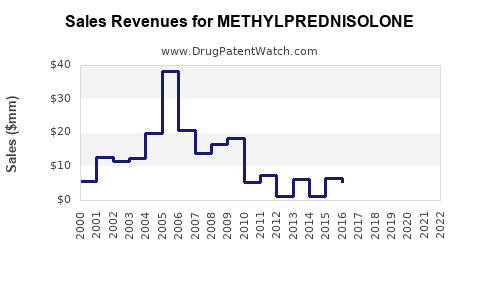
Revenue growth tends to be modest in real terms, and total revenue is more sensitive to:
- unit volumes (case incidence, hospital admissions, seasonal inflammatory patterns),
- mix (injectable vs oral, higher-acuity dosing),
- and supply constraints that create temporary pricing relief.
When supply expands and multiple generics compete on the same vial strengths, net pricing typically falls faster than volume rises.
How do shortages affect short-term financial outcomes?
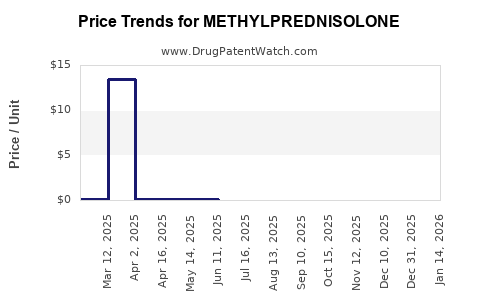
Corticosteroid shortages can create temporary pricing spikes, allocation premiums, and substitution to in-stock products. Financial impact concentrates in:
- quarters with constrained supply,
- SKUs that become “preferred” during allocation,
- and manufacturers with manufacturing capacity stability.
Shortages reverse when capacity normalizes across competitors.
Does methylprednisolone have major patents or exclusivity that influence market timing?
Methylprednisolone’s base molecule is longstanding and is not the kind of drug where exclusivity drives multi-year revenue runway. Commercial dynamics are primarily governed by:
- patent estate status for specific formulations, delivery systems, and manufacturing processes,
- any remaining orphans/niche exclusivity (if applicable to specific reformulations),
- and regulatory exclusivities tied to specific NDA/ANDA products rather than the active ingredient.
What matters for market exclusivity in practice?
For methylprednisolone, investors and licensors typically underwrite exclusivity at the product level:
- specific injectable presentations (strength, package, route, and stability profile),
- specific oral dosage presentations (formulation and release characteristics),
- manufacturing method patents that protect compliance processes, stability, or yield.
How does the Orange Book status affect competitive entry?
In mature corticosteroid molecules, the Orange Book usually shows:
- many ANDAs with broad generic coverage,
- limited remaining time windows for specific formulation or method-of-use products,
- and complex overlaps where the “blocking” right is often product-specific rather than molecule-wide.
Because this question depends on current Orange Book listings by each exact methylprednisolone NDA/ANDA product and strength, the actionable takeaway is that market timing is best modeled as SKU-by-SKU entry and supply, not as a single molecule exclusivity curve.
When do methylprednisolone generics lose exclusivity and what generic entry risks exist?
There is no single “methylprednisolone exclusivity loss date” that defines the entire competitive landscape. Instead, generic entry risk is tied to:
- whether a particular methylprednisolone presentation has enforceable patents (formulation, process, or method-of-use),
- whether challengers successfully file Paragraph IV (or Section viii carve-out strategies),
- and whether a specific product is subject to exclusivity from first-to-file ANDAs or data exclusivity for a particular route/strength package.
What is the Paragraph IV landscape likelihood for methylprednisolone?
Paragraph IV challenges can occur for product-specific patent sets, but for an established corticosteroid the majority of risk is already “de-risked” because:
- multiple sources exist,
- older patents often expired or are not asserted broadly,
- and remaining disputes are typically narrow to specific presentations.
How does biosimilar risk apply?
Biosimilar risk does not apply in the standard sense because methylprednisolone is a small molecule corticosteroid, not a biologic.
What is the financial trajectory for methylprednisolone at the company level?
Financial outcomes vary by manufacturer role:
- Low-margin diversified generic players: methylprednisolone often contributes steady but price-sensitive revenue with limited upside.
- Hospital-specialty generic producers: injectable mix can add more stable demand, but pricing compresses quickly once competitors are fully contracted.
- Manufacturers with supply constraints: can record quarter-level outperformance during shortages and allocation periods.
Key pattern in mature generic steroids
- Revenue is relatively stable in volume but fluctuates in net price.
- Operating profit follows net price more than volume.
- Working capital and manufacturing utilization matter because batch yields and inspection outcomes drive cost of goods.
What revenue risks matter most?
Primary risks:
- new generic entrants reduce net pricing,
- contract renewals reset hospital pricing,
- manufacturing disruptions or quality events reduce shipment volume,
- policy shifts that encourage non-steroid alternatives for specific indications.
How does methylprednisolone compare with other corticosteroids on market dynamics and pricing?
Compared with other systemic corticosteroids (prednisone, dexamethasone, hydrocortisone, prednisolone), methylprednisolone typically faces:
- strong generic parity,
- pricing determined by tendering and procurement,
- and preference cycles influenced by clinician familiarity, vial packaging, and dosing equivalency protocols.
Why can mix matter more than molecule choice?
Clinicians may switch between corticosteroids based on:
- dosing schedules,
- infusion logistics,
- and historical responsiveness of patients in that facility.
For companies, this means methylprednisolone’s revenue trajectory depends on hospital protocol adoption and drug-room stocking practices as much as clinical practice guidelines.
What regulatory and supply factors affect methylprednisolone financial performance?
FDA and manufacturing compliance
Generic injectables are exposed to:
- CMC inspection outcomes,
- sterility assurance and particle control compliance,
- and label-change or formulation adjustments that can delay shipments.
Shortage reporting and allocation
In the US, shortages can change distribution behavior and pricing temporarily. Long-run impact is constrained once additional production is added.
Which companies are likely the main players and how does competitive landscape influence pricing?
Competitive landscapes for mature injectables include multiple ANDA holders per strength. Pricing pressure is strongest where:
- multiple suppliers can meet hospital demand with comparable lead times,
- and the contracting process prioritizes net price.
How many SKUs and strengths matter commercially?
For methylprednisolone, each strength and presentation can behave like a separate mini-market:
- some strengths are more heavily used in acute settings,
- some packaging formats are more preferred by institutions,
- and some SKUs are more prone to stockouts during capacity disruptions.
What formulations are protected by patents and how does that change commercialization?
For mature small molecules, actionable IP typically clusters around:
- specific injectable formulation stability,
- manufacturing processes that improve yield or reduce impurities,
- and packaging or delivery features that improve handling in clinical settings.
How do formulation patents show up in litigation or licensing?
Where patents exist, they often create:
- narrow litigation (specific strengths/packaging),
- settlement-driven timed entry,
- and “design-around” filings that change composition slightly or use alternative process steps.
What methylprednisolone litigation and settlements affect generic launch timing?
In mature corticosteroids, litigation is commonly:
- product-specific and narrow in scope,
- driven by formulation or process claims rather than the underlying molecule,
- and resolved through settlement agreements that define entry dates or carve-outs by strength/route.
The business impact is often timing, not elimination of competition. Financial models typically treat settlements as “schedule shifts” that determine near-term shipment volumes.
Key Takeaways
- Methylprednisolone revenue is primarily volume- and procurement-led, not exclusivity-led, because the active ingredient is long out of patent-driven brand territory.
- Generic competition drives sustained net price compression, with financial outcomes most sensitive to tender terms and contract renewals.
- Injectable SKUs are the principal swing factor for quarters, due to acute-care demand and shortage-driven allocation effects.
- Product-level IP and regulatory status determine timing at the SKU level, not the molecule level, so modeling must be presentation-specific.
- Operational reliability is a financial lever for manufacturers: CMC compliance and supply stability can outweigh marginal pricing differences.
FAQs
- How do GPO contracts impact methylprednisolone net price for hospitals?
- Which methylprednisolone strengths and presentations tend to be most affected by shortages?
- What is the typical timeline for generic ANDA approval and market entry for mature injectables like methylprednisolone?
- How do formulation or manufacturing process patents delay methylprednisolone generic competition?
- How does switching between methylprednisolone and alternative corticosteroids affect market volume share in acute care?
References
- FDA. Orange Book: Approved Drug Products with Therapeutic Equivalence Evaluations. (Accessed via FDA Orange Book).
- FDA. Drug Shortages: FDA Safety Alerts and Drug Shortage Reports. (Accessed via FDA drug shortage database).
- FDA. Approved Drug Products and Therapeutic Equivalence Evaluations (ANDA and NDA regulatory framework materials). APA format entries vary by product page.