Last updated: October 13, 2026
Montelukast sodium is a mature, globally genericized leukotriene receptor antagonist marketed originally by Merck as Singulair. Its core U.S. patent protection ended in 2012, followed by generic entry and a rapid decline in branded revenue. The product remains commercially relevant because of high prescription volume, low manufacturing complexity, broad availability, and use in asthma and allergic rhinitis. Its principal market risks are price erosion, substitution by inhaled therapies and antihistamines, and regulatory restrictions arising from neuropsychiatric adverse-event concerns.
What is montelukast sodium and how is it used?
Montelukast sodium is the sodium salt of montelukast, a selective cysteinyl leukotriene type 1 receptor antagonist. It blocks leukotriene-mediated bronchoconstriction, airway inflammation, and vascular permeability.
The FDA-approved indications for Singulair included:
- Prophylaxis and chronic treatment of asthma
- Prevention of exercise-induced bronchoconstriction
- Relief of symptoms of seasonal allergic rhinitis
- Relief of symptoms of perennial allergic rhinitis
The product has been sold in several dosage forms:
| Dosage form |
Common strength |
Primary use |
| Film-coated tablet |
10 mg |
Adults and adolescents |
| Chewable tablet |
4 mg, 5 mg |
Pediatric patients |
| Oral granules |
4 mg |
Young children |
Montelukast is generally administered once daily. It is not a rescue medicine for acute bronchospasm and does not replace inhaled short-acting bronchodilators.
In 2020, the FDA required a boxed warning for serious neuropsychiatric events, including suicidal thoughts or actions, associated with montelukast. The FDA advised against prescribing montelukast for mild allergic rhinitis when alternative treatments are available (U.S. Food and Drug Administration, 2020).
When did montelukast lose market exclusivity?
Montelukast lost effective U.S. market exclusivity in 2012. The original Singulair franchise had benefited from patent protection, pediatric exclusivity, and substantial physician adoption in asthma and allergy care.
| Event |
Approximate date |
Commercial effect |
| Singulair FDA approval |
1998 |
Launch of the branded franchise |
| Pediatric oral granule approval |
2000s |
Expanded use in young children |
| Core U.S. patent expiration |
2012 |
Generic entry became possible |
| U.S. generic approvals |
2012 onward |
Rapid price and share erosion |
| FDA boxed warning |
March 2020 |
Reduced use in mild allergic rhinitis and increased prescribing scrutiny |
Merck’s core montelukast patent protection was widely reported as expiring in 2012, with pediatric exclusivity extending the effective protection period into 2013. Generic approvals began in 2012, including products from companies such as Teva and Apotex.
The precise end date differs by patent, regulatory exclusivity, jurisdiction, and dosage form. The commercial result was consistent: branded Singulair lost its ability to sustain premium pricing after generic launch.
What patents protect montelukast sodium?
The principal U.S. patent estate protected montelukast’s chemical entity and related pharmaceutical use. The most commercially important patent was U.S. Patent No. 5,565,473, assigned to Merck-related entities and directed to montelukast compounds and pharmaceutical compositions.
Core patent protection
| Patent or protection |
Subject matter |
Status |
| U.S. Patent No. 5,565,473 |
Montelukast compound and related pharmaceutical protection |
Expired |
| Pediatric exclusivity |
Regulatory extension linked to pediatric studies |
Expired |
| Formulation and dosage-form patents |
Chewable tablets, granules, compositions, and manufacturing aspects |
Expired or commercially nonblocking in the U.S. |
| Method-of-use patents |
Asthma, allergic rhinitis, and exercise-induced bronchoconstriction uses |
Expired or of limited practical value |
Montelukast’s composition-of-matter protection was the most valuable component of the estate. Once that protection expired, secondary patents could not preserve the original branded revenue base because generic companies could generally enter with approved versions that did not infringe enforceable, unexpired claims.
Are formulation patents still a material barrier?
Formulation patents have limited commercial significance for standard montelukast products. Chewable tablets, oral granules, and immediate-release tablets can be manufactured using established pharmaceutical technologies. The molecule does not require a complex delivery device, sterile processing, biologic manufacturing platform, or sophisticated sustained-release system.
A formulation patent could still matter for a narrow product presentation, flavor system, particle-size distribution, or manufacturing process. Such protection would generally be less effective than a composition patent because competitors can design around a narrow claim set.
What is the Orange Book status of montelukast?
Montelukast sodium is an established small-molecule prescription drug with generic approvals listed in the FDA’s Approved Drug Products with Therapeutic Equivalence Evaluations, commonly called the Orange Book.
The Orange Book historically listed Singulair patents and related exclusivity information. The core patent listings have expired. Generic montelukast products are approved in multiple strengths and dosage forms, including tablets, chewable tablets, and oral granules.
Current commercial protection does not depend on a live branded Orange Book patent estate. The key regulatory issues are therapeutic equivalence, labeling, dosage-form availability, and compliance with the boxed-warning requirements.
Which companies are challenging or competing with Singulair?
Generic competition is broad and fragmented. Major suppliers have included Teva, Apotex, Mylan, Sandoz, Dr. Reddy’s Laboratories, Lupin, Aurobindo, Torrent, and other regional manufacturers.
The competitive market has two layers:
- Generic montelukast suppliers compete primarily on price, supply reliability, wholesaler access, and dosage-form coverage.
- Therapeutic alternatives compete on clinical positioning, including inhaled corticosteroids, combination inhalers, antihistamines, nasal corticosteroids, and biologic asthma therapies.
Representative competitors include:
| Product or class |
Competitive relationship |
| Generic montelukast |
Direct substitution for Singulair |
| Inhaled corticosteroids |
Core controller alternative for asthma |
| ICS/LABA combinations |
Stronger controller option for moderate or persistent asthma |
| Intranasal corticosteroids |
Alternative for allergic rhinitis |
| Oral antihistamines |
Common alternative for allergy symptoms |
| Biologic asthma therapies |
High-cost treatment for severe eosinophilic or allergic asthma |
Clinical guidelines have generally placed leukotriene receptor antagonists below inhaled corticosteroids for many patients with persistent asthma. This positioning limits montelukast’s ability to regain pricing power even when generic supply is constrained.
How has Singulair revenue changed since generic entry?
Singulair was one of Merck’s largest products before patent expiry. Its commercial decline illustrates the typical small-molecule loss-of-exclusivity pattern: high peak sales, rapid generic share capture, and persistent unit demand at sharply lower prices.
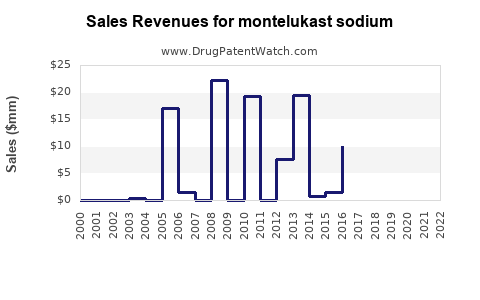
Merck reported Singulair sales of approximately $5.5 billion in 2011. Sales fell materially after generic availability and reached approximately $1.0 billion in 2013, according to Merck annual-report disclosures (Merck & Co., 2012, 2014).
| Period |
Financial trajectory |
| Pre-expiry period |
Global branded sales at multibillion-dollar scale |
| 2011 |
Approximately $5.5 billion in Singulair sales |
| 2012 |
Decline began as U.S. generic competition emerged |
| 2013 |
Sales fell to roughly $1 billion |
| Post-2013 |
Branded revenue became substantially less important |
| Current market |
High-volume, low-price generic business |
The decline reflected more than generic substitution. Prescription behavior also shifted toward inhaled corticosteroids, combination inhalers, and alternative allergy medicines. The 2020 boxed warning created another demand constraint, especially in allergic rhinitis.
What is the current market structure for montelukast sodium?
Montelukast is a mature, price-sensitive generic market. Its economic value is concentrated in volume rather than molecule-level exclusivity.
Demand drivers
- Large installed patient population
- Once-daily oral administration
- Pediatric chewable and granule formulations
- Use across asthma and allergic rhinitis
- Availability through retail and mail-order pharmacies
- Low acquisition cost for payers and patients
- Continued use in markets with limited access to inhaled therapies
Demand constraints
- Generic price erosion
- Substitution by inhaled corticosteroids
- Expanded use of biologic therapies in severe asthma
- Safety concerns involving neuropsychiatric events
- Reduced use for mild allergic rhinitis
- Limited differentiation among generic suppliers
- Payer preference for low-cost alternatives
Public companies generally do not report montelukast revenue separately after genericization. Financial analysis therefore requires product-level prescription, volume, and average selling price data from commercial databases. Public filings support the historical branded trajectory but do not provide a reliable current global market total.
What is the FDA regulatory status of montelukast?
Montelukast remains FDA-approved and commercially available by prescription. The principal regulatory development is the March 2020 boxed warning concerning serious neuropsychiatric events.
The FDA recommended that healthcare professionals:
- Ask patients about psychiatric history before prescribing
- Discuss potential neuropsychiatric risks
- Monitor for behavioral or mood-related changes
- Avoid montelukast for mild allergic rhinitis unless alternatives are inadequate or not tolerated
The warning did not remove montelukast from the market. It changed the benefit-risk assessment for allergic rhinitis and increased the importance of appropriate patient selection.
Are biosimilars a risk to montelukast?
No. Biosimilar risk is not applicable because montelukast sodium is a chemically synthesized small molecule, not a biologic.
The relevant competitive risk is generic substitution under the Abbreviated New Drug Application pathway. Generic montelukast products must demonstrate pharmaceutical equivalence and bioequivalence to the reference product. They do not face the clinical development burden associated with biosimilar approval.
What Paragraph IV challenges and litigation affected montelukast?
Montelukast was the subject of generic patent challenges before its core U.S. exclusivity expired. Generic applicants commonly used Paragraph IV certifications to assert that listed patents were invalid, unenforceable, or not infringed.
The principal commercial dispute was tied to generic entry against Merck’s Singulair patent estate. Settlement and litigation activity helped shape the timing of market entry, but the central commercial result was generic availability in 2012.
Because the relevant composition and formulation patents have expired, current U.S. litigation risk is low relative to the period before loss of exclusivity. Potential disputes are more likely to involve:
- Manufacturing processes
- Trade secrets
- Contract manufacturing agreements
- Product recalls
- Regulatory compliance
- Labeling and pharmacovigilance
- Narrow formulation claims in specific jurisdictions
A current, material patent lawsuit comparable to the original Singulair Paragraph IV disputes is not a central feature of the montelukast market.
What licensing deals affect montelukast sodium?
Montelukast’s original commercial value was tied primarily to Merck’s internal discovery, development, manufacturing, and global commercialization capabilities. After generic entry, licensing economics became less important than supply agreements, authorized-generic arrangements, and contract manufacturing.
Commercial arrangements may still exist at the regional level, especially for:
- Private-label generic supply
- Hospital and government tenders
- Pediatric dosage forms
- Local marketing authorizations
- Contract manufacturing
- Distribution rights
These arrangements generally do not create durable molecule-level exclusivity. They support volume access and market coverage rather than premium pricing.
How strong is the patent estate for montelukast today?
The patent estate is commercially weak in the United States and other major markets because the core patents have expired.
| Patent-strength factor |
Current assessment |
| Composition-of-matter protection |
Expired |
| Regulatory exclusivity |
Expired |
| Standard formulation protection |
Expired or nonblocking |
| Generic availability |
Broad |
| Manufacturing complexity |
Low to moderate |
| Biosimilar barrier |
Not applicable |
| Pricing power |
Low |
| Litigation leverage |
Limited |
| Geographic variation |
Meaningful in smaller or slower generic markets |
Remaining value may exist in local markets where regulatory registration is limited, supply is concentrated, or generic competition is weak. That value arises from execution and distribution, not from a defensible global patent moat.
What generic launch scenarios exist for montelukast?
The standard U.S. generic launch scenario has already occurred. Future commercial changes are more likely to involve consolidation, shortages, supplier exits, or regional expansion.
Base case
Multiple generic suppliers remain active. Prices stay low, prescription volume remains stable, and revenue accrues primarily to high-volume manufacturers with efficient procurement and distribution.
Supply-concentration case
Manufacturers exit because of low margins, regulatory costs, or manufacturing disruptions. Remaining suppliers gain temporary volume and pricing leverage, but new entrants can often enter because patent barriers are absent.
Demand-decline case
Prescribing falls as clinicians favor inhaled corticosteroids, newer asthma therapies, and non-montelukast allergy treatments. Generic volume declines gradually, with limited effect on patient access because alternatives are available.
Regional-growth case
Demand grows in emerging markets where oral asthma therapy is more accessible than inhaled therapy. Revenue growth depends on local reimbursement, tender pricing, regulatory approval, and distribution rather than patent exclusivity.
How does montelukast compare with competing asthma drugs?
| Attribute |
Montelukast sodium |
Inhaled corticosteroids |
Biologic asthma therapies |
| Molecular type |
Small molecule |
Small molecule |
Biologic |
| Administration |
Oral, once daily |
Inhaled |
Injection or infusion |
| Patent position |
Largely expired |
Varies by product |
Often active |
| Price |
Low generic pricing |
Generic and branded range |
High |
| Role in therapy |
Controller or adjunct |
Core controller for many patients |
Severe disease |
| Manufacturing barrier |
Low to moderate |
Device and formulation complexity |
High |
| Biosimilar exposure |
None |
None in conventional sense |
Material |
| Commercial outlook |
Stable volume, low margin |
Larger competitive market |
Growth with high payer scrutiny |
Montelukast’s commercial advantage is convenience and low cost. Its disadvantages are weaker guideline positioning for persistent asthma and safety concerns in allergic rhinitis.
Key Takeaways
- Montelukast sodium is a mature, genericized small-molecule drug.
- Singulair lost core U.S. patent protection in 2012, with pediatric exclusivity extending effective protection into 2013.
- Merck’s Singulair sales peaked at approximately $5.5 billion in 2011 and fell to roughly $1 billion by 2013.
- No biosimilar risk exists because montelukast is not a biologic.
- The current market is driven by prescription volume, low-cost manufacturing, regional distribution, and tender access.
- The FDA boxed warning issued in 2020 reduced the attractiveness of montelukast for mild allergic rhinitis.
- Patent litigation and Paragraph IV challenges were historically important but are not current primary barriers.
- Generic pricing power is low, although temporary supply concentration can improve manufacturer economics.
- The strongest long-term competitors are inhaled corticosteroids, combination inhalers, antihistamines, and biologic therapies for severe asthma.
FAQs
Is montelukast sodium still profitable for generic manufacturers?
Yes, but profitability depends on manufacturing efficiency, scale, procurement, and supply reliability. The molecule does not support branded-level margins.
Can a company obtain new patent protection for montelukast?
A company may pursue narrow patents covering a specific formulation, process, combination, or delivery approach. Such patents would not restore broad composition-of-matter exclusivity.
Is montelukast an over-the-counter drug in the United States?
No. Montelukast remains a prescription drug in the United States.
Does montelukast have a durable pediatric market?
Pediatric demand remains commercially relevant because chewable tablets and oral granules provide convenient administration. The market is still exposed to generic price erosion and neuropsychiatric safety monitoring.
What is the principal investment risk in the montelukast market?
The main risk is commodity-style generic economics: low prices, limited product differentiation, supplier consolidation, regulatory costs, and substitution by alternative asthma and allergy therapies.
References
Merck & Co., Inc. (2012). 2011 annual report. Merck & Co.
Merck & Co., Inc. (2014). 2013 annual report. Merck & Co.
U.S. Food and Drug Administration. (2020, March 4). FDA requires boxed warning about serious mental health side effects for asthma and allergy drug montelukast. https://www.fda.gov/
U.S. Food and Drug Administration. (2024). Approved drug products with therapeutic equivalence evaluations. U.S. Department of Health and Human Services.
U.S. Patent No. 5,565,473. (1996). Montelukast compounds and pharmaceutical compositions. United States Patent and Trademark Office.