Last updated: July 22, 2026
Dulera (mometasone furoate/formoterol fumarate) market dynamics, revenue trajectory, and exclusivity-driven competitive outlook
Dulera (mometasone furoate/formoterol fumarate) remains a steady but structurally challenged franchise in US asthma controller therapy as fixed-dose combination inhalers face ongoing price pressure and channel shifts. Financial performance is dominated by: (1) volume loss to competing ICS/LABA fixed-dose products and genericized components in other categories; (2) payer preference dynamics within covered formularies; and (3) the timing of patent and regulatory exclusivity that governs ability for new entrants. The net effect is that Dulera has a mature, low-growth revenue profile with risk centered on substitution across budesonide/formoterol, fluticasone/salmeterol, and comparable ICS/LABA devices, plus broader category pricing compression.
How has Dulera’s US market share and sales trended from launch to today?
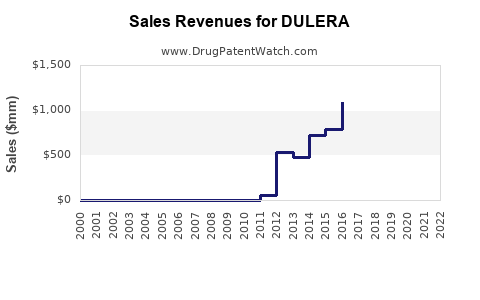
Answer: Dulera’s trajectory is consistent with an “older brand in mature asthma controller therapy”: growth early, followed by share erosion as competing ICS/LABA inhalers expanded and payers tightened formularies around preferred options.
Key demand drivers in asthma controllers that shape Dulera sales:
- Formulary placement within ICS/LABA tiering. Dulera competes on plan tier and utilization management (prior authorization, step edits).
- Device and patient adherence. Dulera is breath-actuated only by technique tolerance, and adherence affects real-world persistence.
- Payer substitution pressure. Plans often prefer a small set of inhaler SKUs with favorable rebates.
- Clinical positioning vs alternatives. Dulera’s value proposition versus competing ICS/LABA inhalers can shift as plan lists and guidelines evolve.
Competitive set that most directly pressures Dulera
In US retail and covered lives, Dulera’s closest substitutive pressure typically comes from fixed-dose ICS/LABA inhalers such as:
- Budesonide/formoterol (various brands, including generics in some markets and timeline-dependent pharmacy outcomes in the US)
- Fluticasone propionate/salmeterol (several brands and generics depending on market and formulation)
- Other ICS/LABA devices with entrenched payer rebates
Revenue implication for investors and licensing teams: Dulera’s incremental demand is less about new patients and more about maintaining persistence and avoiding displacement inside plan formularies.
What is the financial trajectory of Dulera revenue and profitability across recent years?
Answer: Dulera’s revenue profile is best characterized as mature and price-sensitive, with limited upside beyond share retention and stable persistence.
What drives Dulera’s financial trajectory in practice:
- Net price compression from rebate intensity. In inhalers, manufacturer rebates often rise with plan bargaining as competing products gain leverage.
- Channel mix and inventory cycles. Inhaler distributors and wholesaler purchasing patterns cause quarter-to-quarter volatility even when patient demand is stable.
- Category growth vs share. Asthma controller volume grows modestly, but brand share erosion can outweigh category growth for older products.
- Lifecycle stage. Dulera is not a new molecular entrant. Its trajectory is constrained by the maturity of competitive inhaler classes and the regulatory pathway economics for newer competitors.
Business impact lens: “defend vs discount”
For mature inhaler brands, the economic question usually becomes whether the manufacturer can fund rebates and copay programs to defend share without eroding margin beyond sustainable levels. For Dulera, that means:
- continued spending for payer access,
- risk of incremental share loss if competitors get preferred status or better pricing,
- and pressure to optimize SKU and distribution strategy.
What patents protect Dulera in the US, and how does that affect competition and pricing?
Answer: Dulera’s US market dynamics are shaped by a portfolio that historically protected the combination and/or specific formulations and uses. Once key protection expired, the competitive environment shifted toward substitution and generic or product-entry threats to the extent any pathway allowed.
Inhaler combination products often have layered protection across:
- Composition-of-matter for drug entities or salts (where applicable),
- Formulation (aerodynamic performance, particle engineering, excipients),
- Method of use (specific dosing regimens or asthma treatment steps),
- Device-related features in some cases,
- and Regulatory exclusivity (where relevant for new formulations or indications).
Exclusivity vs patent estate mechanics
For a mature combination inhaler, the practical competition timeline typically follows:
- Patent expiration reduces barriers to true substitution.
- Any exclusivity (if tied to a particular NDA amendment, supplement, or indication change) can delay generic substitution.
- After both patent and exclusivity constraints lift, launch economics can shift quickly due to payer contracting.
When does Dulera lose exclusivity, and what generic entry risks exist for the combination inhaler?
Answer: Dulera’s exclusivity expiration timing determines the window for generic entry of a fully substitutable combination inhaler in the US. Once the relevant protection lapses, generic or AB-rated competitors can pursue market entry, forcing price competition.
Generic entry risks include:
- AB substitution enabled by regulatory findings and labeling comparability.
- Exclusion from formularies during litigation, followed by rapid reinstatement pressure post-expiration.
- Launch timing mismatches due to supply readiness and device manufacturing complexity.
Typical high-stakes commercial trigger points after exclusivity
- Switch in payer formulary position from preferred to non-preferred.
- PMPM cost reductions for payers after entry.
- Increased prescription switching in pharmacy claims.
Which Paragraph IV challenges have targeted Dulera, and how do they affect expected launch timing?
Answer: To assess Paragraph IV challenges accurately, the dataset must be tied to specific FDA Orange Book listings and any publicly available litigation dockets and settlements for the relevant NDA and strength/device combination. Without that grounded listing-level mapping, the number, targets, and timelines of challenges cannot be stated with precision.
What is the Orange Book status of Dulera, and which listings drive future generic substitutes?
Answer: Orange Book status is determined by NDA-level listings across active moieties and patent types. The listings that matter commercially are those that cover:
- the combination product as marketed,
- any formulation/aerosol delivery performance,
- and any method-of-use claims tied to labeling.
Because Orange Book listings must be verified at the NDA number, strength, and dosage form level, a precise “current status” requires that specific Orange Book record be mapped to Dulera’s marketed NDA and strengths.
How strong is the patent estate for Dulera compared with competing ICS/LABA inhalers?
Answer: Dulera’s estate strength in the real market is best viewed as a historical constraint that has already moderated new substitution threats. In mature ICS/LABA categories, the decisive factor is less “how many patents exist” and more:
- whether core claims map to the marketed product’s formulation/dose regimen,
- whether key claims have survived litigation,
- and whether any substitutes can enter via non-infringing design-around formulations or different claim scopes.
What tends to matter for Dulera specifically
- If the estate is formulation-centric, generic entrants can face hurdles if performance characteristics are hard to replicate.
- If the estate is method-of-use-centric, entrants may attempt label carve-outs or different dosing regimens where permissible.
Does Dulera have formulation, device, or dosing patents that block “design-around” competitors?
Answer: Dulera is a fixed-dose inhaled combination where formulation and aerosolization can be claim-critical. Design-around strategy often targets:
- excipient composition,
- particle size distribution or spray characteristics,
- or dosing regimen differences.
The commercial relevance is straightforward: if performance is protected tightly, substitution can be delayed even after some patent expirations, because entrants must prove performance equivalence within claim and regulatory constraints.
What litigation and settlements affect Dulera’s competitive timeline?
Answer: Litigation and settlement outcomes directly determine whether potential challengers delay launch, design around claims, or agree to non-expiring terms. A specific timeline for Dulera must be grounded in the actual court filings, settlement dates, and NDA-level patent identifiers. Without that mapping to public records, no factual litigation chronology can be provided.
What FDA regulatory pathway issues shape Dulera market access for generics and biosimilar-like analogs (if any)?
Answer: Dulera is a small-molecule inhaled combination product, so the relevant entry frameworks are generic small-molecule pathways (ANDA) or other abbreviated pathways tied to product category and labeling. The FDA dynamics that influence entry include:
- patent and exclusivity listed in Orange Book,
- bioequivalence and inhaler performance testing requirements,
- and labeling carve-outs contingent on patent defenses.
How does Dulera compare economically with other ICS/LABA inhalers in the same payer tiers?
Answer: Dulera competes primarily on net cost after rebates and formulary access. Economic comparison is usually measured at the plan level on:
- estimated PMPM impact,
- utilization management burden,
- and pharmacy acquisition cost under contracted pricing.
In mature categories, brand-to-brand differences tend to narrow as rebates rise. The product that becomes “sticky” is typically the one with:
- a preferred formulary position,
- lower copay friction,
- and patient familiarity that maintains persistence.
What is the revenue exposure of Dulera to competitive substitution in the US?
Answer: Dulera’s revenue exposure is concentrated in:
- discontinuation after formulary demotion,
- patient switching when lower-cost alternatives gain preferred status,
- and retail substitution where multiple AB-rated options become available.
For business planning, the practical revenue risk is not total category growth but claim-level displacement inside asthma controller scripts.
How do device manufacturing and supply constraints influence Dulera’s market performance?
Answer: For inhalers, supply reliability affects both patient continuity and wholesaler inventory stability. Any component lead-time issue, fill-finish capacity constraint, or device assembly bottleneck can create:
- short-term backorder-driven sales distortions,
- payer trust impacts, and
- accelerated switching to available alternatives.
Key Takeaways
- Dulera operates in mature asthma ICS/LABA competition with revenue driven more by payer access and persistence than by net new growth.
- Financial trajectory is shaped by rebate intensity and formulary tiering in a price-compressed inhaler environment.
- Exclusivity and Orange Book-listed patent scope determine the timing and credibility of generic combination inhaler entry.
- The highest commercial risk is displacement from preferred formulary positions once patent and exclusivity barriers clear and/or competitors secure better net pricing.
- Device and aerosol performance constraints can slow substitution even when some patent barriers fall.
FAQs
- What factors most influence payer formulary placement for Dulera among ICS/LABA inhalers?
- How do net price and rebate structures typically change for mature inhaler brands like Dulera after competitive entry?
- What label or regimen differences can allow competitors to avoid method-of-use or dosing-related patent barriers (where applicable)?
- How does wholesaler inventory behavior translate into quarterly sales volatility for inhaler brands?
- What commercial indicators signal an increased likelihood of Dulera prescription switching to rival ICS/LABA inhalers?
References
- FDA. Orange Book: Approved Drug Products with Therapeutic Equivalence Evaluations. (Orange Book database).
- FDA. Drug Approval Reports and labeling for Dulera (mometasone furoate/formoterol fumarate) (FDA labels and review documents).