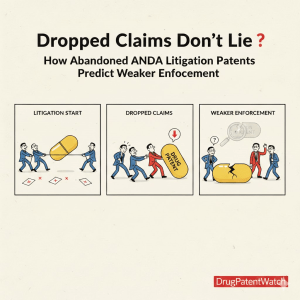
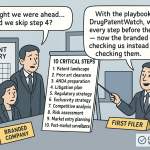
How Abandoned ANDA Litigation Patents Predict Weaker Enforcement
The Most Underrated Signal in Generic Drug Intelligence
When a brand pharmaceutical company drops a patent claim in the middle of ANDA litigation, most generic manufacturers treat it as a procedural footnote. Their lawyers log the voluntary dismissal, update the case file, and move on. That is a mistake.
A dropped claim in Hatch-Waxman litigation is not procedural housekeeping. It is intelligence. It tells you, with reasonable precision, that the patent owner concluded the claim was too expensive to defend, too narrow to win on, or too legally fragile to risk in front of a judge who might invalidate it permanently. Any of those conclusions, once drawn by the brand itself, substantially changes the enforcement calculus for every remaining patent in the same family.
The generic pharmaceutical industry generates roughly 90 percent of all U.S. prescriptions by volume while capturing only about 20 percent of prescription drug revenue by dollar value. The financial distance between a successful paragraph IV challenge and a failed one can be a 180-day exclusivity period worth hundreds of millions of dollars, or the absence of it. In that context, a dismissed patent claim is not a footnote. It is a map.
This article goes deep on that map. It explains the mechanical and strategic reasons patent claims get abandoned during ANDA litigation, traces the historical patterns that reveal which types of abandonments predict genuine enforcement weakness, and shows how generic drug companies, patent analysts, and investors can use that data to make better decisions. Throughout, it draws on case-level data available through DrugPatentWatch, the industry’s primary platform for pharmaceutical patent and FDA approval data, to illustrate exactly how these signals appear in practice.
The central argument is this: systematic analysis of claim-level abandonment in ANDA litigation, not just case-level outcomes, produces a predictive signal for future enforcement weakness that most market participants ignore. The companies and analysts who learn to read it will have a durable competitive advantage over those who do not.
___
The Hatch-Waxman Framework: A Designed Battleground
How the System Creates Structured Conflict
The Drug Price Competition and Patent Term Restoration Act of 1984, universally called Hatch-Waxman after its sponsors, created the legal architecture within which every ANDA patent dispute occurs. To understand what an abandoned claim signals, you first need to understand why claims get litigated in the first place.
Hatch-Waxman resolved a structural problem in pharmaceutical markets. Brand companies investing in clinical trials needed patent protection long enough to recover those costs. Generic companies needed a pathway to enter the market without repeating the same clinical work. The compromise it created gave both sides something, but it also created a highly specific conflict zone: the paragraph IV certification.
When a generic manufacturer files an Abbreviated New Drug Application with the FDA and believes a listed patent is invalid, unenforceable, or not infringed by their formulation, they file a paragraph IV certification. That certification is statutorily deemed an act of patent infringement under 35 U.S.C. 271(e)(2). The brand company then has 45 days to sue. If it does, the FDA imposes an automatic 30-month stay on generic approval, giving the brand company time to litigate. If the brand wins, the generic stays off the market. If the generic wins, or if the brand fails to sue within 45 days, the approval process continues.
This structure means that every ANDA patent case begins at the brand company’s discretion. The brand decides whether to sue, which patents to assert, and which specific claims within those patents to put before the court. Those decisions are not made randomly. They reflect careful legal and commercial analysis. And when the brand later drops a claim or a patent from the case, that reversal reflects a recalculation. Understanding what drove that recalculation is where the analytical value lies.
The Orange Book and the Fortress of Listed Patents
The FDA’s Orange Book, formally titled Approved Drug Products with Therapeutic Equivalence Evaluations, lists all patents that the brand company has declared relevant to a drug’s active ingredient, formulation, or method of use. Brands list patents selectively, and they list them strategically. A patent does not get into the Orange Book by accident. The brand certifies to the FDA that the patent claims cover the approved product, and that listing has legal consequences.
Generic manufacturers use the Orange Book as their litigation target list. Every patent listed for a given drug is a potential obstacle, and for each one, the generic must either certify that the patent is expired, certify that the generic product will not be approved until after the patent expires, or file a paragraph IV certification challenging it.
The result is that Orange Book patents and their specific claims represent the brand’s declared enforcement priorities. When the brand later withdraws from asserting a specific claim during litigation, it is withdrawing from a position it previously chose, under penalty of false statement to a federal agency, to declare relevant to its approved product. That makes the withdrawal meaningful.
What Happens Inside ANDA Litigation
An ANDA patent case typically unfolds over two to four years. After the complaint is filed, the parties exchange contentions about which claims are at issue and why each side believes it will prevail. The next major phase is Markman, or claim construction, where the court determines what the patent claims actually mean. Discovery runs in parallel. Expert reports on validity and infringement come next, followed by summary judgment motions, and then trial if nothing resolves earlier.
At every one of these stages, the brand company has the opportunity to drop claims. They drop claims when claim construction goes against them. They drop claims when validity becomes untenable under the prior art the generic has uncovered. They drop claims when their own experts cannot sustain an infringement opinion at the higher bar required for trial. They drop claims when the litigation economics shift and paying the 180-day exclusivity to settle is cheaper than the projected cost of continuing to assert a particular theory.
Each of those reasons has a different implication for the remaining portfolio. A claim dropped because of a single adverse Markman ruling tells you something specific about the interpretive risk of similar claims. A claim dropped because prior art was found tells you something about the quality of the patent prosecution behind the whole family. Understanding which category an abandonment falls into is the analytical work that converts raw case data into actionable intelligence.
___
Taxonomy of Abandonment: What “Dropped” Actually Means
Voluntary Dismissal Under Rule 41
The most common mechanism for dropping a patent claim in federal litigation is a voluntary dismissal under Federal Rule of Civil Procedure 41. A brand company files a notice stating it is dismissing its claims with respect to certain patents or patent claims, and those claims disappear from the case. If the dismissal is without prejudice, the brand theoretically retains the right to re-assert the claims in a later action. If it is with prejudice, the claims are gone permanently as against that defendant.
The distinction between with and without prejudice matters a great deal. A voluntary dismissal without prejudice after claim construction suggests the brand lost the Markman ruling and does not want a binding adverse judgment, but may hope to assert the patent against a different generic filer whose product differs enough to avoid the same construction problem. A dismissal with prejudice, by contrast, signals that the brand has concluded the claim cannot be successfully asserted under any reasonable reading. That is a much stronger signal of permanent enforcement weakness.
In practice, many ANDA litigation dismissals are without prejudice because of res judicata concerns, but they are still revealing. A brand that drops a claim without prejudice before trial rather than arguing for the construction it wants is signaling that the expected litigation cost of continuing exceeds the expected revenue protection benefit. That ratio is the number generic manufacturers need to know.
Covenants Not to Sue
A covenant not to sue (CNS) is a contractual commitment by the patent holder to refrain from asserting a specific patent against a specific party. In ANDA litigation, CNS agreements typically emerge from settlement negotiations and can be paired with a dismissal of the pending case. They are particularly significant because they are enforceable contract rights, not just litigation decisions that could theoretically be revisited.
When a brand grants a covenant not to sue to a generic filer on a specific patent, it has made an economic judgment that the patent’s remaining enforceable life is worth less than the cost of continuing to litigate. For the recipient, the CNS eliminates a specific enforcement risk. For every other generic filer watching from the outside, it signals something about the patent’s commercial durability.
The Federal Circuit has held in cases like Caraco Pharmaceutical Laboratories v. Forest Laboratories and its progeny that covenants not to sue can create complications around counterclaims and declaratory judgment jurisdiction. Those complications sometimes give brand companies reasons to structure their exit from a patent dispute in ways that preserve optionality. But those structural choices themselves are informative. A brand that carefully engineers a dismissal to preserve maximum future optionality is a brand that still believes in the patent. A brand that grants a broad covenant not to sue is a brand that has given up on it.
Claim Narrowing Through Amendment
Not every abandonment looks like a dismissal. Some of the most analytically significant abandonments happen during prosecution or reexamination proceedings that run parallel to ANDA litigation. A brand can file a request for ex parte reexamination or, before the AIA fully transitioned the system, inter partes reexamination of its own patent, or an accused infringer can petition for post-grant review proceedings at the Patent Trial and Appeal Board.
When claims are amended or cancelled in those proceedings, the brand has effectively abandoned the original claim scope. The surviving claims are narrower, and for an ANDA filer whose generic formulation falls outside the narrowed claim scope, the patent is no longer a problem. But the abandonment tells a broader story. A brand that amends claims under validity pressure has revealed that the original claims were not as strong as they appeared when the patent was listed in the Orange Book. That revelation has implications for sibling claims in the same patent, continuation patents in the same family, and the overall quality of the prosecution record behind the brand’s portfolio.
Strategic Shedding Before Settlement
A fourth category of abandonment is strategic rather than legally compelled. Brand companies and generic manufacturers settle ANDA cases roughly 75 percent of the time before reaching a merits ruling, according to analysis of decade-long Hatch-Waxman litigation trends. Many of those settlements involve the brand dropping specific patent claims as part of the deal, even when those claims might technically be defensible.
Strategic shedding happens because the brand’s litigation goal is not necessarily to win every claim. It is to delay generic entry for as long as economically optimal. Dropping weaker claims early, concentrating resources on the two or three strongest patents or claims, and then settling on a defined entry date is often more profitable than litigating all claims to the end. The claims that get dropped in this process are not necessarily invalid. They may simply be less essential to the brand’s defined defense perimeter.
For analysts, this category is the hardest to interpret correctly. A strategically dropped claim does not carry the same enforcement-weakness signal as a claim dropped after an adverse Markman ruling. The brand may be entirely capable of winning on that claim but chose not to spend the resources. Distinguishing strategic drops from compelled drops requires looking at the sequence of events in the case: what procedural milestone preceded the dismissal, whether the brand was under any court-imposed pressure to narrow its contentions, and whether the dismissal pattern matches what you would expect from a litigation team running low on viable theories versus one executing a triage plan.
___
Reading the Pattern: What History Shows
Fifteen Years of Dismissal Data
Systematic analysis of ANDA litigation dismissal patterns over the past fifteen years reveals several consistent findings. First, claims dropped before claim construction overwhelmingly reflect strategic triage rather than legal compulsion. Brand companies file broad cases, assert every potentially relevant claim, and then narrow as they develop their Markman positions. Pre-Markman narrowing is noise more often than signal.
Second, claims dropped within 60 days of a Markman ruling are highly predictive. When claim construction goes against a brand, they typically drop the affected claims quickly rather than spending additional discovery and expert costs building a case around claims the court has already construed unfavorably. Those post-Markman drops are the clearest signal of claim-level fragility in the record.
Third, claims dropped during or after invalidity discovery, when the generic has produced prior art packages, are predictive of family-wide vulnerability. If prior art destroys a claim in one proceeding, it usually threatens sibling claims in the same family because patent families share prosecution history, and a disclosure that anticipates one claim often anticipates related ones.
Fourth, the rate at which brands drop claims in ANDA litigation has increased steadily as IPR petitions have become available post-2012. The threat of an inter partes review, where claims can be cancelled by the Patent Trial and Appeal Board with a lower proof standard than federal court invalidation, has made brands more selective about which claims they defend through the entire lifecycle of ANDA litigation. When a brand faces a credible IPR threat, it frequently drops ANDA claims it might otherwise have continued asserting, concentrating its defense on claims better suited to survive PTAB scrutiny.
The Lipitor Precedent
The litigation history of atorvastatin, sold as Lipitor by Pfizer and one of the best-selling drugs in pharmaceutical history, offers one of the clearest illustrations of how claim-dropping patterns predict enforcement weakness. Pfizer spent years defending a large portfolio of patents covering Lipitor’s active ingredient, its crystalline forms, its formulations, and its methods of use. As generic manufacturers filed paragraph IV certifications and litigation commenced, Pfizer’s behavior in dropping claims across multiple cases revealed a consistent picture.
The patents covering the base compound itself were defended aggressively through trial. The patents covering specific crystalline forms were narrowed substantially after prior art surfaced during litigation. The method-of-use patents were the first to be dropped in nearly every case, either because the generic manufacturers’ labeling did not clearly practice the claimed methods or because Pfizer’s litigation team concluded that method claims require proving induced infringement, an additional element of proof that was not necessary when the compound patents provided adequate protection.
When Pfizer lost its core compound patent rights, the compound patents had already been tested through full merits adjudication. The crystalline form patents, where claims had been dropped or narrowed during the litigation, provided far less protection. Generic manufacturers who had tracked those claim-dropping patterns understood before the expiration dates arrived which patents represented real enforcement risk and which had been effectively abandoned. They could plan their market entry timing accordingly.
Clopidogrel and the Art of the Narrow Remaining Claim
Sanofi’s defense of clopidogrel bisulfate, sold as Plavix, produced a different but equally instructive pattern. The original patent on the racemate of clopidogrel expired before generic entry became commercially significant, but Sanofi held a second patent on the dextrorotary enantiomer, the specific stereoisomer that constitutes the active ingredient of Plavix. That patent became the primary enforcement tool.
In ANDA litigation over Plavix, Sanofi was remarkably consistent about not dropping the key enantiomer claims while aggressively shedding peripheral claims around formulation and dosing. The pattern of what they kept versus what they dropped told a sophisticated analyst exactly where Sanofi believed its real enforcement boundary was. The remaining core claims survived, Sanofi prevailed in litigation, and generic entry was delayed until a court-approved settlement.
The lesson from Plavix is the inverse lesson. When a brand drops everything except a small cluster of claims and defends those to the end, the remaining claims are probably strong. The analytical value is in the contrast: brands that drop large numbers of claims while defending a small residual set are signaling that the residual set is their real fortress. Brands that drop claims more uniformly across the portfolio are signaling broader weakness.
Esomeprazole and the Enantiomer Re-Run
AstraZeneca’s defense of esomeprazole magnesium, sold as Nexium, followed a pattern that combined elements of both the Lipitor and Plavix stories. AstraZeneca held multiple patents covering the molecule, its polymorphic forms, its oral dosage forms, and methods of treatment. As ANDA filers challenged these patents across multiple cases in New Jersey and Delaware, AstraZeneca dropped several polymorphic form claims after prior art surfaced showing that the crystalline form in question had been described in earlier literature.
The pattern that emerged from the Nexium litigation was highly predictive: the claims AstraZeneca dropped early, the polymorphic form claims, were the claims where multiple generic manufacturers eventually prevailed on invalidity grounds after AstraZeneca chose to defend them in some cases while dropping them in others. The inconsistent treatment of these claims across different ANDA cases, defending them against some filers while dropping them against others, itself became a signal. When a brand picks and chooses which defendants it will defend a claim against, it is revealing that the claim cannot survive the full adversarial process.
___
The Mechanics of Reading Dropped Claims Predictively
Step One: Map the Original Claim Set
The starting point for any dropped-claim analysis is the complete original claim set asserted at the beginning of litigation. This typically appears in the complaint, the infringement contentions filed shortly thereafter, and the joint claim chart if one is required by local patent rules. Most federal district courts that handle significant ANDA dockets, the District of Delaware, the District of New Jersey, and the Northern District of Illinois in particular, have local patent rules requiring early disclosure of asserted claims.
DrugPatentWatch aggregates this case-level information, linking Orange Book listings to litigation records, claim assertion data, and trial outcomes. For a generic manufacturer evaluating a specific drug’s patent landscape before filing an ANDA, the starting question is always: what claims has the brand historically asserted in prior ANDA litigation for this product, and which of those claims did they eventually pursue through final judgment versus drop along the way?
The claim map you produce at this step is your baseline. You need to know what 100 percent of the original claim set looks like before you can identify which 40 or 60 percent was dropped and under what circumstances.
Step Two: Track the Timing and Trigger
Once you have the original claim set, you trace each claim’s lifecycle through the case docket. The question you are asking for each dropped claim is not just when it was dropped but what happened immediately before it was dropped. The proximal cause of the abandonment is the intelligence.
A claim dropped 30 days after a Markman hearing where the court construed a key term narrowly is a Markman-driven drop. A claim dropped two weeks after the generic produced a prior art package containing a 1982 German patent application disclosing the same compound is a prior-art-driven drop. A claim dropped during settlement negotiations whose timing correlates with no particular litigation event is a strategic drop. Each has a different predictive weight.
The timing analysis requires access to complete case dockets, which are available through PACER for federal cases. Services like DrugPatentWatch layer patent-specific data on top of those dockets, flagging the key events in ANDA cases and making the timing analysis manageable. Without that layered data, doing this analysis manually across multiple cases for a single drug product would require thousands of docket entries and substantial legal expertise to interpret correctly.
Step Three: Assess Whether the Drop Was Compelled or Voluntary
The distinction between a compelled drop and a voluntary drop is the central analytical challenge. A compelled drop, where the court or the legal landscape forced the brand to abandon a claim, carries a strong signal. A voluntary drop, where the brand chose to shed claims for tactical reasons unrelated to the claim’s merits, carries a weaker signal.
Indicators of compelled drops include adverse Markman rulings on the relevant claim terms, prior art citations in invalidity contentions that were not overcome in prosecution, inter partes review petitions that received a trial institution decision on the same claims, and Federal Circuit decisions in related cases that undercut the legal theory the brand was advancing.
Indicators of voluntary strategic drops include drops that precede settlement discussions, drops that thin the claim set without any obvious legal trigger, drops that concentrate remaining claims around the brand’s most commercially important formulation, and drops that match what the brand did in earlier ANDA cases for the same product.
Step Four: Evaluate Family-Level Contagion
Patent families are related by shared disclosure. A continuation patent shares its written description with its parent. A divisional patent is required to share at least a partial overlapping disclosure. A continuation-in-part shares everything from the parent application plus new matter added in the CIP. The degree of disclosure sharing is directly relevant to how far a dropped claim’s weakness radiates through the family.
When a claim is dropped because prior art was found that anticipates or renders obvious the claimed invention, that prior art does not affect only the specific claim. It affects every claim in every patent in the family that relies on the same disclosure element for novelty or non-obviousness. If a 1990 journal article renders obvious Claim 3 of Patent A, it very likely also bears on Claim 5 of Continuation Patent B and Claim 8 of Continuation Patent C, particularly if all three claims describe variations on the same core invention.
The family-level contagion analysis is where dropped claims deliver their highest analytical value. Generic manufacturers who track not just which claims were dropped but precisely why they were dropped, and then map that reason onto the entire patent family, can identify entire patent clusters that are vulnerable before they ever appear in new litigation.
Step Five: Cross-Reference with PTAB Activity
The Patent Trial and Appeal Board proceedings created by the America Invents Act of 2011, specifically inter partes review and post-grant review, have become the second front in pharmaceutical patent challenges. As IPR petitions have grown in sophistication and the Board’s institution rates have stabilized around 60 to 65 percent for pharmaceutical cases, the interaction between PTAB proceedings and ANDA litigation has become integral to any dropped-claim analysis.
When claims are dropped in ANDA litigation after an IPR is filed on the same patent, you need to track whether the PTAB proceeding concluded with those claims cancelled, amended, or surviving. A claim dropped in ANDA litigation that was also cancelled by the PTAB in IPR provides double confirmation of weakness. A claim dropped in ANDA litigation that survived IPR intact suggests the brand may have dropped the claim for strategic, not merits-based, reasons.
The interaction runs in the other direction too. Claims that survive IPR with original scope intact are claims the brand feels confident defending across multiple forums. That confidence, demonstrated by actually litigating the IPR rather than settling it, is a positive signal of patent strength from the generic manufacturer’s perspective.
___
Case Studies in Abandonment Analysis
Imatinib and the Gleevec Patent Battles
Novartis’s defense of imatinib mesylate, the active ingredient in Gleevec for treatment of chronic myelogenous leukemia, produced one of the most analyzed patent abandonment sequences in pharmaceutical IP history. Novartis held patents on both the free base form and the beta-crystalline form of imatinib mesylate, along with method-of-use patents and formulation patents.
As ANDA filers challenged the Gleevec patents, Novartis chose to prioritize the defense of its base compound patent and its key method-of-use claims for the CML indication. The crystalline form patents, which covered a specific polymorph of imatinib mesylate, were dropped from ANDA litigation relatively early in the process. That dropping pattern was informative: it signaled that Novartis’s legal team had determined that the crystalline form patent was not necessary for adequate market protection and, critically, was more vulnerable to invalidity challenge.
The Supreme Court of India had already invalidated the corresponding Indian patent on the imatinib beta-crystalline form in 2013 under India’s Section 3(d), which prohibits patents on new forms of known substances unless enhanced efficacy is shown. While a U.S. invalidity proceeding operates under a different legal standard, the prior art analysis that drove the Indian decision was available in U.S. litigation and created a foundation for invalidity arguments that made the beta-crystal claims expensive to defend.
Generic manufacturers who tracked the claim-dropping pattern in Gleevec ANDA cases, cross-referenced with the Indian litigation outcome and the prior art discovered in that proceeding, were able to estimate with reasonable accuracy that the crystalline form claims would not survive full adversarial testing in U.S. litigation. The brands subsequent behavior in dropping those claims confirmed the analysis.
Duloxetine and the Depression Drug Battles
Eli Lilly’s duloxetine, sold as Cymbalta for depression, anxiety disorders, and pain conditions, generated extensive ANDA litigation across the District of Indiana and the District of Delaware. Lilly held an original compound patent that expired in 2013, but also held a patent on a specific enteric-coated pellet formulation that it asserted would extend protection.
The formulation patent claims were asserted against multiple ANDA filers. Lilly dropped certain formulation claims after discovery produced internal documents showing that the formulation elements it was claiming had been described in prior art pellet coating techniques used in the pharmaceutical industry for decades. The claim-dropping was not uniform: Lilly retained claims covering specific combinations of enteric coating material and drug-loading concentrations that it believed could be distinguished from the prior art.
For analysts watching the duloxetine case, the pattern was revealing. Lilly’s systematic dropping of the broader formulation claims while retaining narrow combination claims indicated that the brand believed only the most specific technical implementation could survive prior art challenge. Generic manufacturers who produced formulations not meeting those narrow technical specifications could launch products that the brand’s remaining claims could not reach. The dropping of the broader claims made clear exactly where the brand had drawn its final defensible perimeter.
Pregabalin and the Lyrica Method Claims
Pfizer’s pregabalin, sold as Lyrica for epilepsy, fibromyalgia, and neuropathic pain, produced one of the most instructive dropped-claim patterns involving method-of-use patents. Pfizer held multiple method patents covering the use of pregabalin for specific pain conditions. These method claims were initially asserted against every ANDA filer whose labeling included any of the patented uses.
As litigation proceeded, Pfizer dropped method-of-use claims against ANDA filers whose proposed labeling clearly excluded the patented indications. Skinny labeling, the practice of submitting a label that omits patented uses while including non-patented uses, became the central strategic question in the pregabalin cases. Pfizer’s decision to drop claims against specific filers who were pursuing skinny labels revealed that Pfizer’s own legal team had concluded that induced infringement liability could not be proven against a generic manufacturer selling a product under a label that does not mention the patented use.
The Federal Circuit’s subsequent decision in GlaxoSmithKline v. Teva, which created uncertainty about skinny labeling by allowing brand-side induced infringement claims even when the generic label excludes patented uses, complicated this picture. But at the time Pfizer was dropping claims, their behavior signaled that they believed skinny labeling as a defense was credible. Generic manufacturers who observed those drops could calibrate their labeling strategy accordingly.
Apixaban and the Eliquis Defense
Bristol-Myers Squibb and Pfizer’s joint defense of apixaban, sold as Eliquis for stroke prevention in atrial fibrillation, produced a different pattern. Unlike the previous examples where brands dropped claims under legal pressure, the Eliquis ANDA litigation showed a brand that dropped very few claims and that committed to defending its core patents across multiple ANDA filers.
The absence of significant claim dropping in Eliquis ANDA litigation was itself informative. BMS and Pfizer were signaling through their behavior that they believed every listed patent was defensible and that the prior art risk was manageable. That signal was borne out: the Eliquis compound patent survived ANDA litigation with minimal adjustments to the asserted claim set, and generic entry was successfully delayed for years beyond the original patent expiration.
The inverse lesson from Eliquis is important. When you see no dropping, or minimal dropping, you should look hard at whether the brand’s confidence is justified by the underlying patent strength or whether it reflects a litigation strategy of overassertion designed to intimidate. Reviewing the prosecution history of the core claims, the quality of the prior art cited during prosecution, and the distinctiveness of the claimed invention from the prior art gives you the analytical basis to distinguish justified confidence from bluster.
___
The DrugPatentWatch Data Layer
Building a Systematic Dropped-Claim Database
The analytical framework described in the preceding sections is only as useful as the underlying data that supports it. Executing dropped-claim analysis at scale, across multiple drugs, multiple patent families, and multiple ANDA filers, requires a data infrastructure that goes beyond what a team of lawyers can assemble from raw dockets.
DrugPatentWatch is the pharmaceutical industry’s most comprehensive platform for this data. It connects Orange Book patent listings, FDA approval timelines, ANDA filing histories, litigation case data, PTAB petition records, and patent expiration tracking into a unified database that covers the entire lifecycle of pharmaceutical patents in the U.S. market.
For dropped-claim analysis specifically, DrugPatentWatch’s litigation database allows users to trace the arc of specific patents across multiple ANDA cases, track assertion and dismissal patterns, and identify when a patent’s enforcement history suggests a brand has effectively retreated from key claims. The platform’s tracking of Orange Book patent expirations alongside litigation outcomes creates a combined picture of patent status that goes beyond what either the FDA data or the court records alone would show.
“Analysis of Hatch-Waxman paragraph IV litigation patterns between 2000 and 2022 shows that brand pharmaceutical companies voluntarily dismissed one or more asserted patents in approximately 58 percent of all ANDA cases that proceeded past initial complaint filing, with claim-level narrowing occurring in an estimated additional 22 percent of cases through claim construction orders and reexamination proceedings.” — FTC Hatch-Waxman Study, Drug Patent Settlement Analysis, 2022
That number, 58 percent of cases seeing voluntary dismissal of at least one asserted patent, is the scale at which this phenomenon operates. This is not an edge case. It is standard practice in ANDA litigation, which means systematic tracking of those dismissals produces data sets large enough to support meaningful pattern analysis.
Mapping Orange Book Listings to Litigation Histories
One of the most powerful analytic uses of DrugPatentWatch’s database is the ability to map every Orange Book-listed patent for a given drug against the litigation history of each patent. For most commercially significant drugs, this mapping reveals a heterogeneous enforcement record: some patents were never challenged in litigation, some were challenged and defended successfully, some were challenged and voluntarily dropped, and some were adjudicated with merits rulings.
The relative proportions of those categories tell you something important about the brand’s assessment of its own portfolio. A brand with a high proportion of never-challenged patents may have a paper fortress, patents listed in the Orange Book to deter challenges but not strong enough to actually litigate. A brand with a high proportion of successfully adjudicated patents has proven enforcement capability. The proportion of dropped or narrowed claims in the middle of that spectrum indicates where the portfolio starts to weaken.
Generic manufacturers can use this mapping to identify which Orange Book listings are genuine deterrents, which are paper deterrents, and which are somewhere in between. That calibration directly informs the risk-benefit analysis of filing a paragraph IV certification and facing litigation.
The Expiration Date Versus Litigation Date Gap
A consistently useful data point from DrugPatentWatch is the gap between a patent’s expiration date and the actual date on which the brand ceased enforcing it through active litigation. For many pharmaceutical patents, the brand stops actively defending the patent years before its statutory expiration date. Those years of difference represent protection the brand listed on the label but could not actually deliver in court.
The expiration date that appears in the Orange Book is a legal claim, not a guarantee. A patent listed as expiring in 2029 may have been effectively abandoned in litigation in 2024 because the claims cannot survive adversarial scrutiny. When the gap between nominal protection and actual enforced protection is large, it signals overlistings, a pattern where brands list patents of questionable enforceability to maximize deterrence even when they know the claims are fragile.
Systematic analysis of this gap across a large number of drugs and therapeutic categories reveals which companies engage most heavily in overlisting. Those companies have systematically weaker portfolios on a per-patent basis than their Orange Book listings suggest, and their pattern of dropping claims in ANDA litigation is correspondingly higher.
___
Why Brands Drop Claims: The Strategic Logic
Litigation Cost and the Per-Claim Economics
ANDA litigation is expensive. The American Intellectual Property Law Association estimates that a patent case with more than $25 million at risk costs the patent holder an average of $3 to $5 million per side through trial. Major ANDA cases with billion-dollar drugs at stake can cost substantially more, particularly when multiple expert witnesses, extensive prior art searches, and complex formulation chemistry are involved.
The cost is not evenly distributed across claims. Defending a simple compound claim with straightforward chemistry and well-understood prior art is cheaper than defending a complex formulation claim that requires multiple expert witnesses from different disciplines. A method-of-use claim that depends on proving induced infringement requires additional investigation of physician prescribing practices and pharmacy dispensing patterns that a structural infringement claim does not.
When a brand decides to drop a claim, one factor it is always weighing is whether the expected value of the protection that claim provides justifies the incremental cost of defending it. If a formulation claim adds two months of market exclusivity but defending it costs $1.5 million more than dropping it, and the brand is confident it will win on its compound claim anyway, dropping the formulation claim is straightforward economics. For analysts, this means that strategically dropped claims are not necessarily weak claims. They may be perfectly good claims that simply fell below the cost-benefit threshold in the context of the specific case.
The Risk of Creating Bad Precedent
A second and often underweighted reason brands drop claims is the risk of creating binding adverse precedent. When a court rules on a patent claim, that ruling may bind the brand in future cases against other defendants. A Markman ruling that construes a claim term narrowly, reducing the claim’s infringement scope, applies not just to the current defendant but to any defendant who is sued on the same claim in the same district, and has persuasive weight in other districts.
If a brand believes it will likely lose on a particular claim’s Markman construction, it may prefer to drop that claim before the court rules rather than receive an adverse ruling that locks in a narrow construction for all future cases. The drop appears voluntary, but it is actually driven by the desire to avoid an unfavorable precedent that would harm enforcement against every subsequent ANDA filer.
This dynamic is particularly acute for claims whose scope is contested across multiple ANDA filings. A brand defending the same claim against five generic manufacturers simultaneously must be careful about which cases it pushes to Markman ruling and which it resolves earlier. Losing a Markman ruling in one case can effectively unravel the enforcement strategy across all the other cases. The dropping pattern that emerges from this constraint tells analysts which claims the brand is most worried about on construction grounds.
The 30-Month Stay Expiration Problem
The automatic 30-month stay that the FDA imposes when a brand company sues within 45 days of a paragraph IV notification does not last forever. If the litigation has not produced a final judgment by the time the stay expires, the FDA can approve the generic product, and the brand must seek a preliminary injunction to continue blocking the generic from the market. Preliminary injunctions require demonstrating a likelihood of success on the merits, immediate and irreparable harm, and a balance of hardships in the brand’s favor.
Brands that cannot sustain a preliminary injunction showing on particular claims will often drop those claims before the stay expires rather than risk losing the injunction motion and having those claims permanently exposed as weak. The timing of claim drops relative to 30-month stay expirations is accordingly a useful signal. A claim dropped as the stay expiration approaches, absent any other obvious litigation trigger, suggests the brand does not believe it can make the preliminary injunction showing on that claim, which is strong evidence of enforcement weakness.
PTAB Estoppel and the IPR Interaction
Inter partes review creates a specific strategic pressure that drives some ANDA claim drops. When a patent challenger files an IPR petition and the PTAB institutes trial, the petitioner becomes estopped from raising in subsequent district court litigation any invalidity ground it actually raised or reasonably could have raised in the IPR. That estoppel runs one way: it limits the generic’s invalidity arguments in the district court, not the brand’s infringement arguments.
But the estoppel also affects the brand’s strategy. If the brand wins IPR on certain claims but loses on others, the cancelled claims obviously disappear from the ANDA case. The surviving claims have been validated by the PTAB, which may strengthen the brand’s position on those claims in district court. Brands sometimes use IPR strategically to get a faster validity ruling on their strongest claims while dropping other claims from the ANDA case to simplify the remaining issues.
The strategic use of IPR to clear patent claims, combined with dropping weaker claims from the parallel ANDA litigation, is an increasingly common pattern. Analysts who track both the PTAB docket and the ANDA litigation docket simultaneously can identify this two-front strategy and distinguish claims being actively strengthened through PTAB validation from claims being quietly abandoned.
___
Generic Manufacturer Strategy: Using the Signals
Pre-Filing Patent Landscape Assessment
The most valuable application of dropped-claim analysis is the pre-filing patent landscape assessment that a generic manufacturer conducts before deciding whether to file a paragraph IV ANDA on a particular drug. This assessment determines whether, and when, to challenge the Orange Book patents, which claims to challenge, and what invalidity arguments to develop.
A pre-filing assessment that incorporates dropped-claim analysis from prior ANDA litigation for the same drug is fundamentally different from one that looks only at the patents as written. The raw patents tell you what the brand claimed during prosecution. The litigation history tells you what the brand was actually able to defend under adversarial conditions. Those two things are often substantially different.
A specific drug may have eight Orange Book patents. Prior ANDA litigation may show that the brand dropped claims from four of those patents under prior art pressure, defended claims in two others successfully through trial, and listed two additional patents that were never challenged. A generic manufacturer doing a pre-filing assessment using this history knows immediately which of the eight patents represents genuine risk, which has already revealed its vulnerability, and which is an unknown. That knowledge shapes the litigation strategy, the expert witness selection, and the business decision about whether the 180-day exclusivity opportunity is worth pursuing.
Invalidity Argument Prioritization
Once a generic manufacturer has decided to file a paragraph IV ANDA and expects litigation, the dropped-claim history guides the prioritization of invalidity arguments in contentions. If prior ANDA litigation showed that a particular prior art reference drove the brand to drop claims, that reference should be the centerpiece of the generic’s invalidity contentions, not a backup argument. The brand’s own behavior has already validated the relevance of that reference.
This focus pays dividends in the expert witness budget. Developing and presenting an invalidity argument through an expert witness is expensive. A generic manufacturer who knows, from the brand’s prior behavior, that a specific invalidity argument was compelling enough to drive claim drops can allocate its expert resources confidently to that argument rather than spreading budget across five or six different invalidity theories.
The same principle applies to claim construction strategy. If prior Markman rulings in related cases construed a claim term unfavorably for the brand, those rulings are persuasive authority in subsequent cases. The generic manufacturer can anchor its Markman brief to those prior rulings, forcing the brand to argue for a different construction despite its own prior litigation losses, a difficult position that often makes the brand’s advocacy less credible with the court.
Settlement Timing and Authorized Entry Negotiations
Generic manufacturers that understand which claims have been abandoned historically, and which are genuinely strong, negotiate authorized entry settlements from a position of better information. An authorized entry settlement, where the brand authorizes the generic to sell the branded drug or an authorized generic version before the patent expiration date in exchange for dropping the litigation, involves a tradeoff: the generic gives up the chance to win full invalidation and open the market to all competitors, in exchange for a specific market entry date and sometimes a royalty or authorized generic license.
The negotiated entry date is the economic heart of the deal. A generic manufacturer that knows the brand’s remaining strong claims are genuinely defensible will accept a later authorized entry date because it correctly believes the brand could delay entry further through successful litigation. A generic manufacturer that knows the brand’s remaining claims are weakened by prior drops and adverse Markman rulings will push for an earlier entry date and a lower royalty, because the alternative, winning at trial, produces an earlier unconstrained entry.
Brand companies understand this dynamic too, and they use information asymmetry to extract better settlement terms. The generic’s job is to minimize that information asymmetry by doing the analytical work of dropped-claim history before sitting down at the negotiating table.
First-Filer Advantage and the 180-Day Exclusivity Decision
The 180-day marketing exclusivity period available to the first generic manufacturer to file a paragraph IV ANDA certification is the economic engine of generic pharmaceutical strategy. A successful first-filer typically earns revenue at prices close to the brand price for six months before other generics enter and prices collapse. For a drug with $2 billion in annual U.S. sales, 180-day exclusivity can be worth several hundred million dollars in incremental profit.
Deciding whether to be the first filer on a given drug is therefore one of the most consequential business decisions a generic pharmaceutical company makes. The decision requires estimating the probability of winning the resulting litigation, the timeline to market entry, the discount rate applied to future cash flows, and the cost of the litigation itself. Dropped-claim analysis directly improves the probability estimate component of this decision.
A drug whose Orange Book patents include several patents that experienced significant claim dropping in prior litigation for different formulations of the same active ingredient is a drug where the brand’s enforcement record is demonstrably imperfect. The probability of winning the paragraph IV challenge is higher than the raw patent count might suggest. That adjusted probability estimate translates directly into a higher expected value for the first-filer bet, which affects not only the go or no-go decision but also how aggressively the generic pursues litigation once it starts.
___
Investor and Financial Analyst Applications
Pricing Patent Risk in Generic Company Valuations
Generic pharmaceutical company valuations depend heavily on pipeline estimates, including the probability-weighted present value of 180-day exclusivity opportunities in development. Analysts who model those pipelines without incorporating dropped-claim history systematically misestimate the patent risk embedded in key ANDA challenges.
A generic company with a first-filed paragraph IV certification on a drug whose Orange Book patents have experienced heavy claim dropping in prior litigation has a better-than-average chance of prevailing in the resulting case. Standard pipeline models, which apply generic probability estimates to all paragraph IV challenges without adjusting for patent-specific enforcement history, undervalue that company’s pipeline relative to its actual risk-adjusted prospects.
The reverse is also true. A generic company with a first-filed certification on a drug whose Orange Book patents have been successfully defended through trial, with minimal claim dropping, has a below-average chance of prevailing. Standard models that treat all paragraph IV challenges equally overvalue this company’s pipeline.
Institutional investors and buy-side analysts who develop expertise in reading dropped-claim patterns have a durable informational advantage in valuing generic pharmaceutical companies. That advantage is particularly useful around catalysts like ANDA filing announcements, litigation milestones, and settlement disclosures, where the market often moves on incomplete information.
Brand Company Portfolio Assessment
For investors in branded pharmaceutical companies, dropped-claim analysis runs in the opposite direction. A brand company whose patents have experienced heavy claim dropping across multiple ANDA cases has a weaker defensive portfolio than its listed patents suggest. The market often values a brand’s patent-protected revenue stream by reference to the nominal patent expiration dates in the Orange Book. But those nominal dates overstate protection if the underlying claims cannot actually be enforced.
Systematic analysis of dropped-claim rates by brand company, cross-referenced with DrugPatentWatch data on litigation outcomes, allows investors to assess portfolio quality on a per-claim basis rather than a per-patent basis. A brand with 40 Orange Book patents but a history of dropping 60 percent of asserted claims under legal pressure has a weaker real portfolio than one with 20 Orange Book patents and a history of successfully defending every asserted claim.
This analysis is particularly relevant for drugs approaching patent cliff exposure, where the market is trying to estimate how long the brand can sustain exclusivity beyond the first patent expiration. A brand with a strong second-line patent that has never been dropped, successfully defended through litigation against prior art challenges, provides more reliable exclusivity than a brand with a second-line patent whose sibling claims were dropped under prior art pressure.
Event-Driven Opportunities
Dropped-claim events in ongoing ANDA litigation are material enough to affect stock prices but occur with enough frequency that systematic tracking creates trading opportunities. When a brand company drops a significant patent from ANDA litigation, the market may interpret this as a signal of weaker-than-expected exclusivity protection, which should reduce the value of the brand’s revenue stream from the affected drug. The market does not always price these events correctly or quickly.
Conversely, when a generic manufacturer achieves an adverse Markman ruling that causes the brand to drop claims, the generic’s probability of winning the overall case improves. If the generic is publicly traded, or if its 180-day exclusivity would allow it to enter the market as a competitor to a publicly traded brand, that improvement in litigation odds has equity implications.
Investors who systematically monitor ANDA litigation dockets for claim-dropping events, interpret those events using the analytical framework described here, and act on the resulting probability updates can capture informational alpha in pharmaceutical equities. The information is publicly available in court dockets; the alpha comes from the analytical work of interpreting it correctly.
___
The Predictive Model: Building a Scoring Framework
Claim-Level Factors That Predict Abandonment
Based on the historical patterns described throughout this article, you can construct a practical scoring framework for predicting which patent claims are most likely to be abandoned during ANDA litigation. This framework does not eliminate uncertainty, but it gives you a principled basis for prioritizing where to focus invalidity research and how to weight competing risks in a pre-litigation assessment.
The first factor to assess is claim type. Compound claims, covering a chemical entity itself, are the most commonly defended claims and the least commonly abandoned without a merits ruling. They are valuable, broadly infringed, and the brand’s entire market protection depends on them. Formulation claims, covering a specific dosage form or delivery system, are more frequently abandoned because they require proving infringement of specific technical parameters and are often vulnerable to prior art in formulation chemistry literature. Method-of-use claims are abandoned most often of all, because proving induced infringement requires showing that the generic’s label specifically directs the patented use, which skinny labeling can often avoid.
The second factor is prosecution history quality. A patent claim that was allowed without substantial amendment during prosecution, meaning the examiner accepted it without requiring the applicant to narrow the claims or distinguish prior art, is more likely to survive litigation because its scope is undefined by prosecution estoppel. A claim that was repeatedly rejected and substantially amended is more likely to be abandoned because the prior art that drove those amendments is typically the same prior art that will drive invalidity arguments in litigation.
The third factor is family size and claim diversity. A large patent family with many claims covering many different aspects of the same invention provides more tactical flexibility to the brand, but also more targets for invalidity challenge. Brands with large families often drop peripheral claims early because the core claims provide adequate protection without them. Small families with a few core claims are more likely to see the brand defend every claim.
The fourth factor is the prior art density in the relevant technical area. Patents covering therapeutic areas with long prior art histories, pain management, cardiovascular disease, antibiotic resistance mechanisms, are more frequently subject to prior art invalidity arguments and accordingly more frequently abandoned. Patents in more novel areas, specifically biologics, gene therapy, RNA-based therapeutics, where the prior art landscape is thinner, are less frequently abandoned on invalidity grounds.
Case-Level Factors That Predict Abandonment
Beyond claim-specific factors, case-level dynamics also predict abandonment rates. The forum is one of the strongest predictors. The District of Delaware has consistently produced more patent-holder-unfavorable Markman rulings than other ANDA-heavy jurisdictions in certain technical areas, particularly polymorphic form patents. Brands litigating in Delaware face higher abandonment rates for formulation claims than those litigating in New Jersey, historically more brand-friendly.
The sophistication of the generic manufacturer’s litigation team is a second predictor. Certain generic manufacturers have consistently produced higher-quality invalidity contentions, more focused prior art packages, and more effective Markman briefing than others. The track record of the specific law firms and technical experts on both sides affects the probability that a given set of claims will be abandoned versus defended.
The number of co-defendants is a third factor. When multiple generic manufacturers are litigating the same patents simultaneously, the brand faces greater invalidity pressure because each defendant can contribute its own prior art search results to the collective effort. Multiple defendants also create forum shopping and timing complications that sometimes force the brand to drop claims in certain cases to manage overall litigation exposure. High co-defendant counts correlate with higher brand abandonment rates.
A Working Scorecard
Combining the claim-level and case-level factors into a working scorecard produces a practical tool for pre-filing assessment. For each Orange Book-listed patent, you assign scores to the four claim-level factors and three case-level factors, producing a composite score that indicates the relative likelihood of brand abandonment if litigation proceeds.
Patents scoring high on abandonment probability deserve less weight in your litigation risk model. They are likely to be dropped or narrowed before trial, reducing the actual enforcement threat they represent. Patents scoring low on abandonment probability deserve full weight as genuine enforcement risks that may proceed to final judgment.
The scorecard is not a prediction engine with calculable certainty. It is a structured way to organize the analysis so that the limited research budget of a pre-filing assessment is directed toward the claims and patents that matter most. The goal is to distinguish the orange book listings that are paper deterrents from the ones that are real obstacles, using the brand’s own historical behavior as the primary evidence.
___
The Brand Perspective: Patent Portfolio Management After Drops
Rehabilitation Through Continuation Prosecution
When a brand’s claims are dropped or narrowed in ANDA litigation, the legal team responsible for the pharmaceutical patent portfolio does not simply accept the loss and move on. In most cases, they analyze the specific legal reason for the drop and explore whether new claims in continuation applications can recover some or all of the lost protection.
Continuation prosecution is the most common rehabilitation mechanism. If claims were dropped because of adverse Markman construction that narrowed the claim scope, a continuation application can present new claims drafted to avoid the adverse construction while still covering the branded product. If claims were dropped because of prior art, new claims in a continuation can be drafted to focus on specific structural or functional differences between the claimed invention and the prior art that the litigation process identified.
This continuation strategy creates what patent practitioners call prosecution laches risk: a brand that files continuation after continuation, repeatedly attempting to cover the same basic product with new claim language, may eventually face a defense that the prolonged prosecution is inequitable or that the continuation claims are estopped by the prosecution history of the parent. Courts have been increasingly willing to find prosecution laches where the continuation prosecution is obviously designed to generate new weapons against competitors who entered the market during the prolonged prosecution.
Evergreening and Its Limits
The dropped-claim analysis intersects directly with the pharmaceutical patent policy debate around evergreening, the practice of using continuation patents, formulation patents, and method patents to extend effective exclusivity beyond the initial compound patent’s expiration. Dropped claims are in some sense evidence that evergreening strategies have limits in the adversarial context.
Brands can list dozens of continuation and formulation patents in the Orange Book, each with nominal expiration dates that extend protection for years beyond the base compound patent. But the dropped-claim history of those patents reveals which are genuinely defensible and which are deterrent listings that cannot survive litigation. The effective patent life of a drug, as opposed to its nominal listed life, is defined by the claims the brand can actually defend, not the claims it has listed.
FDA reform proposals and legislative discussions around pharmaceutical patent listing requirements often reference the concept of requiring brands to certify that listed patents are relevant to the approved product and reasonably enforceable, going beyond the current requirement of mere relevance. Dropped-claim data provides empirical grounding for those discussions: if brands routinely list patents that they subsequently abandon under adversarial pressure, the listing practice is inflating the apparent patent protection around drugs beyond the defensible reality.
After the Drop: Reassessing the Remaining Portfolio
From the brand’s internal perspective, a significant claim drop during ANDA litigation triggers an immediate reassessment of the remaining portfolio. Patent counsel evaluates which remaining claims might be vulnerable to the same invalidity argument, what prior art exposure exists across sibling patents, and whether inter partes review petitions on remaining patents are likely.
This reassessment sometimes produces additional drops, as the brand identifies claims that are exposed by the same prior art that drove the original drop. In some cases it produces reinforcement, as the brand files new continuation applications designed to paper over the gap left by the dropped claims. In all cases it produces better information about the real shape of the defensive portfolio.
From an analyst’s perspective, the reassessment produces a signal of its own. A brand that responds to a major claim drop by immediately filing new continuation applications is a brand that is worried about the gap and trying to fill it. A brand that makes no prosecution response after a major drop may have concluded that the remaining claims provide adequate protection. The prosecution docket at the USPTO, which is publicly searchable, reveals these follow-on filing patterns.
___
Regulatory Dimensions: FDA and the 30-Month Stay Calculus
How Dropped Claims Affect Stay Calculations
The FDA’s 30-month stay is triggered by the brand filing suit on any listed patent within 45 days of receiving paragraph IV notification. The stay covers the entire ANDA approval, regardless of how many patents are asserted or how many claims within those patents are at issue. When claims are dropped during the stay period, the stay does not automatically shorten. The brand still benefits from the stay’s remaining duration even if it has abandoned some of the claims that motivated the original suit.
This creates an asymmetry. Brands can drop claims at little cost in terms of stay benefit, because the stay clock is already running and will run to completion regardless. They drop claims to reduce their litigation exposure and avoid adverse precedent, while retaining the full benefit of the regulatory delay. That asymmetry is one reason why claim dropping rates are as high as they are: the cost of dropping a claim during the stay period is low, because the stay benefit is secured, while the benefit of dropping a weak claim is meaningful, because it avoids a potentially binding adverse ruling.
For generic manufacturers, this means that a brand dropping claims during the 30-month stay tells you more about the claim’s legal vulnerability than about the brand’s commercial commitment. The brand can afford to be honest about weak claims during the stay because dropping them costs nothing in terms of regulatory delay. The claims that survive through the end of the stay, despite the brand having nothing to lose by dropping them, are the claims the brand genuinely believes it can win on.
Pediatric Exclusivity and Its Interaction with Claim Drops
Pediatric exclusivity, a six-month extension of all statutory patent and non-patent exclusivities granted under the Best Pharmaceuticals for Children Act when a brand studies a drug in pediatric populations, creates additional complexity in dropped-claim analysis. When pediatric exclusivity attaches, it extends the effective exclusivity date by six months even for patents where the underlying claims may have been dropped or abandoned in prior ANDA litigation.
Brands with weak patent portfolios sometimes rely on pediatric exclusivity as a backstop, knowing that their claims cannot survive adversarial testing but that the regulatory exclusivity period provides a guaranteed delay regardless of litigation outcomes. When you see a brand dropping claims aggressively while simultaneously completing pediatric studies to qualify for the six-month extension, you are watching a brand that has given up on patent-based exclusivity and is pivoting to regulatory exclusivity as its primary protection mechanism.
That pivot is relevant for generic manufacturers timing their market entry. Winning the patent litigation and having a paragraph IV certified ANDA in hand does not mean immediate market entry if pediatric exclusivity still protects the brand. The total effective exclusivity calculation requires accounting for both patent-based protection, adjusted for dropped claims, and regulatory exclusivity stacked on top.
Citizen Petitions and the Abandoned-Claim Question
Brands sometimes use FDA citizen petitions to create additional regulatory delay after patent-based protection proves unenforceable. A citizen petition asks the FDA to take or refrain from a specific regulatory action, and the FDA must respond to the petition before approving affected applications. Processing citizen petitions can take months, creating delay that bridges the gap between patent expiration and generic approval.
The correlation between aggressive brand citizen petition filing and prior dropped-claim patterns is striking. Brands that have experienced significant claim dropping in ANDA litigation, effectively demonstrating that their patent portfolio cannot provide the desired delay, file citizen petitions at higher rates than brands with strong litigation records. DrugPatentWatch’s data allows researchers to correlate citizen petition filings with prior litigation outcomes, producing a compound picture of brand defense strategy that incorporates both patent and regulatory tools.
For the generic manufacturer, a brand filing citizen petitions against its ANDA is a signal in two directions. It may signal that the brand believes the patent case is lost and is looking for regulatory alternatives. Or it may signal that the brand is raising genuine regulatory science concerns that the generic manufacturer needs to address. Distinguishing between those two interpretations requires looking at whether the citizen petition’s concerns are substantive, whether other generics have faced the same arguments, and whether the brand’s litigation behavior in dropping claims suggests that patent protection has already been conceded.
___
The International Dimension: Global Patent Drops and Their U.S. Implications
How Foreign Court Decisions Precede U.S. Claim Drops
Pharmaceutical patent litigation is a global activity. Many of the molecules that appear in U.S. ANDA litigation have also been litigated in Europe, Canada, Australia, and India, where patent laws differ but the underlying chemistry and prior art are the same. A court ruling in Germany or the UK that invalidates a crystalline form claim on the ground that the claimed polymorph was described in an earlier academic paper creates prior art that is equally relevant in U.S. proceedings.
Generic manufacturers and patent analysts who monitor international patent litigation for the same molecules they are analyzing in U.S. ANDA proceedings often find that foreign courts reach invalidity conclusions that precede U.S. claim drops by months or years. The brand’s response to those foreign decisions, particularly whether it drops the same claims in pending U.S. ANDA cases after losing abroad, is itself informative. A brand that fights a validity battle internationally and loses, then immediately drops the same claims in U.S. proceedings, has effectively confirmed the global weakness of those claims.
Conversely, a brand that loses a foreign validity ruling but continues to defend the same claims vigorously in U.S. ANDA litigation may have a basis for distinguishing the foreign result, perhaps because U.S. claim construction differs from the European interpretation or because the U.S. claims are drafted more narrowly. Analysts who understand both the foreign ruling and the U.S. claim scope can assess whether the brand’s continued defense reflects genuine legal confidence or litigation stubbornness.
The Canada-U.S. Patent Corridor
Canada’s pharmaceutical patent linkage system, established under the Patented Medicines (Notice of Compliance) Regulations, is structurally similar to Hatch-Waxman. Generic manufacturers seeking approval for drugs under patent protection in Canada must address listed patents, brands can sue to impose regulatory delay, and the litigation proceeds through Canadian federal courts. The prior art available in Canadian proceedings is substantially identical to what is available in U.S. proceedings.
Canadian pharmaceutical patent decisions invalidating specific claims have frequently preceded parallel U.S. claim drops. When a Canadian court finds that a formulation claim is anticipated by prior art, and the brand subsequently drops the corresponding U.S. formulation claim in pending ANDA litigation, the Canadian ruling effectively served as a preview of the U.S. result. Generic manufacturers who track Canadian pharmaceutical patent decisions alongside U.S. ANDA litigation data have access to an early warning system that most competitors underutilize.
DrugPatentWatch’s coverage of U.S. pharmaceutical patents, combined with independent databases tracking Canadian judicial decisions and European Patent Office opposition proceedings, allows sophisticated analysts to build a global enforcement picture for any given drug. That global picture makes the U.S. claim-drop analysis more interpretable by providing independent external validation of the underlying invalidity arguments.
___
Practical Playbook: Executing the Analysis
Building the Litigation History Database
The starting point for a systematic dropped-claim analysis practice is a litigation history database. This database should contain every ANDA case filed on the drugs of interest, organized by drug, then by patent, then by claim. For each claim, the database should record whether the claim was asserted, when and how it was resolved, and what procedural event immediately preceded any voluntary dismissal or narrowing.
Building this database from scratch requires PACER access for case dockets, USPTO records for patent claim text, and the Orange Book for official listing status. DrugPatentWatch substantially accelerates the construction by providing pre-organized data that links these sources together. The platform’s case tracking features allow users to follow ongoing litigation in real time, receiving updates when new filings occur, and to query historical litigation outcomes for completed cases.
Once the database is built, the analytical work involves categorizing each claim disposition by the compelled-versus-voluntary framework described earlier, scoring each patent’s overall dropped-claim history, and mapping those scores onto the current Orange Book listings for the drugs of interest. The output is a tiered risk assessment for each currently listed patent: high enforcement risk, uncertain risk, or low enforcement risk based on demonstrated historical behavior.
Integrating PTAB Data
The PTAB’s PTAB Trial Tracker, available at ptab.usitc.gov, records every IPR, PGR, and covered business method petition, including the outcome of institution decisions, final written decisions, and appeal results. Integrating this data with the ANDA litigation database requires matching petitions by patent number and claim, then tracking whether challenged claims survived, were amended, or were cancelled.
Claims that survived IPR with original scope intact should be flagged as validated claims in the enforcement risk assessment. Claims that were amended in IPR to survive carry a modified-claim flag. Claims that were cancelled carry the strongest enforcement-weakness signal of all: the PTAB, applying a lower proof standard than federal court invalidity, found them unpatentable.
The combination of ANDA litigation drop history and PTAB outcome data produces the most reliable multi-source signal available for predicting future enforcement weakness. A claim that was dropped in ANDA litigation and subsequently cancelled in IPR has been subjected to two independent adversarial processes, both of which concluded it was indefensible. Any brand that continues to list the patent covering those claims in the Orange Book after this combined outcome is engaged in a deterrence strategy that cannot survive litigation, which is itself a signal worth tracking.
The Analyst’s Checklist
A practical checklist for executing dropped-claim analysis on any drug product should include the following steps:
Retrieve all Orange Book patent listings for the drug, organized by patent number, expiration date, and claim types covered.
Pull complete litigation history from DrugPatentWatch and PACER for each listed patent, including all ANDA cases in which the patent was asserted.
For each ANDA case, document the original asserted claim set and the final resolved claim set, identifying any claims dropped, dismissed, or narrowed along the way.
For each dropped claim, identify the proximate procedural event: adverse Markman ruling, prior art disclosure, PTAB institution, settlement negotiation, or pre-stay-expiration strategic triage.
Search the USPTO for continuation applications filed within 12 months of any significant claim drop, which may indicate brand rehabilitation attempts that create additional Orange Book listings.
Query the PTAB Trial Tracker for any IPR or PGR petitions on the same patents, and cross-reference institution and final written decisions with the ANDA litigation timeline.
Review international patent databases for related decisions on the same molecule, particularly decisions from UK, German, Canadian, and Indian courts that have a history of well-reasoned pharmaceutical patent analysis.
Score each patent on the abandonment probability scorecard and produce a tiered enforcement risk assessment for the pre-filing analysis.
This checklist, executed systematically for each drug product in the company’s ANDA pipeline, produces the foundation for a rational, evidence-based litigation risk assessment that goes substantially beyond the standard patent expiration date analysis.
Common Analytical Errors to Avoid
The most common error in dropped-claim analysis is treating all drops as equivalent. A claim dropped before any substantive litigation activity has occurred is not the same as a claim dropped after an adverse Markman ruling. The former may reflect routine triage; the latter reflects demonstrated weakness. Conflating the two overstates the signal strength and leads to overconfident invalidity assessments.
A second common error is failing to account for the specific generic manufacturer’s product. Claims may be dropped against one ANDA filer because that filer’s product does not infringe those claims, not because the claims are invalid or poorly drafted. If the claims would be infringed by a different filer’s product, the brand would not have dropped them. Analysts must always check whether the dropped claim was claim-specific or product-specific in its weakness.
A third error is ignoring prosecution history of continuation patents filed after major drops. If a brand dropped claims in ANDA litigation and then immediately filed continuation applications with new claims designed to cover the same product, those new continuation claims represent a renewed enforcement threat. They do not carry the dropped-claim weakness of their predecessors; they are new claims that need to be analyzed on their own merits.
___
The Future of Dropped-Claim Analysis
Machine Learning Applications
The volume of ANDA litigation docket data, combined with structured claim-level analysis, creates a dataset well suited to machine learning applications. Supervised learning models trained on historical claim-dropping patterns, using claim type, prosecution history quality, technical area, and case-level factors as features, can produce probabilistic predictions of which currently asserted claims are most likely to be dropped in ongoing litigation.
Several specialized pharmaceutical IP analytics firms are actively developing such models, and DrugPatentWatch’s structured data infrastructure provides the labeled training data that supervised learning requires. The technical challenges are significant, including natural language processing of patent claim text, parsing of court dockets for procedural events, and handling of the relatively small labeled dataset size compared to other machine learning domains. But the potential value of accurate probabilistic predictions of claim-dropping events is large enough to attract serious development efforts.
The most practically useful ML application in the near term is not claim-drop prediction per se but litigation outcome prediction conditioned on claim-level inputs. Models that can estimate the probability of a merits ruling in favor of the generic given the specific claims at issue, the forum, and the prior art package have direct commercial value for both litigation teams and investors pricing ANDA-related options.
Legislative Changes on the Horizon
Patent reform legislation introduced in recent Congressional sessions has targeted several aspects of pharmaceutical patent listings and ANDA litigation that are directly relevant to dropped-claim analysis. Proposed reforms include requirements for more granular certification of patent relevance when listing in the Orange Book, penalties for listing patents that are subsequently found to be improperly listed, and restrictions on the use of inter partes review by generic manufacturers as a parallel validity challenge tool alongside ANDA litigation.
If listing standards are tightened and brands face consequences for listing patents they cannot defend, the frequency of pre-litigation strategic listings should decline, and the patents that do appear in the Orange Book should represent a higher average quality. That change would reduce the informativeness of dropped-claim analysis as an overassertion signal, because there would be fewer overasserted claims to begin with. But it would increase the informativeness of each drop that does occur, since each dropped claim would more clearly represent a claim the brand initially believed was defensible and then discovered was not.
Changes to IPR availability, particularly any restriction on generic manufacturers filing IPR petitions on patents being litigated in ANDA cases, would change the PTAB-ANDA interaction dynamic that currently produces some of the most informative multi-forum signals. Analysts should monitor the legislative landscape closely, because regulatory changes to the Hatch-Waxman system can fundamentally alter the signaling value of specific types of patent events.
Biologics and the Biosimilar Frontier
The Biologics Price Competition and Innovation Act of 2009, Hatch-Waxman’s analog for biological products, created a patent dance between reference product sponsors and biosimilar applicants that has different mechanics but similar strategic logic. As the biosimilar market matures and the volume of patent dance disputes increases, dropped-claim analysis will become as relevant to biosimilar patent strategy as it is to small-molecule ANDA strategy today.
Biological patents typically involve more complex technical claims covering protein sequences, cell culture conditions, glycosylation patterns, and manufacturing processes, in addition to traditional compound and method claims. The dropped-claim patterns in biosimilar disputes may differ from small-molecule ANDA patterns in ways that require adapted analytical frameworks. Early data from the most heavily litigated biosimilar patent disputes, including those involving adalimumab, trastuzumab, and bevacizumab, is beginning to reveal those patterns.
The firms and analysts who develop dropped-claim analysis expertise in the small-molecule ANDA context today will be best positioned to extend that methodology to the biosimilar patent dispute landscape as it develops over the next decade.
___
Claim Construction as the Fulcrum: Why Markman Is Where Portfolios Break
The Mechanics of Markman Hearings in ANDA Cases
Federal patent law requires that disputed claim terms be construed by the judge as a matter of law. The Supreme Court’s 1996 ruling in Markman v. Westview Instruments established this principle and gave rise to the pre-trial hearing that now bears the same name. In ANDA litigation, Markman hearings are frequently the inflection point that determines whether a patent claim can survive or must be abandoned.
The claim construction process begins with the language of the claim itself, then the specification of the patent, then the prosecution history, and finally extrinsic evidence including expert testimony and technical dictionaries. Each of these sources can produce a different claim scope, and the order of priority matters: the claim language governs unless the specification or prosecution history compels a different reading.
For brand pharmaceutical companies, the Markman hearing represents the first moment when the abstract scope they claimed during prosecution must be defended in an adversarial setting before a decision-maker with no institutional interest in preserving broad claims. Brand companies often discover at Markman that claims they believed were broad enough to cover the generic’s formulation are construed narrowly enough to exclude it. When that happens, the claim drops from the case.
A judge’s claim construction order is not immediately appealable in most circuits. The brand must decide whether to drop the narrowly construed claim or continue to argue infringement under the narrower construction. If the brand concludes that even the narrowly construed claim is infringed, it will continue. If the narrow construction defeats infringement, or if the brand prefers not to lock in the narrow construction as binding precedent for future cases, it drops the claim. That tactical decision reveals where the brand drew its own assessment of the claim’s value.
The Federal Circuit’s Influence on ANDA Claim Dropping
The Federal Circuit hears all appeals in patent cases, including ANDA cases. Its decisions on claim construction methodology, the scope of the prosecution history estoppel doctrine, and the enablement and written description requirements directly affect how brand companies assess the defensibility of their claims in district court proceedings.
Federal Circuit decisions in non-ANDA cases frequently influence ANDA claim dropping. When the Federal Circuit issues a ruling that narrows the scope of a particular type of claim, brands litigating similar claims in pending ANDA cases must assess whether their claims are vulnerable to the same analysis. If the answer is yes, voluntary dismissal often follows within months.
The Federal Circuit’s 2019 decision in Teva Pharmaceuticals USA v. Corcept Therapeutics, which addressed method-of-use claims and skinny labeling induced infringement arguments, produced a wave of reassessment in pending ANDA cases where method claims were asserted. Brands litigating method claims against ANDA filers pursuing skinny labeling had to evaluate their claims against the Federal Circuit’s evolving guidance. Some chose to drop; others doubled down. Tracking which brands dropped method claims after which Federal Circuit decisions produces a secondary signal about how brands assess their own claim quality relative to current law.
Prosecution History Estoppel and Its Role in Narrowing
When a patent applicant amends a claim during prosecution to overcome a prior art rejection, that amendment surrenders the scope of the claims that was given up. The Festo doctrine, named for the Supreme Court’s 2002 decision, holds that prosecution history estoppel completely bars the doctrine of equivalents for surrendered subject matter unless the applicant can show the reason for the amendment was not related to patentability, or that the equivalent was unforeseeable at the time of amendment.
In ANDA litigation, prosecution history estoppel arguments are a frequent trigger for claim drops. When the generic’s invalidity and noninfringement contentions include a detailed prosecution history estoppel argument showing that the brand amended its claims during prosecution to exclude exactly the type of formulation or compound the generic is using, brands often cannot overcome that argument without essentially arguing that their own prosecution statements were made in error.
The patent claims most vulnerable to prosecution history estoppel arguments are those where the examiner rejected broad claims and the applicant narrowed them with specific limiting language. Those specific limitations become the floor of the claim scope. If the generic’s product falls outside the specific limitation, there is no infringement even if the product is functionally equivalent to what the broad original claim would have covered. Brands facing this argument have limited options: they can argue the amendment was for reasons unrelated to patentability, which is often implausible given the standard language of prosecution responses, or they can drop the claim.
Teaching the Courts: Expert Witness Strategy and Claim Survival
The quality of technical expert witnesses plays a role in whether claims survive to trial or are dropped before reaching it. In ANDA litigation, both sides retain Ph.D.-level or clinician-level experts in formulation science, organic chemistry, pharmacokinetics, and clinical pharmacology, depending on the type of claims at issue. An expert who cannot adequately explain the technical basis for an infringement theory, or who is effectively impeached by the opposing expert’s testimony during depositions, can make a claim untenable regardless of its legal strength.
Brand companies sometimes drop claims not because the claims are legally weak but because their expert witness on a particular claim cannot deliver a convincing opinion under the rigors of cross-examination. This category of drop is particularly difficult to interpret analytically because it conflates claim quality with expert quality. A claim dropped because an expert witness failed may be entirely valid, just poorly presented in that specific case.
Analysts who understand the litigation teams involved, specifically the expert witnesses used by both sides and their track records in prior ANDA cases, can make more accurate judgments about whether a given claim drop reflects claim weakness or expert weakness. This level of team-specific analysis is granular but potentially very valuable for high-stakes paragraph IV decisions.
___
Litigation Finance and Its Impact on Claim Dropping Dynamics
Third-Party Funding Changes the Calculus
Litigation finance, in which a third-party investor funds litigation costs in exchange for a share of any monetary recovery or settlement proceeds, has become a significant factor in ANDA litigation economics over the past decade. Several large litigation finance funds, including Burford Capital, Bentham IMF, and Omni Bridgeway, have funded generic pharmaceutical patent challenges, allowing smaller or less capitalized generic manufacturers to sustain prolonged ANDA litigation campaigns they could not otherwise afford.
The availability of litigation finance changes the claim-dropping dynamics in a specific way: it removes or reduces the cost constraint that previously forced underfunded generic manufacturers to drop invalidity arguments or counterclaims when litigation expenses became prohibitive. A well-funded ANDA challenge can sustain comprehensive prior art searches, retain multiple expert witnesses across different technical disciplines, and pursue post-grant review proceedings at the PTAB simultaneously with district court litigation.
From the brand’s perspective, a litigant funded by a sophisticated third-party investor represents a more serious adversary than one funding its own litigation. Litigation finance funds conduct independent merits assessments before committing capital; a funded challenge is a challenge someone else has already concluded is likely to succeed. Brands facing funded ANDA challenges accordingly make different strategic decisions about which claims to defend, knowing that the opposing team has virtually unlimited resources to pursue invalidity arguments.
The Economics of Dropping Claims When Funded
Litigation finance also affects which claims get dropped and when. A generic manufacturer funding its own ANDA litigation might drop a counterclaim for invalidity on a secondary patent to reduce its litigation costs even if it believes the counterclaim would succeed. A generic funded by a litigation finance investor has no such cost pressure. It can pursue every viable invalidity theory simultaneously, which forces the brand to either defend every claim or make explicit choices about which claims to sacrifice.
That pressure on the brand’s claim-selection decisions produces more informative drops. When a brand facing a well-funded adversary drops a claim, the drop is not driven by the generic’s resource limitations forcing a suboptimal challenge. It reflects the brand’s own assessment of the claim under a genuinely adversarial process where the opposing side has the resources to exploit any weakness. Those drops carry a stronger predictive signal than drops that occurred in underfunded proceedings where the generic’s invalidity contentions were limited by budget constraints.
Tracking whether ANDA challenges were funded by third-party investors is accordingly a useful input to the dropped-claim analysis. Drops from funded proceedings deserve more analytical weight than drops from unfunded proceedings, all else equal, because the funding filter provides independent validation that the invalidity arguments were strong enough to attract outside investment.
Settlement Economics Under Litigation Finance
Litigation finance also affects the settlement timing and structure that produces authorized entry agreements, which represent the outcome in a majority of ANDA cases. Third-party investors who have committed capital to an ANDA challenge have their own financial models for the investment’s expected return. Those models are built around specific assumptions about the probability of winning at trial, the probability of a settlement that delivers an authorized entry date, and the time value of money.
When a litigation finance investor concludes that an authorized entry settlement at a specific date exceeds the expected value of trial, it will advise the generic manufacturer to settle on those terms. When the investor concludes that the trial outcome is expected to be more favorable than the brand’s settlement offer, it will advise the generic to continue litigating. This dynamic makes the settlement timing in funded cases a secondary signal about the investor’s private assessment of litigation strength.
A funded ANDA case that settles very quickly after a significant brand claim drop suggests the investor concluded the drop validated the investment thesis, that the remaining claims were winnable but the economic value of an early authorized entry outweighs the marginal benefit of winning on more claims at trial. A funded case that continues aggressively after a brand claim drop suggests the investor has concluded the drop reveals portfolio weakness that makes the remaining claims beatable, making a trial win more valuable than a settlement.
___
Extending the Framework: What Small-Molecule Learning Teaches the Biosimilar Market
The Patent Dance and Its Abandonment Equivalents
The Biologics Price Competition and Innovation Act’s patent dance, the process by which biosimilar applicants and reference product sponsors exchange patent lists and then litigate in a structured sequence, is a younger and less mature system than Hatch-Waxman. The volume of completed patent dance litigations is smaller, the claim types involved are more varied and complex, and the prior art landscape is different. But the fundamental strategic logic of claim dropping translates directly.
Reference product sponsors in patent dance litigation face the same basic choice that brand companies face in ANDA litigation: assert every potentially relevant claim against the biosimilar applicant and risk adverse rulings on weak claims, or triage early and concentrate resources on the strongest claims. The brand’s triage decisions reveal the same information about claim quality in the biologics context as they do in the small-molecule context.
The biologics claims most frequently dropped in early patent dance litigation have been manufacturing process claims covering specific cell culture conditions, growth factors, or bioreactor parameters that the biosimilar manufacturer has demonstrated it does not use. Those drops, while often based on non-infringement rather than invalidity, reveal where the reference product sponsor’s enforcement perimeter falls. Biosimilar manufacturers who map those drops can identify which process alternatives give them clear freedom to operate.
Glycosylation and Formulation Claims in Biosimilar Disputes
Two categories of biologics claims have produced the most analytically informative dropping patterns in early biosimilar patent disputes: glycosylation pattern claims and formulation claims covering excipients and stabilizers. Glycosylation pattern claims cover the specific sugar attachments to a protein molecule that result from a particular cell line and culture conditions. Formulation claims cover the composition of the final drug product, including pH adjusters, tonicity agents, and stabilizing proteins.
Glycosylation pattern claims have been dropped frequently in biosimilar disputes when the reference product sponsor could not demonstrate that its own described glycosylation pattern was reproducibly achieved in a biosimilar product using a different cell line. The infringement analysis for glycosylation claims requires comparing the glycan profiles of the reference product and the biosimilar, which is analytically complex and expert-dependent. When the analytical comparison does not clearly favor the brand, the infringement theory becomes untenable and the claims are dropped.
Formulation claims, by contrast, have survived more frequently because biosimilar manufacturers who want to demonstrate physicochemical similarity to the reference product often end up using similar excipient compositions. But brands that list formulation patents whose specific concentration ranges the biosimilar manufacturer has deliberately designed around tend to drop those claims early, when it becomes clear that the biosimilar’s formulation falls outside the claimed ranges.
Building Biosimilar Dropped-Claim Intelligence
The infrastructure for systematic biosimilar dropped-claim analysis is less mature than the ANDA analysis infrastructure. The patent dance process does not have an equivalent of the Orange Book that provides a comprehensive, publicly accessible listing of all patents a reference product sponsor intends to enforce. The list exchange in the patent dance is bilateral, not public. Litigation records become available through PACER once a case is filed, but the pre-litigation exchange of lists is private.
DrugPatentWatch and similar platforms are beginning to build biosimilar patent tracking databases that leverage the public portions of the patent dance process alongside litigation records and Purple Book data, the FDA’s equivalent of the Orange Book for biological products. As the volume of completed biosimilar patent dance litigations grows, the pattern analysis that has proven so valuable in the ANDA context will become increasingly applicable to the biologics market.
Generic pharmaceutical companies that develop analytical competence in ANDA dropped-claim analysis now are investing in a methodology that will transfer directly to the biosimilar competitive intelligence challenge. The technical claim types are different, but the strategic logic, that a brand’s decision to abandon a claim reveals more about its quality than any neutral analysis of the written claim could, applies with equal force to biological patent disputes.
___
Key Takeaways
Abandoned patent claims in ANDA litigation are the pharmaceutical patent market’s most underutilized intelligence resource. The core principles that emerge from systematic analysis of dropping patterns are the following:
Not all drops are equal. Claims dropped after adverse Markman rulings, prior art disclosures, or PTAB institution decisions are compelled drops and carry strong enforcement-weakness signals. Claims dropped for strategic triage reasons, particularly before substantive litigation activity, are less informative.
Family-level contagion is real. When a claim is dropped because of prior art, that art usually threatens the entire patent family. The weakness radiates to sibling claims in continuing applications and related patents that share the same disclosure.
The timing tells the story. The calendar gap between a substantive litigation event and a claim dismissal is the most reliable indicator of whether the drop was compelled or strategic. Thirty-day post-Markman drops almost always reflect compelled decisions.
International decisions precede U.S. drops. Foreign court invalidity findings on the same molecules, particularly from the UK, Germany, and Canada, frequently anticipate U.S. claim abandonments. Building a global surveillance practice accelerates the signal.
DrugPatentWatch is the infrastructure layer. Systematic dropped-claim analysis at scale requires organized patent-litigation linkage data that connects Orange Book listings to case-level outcomes at the claim level. Building this infrastructure from raw sources is feasible but time-intensive; purpose-built platforms substantially reduce that burden.
The scorecard produces better decisions. A structured claim-abandonment probability assessment, incorporating claim type, prosecution history quality, forum, and prior art density, produces better-calibrated litigation risk estimates than qualitative analysis alone.
Investors should price this. Standard pipeline models for generic pharmaceutical companies systematically misestimate patent risk by ignoring claim-dropping history. The informational advantage available to analysts who incorporate dropping patterns into valuation models is substantial and durable.
Continuation prosecution is the rehabilitation mechanism. Brands that drop major claims immediately begin filing continuation applications to close the gap. Tracking those post-drop continuation filings is part of any complete enforcement landscape analysis.
___
FAQ
Q1: What is the most reliable indicator that a dropped claim signals genuine portfolio weakness rather than strategic triage?
The most reliable indicator is the temporal relationship between a specific litigation event and the dismissal filing date. When a brand drops a claim within 30 to 60 days of an adverse Markman ruling on the specific claim’s key terms, or within 30 to 60 days of the generic producing a prior art package that directly anticipates those terms, the drop is almost certainly compelled rather than strategic. Compelled drops carry a substantially higher predictive signal than drops that occur without any proximate litigation trigger. The second-most reliable indicator is whether the brand’s law firm simultaneously filed continuation applications at the USPTO covering the same product, which reveals that the brand acknowledged the dropped claims were indefensible and began building a replacement fortification.
Q2: How should a generic pharmaceutical company weight dropped-claim history against formal patent expiration dates when deciding whether to file a first paragraph IV ANDA?
Formal expiration dates should be treated as the outer boundary of legal protection, not as reliable indicators of actual enforcement risk. The first-filer analysis should begin with the expiration dates to establish the timeline, then adjust enforcement risk downward for each patent whose claims have experienced compelled drops in prior ANDA litigation. A patent with an expiration date eight years away but whose core claims were dropped under prior art pressure in three prior ANDA cases may represent far less real enforcement risk than a patent expiring in two years whose claims were defended through trial and upheld. The economic model for the first-filer decision should assign probability weights to each remaining asserted claim based on its dropping history, not treat all patents as binary protection or no-protection propositions.
Q3: Can dropped-claim analysis be used defensively by brand companies to identify which elements of their portfolio need reinforcement before generic challenges are filed?
Absolutely, and sophisticated brand patent departments already use it this way. By systematically reviewing the ANDA litigation history for structurally similar drugs in the same therapeutic category, brand patent teams can identify which types of claims, which prosecution patterns, and which technical areas have produced the highest compelled-drop rates. They use those findings to draft stronger continuation claims, file reexaminations to address identified prior art proactively, and build invalidity-response packages before litigation begins. A brand that knows from competitor ANDA history that crystalline form claims in its therapeutic area have a high compelled-drop rate can invest in more rigorous prosecution of its own polymorphic form claims, or simply decline to list those claims in the Orange Book if it concludes they cannot be defended.
Q4: How does the availability of inter partes review at the PTAB change the analytical weight given to ANDA litigation claim drops?
IPR availability has made the signal richer but also more complex. When a brand drops ANDA claims shortly after an IPR petition is filed on the same patent, the drop is often pre-empting a PTAB institution decision that the brand expects to go against it. That type of drop carries a very strong signal because the brand has effectively disclosed its internal assessment that the challenged claims are below the PTAB’s unpatentability threshold. Conversely, when a brand drops ANDA claims from litigation but simultaneously fights the IPR aggressively through institution and final written decision, the ANDA drop may reflect forum-specific strategy rather than genuine weakness. The two-forum analysis, tracking both the ANDA litigation and the parallel PTAB proceeding, produces a more complete picture than either forum alone.
Q5: How far back in ANDA litigation history should an analyst look when assessing dropped-claim patterns for a currently listed Orange Book patent?
The practically useful lookback window is typically the lifespan of the current patent family, meaning from the date of the earliest parent application to the present. Claim drops in cases litigated more than ten years ago carry somewhat diminished signal because the prior art landscape and litigation strategies have evolved, and because claims that were vulnerable a decade ago may have been replaced by continuation claims with different prosecution histories. The highest-quality signal comes from drops in cases litigated within the past five years, where the prior art discovered in those cases remains current and the litigation dynamics are comparable to what a new ANDA filer would face. Drops in cases older than ten years are still worth documenting as part of the historical record but should be weighted less heavily in a current enforcement risk assessment.
___
Data sourced from DrugPatentWatch, the FDA Orange Book, PACER federal case dockets, USPTO patent records, and PTAB Trial Tracker. Case analysis reflects publicly available court records and regulatory filings. This article does not constitute legal advice. Readers should consult qualified patent counsel before making ANDA filing, litigation, or investment decisions based on patent landscape analysis.