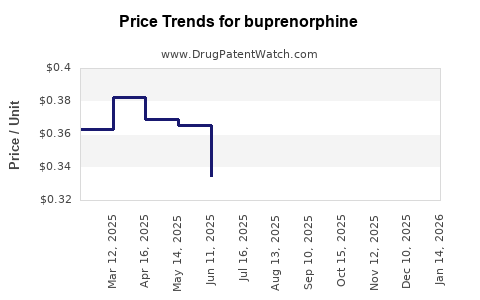
Last updated: September 23, 2026
Buprenorphine is shifting from a sublingual-generic market toward a long-acting injectable market led by Indivior's Sublocade and Braeburn's Brixadi. Sublingual tablets, films, and buccal products face extensive generic competition, while depot injections retain stronger commercial protection, higher pricing, and greater manufacturing barriers. Indivior remains the leading commercial beneficiary, but its revenue concentration in Sublocade creates material product and patent risk.
What is the current buprenorphine market structure?
Buprenorphine is marketed in several dosage forms and for multiple indications:
| Product or category |
Active ingredient |
Primary indication |
Commercial position |
| Sublocade |
Buprenorphine extended-release injection |
Opioid use disorder |
Leading long-acting injectable |
| Brixadi |
Buprenorphine extended-release injection |
Opioid use disorder |
Direct long-acting competitor |
| Suboxone film and tablets |
Buprenorphine/naloxone |
Opioid use disorder |
Originator products with generic competition |
| Generic buprenorphine/naloxone |
Buprenorphine/naloxone |
Opioid use disorder |
Large, price-sensitive segment |
| Zubsolv |
Buprenorphine/naloxone sublingual tablet |
Opioid use disorder |
Branded differentiated formulation |
| Bunavail |
Buprenorphine/naloxone buccal film |
Opioid use disorder |
Limited commercial presence |
| Belbuca |
Buprenorphine buccal film |
Chronic pain |
Branded pain product |
| Butrans |
Buprenorphine transdermal system |
Chronic pain |
Mature, declining transdermal segment |
The market divides into opioid-use-disorder treatment and pain management. Opioid-use-disorder products account for the strategic growth opportunity because long-acting injections can improve adherence, reduce diversion, and support administration through healthcare providers. Pain products remain commercially relevant but operate in a more mature and competitive market.
The United States is the most important market because of its high treatment demand, reimbursement infrastructure, and concentration of branded long-acting products. Europe has broader use of buprenorphine for opioid dependence and pain, but pricing is generally more constrained and product access varies by country.
How large is the buprenorphine market?
The addressable market is driven by opioid-use-disorder prevalence, treatment penetration, payer coverage, prescribing capacity, and patient retention. The United States continues to have a substantial untreated population despite expanded access to medications for opioid-use disorder.
SAMHSA reported millions of Americans with opioid use disorder in recent National Survey on Drug Use and Health releases, while treatment penetration remains materially below the estimated need (Substance Abuse and Mental Health Services Administration, 2023). Buprenorphine competes with methadone and extended-release naltrexone, but it has important advantages in office-based treatment and pharmacy distribution.
Market growth is coming from four sources:
- Conversion of patients from daily sublingual therapy to monthly or weekly injections.
- Increased prescribing by primary-care physicians and community health providers.
- Greater use in correctional, public-health, and integrated behavioral-health settings.
- Better retention among patients who struggle with daily dosing, diversion, or stigma.
The injectable segment has a higher revenue opportunity per treated patient than generic tablets or films. Its expansion is limited by acquisition cost, prior authorization, provider administration, cold-chain and inventory requirements, and reimbursement variability.
Which companies are leading the buprenorphine market?
Indivior
Indivior is the largest branded buprenorphine company. Its portfolio includes Sublocade, Suboxone, and other opioid-dependence products. Sublocade has become the central growth asset as Suboxone faces generic substitution.
Indivior reported total net revenue of approximately $1.1 billion in 2023, with Sublocade revenue exceeding $600 million and continuing to grow at a significantly faster rate than the legacy sublingual franchise (Indivior PLC, 2024). Sublocade's contribution has increased the company's dependence on one depot product.
Braeburn
Braeburn commercializes Brixadi in the United States. The FDA approved Brixadi in May 2023 for moderate-to-severe opioid use disorder in patients who have initiated treatment with a single dose of a transmucosal buprenorphine product or who are already receiving buprenorphine treatment (U.S. Food and Drug Administration, 2023).
Brixadi offers weekly and monthly dosing options. That schedule flexibility creates a direct competitive distinction against Sublocade's monthly administration. Braeburn's commercial strategy depends on provider adoption, payer access, and differentiation in induction, dosing frequency, and patient retention.
Camurus
Camurus developed the FluidCrystal depot technology used in Brixadi and has an economic interest through its commercial relationship with Braeburn. Camurus also markets long-acting buprenorphine products in selected markets outside the United States.
Generic manufacturers
Generic manufacturers include Teva, Dr. Reddy's Laboratories, Alvogen, Sandoz, and other suppliers of buprenorphine/naloxone tablets and films. Competition is concentrated in sublingual dosage forms, where manufacturing is less complex than depot injectable delivery.
What is the financial trajectory for buprenorphine products?
The financial trajectory is diverging by formulation.
| Segment |
Revenue direction |
Pricing |
Main risk |
| Sublocade |
Strong growth |
High |
Patent and competing depot entry |
| Brixadi |
Early growth from a small base |
High |
Payer access and provider adoption |
| Suboxone branded film |
Declining or pressured |
Lower than historical peak |
Generic substitution and litigation |
| Generic buprenorphine/naloxone |
Volume growth, price pressure |
Low |
Commoditization and supply interruptions |
| Zubsolv |
Stable to pressured |
Mid-range branded |
Competition from generics |
| Belbuca and Butrans |
Mature or declining |
Branded |
Pain-market competition and opioid controls |
Indivior's financial model has moved from broad dependence on Suboxone to concentration in Sublocade. That transition improves near-term growth, but it also raises single-product exposure. A slowdown in Sublocade uptake, reimbursement restrictions, safety concerns, or an earlier-than-expected competing depot could materially affect Indivior's earnings.
Sublocade's economic value comes from its delivery technology, administration by healthcare professionals, monthly dosing, and relatively high net price. Brixadi increases competitive pressure but may expand the total long-acting market rather than simply displace Sublocade. The two products can compete through different dosing intervals, provider preferences, patient populations, and contracting arrangements.
For generic suppliers, the financial opportunity is based on volume rather than price. Buprenorphine/naloxone has become a scale market in which supply reliability, regulatory compliance, and manufacturing cost are more important than brand recognition.
When does buprenorphine lose exclusivity?
Buprenorphine does not have one market-wide exclusivity date because each formulation has a separate patent and regulatory history.
Sublingual buprenorphine/naloxone
Suboxone's most important commercial protections have expired or lost practical exclusivity in the United States. Generic tablets and films have entered the market, and the FDA Orange Book identifies the patents and regulatory exclusivities associated with individual products rather than the active ingredient as a whole (U.S. Food and Drug Administration, n.d.-a).
The branded sublingual franchise remains relevant through physician familiarity, product availability, and payer positioning, but its economic protection is weaker than during the pre-generic period. Product-specific litigation and settlements have influenced launch timing for individual generic manufacturers.
Sublocade
Sublocade has later-expiring protection than Suboxone because it is based on a depot delivery system, formulation claims, manufacturing controls, and injection technology. Its patent estate is expected to extend into the 2030s through multiple patents and continuations, subject to validity, enforceability, terminal disclaimers, patent-term adjustment, and litigation outcomes.
The principal risk is not immediate tablet-style generic erosion. It is a later biosimilar-like or complex-generic challenge involving injectable formulation equivalence, manufacturing reproducibility, device or syringe components, and clinical bridging requirements.
Brixadi
Brixadi has its own formulation and delivery patents. Its competitive position depends on the enforceability of those patents and on whether a future entrant can design around the depot matrix, injection characteristics, dosage strengths, and manufacturing process.
What patents protect Sublocade and other buprenorphine products?
The relevant patent categories differ by dosage form.
Long-acting injectable patents
Sublocade protection may include claims directed to:
- Extended-release buprenorphine formulations.
- Polymer or depot matrices.
- Drug loading and release profiles.
- Injection volumes and dosage strengths.
- Manufacturing and sterilization processes.
- Prefilled syringes and administration systems.
- Methods of treating opioid use disorder with specified dosing schedules.
Brixadi protection similarly centers on the depot formulation, delivery matrix, weekly and monthly dosing regimens, and manufacturing methods.
Exact patent scope must be assessed at the product level through the FDA Orange Book, USPTO records, patent-family analysis, and any active Paragraph IV litigation. Patent expiration is not equivalent to a guaranteed generic launch date.
Sublingual and buccal products
Suboxone, Zubsolv, Bunavail, and Belbuca have relied on combinations of:
- Film or tablet composition claims.
- Mucoadhesive delivery systems.
- Flavoring and taste-masking technologies.
- Dose uniformity and dissolution claims.
- Buprenorphine/naloxone ratios.
- Manufacturing processes.
- Method-of-use patents.
These protections have generally been more vulnerable to generic substitution than depot-injection patents because the products are easier to manufacture and evaluate through abbreviated regulatory pathways.
What is the FDA regulatory status of buprenorphine products?
Sublocade and Brixadi are FDA-approved extended-release injectable buprenorphine products for opioid use disorder. Both are intended for patients who have initiated treatment with transmucosal buprenorphine or are already stabilized on buprenorphine, subject to product-specific labeling.
The regulatory distinction between injectable and transmucosal products affects market access. Injections require healthcare-provider administration and create additional procurement and billing steps. Sublingual products can be dispensed through pharmacies and are easier to initiate, but they carry greater concerns about adherence, diversion, and daily medication burden.
The FDA has also expanded the number of clinicians who can prescribe buprenorphine by eliminating the federal X-waiver requirement in 2023. The change removes a major regulatory barrier, although prescriber capacity, training, reimbursement, and local treatment infrastructure continue to limit uptake (U.S. Food and Drug Administration, 2023; U.S. Department of Health and Human Services, 2023).
Which companies are challenging buprenorphine patents?
Generic companies have challenged or entered around the patents covering Suboxone and other transmucosal products. The competitive field includes Teva, Dr. Reddy's, Alvogen, Sandoz, and other abbreviated new drug application holders.
The principal challenge routes are:
- Paragraph IV certifications asserting that listed patents are invalid, unenforceable, or not infringed.
- Paragraph III certifications agreeing to wait until patent expiry.
- Non-infringement strategies based on different film composition or manufacturing processes.
- Product launches after settlements or court decisions.
- Administrative patent challenges and district-court litigation.
Long-acting injectable competition is more difficult because a generic applicant must address complex formulation and manufacturing issues. A successful challenge could still occur through a formulation design-around, an abbreviated pathway, or a 505(b)(2) application, but the technical barrier is higher than for tablets and films.
What patent litigation affects the buprenorphine market?
Suboxone litigation has involved both patent disputes and antitrust allegations concerning product reformulation, generic entry, and distribution practices. Indivior resolved major U.S. government criminal and civil matters in 2020, including a $289 million settlement related to the marketing of Suboxone (U.S. Department of Justice, 2020).
Private antitrust litigation has also created material financial exposure. Indivior disclosed settlements and litigation-related costs associated with claims concerning Suboxone competition and generic access in its public filings (Indivior PLC, 2024).
Future litigation is more likely to focus on Sublocade and Brixadi patent scope, injectable equivalence, manufacturing processes, and product-specific patent-term calculations. Court outcomes could shift launch timing by several years.
What generic entry risks exist for buprenorphine?
Near-term risk
The greatest near-term risk is continued price erosion in sublingual buprenorphine/naloxone products. Generic supply is likely to remain the default for cost-sensitive payers and state Medicaid programs.
Medium-term risk
The principal medium-term risk is accelerated conversion from branded sublingual products to generic equivalents. Branded products can retain share through formulation preference, film availability, adherence support, and contracting, but these advantages rarely sustain historical pricing.
Long-term risk
The largest long-term risk is complex-generic or 505(b)(2) competition for Sublocade and Brixadi. A competitor would need to reproduce clinically meaningful release characteristics and injectable performance. If the FDA accepts an efficient bridging strategy, market entry could occur before all formulation patents expire.
How strong is the buprenorphine patent estate?
The estate is weak for mature sublingual products and materially stronger for depot injectables.
| Product category |
Patent strength |
Manufacturing barrier |
Generic risk |
| Generic buprenorphine/naloxone tablet |
Low |
Low |
High |
| Suboxone film |
Low to moderate |
Moderate |
High |
| Zubsolv |
Moderate |
Moderate |
Moderate to high |
| Belbuca |
Moderate |
Moderate |
Moderate |
| Sublocade |
Moderate to strong |
High |
Lower before the 2030s |
| Brixadi |
Moderate to strong |
High |
Lower before late-life patent expiry |
The strength of a patent estate depends on claim breadth, patent-family continuity, prosecution history, terminal disclaimers, enablement, written description, commercial products, and prior-art quality. A large patent count does not guarantee protection if the surviving claims are narrow or vulnerable.
What licensing deals shape the buprenorphine market?
The market includes technology and commercialization relationships rather than a single dominant licensing structure. Camurus licensed or partnered its depot technology with Braeburn for the U.S. Brixadi program. Indivior developed and commercialized Sublocade internally after building its opioid-dependence franchise around Suboxone.
Licensing economics are likely to favor the technology owner when the product has a differentiated injectable platform and high manufacturing complexity. Commercial partners assume market-access, sales-force, reimbursement, and launch risk. Royalty and milestone obligations reduce the net economic value of product sales but can lower the capital required for commercialization.
How does Sublocade compare with Brixadi?
| Factor |
Sublocade |
Brixadi |
| Commercial launch |
Earlier |
2023 U.S. launch |
| Dosing |
Monthly |
Weekly and monthly |
| Sponsor |
Indivior |
Braeburn |
| Technology origin |
Indivior depot system |
Camurus FluidCrystal platform |
| Strategic advantage |
First-mover scale and provider familiarity |
Dosing flexibility |
| Main weakness |
Product concentration and high cost |
Newer market presence and access execution |
| Competitive risk |
Brixadi and future complex generics |
Sublocade scale and contracting |
Brixadi is the first direct branded U.S. depot competitor to Sublocade. Its weekly option can support titration, transition, and patients who do not fit a fixed monthly schedule. Sublocade benefits from earlier market entry, established reimbursement processes, and a larger commercial base.
What is the outlook for buprenorphine revenue?
The market outlook is positive for long-acting injections and mixed for the broader molecule.
Indivior is positioned to capture continued growth if Sublocade expands treatment penetration and maintains reimbursement. Brixadi should increase competitive intensity and may broaden clinician acceptance of injectable treatment. Generic sublingual products will continue to grow in volume while losing pricing power.
The key variables are:
- Long-acting treatment adoption.
- State Medicaid and commercial-plan coverage.
- Provider willingness to stock and administer injections.
- Patient retention compared with daily therapy.
- Federal and state opioid-treatment policy.
- Patent litigation outcomes.
- Manufacturing capacity and injectable quality.
- Future entrants using complex-generic or 505(b)(2) pathways.
Key Takeaways
- Buprenorphine is a fragmented market with sharply different economics by formulation.
- Sublingual tablets and films are heavily exposed to generic competition and price erosion.
- Sublocade is Indivior's principal growth product and its largest concentration risk.
- Brixadi introduces direct branded competition with weekly and monthly dosing.
- Long-acting injectables have stronger patent and manufacturing barriers than transmucosal products.
- The most important future legal risk is complex-generic or 505(b)(2) competition for depot injections.
- Buprenorphine demand should remain structurally strong because opioid-use-disorder treatment penetration is below clinical need.
- Revenue growth will depend more on conversion to long-acting therapy than on expansion of branded sublingual products.
FAQs About Buprenorphine Market and Patent Risk
Is Sublocade more commercially valuable than Suboxone?
Yes. Sublocade has higher revenue per treated patient and stronger differentiation, while Suboxone faces broad generic competition. Suboxone retains substantial clinical familiarity and distribution volume but has weaker pricing power.
Can a generic company launch a competing Sublocade product before all patents expire?
Potentially. A company could challenge listed patents, design around formulation claims, pursue a 505(b)(2) application, or establish that certain patents are invalid or not infringed. FDA approval and commercial launch would depend on the regulatory pathway and litigation outcome.
Does Brixadi reduce Indivior's Sublocade revenue?
It can reduce share and pricing, but the market may also expand as providers gain a second long-acting option. The net impact depends on payer contracting, weekly-versus-monthly preferences, and patient retention.
Are buprenorphine products eligible for biosimilar approval?
Traditional biosimilar rules apply to biologics, not small-molecule buprenorphine. A competing injectable would more likely use an abbreviated new drug application, a 505(b)(2) application, or another small-molecule regulatory route.
Which buprenorphine products have the highest manufacturing barriers?
Sublocade and Brixadi have the highest barriers because they require reproducible depot formation, controlled drug release, sterile injectable manufacturing, product stability, and specialized quality controls. Tablets and films are less technically difficult to reproduce.
References
- Camurus AB. (2024). Annual report 2023. Camurus.
- Indivior PLC. (2024). Annual report 2023. Indivior PLC.
- Substance Abuse and Mental Health Services Administration. (2023). 2023 National Survey on Drug Use and Health. U.S. Department of Health and Human Services.
- U.S. Department of Health and Human Services. (2023). Removal of X-waiver requirement for buprenorphine prescribing. U.S. Department of Health and Human Services.
- U.S. Department of Justice. (2020). Indivior Solutions agrees to pay $289 million to resolve criminal and civil claims. U.S. Department of Justice.
- U.S. Food and Drug Administration. (2023). FDA approves new buprenorphine injection for opioid use disorder. FDA.
- U.S. Food and Drug Administration. (n.d.-a). Approved drug products with therapeutic equivalence evaluations: Orange Book. FDA.