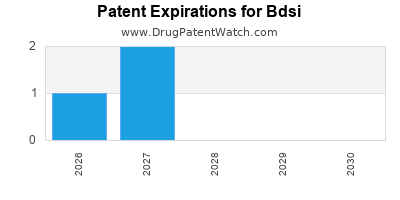
Last updated: July 31, 2026
BioDelivery Sciences International (BDSI) is no longer an independent pharmaceutical company. Collegium Pharmaceutical acquired BDSI in January 2022 for approximately $604 million, creating a branded pain and supportive-care portfolio centered on Belbuca, a buprenorphine buccal film, and Symproic, an oral treatment for opioid-induced constipation.[1] BDSI’s principal strategic value was its proprietary BioErodible MucoAdhesive (BEMA) drug-delivery platform, commercial products, and established prescriber relationships in pain medicine.
The combined company’s position is strongest in specialty pain, where controlled-substance distribution, payer access, formulation know-how, and commercial infrastructure create barriers beyond the underlying active ingredients. Its main risks are generic substitution, opioid-market controls, reimbursement pressure, reliance on mature products, and limited pipeline depth.
What is BDSI’s current market position?
BDSI operates as an acquired portfolio rather than a standalone public-company competitor. Collegium retained BDSI’s marketed products and commercial capabilities after closing the transaction.[1]
| Asset |
Active ingredient |
Indication |
Current strategic owner |
Competitive category |
| Belbuca |
Buprenorphine |
Chronic pain requiring opioid treatment |
Collegium |
Branded opioid analgesic |
| Symproic |
Naldemedine |
Opioid-induced constipation |
Collegium |
Peripheral mu-opioid receptor antagonist |
| Bunavail |
Buprenorphine/naloxone |
Opioid use disorder |
BDSI legacy asset |
Discontinued or commercially reduced legacy product |
| Oxtellar XR |
Oxcarbazepine |
Epilepsy |
Supernus Pharmaceuticals |
Divested BDSI legacy asset |
| ELYXYB |
Celecoxib oral solution |
Acute migraine |
BDSI legacy asset |
Divested or transferred legacy asset |
Belbuca is the core commercial asset. Its buccal-film formulation differentiates it from conventional buprenorphine tablets, transdermal patches, and extended-release injectable products. Symproic broadens the portfolio into opioid-induced constipation, where its principal commercial comparators include Movantik, Relistor, and generic or branded naldemedine alternatives.
Collegium’s acquisition also reduced BDSI’s standalone corporate cost structure and placed the products within a company already focused on specialty pharmaceuticals and controlled-substance commercialization.[1]
What products and technologies made BDSI competitive?
How does the BEMA delivery platform support BDSI’s products?
BEMA is a thin, mucoadhesive film designed to deliver drug across the buccal mucosa. The system can improve local adhesion, support drug absorption, and avoid gastrointestinal degradation associated with some oral dosage forms. Belbuca uses the platform to administer buprenorphine through the inside of the cheek.
The platform’s commercial value is product-specific. BEMA does not automatically block competitors from using the same active ingredient. Its strength depends on issued formulation, composition, manufacturing, and method-of-use claims, plus the difficulty of reproducing the film’s drug loading, adhesion, dissolution, stability, and bioequivalence profile.
BDSI’s competitive advantages included:
- A marketed buccal-film product with regulatory precedent.
- Manufacturing and scale-up experience for a complex oral film.
- A branded product with established dosing strengths.
- Specialty prescriber access in pain and addiction medicine.
- Know-how relating to drug loading, film uniformity, adhesion, and packaging.
- A commercial platform that could support additional transmucosal products.
What makes Belbuca commercially differentiated?
Belbuca provides buprenorphine through a buccal film in multiple dosage strengths. The product is positioned for patients requiring continuous opioid analgesia for chronic pain and who have already received prior opioid therapy.[2]
Its differentiation rests on:
- A non-tablet dosage form.
- Long-duration dosing compared with immediate-release products.
- Lower full-agonist activity than many conventional opioids.
- A formulation that can be used without swallowing a conventional tablet.
- Brand recognition among pain specialists.
Belbuca remains exposed to broad opioid prescribing controls, prior authorization requirements, reimbursement limits, and prescriber reluctance to initiate chronic opioid treatment.
How does BDSI compare with competing pain and opioid products?
Belbuca competes across several product classes rather than against one direct substitute.
| Competitive segment |
Examples |
Competitive effect on Belbuca |
| Buprenorphine transdermal systems |
Butrans and generic equivalents |
Compete for chronic pain patients needing buprenorphine |
| Immediate-release opioids |
Hydrocodone, oxycodone, tramadol |
Compete for broader chronic pain prescribing |
| Extended-release opioids |
Morphine ER, oxycodone ER, tapentadol ER |
Compete for continuous analgesia |
| Buprenorphine OUD products |
Suboxone, generic buprenorphine/naloxone, Sublocade |
Compete for prescriber attention and patient access in addiction medicine |
| Non-opioid pain treatments |
NSAIDs, anticonvulsants, antidepressants |
Reduce the addressable opioid market |
| Digital and interventional pain care |
Physical therapy, injections, neuromodulation |
Substitute for chronic opioid treatment in selected patients |
Belbuca’s strongest commercial position is within the niche of branded buprenorphine treatment for chronic pain. It does not control the broader opioid market, where low-cost generic products dominate volume.
Symproic competes with other peripherally acting mu-opioid receptor antagonists. Its growth depends on opioid-induced constipation diagnosis, payer coverage, formulary placement, and prescriber preference among products with similar treatment goals.
What patents protect Belbuca and the BDSI platform?
Belbuca’s protection is based primarily on formulation and delivery patents rather than composition-of-matter protection for buprenorphine. Buprenorphine is an established active ingredient, so the commercially relevant claims concern the film, drug distribution, mucoadhesive system, dosage strengths, and methods of treatment.
Publicly reported Belbuca patent disputes have involved patents including U.S. Patent No. 8,475,832 and related BEMA formulation patents. BDSI brought patent litigation against generic applicants after Paragraph IV certifications concerning Belbuca.[3]
| Protection category |
Relevance to Belbuca |
| Buprenorphine composition |
Limited value because the active ingredient is old |
| Buccal-film composition |
Protects polymer, drug, and film architecture |
| Mucoadhesive delivery |
Protects adhesion and transmucosal delivery characteristics |
| Dose and strength claims |
Can support Orange Book listing and generic litigation |
| Manufacturing process |
May create technical barriers but is less visible in ANDA litigation |
| Method of treatment |
Can support infringement claims for labeled uses |
| Device or packaging claims |
May add narrower commercial protection |
The practical strength of the estate depends on claim scope, validity under post-America Invents Act standards, obviousness risk, written-description support, and whether a generic can design around the claimed film architecture.
What is the Orange Book status of Belbuca?
Belbuca is an FDA-approved prescription drug listed in the FDA’s Approved Drug Products with Therapeutic Equivalence Evaluations, commonly called the Orange Book.[4] The Orange Book identifies patents and regulatory exclusivity associated with approved products. Generic applicants must address listed patents through Paragraph IV certifications or wait for applicable patent and exclusivity periods to expire.
Belbuca’s Orange Book protection is formulation-driven. That structure generally gives the brand a more limited defensive position than a product protected by a new chemical entity patent. A generic applicant can challenge listed patents while relying on the established safety and efficacy profile of buprenorphine.
The Orange Book should be reviewed periodically because listed patents, expiration dates, delisting actions, and litigation outcomes can change. The commercial question is not only whether a patent remains listed, but whether it can withstand invalidity and non-infringement challenges.
When does BDSI lose exclusivity for Belbuca?
Belbuca’s regulatory exclusivity is separate from its patent protection. The product was approved in 2015, and any original new-drug exclusivity period has expired. Current market protection therefore depends mainly on patents, litigation outcomes, regulatory review of ANDAs, and commercial barriers associated with the buccal-film dosage form.[2][4]
The principal generic-entry scenario is a Paragraph IV challenge to listed formulation patents. A successful challenge could permit entry before the latest listed patent expiration. A settlement could delay entry until an agreed date, subject to antitrust and regulatory considerations.
Belbuca does not face biosimilar risk because it is a small-molecule drug, not a biologic. Its competitive threat is generic substitution through the ANDA pathway.
Which companies have challenged BDSI’s Belbuca patents?
Generic manufacturers have challenged Belbuca patent protection through Paragraph IV certifications and related patent litigation. Publicly reported litigation has included challenges involving Teva Pharmaceuticals and Actavis-related entities.[3]
The legal risk has several dimensions:
- Whether the asserted patent claims are valid.
- Whether the proposed generic film infringes.
- Whether the generic’s label induces infringement of method-of-use claims.
- Whether formulation claims are broad enough to cover alternative film designs.
- Whether a settlement delays entry or permits a launch before all patents expire.
Generic challenges to complex oral films can be more expensive than challenges to conventional tablets because the applicant must establish pharmaceutical equivalence and bioequivalence for a dosage form with multiple manufacturing variables. That complexity can slow entry, but it does not eliminate the risk.
What patent litigation affects BDSI and Collegium?
The most important legacy litigation issue is Belbuca generic competition. The acquisition transferred the economic value of the product and associated legal rights to Collegium.[1]
The litigation profile differs from a conventional small-molecule tablet because:
- Film thickness and composition can affect drug release.
- Adhesion and mucosal residence may affect performance.
- Generic applicants may pursue formulation alternatives.
- Manufacturing differences can create disputes over equivalence and infringement.
- A patent win may protect only selected strengths or claim categories.
The company’s broader litigation exposure also includes controlled-substance compliance, product liability, promotional practices, and commercial contracting. Those issues are separate from patent validity but can affect valuation and commercialization costs.
What is the competitive landscape for Symproic?
Symproic is naldemedine, a peripherally acting mu-opioid receptor antagonist approved for opioid-induced constipation in adults with chronic non-cancer pain or cancer pain.[5]
Its competitive set includes:
| Product |
Active ingredient |
Company or originator |
Market issue |
| Symproic |
Naldemedine |
Shionogi, commercialized by Collegium |
Brand and formulation competition |
| Movantik |
Naloxegol |
AstraZeneca, later commercial partners |
Established class competitor |
| Relistor |
Methylnaltrexone |
Salix/Valeant legacy product |
Oral and injectable positioning |
| Generic alternatives |
Varies |
Multiple ANDA applicants |
Price pressure and payer substitution |
Symproic is not protected by the BEMA platform. Its commercial profile depends on naldemedine-specific patents, labeling, payer access, and the strength of its clinical positioning. Its presence gives Collegium a supportive-care product that can be promoted alongside opioid analgesia, but cross-selling potential is constrained by separate prescribing decisions and reimbursement.
How strong is the BDSI patent estate?
BDSI’s patent estate is strongest where formulation complexity and manufacturing know-how reinforce issued claims. It is weaker where protection depends on broad claims covering an old active ingredient or a general therapeutic concept.
| Strength factor |
Assessment |
| Active ingredient protection |
Weak for buprenorphine because of prior art |
| Formulation protection |
Moderate to strong, depending on claim construction |
| Manufacturing know-how |
Potentially meaningful but difficult to enforce without discovery |
| Regulatory exclusivity |
Limited for mature products |
| Generic substitution risk |
Material |
| Biosimilar risk |
None for Belbuca and Symproic |
| Commercial switching costs |
Moderate because prescriber and patient familiarity matter |
| Platform reuse |
Valuable, but depends on new product development |
The estate supports a branded franchise but does not create an impenetrable barrier to generic entry. Its strongest defensive feature is the combination of patents, manufacturing expertise, and a complex dosage form.
What licensing deals shaped BDSI’s portfolio?
BDSI built its portfolio through licensing, partnerships, and acquisitions. Key arrangements included:
- Collaboration with Endo Pharmaceuticals for certain BEMA products.
- Commercial relationships involving Belbuca and Symproic.
- Licensing and commercialization arrangements for Oxtellar XR before its sale to Supernus.
- Product rights associated with ELYXYB and other non-core assets.
- Acquisition of BDSI by Collegium, which consolidated the commercial rights and infrastructure.[1]
Licensing value varied by product. Oxtellar XR provided a non-opioid neurology asset but was divested, while Belbuca became central to the company’s specialty-pain strategy. The portfolio history shows BDSI’s preference for acquiring or licensing differentiated delivery technologies rather than developing only traditional oral dosage forms.
What FDA regulatory status applies to BDSI products?
Belbuca and Symproic are FDA-approved prescription drugs. Belbuca is a Schedule III controlled substance, which increases distribution, monitoring, compliance, and promotional requirements.[2] Symproic is not an opioid analgesic and does not carry the same controlled-substance distribution profile.[5]
FDA-related commercial considerations include:
- ANDA review for generic Belbuca.
- Orange Book patent certifications.
- REMS and opioid-risk-management obligations where applicable.
- Manufacturing compliance for complex films.
- Labeling restrictions affecting opioid promotion.
- Postmarketing safety obligations.
FDA approval does not prevent generic entry after patent and exclusivity barriers are overcome. It establishes the regulatory basis for competition.
What generic launch scenarios exist for Belbuca?
Scenario 1: Delayed generic entry
Patent litigation or settlement delays entry until the later listed patent date or an agreed launch date. Collegium preserves branded pricing and uses contracting to retain share.
Scenario 2: Single generic launch
One approved generic enters first, potentially receiving 180-day Paragraph IV exclusivity if statutory requirements are met. Pricing pressure increases, but branded retention may remain meaningful because of payer and prescriber segmentation.
Scenario 3: Multiple generic launches
Several ANDA applicants enter after patent barriers fall. This produces the fastest erosion in price and volume, particularly in commercially insured and Medicaid channels.
Scenario 4: Formulation-specific competition
A generic obtains approval for selected strengths or a technically different film. Substitution may develop unevenly across dosage strengths and payer formularies.
The most important variables are the final patent litigation outcome, settlement terms, ANDA approval timing, first-filer status, and the ability of Collegium to maintain branded access.
How does BDSI compare with Collegium’s other competitors?
Collegium’s strategic position is narrower than that of diversified pharmaceutical companies but stronger than that of a single-product specialty company. Competitors include large generic manufacturers, branded opioid companies, specialty firms in pain management, and companies selling non-opioid therapies.
| Company type |
Advantage over Collegium |
Collegium advantage |
| Generic manufacturers |
Lower cost and broad distribution |
Brand, formulation knowledge, contracting |
| Large diversified pharma |
Greater capital and portfolio breadth |
Focused specialty commercialization |
| Specialty pain companies |
Similar therapeutic focus |
Belbuca and Symproic commercial infrastructure |
| Non-opioid developers |
Lower controlled-substance exposure |
Established opioid-treatment products |
| Biotech delivery companies |
Novel platform potential |
Commercially validated film technology |
What revenue exposure does BDSI create for Collegium?
BDSI’s value is concentrated in mature branded products rather than a broad discovery pipeline. Belbuca revenue is exposed to:
- Generic entry.
- Opioid prescribing contraction.
- Gross-to-net discounting.
- Payer restrictions.
- Controlled-substance enforcement.
- Competition from transdermal buprenorphine.
- Product-liability and compliance costs.
Symproic provides diversification but remains exposed to class competition and formulary pressure. The acquisition therefore improved Collegium’s scale and product breadth while increasing reliance on products with limited regulatory exclusivity.
Key Takeaways
- BDSI is now part of Collegium Pharmaceutical, following the January 2022 acquisition.
- Belbuca is the principal strategic asset and uses BDSI’s BEMA buccal-film technology.
- The patent estate is based mainly on formulation, delivery, and method-of-use claims rather than new chemical entity protection.
- Belbuca faces generic, not biosimilar, risk.
- Paragraph IV litigation is the central route to accelerated generic entry.
- Symproic adds opioid-induced constipation exposure but faces Movantik, Relistor, and generic competition.
- BDSI’s commercial strength lies in specialty-pain commercialization, controlled-substance infrastructure, and complex-film manufacturing know-how.
- The main valuation risk is erosion of Belbuca revenue after patent litigation, settlement, or ANDA approval.
- The portfolio provides commercial scale but has limited late-stage pipeline diversification.
FAQs About BDSI’s Pharmaceutical Competitive Position
Is BDSI still an independent pharmaceutical company?
No. Collegium Pharmaceutical acquired BDSI in January 2022. BDSI’s products and commercial operations are now evaluated within Collegium’s specialty-pharmaceutical portfolio.[1]
Is Belbuca a biologic or biosimilar product?
No. Belbuca contains buprenorphine, a small-molecule active ingredient. Competitors would use the ANDA generic-drug pathway, not the biosimilar pathway.
What is the main patent risk for Belbuca?
The main risk is a Paragraph IV challenge to patents covering the buccal film, mucoadhesive composition, dosage form, or related methods of use. The outcome depends on patent validity, infringement, settlement terms, and FDA approval timing.
Does BEMA protect every BDSI product?
No. BEMA is relevant to products using the buccal-film platform, such as Belbuca. Symproic uses naldemedine in a conventional oral dosage form and depends on its own product-specific regulatory and patent protections.
Which product is more strategically important, Belbuca or Symproic?
Belbuca is more strategically important because it is tied directly to BDSI’s proprietary delivery technology and specialty-pain infrastructure. Symproic provides diversification in opioid-induced constipation but faces a broader class of branded and generic competitors.
References
- Collegium Pharmaceutical, Inc. (2022, January 11). Collegium Pharmaceutical completes acquisition of BioDelivery Sciences International.
- U.S. Food and Drug Administration. (2015). Belbuca (buprenorphine buccal film) prescribing information.
- U.S. District Court for the District of Delaware. (2018-2021). BioDelivery Sciences International, Inc. patent litigation concerning Belbuca.
- U.S. Food and Drug Administration. (2024). Approved drug products with therapeutic equivalence evaluations, Orange Book.
- U.S. Food and Drug Administration. (2017). Symproic (naldemedine) prescribing information.