Last updated: August 27, 2026
Butrans is a buprenorphine transdermal system used for the management of severe, persistent pain requiring a continuous opioid analgesic. Its commercial trajectory has been shaped by three forces: declining opioid prescribing, generic transdermal competition, and Purdue Pharma’s financial and legal restructuring. Butrans remains a differentiated product because of its weekly delivery system and Schedule III status, but its market position is materially weaker than during its peak commercialization period.
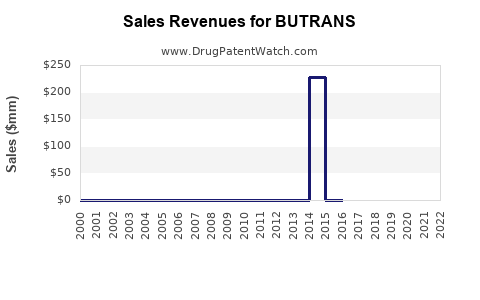
Standalone Butrans revenue is not publicly reported. Purdue Pharma is privately held, and its public bankruptcy and restructuring disclosures report product portfolios rather than consistent brand-level sales. The financial outlook therefore depends on prescription volume, generic substitution, payer coverage, opioid-control policies, and Purdue’s ability to maintain distribution.
What is Butrans and how does its market position compare with other opioids?
Butrans contains buprenorphine, a partial mu-opioid receptor agonist, delivered through a seven-day transdermal patch. It is approved in the United States for chronic pain requiring continuous, around-the-clock opioid treatment when alternatives are inadequate.
| Product characteristic |
Butrans |
| Active ingredient |
Buprenorphine |
| Dosage form |
Weekly transdermal patch |
| U.S. FDA approval |
2010 |
| Sponsor |
Purdue Pharma L.P. |
| Indication |
Severe, persistent pain requiring continuous opioid treatment |
| Strengths |
5, 7.5, 10, 15, and 20 mcg/hour |
| Controlled-substance schedule |
Schedule III |
| Administration |
Once weekly |
| Main competitors |
Generic buprenorphine patches, buprenorphine products, extended-release opioids, non-opioid pain therapies |
| Commercial category |
Branded chronic-pain opioid with generic competition |
The patch differentiates Butrans from immediate-release oxycodone, hydrocodone, and morphine products. Its weekly dosing can improve adherence and reduce daily pill burden. Buprenorphine’s partial-agonist pharmacology also gives it a different safety and abuse profile from full opioid agonists, although the product still carries boxed warnings for addiction, misuse, respiratory depression, accidental exposure, and neonatal opioid withdrawal syndrome. [1]
Butrans does not compete directly with buprenorphine/naloxone products such as Suboxone in opioid-use-disorder treatment. Those products address a different indication, although they compete for prescriber familiarity with buprenorphine and influence perceptions of the molecule.
How large is the Butrans market and what is its financial trajectory?
No authoritative public source provides a current, standalone Butrans revenue series. Purdue’s private-company structure, product-level reporting limitations, generic entry, and opioid litigation make revenue reconstruction difficult.
The product’s financial trajectory can be divided into four periods:
| Period |
Commercial condition |
Financial effect |
| 2010-2014 |
U.S. launch and physician adoption |
Revenue growth from branded penetration |
| 2015-2018 |
Expanded opioid scrutiny and tighter prescribing controls |
Slower volume growth and higher compliance costs |
| 2018-2021 |
Generic transdermal buprenorphine competition |
Price and market-share erosion |
| 2022 onward |
Mature generic market and Purdue restructuring |
Lower branded growth potential; cash flow depends on residual brand demand and authorized/generic economics |
Butrans benefited from being a lower-frequency opioid delivery system during the early 2010s. Its commercial opportunity narrowed after the Centers for Disease Control and Prevention issued opioid-prescribing guidance in 2016 and insurers tightened utilization controls. The 2022 CDC update retained a cautious approach to chronic opioid therapy and continued to emphasize non-opioid treatments where appropriate. [2]
The U.S. opioid market has not disappeared, but demand has shifted toward lower-risk prescribing, specialist management, abuse-deterrent technologies, non-opioid analgesics, and medications for opioid-use disorder. Butrans retains a niche in chronic pain, particularly when clinicians seek a transdermal product or a buprenorphine-based alternative to full agonists.
What financial indicators matter for Butrans?
The most relevant commercial indicators are:
- Brand and generic prescription volume.
- Average selling price and payer reimbursement.
- Generic substitution rates.
- Share of prescriptions written by pain specialists and primary-care physicians.
- Medicaid and commercial-plan formulary placement.
- Purdue’s distribution and restructuring arrangements.
- Product liability and opioid-settlement costs.
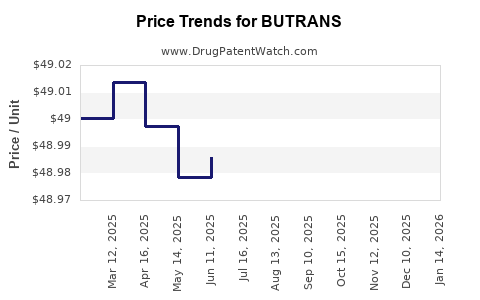
Prescription growth alone is not a reliable revenue indicator because generic products can increase total market volume while reducing branded net sales. A declining branded price, mandatory substitution, or lower formulary placement can reduce revenue even if total transdermal buprenorphine prescriptions remain stable.
What patents protect Butrans and when does it lose exclusivity?
Butrans protection has depended on patents covering the transdermal delivery system, buprenorphine formulations, patch construction, and related delivery technology. FDA Orange Book entries, rather than the product label alone, determine which patents can support a Paragraph IV certification against an abbreviated new drug application. [3]
The commercial patent position is now mature. The principal risk is not a future loss of exclusivity event comparable to an initial launch. Generic buprenorphine transdermal products have already entered the U.S. market, which means Butrans is exposed to ongoing substitution and price competition.
What formulations are protected by Butrans-related patents?
The relevant patent categories include:
- Buprenorphine-containing transdermal systems.
- Adhesive matrices and drug reservoirs.
- Controlled release over a seven-day period.
- Patch dimensions, backing layers, and drug loading.
- Manufacturing processes that support consistent drug delivery.
- Product-specific strengths and dosage configurations.
These protections can create technical barriers without preventing all generic competition. A generic manufacturer can avoid a patent claim through a different adhesive matrix, reservoir architecture, manufacturing process, or claim interpretation. FDA approval also depends on demonstrating pharmaceutical equivalence and bioequivalence or satisfying the applicable product-specific requirements.
The practical patent conclusion is that formulation and manufacturing patents may retain defensive value, but they no longer provide Butrans with meaningful U.S. market exclusivity against approved generic patches.
What is the FDA regulatory and Orange Book status of Butrans?
Butrans is an FDA-approved prescription product marketed under NDA 021306. The FDA label identifies Purdue Pharma L.P. as the applicant and describes the product as a buprenorphine transdermal system for chronic pain. [1]
Generic buprenorphine transdermal systems have been approved under ANDAs. The generic products are therapeutically equivalent where listed by FDA as substitutable for the corresponding Butrans strengths. The market therefore operates under conventional generic substitution rather than biosimilar competition.
| Regulatory issue |
Butrans status |
| NDA pathway |
505(b)(1) new drug application |
| Generic pathway |
ANDA under Section 505(j) |
| Biosimilar pathway |
Not applicable |
| Orange Book relevance |
Listed patents and therapeutic-equivalence information |
| FDA exclusivity risk |
Primarily generic substitution and labeling competition |
| Controlled-substance requirements |
DEA and state opioid-prescribing controls apply |
The relevant regulatory exposure is generic entry, not biosimilar entry. Buprenorphine is a small-molecule active ingredient, and Butrans is not a biologic.
Which companies challenge Butrans and what is the generic launch risk?
Generic competition has come from multiple manufacturers of buprenorphine transdermal systems, including large generic companies and specialty manufacturers. Public FDA records identify approved generic products, but manufacturer participation can change as products are transferred, discontinued, or marketed through different affiliates.
The generic launch risk is high because:
- Generic patches are already available.
- The product has no biologic manufacturing barrier.
- The dosage form is established and technically reproducible.
- Payers generally favor lower-cost alternatives.
- Chronic pain treatment is highly sensitive to reimbursement and formulary restrictions.
- Multiple generic suppliers reduce dependence on a single challenger.
The remaining commercial value lies in brand recognition, prescriber familiarity, supply reliability, and patients who remain on the branded product because of coverage, tolerability, or patch performance. Those advantages support residual revenue but do not recreate protected-market economics.
What patent litigation and Paragraph IV disputes affect Butrans?
Paragraph IV litigation is relevant when an ANDA applicant certifies that an Orange Book-listed patent is invalid, unenforceable, or will not be infringed. A timely suit can trigger a 30-month stay of FDA approval under the Hatch-Waxman framework, subject to statutory exceptions. [4]
Butrans’ current risk profile is different from that of a newly approaching loss-of-exclusivity product. Generic approval and commercial availability indicate that any earlier patent disputes did not preserve a durable branded monopoly. The key diligence issues are:
- Whether a listed patent remained in force when each generic was approved.
- Whether Purdue settled with individual generic applicants.
- Whether settlements included launch dates, licenses, or supply arrangements.
- Whether any patch-specific patent claims were invalidated or narrowed.
- Whether later-approved strengths relied on different patent certifications.
A complete litigation chronology requires review of FDA Orange Book patent records, federal district-court dockets, ANDA litigation complaints, and settlement filings. Public sources do not provide a single consolidated Butrans litigation record.
How does Butrans compare with competing pain products?
| Product or class |
Main advantage over Butrans |
Main disadvantage versus Butrans |
| OxyContin and generic oxycodone ER |
Broad physician familiarity and oral dosing |
Higher full-agonist risk profile; substantial opioid scrutiny |
| Hysingla ER |
Extended-release oral formulation and abuse-deterrent design |
Daily dosing and full-agonist opioid risks |
| Xtampza ER |
Abuse-deterrent oral oxycodone formulation |
Higher cost and oral administration |
| Fentanyl patches |
Potent long-acting transdermal delivery |
Schedule II status and greater respiratory-depression concerns |
| Buprenorphine sublingual products |
Established buprenorphine ecosystem |
Different indication and administration |
| Non-opioid analgesics |
Lower opioid-related regulatory exposure |
May provide inadequate relief for some severe chronic pain patients |
| Generic buprenorphine patch |
Lower price |
Potential differences in supply, device attributes, and brand familiarity |
Butrans’ strongest competitive position is against oral full-agonist opioids in patients who need continuous treatment but may benefit from buprenorphine’s pharmacology and weekly dosing. Its weakest position is against low-cost generic patches and non-opioid therapies favored by payers and prescribing guidelines.
What licensing deals and manufacturing barriers affect Butrans?
There is no widely disclosed licensing transaction that has become a principal public driver of Butrans valuation. Purdue’s main strategic issue has been corporate restructuring rather than external licensing expansion.
Manufacturing remains a moderate barrier. A transdermal patch requires control over:
- Drug loading uniformity.
- Adhesive performance.
- Seven-day release kinetics.
- Patch adhesion across temperature and activity conditions.
- Residual drug content and disposal safety.
- Scale-up consistency and batch release testing.
These requirements can limit the number of reliable suppliers. They do not create the level of manufacturing exclusivity associated with complex biologics, sterile injectables, or cell therapies. A supplier interruption could temporarily benefit the brand or another generic manufacturer, but it would not materially restore long-term pricing power.
What generic launch scenarios exist for Butrans?
Base case: continued branded erosion
Generic substitution continues, with Butrans retaining a smaller specialist-driven segment. Net sales decline gradually as payers increase generic use.
Downside case: accelerated formulary displacement
Large commercial plans and Medicaid programs place generic patches on preferred tiers and require prior authorization for Butrans. Brand volume falls faster, while pricing and rebates increase.
Limited upside case: supply or quality disruption
A shortage, recall, or manufacturing problem affecting generic suppliers could temporarily increase brand demand. This would likely produce episodic revenue improvement rather than a durable reversal.
Strategic case: portfolio monetization
Purdue or a successor entity could transfer, license, or sell commercial rights. The asset would be more attractive to a specialty-pharmaceutical company with pain-care distribution than to a broad primary-care platform. The valuation would depend on net sales after generic substitution, litigation exposure, supply reliability, and remaining brand loyalty.
How strong is the Butrans patent estate?
The Butrans patent estate is commercially weak to moderate as a current exclusivity asset.
| Factor |
Assessment |
| Core composition-of-matter protection |
Limited relevance because buprenorphine is an established molecule |
| Formulation protection |
Historically important; now weakened by generic entry |
| Device and manufacturing protection |
Can create design-around costs |
| Regulatory exclusivity |
Expired or no longer a central commercial barrier |
| Generic substitution risk |
High |
| Biosimilar risk |
None |
| Litigation leverage |
Limited compared with pre-generic launch products |
| Long-term pricing power |
Low |
| Residual brand value |
Moderate in specialist chronic-pain use |
The estate can still matter in litigation, licensing, and supply negotiations. It is unlikely to support premium pricing without a meaningful clinical or reimbursement advantage.
What is the outlook for Butrans revenue exposure?
Butrans revenue exposure is concentrated in U.S. chronic-pain prescribing and is therefore sensitive to policy, payer, and litigation developments. The product lacks the geographic diversification of a global specialty drug.
Key revenue risks include:
- Continued reduction in opioid prescribing.
- Generic price compression.
- Payer exclusion or step therapy.
- Purdue-related distribution constraints.
- Product liability and settlement obligations.
- Physician migration to non-opioid or buprenorphine-based alternatives.
- Potential supply disruption involving patch components.
Potential stabilizers include weekly administration, established FDA labeling, patient familiarity, and clinical use in patients who cannot tolerate or should not receive certain full opioid agonists.
Key Takeaways
- Butrans is a weekly buprenorphine patch approved for severe, persistent chronic pain.
- Its standalone revenue is not publicly disclosed, and Purdue’s private structure limits financial transparency.
- The product’s financial trajectory has moved from branded growth to mature-market erosion.
- Generic buprenorphine patches are the principal competitive threat.
- Biosimilar risk does not apply because Butrans is a small-molecule drug.
- Formulation, device, and manufacturing patents have defensive value but do not provide effective current U.S. exclusivity.
- Opioid-prescribing restrictions, payer controls, and generic substitution are the main market pressures.
- Residual value depends on brand retention, specialist prescribing, supply reliability, and potential portfolio transactions.
FAQs About Butrans Market and Patent Risk
Is Butrans still commercially available in the United States?
Butrans has remained an FDA-approved branded product, while generic buprenorphine transdermal systems compete in the same market. Availability can vary by strength, wholesaler inventory, and payer coverage.
Does Butrans have orphan-drug exclusivity?
No. Butrans is not an orphan drug, and its commercial protection does not depend on orphan-drug exclusivity.
Can a generic pharmacy automatically substitute for Butrans?
Substitution depends on FDA therapeutic-equivalence listings, state pharmacy law, payer rules, and the prescribed product and strength. Pharmacists generally can substitute an FDA-rated equivalent where permitted.
Is Butrans safer than fentanyl patches?
The products have different pharmacology, potency, scheduling, and labeling. Butrans is not risk-free and carries serious opioid warnings. A direct safety ranking is not appropriate without considering dose, patient history, indication, and concomitant medicines.
Could a new Butrans formulation regain market share?
A reformulation could improve adhesion, tolerability, packaging, or delivery performance, but it would face generic substitution, FDA requirements, payer scrutiny, and potential patent challenges. Commercial success would require a measurable advantage beyond the existing weekly patch.
References
- U.S. Food and Drug Administration. (2023). Butrans (buprenorphine) transdermal system prescribing information.
- Centers for Disease Control and Prevention. (2022). CDC clinical practice guideline for prescribing opioids for pain: United States, 2022. MMWR Recommendations and Reports, 71(3), 1-95.
- U.S. Food and Drug Administration. (2024). Approved drug products with therapeutic equivalence evaluations: Orange Book.
- U.S. Congress. (1984). Drug Price Competition and Patent Term Restoration Act of 1984, Pub. L. No. 98-417.
- Purdue Pharma L.P. (2020). Chapter 11 restructuring and bankruptcy court filings.
- U.S. Drug Enforcement Administration. (2024). Controlled substances schedules.