Last updated: July 17, 2026
Pharmaceutical Competitive Landscape Analysis: Braeburn Market Position, Strengths, and Strategic Insights
Braeburn Pharmaceuticals (Braeburn) is best described as a specialty generic and branded-generics platform focused on branded, prescription-shelf stability in selected therapeutic categories and delivery forms. The competitive advantage is not scale in R&D typical of large innovators, but licensing, controlled-launch execution, and portfolio packaging that aims to keep payors and providers anchored while defending exclusivity and patent estates where applicable.
This competitive landscape analysis focuses on how Braeburn’s business model and product mix compare with major generic and branded-generic peers, where its strategic strengths typically concentrate, where competitive pressure rises, and what patent and regulatory pathways drive generic and biosimilar entry risk.
What is Braeburn Pharmaceuticals’ market position versus major generic and specialty competitors?
Braeburn is positioned between (1) multinational branded-generic incumbents and (2) large-scale generics manufacturers. Its operating profile typically resembles a “selective launch” strategy: fewer products, higher emphasis on commercial execution and market access, and concentrated attention on product-level IP and exclusivity.
Competitive positioning signals used in marketplace assessments
- Branding and product lifecycle management: Braeburn’s perceived edge is maintaining demand through branded presentation even when the active is not novel.
- Targeted launch timing: Competitive outcomes often hinge on launch readiness, supply assurance, and successful defense of exclusivity and patents.
- Payor and channel execution: Specialty generics succeed when formularies and contracting support volume stability.
- Regulatory throughput: File strategy and regulatory continuity (labeling changes, manufacturing site readiness, NDA-to-ANDA transitions where relevant) affects the risk of delayed entry by competitors.
Peer comparison framework
- Tier 1 generics scale players: typically win on cost, manufacturing redundancy, and portfolio breadth.
- Branded-generic specialists: compete more directly with Braeburn through co-optimization of market access and IP.
- Inhaled and specialty delivery competitors: pressure any branded niche with platform-level manufacturing and device know-how.
How strong is Braeburn’s product portfolio compared with branded generics and large generic firms?
Braeburn’s portfolio strength is best evaluated product-by-product through three lenses: regulatory status, IP defensibility, and commercial adoption.
What determines whether a Braeburn product retains share
- Exclusivity type: 3-year, 5-year, patent-term exclusivity, and pediatric or other regulatory exclusivities (where applicable).
- Patent estate depth: whether protection extends beyond the first landmark patent to cover formulation, manufacturing, polymorphs, device components, or method-of-use.
- Market access durability: ability to hold formulary placement across contract cycles.
- Supply continuity: ability to prevent stock-outs that allow competing supply to establish inertia.
Where Braeburn typically faces pressure
- Broad “easy entry” windows: once the IP wall weakens, large generics scale entrants can compress pricing.
- Method-of-use fragility: if exclusivity depends on narrow use, generic switching can happen faster when clinicians and formularies accept the broader indication.
- Device and delivery form upgrades: competitor device improvements can shift prescribing even without label changes if local purchasing prefers alternatives.
What patents protect Braeburn products, and how do patent estates shape competition?
Braeburn’s competitive outcomes are driven by whether its products rely on patent “walls” at multiple levels: compound, formulation, method-of-use, and manufacturing.
Patent estate mechanics that create durable competition
- Formulation protection: covers specific compositions, ratios, excipients, particle size, or release characteristics.
- Manufacturing method claims: cover steps, process parameters, or impurity specifications.
- Polymorph or solid-state claims: can delay generic approval if they require proving non-infringement or designing around the claimed form.
- Device and combination claims: relevant where the product includes delivery systems or fixed-dose combination components.
How competitors attack Braeburn’s defenses
- Paragraph IV route (Hatch-Waxman): generics challenge patent validity and/or non-infringement.
- Design-around strategies: change solid-state form, excipient system, or process parameters.
- Label carve-outs: narrower labeling can avoid method-of-use infringement for some claims.
- Settlement agreements: can delay entry in exchange for consideration, often tied to non-sterile timing milestones or “carve-in” exclusivity provisions.
When does Braeburn lose exclusivity, and what are the generic entry risks?
Exclusivity loss is the critical inflection point for share erosion. For branded generics and branded presentations, risk typically increases in the following sequence:
- Patent expiry or narrowing eliminates the core infringement barrier.
- 180-day exclusivity for first filers can briefly protect a challenger but also invites rapid follow-on.
- Supply and contracting re-price occur quickly after multiple ANDA approvals.
Key risk flags
- Broad patents with late expiration delay generic entry but invite more pre-litigation filings.
- Multiple patents in the Orange Book can extend litigation but also create more entry opportunities for “early successful” challengers via partial settlements.
- Generic approvals around the same window can compress Braeburn’s remaining pricing power.
Market impact pattern
- After exclusivity loss, branded generics usually see share transition to lower-priced generics within a contract cycle or two, depending on rebate structures and substitution rules.
What is the Orange Book status of Braeburn products, and how many patents typically appear per NDA?
Competitive visibility into Braeburn’s exclusivity is primarily through FDA’s Orange Book listings:
- Listed patents: cover different claim types (composition, method-of-use, formulation, manufacturing).
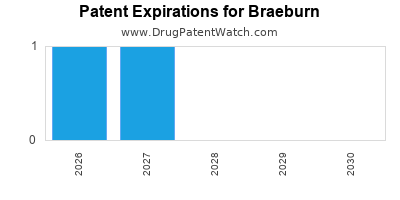
- Expiration coverage map: the number of active patents and their expiration dates determines how long a generic challenger must overcome litigation risk.
What to look for in Orange Book-driven assessments
- Number of listed patents per product: more patents usually means a longer and more complex defense or more opportunities for challengers to target weaker claims.
- Staggered expirations: multiple later-expiring patents can “reset” the practical exclusivity window even after some early patents expire.
- Patent claim type mix: formulation and method-of-use patents often generate different infringement analyses than process claims.
Which companies challenge Braeburn via Paragraph IV, and what litigation affects generic entry?
Paragraph IV challengers are typically high-activity generic firms seeking market share and can include both:
- Early filers attempting to capture 180-day exclusivity, and
- Follower challengers aiming for quicker entry after settlements.
Litigation impacts that matter for investors and licensors
- Validity outcomes: invalidation accelerates generic entry.
- Non-infringement outcomes: challenger can launch immediately if the product is not found infringing.
- Stay orders: can delay entry when the court or FDA interactions trigger litigation stays.
- Settlement frameworks: often allocate time windows or specify “launch date after X” with restrictions on design-around changes.
What settlement agreements or consent decrees shape the timing of Braeburn’s competitive threats?
For branded generics, settlements often determine the practical entry date more than theoretical patent expiry.
Settlement-driven entry dynamics
- Early settlements: can push entry later than the challenger’s initial proposed launch.
- Partial settlements: allow some strengths or presentations to enter earlier than others.
- Carve-outs: can prevent generic entry for certain dosage forms or indication-specific labeling.
- Concurrent litigation and parallel Hatch-Waxman filings: can produce overlapping triggers for different strengths.
How does Braeburn’s regulatory strategy affect competitive timing under FDA pathways?
Regulatory strategy drives lead time and launch readiness. For generic threats, the decisive question is whether Braeburn’s product is susceptible to:
- ANDA approval after patent challenges, or
- Switching to alternative forms without infringing method-of-use claims.
Regulatory levers
- Manufacturing site readiness and comparability: determines whether approvals translate into actual market entry.
- Labeling stability: changes can create new barriers (if they avoid carve-outs) but can also invite new challenges.
- Drug-device combination updates: if present, can raise additional regulatory and IP complexity for generic rivals.
How does Braeburn compare with other branded-generic and specialty generics in pricing and defensibility?
Braeburn competes more on defensibility and channel execution than on raw scale.
Competitive comparison axes
- Defensibility: strength and breadth of Orange Book-linked patents.
- Commercial adoption: volume retention through contracting and pharmacy channel stocking.
- Execution risk: supply stability under demand spikes around exclusivity cliffs.
- Lifecycle management: ability to introduce line extensions or reduce vulnerability of single-product dependency.
Where larger firms can outcompete
- Cost advantage after exclusivity: large generics can pressure pricing and rebates faster.
- Portfolio bundling: broad catalog supports formulary inclusion even after switching.
Where Braeburn can remain resilient
- Narrow niche specialization: if the product is difficult to replicate (device, specialized manufacturing, or complex formulation).
- Contractual stickiness: if payors prioritize consistent supply and patient stability.
What formulations are protected in Braeburn portfolios, and how does that affect generic design-around?
Formulation patents typically pose the highest practical barrier where generic products must match:
- release profiles,
- particle size distributions,
- impurity profiles,
- or specific excipient systems.
Design-around pathways available to generic challengers
- Different solid-state form: shifts infringement analysis.
- Different excipient system: targets composition claim elements.
- Different process parameters: attempts to avoid manufacturing method claims.
- Bioequivalence-based entry: can still fail if infringement is established for formulation or manufacturing patents.
What method-of-use patents for Braeburn products restrict label and substitution after approval?
Method-of-use patents control how broadly a generic can market and when it can be prescribed.
How method-of-use affects competitive behavior
- Label restriction risk: generic companies avoid filing positions that invite infringement if the method-of-use claim requires a specific patient population or dosing regimen.
- Clinical substitution constraints: if prescribers and payors follow specific practice patterns tied to the branded indication, generic entry can be slower even after regulatory approval.
What generic entry scenarios exist if Braeburn’s patents are invalidated or not infringed?
Post-ruling scenarios are typically mapped by:
- launch timing by strength/dosage form (if claim coverage differs across presentations),
- label scope (carve-outs),
- design-around acceptance by the court and FDA,
- work sharing and manufacturing scalability for generic entrants.
Most common entry scenarios
- Immediate generic launch if all relevant asserted patents are found not infringed or invalid.
- Delayed launch if only partial patents are knocked out or if settlement enforces a launch date.
- Limited launch if only certain strengths/presentations are cleared.
- Co-existence with label carve-outs if method-of-use patents remain enforceable or if the court allows only non-infringing labeling.
Biosimilar and advanced therapy risks: Does Braeburn face biologics competition?
If Braeburn’s portfolio includes biologics or biosimilar-adjacent products, competition risk is driven by:
- biosimilar exclusivity and interchangeability pathways,
- reference product label protections,
- manufacturing comparability and CMC litigation risk.
For a purely small-molecule branded-generic portfolio, the biosimilar risk is lower, but advanced competition may still arise from novel formulations or combination products.
Key competitive implications for licensing: Where are Braeburn’s opportunities and threats?
Licensing decisions around branded generics usually hinge on three deal economics:
- how long the exclusivity runway lasts,
- probability and timeline of Paragraph IV success by challengers,
- net margin after discounting, rebate, and anticipated competition.
Braeburn opportunity zones
- assets with multi-patent formulation or method-of-use coverage
- assets where generic entry is complex due to device or solid-state requirements
- portfolio segments where Braeburn can defend access through supply stability
Threat zones
- assets with single, fast-expiring patents
- assets with broad, easy-to-design-around claims
- assets facing multiple active challengers across successive filing waves
Key Takeaways
- Braeburn’s competitive profile is defined by a specialty generics and branded-generics operating model, with defensibility primarily driven by Orange Book patent estates and execution around exclusivity cliffs.
- Patent claim depth matters: formulation and manufacturing patents often slow generic design-around more than simple claim structures.
- Generic entry risk rises sharply at exclusivity and patent expiry windows, with settlement agreements and partial carve-outs frequently determining the practical launch timeline.
- Competitive outcomes are dominated by (1) patent validity and infringement rulings tied to listed patents, (2) supply readiness of challengers, and (3) payor contracting cycles that accelerate switching after price pressure begins.
FAQs
1) What drives generic launch timing for a Braeburn-branded product after Orange Book patents expire?
Court outcomes on asserted patents, settlement terms, and FDA approval timing for ANDAs by strength and dosage form.
2) How do formulation patents change the likelihood of a generic successfully designing around Braeburn products?
They force generic challengers to match or avoid specific composition and release-profile elements, raising CQA and infringement risk.
3) When does a Paragraph IV first filer’s 180-day exclusivity matter for Braeburn’s pricing and share?
It can delay or concentrate the entry of the first generic, but follow-on filings often compress share quickly once multiple approvals become available.
4) What label carve-outs most often limit generic substitution against a Braeburn product?
Method-of-use-limited labels, patient population restrictions, and regimen-specific dosing language that maintains clinician and formulary friction.
5) How do manufacturing and supply constraints affect Braeburn’s ability to defend market share during exclusivity transitions?
Stock-outs and delayed supply allow competing suppliers to establish pharmacy and wholesaler relationships, accelerating switching even if legal barriers remain.
References (APA)
- FDA Center for Drug Evaluation and Research. Orange Book: Approved Drug Products with Therapeutic Equivalence Evaluations. U.S. Food and Drug Administration.
- U.S. FDA. Hatch-Waxman Amendments and ANDA approval pathway resources. U.S. Food and Drug Administration.