Last updated: August 2, 2026
Sumatriptan is a mature, largely genericized migraine medicine with limited remaining patent protection and low manufacturer pricing. The original Imitrex franchise generated blockbuster revenue before generic entry, but current value is distributed across multiple generic suppliers and dosage forms. Commercial performance depends more on prescription volume, channel mix, supply reliability, and formulation differentiation than on exclusivity.
How large is the sumatriptan market?
No major manufacturer publicly reports global sumatriptan revenue as a standalone line item. Public financial statements generally combine sumatriptan with broader prescription portfolios or do not disclose product-level sales. Market-research estimates vary materially because they differ in geographic scope, inclusion of combination products, hospital use, and retail versus manufacturer revenue.
The commercial market includes:
- Sumatriptan tablets, primarily 25 mg, 50 mg, and 100 mg
- Subcutaneous injection products, including prefilled autoinjectors and cartridges
- Nasal spray
- Combination products containing sumatriptan and naproxen
- Branded products such as Imitrex and Imigran
- Generic products supplied by multiple manufacturers
The tablet segment has the highest unit volume and the lowest average selling price. Injection products have higher unit economics because of device components, sterile manufacturing, and patient convenience. Nasal spray occupies a smaller segment but has greater formulation and device complexity.
What drives sumatriptan demand?
Sumatriptan demand is supported by several structural factors:
- Migraine is a chronic, recurring condition with a large treated population.
- Sumatriptan remains a familiar first-line or early-line triptan.
- Generic pricing expands access and supports prescription volume.
- Oral, nasal, and injectable dosage forms cover patients with different attack severity and gastrointestinal symptoms.
- Newer CGRP therapies have expanded the preventive and acute migraine market without eliminating triptan use.
Demand is constrained by contraindications in patients with certain cardiovascular conditions, treatment failure in some migraine patients, medication-overuse concerns, and migration to CGRP receptor antagonists such as ubrogepant and rimegepant.
When did sumatriptan lose market exclusivity?
The original U.S. sumatriptan exclusivity period ended years ago. FDA approved Imitrex tablets in 1995 and injectable Imitrex earlier in the 1990s. Generic competition entered after the relevant patents and regulatory exclusivity periods expired or ceased to block approval.
| Milestone |
Approximate timing |
Commercial effect |
| FDA approval of injectable Imitrex |
1992 |
Established sumatriptan as a prescription migraine product |
| FDA approval of Imitrex tablets |
1995 |
Expanded high-volume oral use |
| FDA approval of Imitrex nasal spray |
1997 |
Added non-oral delivery |
| First U.S. generic tablet approvals |
2000s |
Accelerated price erosion |
| Broader generic competition |
2010s |
Reduced branded share and manufacturer margins |
| Current market |
2020s |
Mature, multisupplier generic market |
The exact launch date for a generic product depends on dosage form, strength, applicant, and litigation outcome. FDA approval records, product labels, and Orange Book entries should be reviewed at the application level rather than treated as one date for all sumatriptan products.
What patents protect sumatriptan?
The foundational compound and early product patents associated with sumatriptan are expired. The original innovator was Glaxo, now part of GSK. Core U.S. patent protection did not survive into the current commercial period.
Historic Imitrex patent protection covered the active compound, pharmaceutical compositions, and specific delivery formats. The relevant claims were directed to:
- Sumatriptan succinate and related salt forms
- Pharmaceutical formulations
- Methods for treating migraine
- Injectable delivery
- Nasal administration
- Later product-specific delivery systems
The core composition-of-matter estate is no longer a barrier to ordinary generic tablets. Any remaining patent risk is product-specific and usually concerns a formulation, device, combination, or method-of-use claim rather than the basic sumatriptan molecule.
What formulations are protected by sumatriptan patents?
Potentially relevant formulation categories include:
- Subcutaneous injection systems
- Autoinjector devices
- Nasal spray compositions and delivery systems
- Sustained-release or modified-release formulations
- Sumatriptan-naproxen combination products
- Salt, particle-size, excipient, or stability claims
Formulation patents can affect a specific abbreviated new drug application without preventing all generic versions of sumatriptan. A tablet applicant may avoid a nasal-spray patent, while a nasal-spray applicant may need to address device or formulation claims.
Are sumatriptan method-of-use patents still commercially important?
Method-of-use patents historically covered treatment of migraine and related headache conditions. Most broad method claims have expired or provide limited practical protection because generic labels can use FDA-approved indications while carving out protected indications when permitted.
For a mature product, method-of-use patents are less commercially important than:
- Device patents
- Manufacturing patents
- Combination-product patents
- Labeling restrictions
- Regulatory exclusivity tied to a new dosage form
What is the Orange Book status of sumatriptan?
The FDA Orange Book lists approved U.S. drug products and patent information submitted by applicants. Sumatriptan products are present across several dosage forms, including tablets, nasal spray, and injection products.
Orange Book analysis should distinguish:
- Original Imitrex listings
- Generic abbreviated new drug applications
- Patent certifications under Paragraph I, II, III, or IV
- Listed patents for specific dosage forms
- Products whose patents have expired
- Products with discontinued commercial status
For standard sumatriptan tablets, the Orange Book does not create a meaningful current compound-level exclusivity barrier. The main regulatory issue is whether a generic applicant has satisfied bioequivalence, manufacturing, labeling, and, for complex products, device or formulation requirements.
Which companies are challenging sumatriptan patents?
The market has moved beyond the central patent-challenge phase for ordinary sumatriptan tablets. Numerous generic manufacturers have obtained approvals or marketed products over time, including companies such as Teva, Mylan or Viatris, Dr. Reddy's Laboratories, Apotex, and other regional suppliers.
The competitive process has generally involved:
- ANDA filings for immediate-release tablets
- Paragraph IV certifications against listed patents where applicable
- Paragraph III certifications where patents remained valid but expired before launch
- Product-specific challenges for nasal spray or injectable formats
- Formulation and device workarounds
The presence of multiple approved applicants means that patent litigation is no longer the principal determinant of tablet availability. Manufacturing capacity, supplier reliability, and pharmacy contracting have greater commercial importance.
What patent litigation affects sumatriptan?
The most commercially significant litigation occurred during the transition from branded Imitrex to generic competition. Earlier disputes involved the scope and validity of patents covering sumatriptan formulations and delivery systems.
Current litigation exposure is more likely to arise from:
- A branded reformulation
- A new injection device
- A combination product
- A complex nasal delivery system
- A manufacturing process with narrow claims
There is no broad, active compound patent that restores exclusivity for conventional sumatriptan tablets. Settlement agreements from the original generic-entry period may have affected historical launch timing, but they do not create a current market-wide barrier unless tied to surviving, product-specific rights.
How strong is the sumatriptan patent estate?
The patent estate is weak for conventional oral sumatriptan and stronger only in selected delivery or combination niches.
| Patent category |
Current strength |
Commercial relevance |
| Core compound patent |
Expired |
No meaningful barrier |
| Standard tablet formulation |
Weak |
Multiple generic suppliers |
| Nasal spray formulation |
Moderate for specific products |
May raise development and device costs |
| Injection device |
Moderate to strong for a particular device |
Can delay or narrow substitution |
| Sumatriptan-naproxen combination |
Stronger than single-agent tablet in some periods |
Product-specific litigation and labeling issues |
| Manufacturing process |
Variable |
Usually does not block all alternative processes |
| Broad migraine method of use |
Low |
Limited practical exclusivity |
The estate can still protect differentiated products, but it does not support premium pricing for the basic active ingredient.
How does sumatriptan compare with newer migraine drugs?
Sumatriptan competes with triptans, gepants, ditans, and preventive therapies.
| Product class |
Examples |
Main advantage |
Main commercial limitation |
| Triptans |
Sumatriptan, rizatriptan, eletriptan |
Low cost and established efficacy |
Cardiovascular restrictions and variable tolerability |
| Gepants |
Ubrogepant, rimegepant, zavegepant |
No vasoconstrictive mechanism |
Higher price and active patent estates |
| Ditan |
Lasmiditan |
Option for some patients unable to use triptans |
Driving restrictions and lower commercial uptake |
| Preventive CGRP therapies |
Erenumab, fremanezumab, galcanezumab |
Reduces attack frequency |
High cost and administration burden |
| NSAID combinations |
Sumatriptan-naproxen |
Dual mechanism and longer symptom control |
Gastrointestinal and cardiovascular limitations |
Sumatriptan retains a cost advantage. Newer products compete by addressing patients who do not respond to triptans, cannot tolerate vasoconstriction, or require preventive treatment.
What is the financial trajectory of sumatriptan?
The financial trajectory has four phases.
1. Branded growth
Imitrex expanded rapidly after launch as clinicians adopted triptans for acute migraine treatment. The product benefited from medical need, repeat use, multiple dosage forms, and broad physician familiarity.
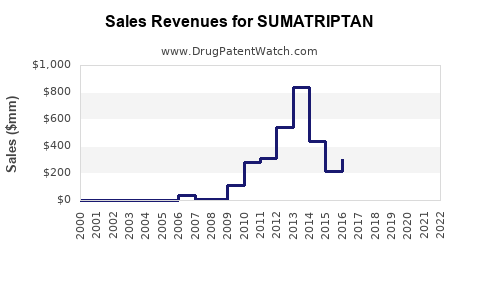
2. Peak branded sales
Imitrex became one of GSK's major prescription products. Historical sales were in the blockbuster range before generic entry. Product-level sales later declined as patent expiry approached and generic substitution increased.
3. Generic price erosion
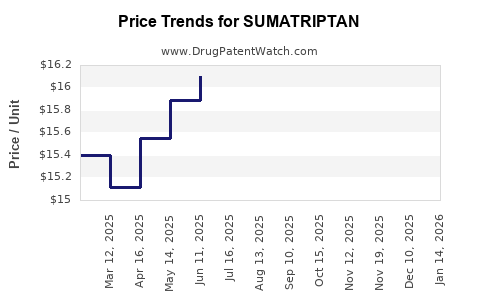
After generic entry, revenue shifted from one originator to many suppliers. Average selling prices fell, especially for tablets. Pharmacy benefit managers and wholesalers gained negotiating leverage, while manufacturers competed on cost and supply continuity.
4. Mature-volume market
The current market is primarily a volume business. Financial performance depends on:
- Number of prescriptions and units
- Generic market share
- Contract pricing
- Shortages and allocation
- Dosage-form mix
- Manufacturing yield
- Active pharmaceutical ingredient costs
- Retail, mail-order, and government reimbursement
A manufacturer with a low-cost tablet supply chain may achieve acceptable returns despite low prices. Injectable and nasal products can generate better margins, but they require greater regulatory, device, and manufacturing investment.
What is the revenue exposure for major manufacturers?
Direct exposure is limited because sumatriptan is generally not a material standalone revenue driver for diversified pharmaceutical companies.
| Company type |
Revenue exposure |
Economic profile |
| Original innovator |
Historical high exposure through Imitrex |
Revenue collapsed after generic entry |
| Large generic manufacturer |
Low to moderate product-level exposure |
Volume-driven, price-sensitive |
| Specialty device manufacturer |
Potentially higher exposure in injection or nasal formats |
Better margins, higher development risk |
| API supplier |
Indirect exposure |
Sensitive to supply contracts and capacity |
| Pharmacy and wholesaler |
Transaction-volume exposure |
Low margin, high turnover |
The original Imitrex franchise created substantial historical value, but the remaining opportunity is fragmented. A company seeking material growth would generally need a differentiated delivery system, combination product, or reformulation rather than another conventional tablet.
What generic entry risks exist for sumatriptan?
Generic-entry risk is already realized for standard tablets. The remaining risks are product-specific.
Conventional tablet scenario
The market remains highly competitive. New entrants can face low prices, limited formulary leverage, and difficulty securing sufficient volume. A new applicant may obtain approval but fail to gain meaningful market share.
Nasal spray scenario
Nasal spray entrants face formulation, device, and bioequivalence complexity. Regulatory approval may take longer, and substitution may be less automatic than for tablets.
Injection scenario
Injectable products face sterile manufacturing, container-closure, device, and human-factors requirements. Supply disruption can create temporary pricing opportunities, but those gains may attract additional entrants.
Branded reformulation scenario
A branded reformulation can preserve pricing if it provides a clinically meaningful convenience benefit and receives effective patent or regulatory protection. The strategy remains vulnerable to payer rejection and competition from gepants.
Does sumatriptan have biosimilar risk?
No. Sumatriptan is a small-molecule drug, not a biologic. Biosimilar regulation does not apply. Competitive products are approved primarily through the ANDA pathway, subject to pharmaceutical equivalence and bioequivalence requirements. The relevant competitive threat is generic substitution, not biosimilar interchangeability.
What FDA regulatory status does sumatriptan have?
Sumatriptan is FDA-approved for acute treatment of migraine, with or without aura, in multiple dosage forms. It is a prescription product. Regulatory review differs by presentation:
- Tablets generally use conventional ANDA pathways.
- Nasal spray requires more complex formulation and delivery evaluation.
- Injection products require sterile manufacturing and device-related controls.
- Combination products require assessment of both active ingredients and their combined performance.
FDA labeling includes contraindications and warnings relating to cardiovascular disease, cerebrovascular disease, peripheral vascular disease, uncontrolled hypertension, serotonin-related reactions, and medication-overuse headache. These restrictions influence the addressable market and support demand for non-vasoconstrictive competitors.
What licensing deals affect sumatriptan?
The principal historical commercial relationship was between Glaxo and later GSK and the product rights associated with Imitrex and Imigran. Sumatriptan was commercialized internationally under different brand and licensing arrangements.
Current licensing value is limited for unmodified sumatriptan. Potentially attractive transactions would focus on:
- Proprietary injection devices
- Nasal delivery technology
- Combination products
- Geographic commercialization rights
- Contract manufacturing and API supply
- Reformulations with differentiated patient use
A license covering only conventional sumatriptan tablets would have weak negotiating leverage because multiple generic alternatives exist.
What geographic markets remain attractive?
The United States is mature and heavily genericized. Opportunity is more likely in:
- Markets with incomplete generic penetration
- Countries with supply shortages
- Regions where branded Imigran retains physician preference
- Emerging markets with increasing migraine diagnosis
- Markets favoring nasal or injectable delivery
- Territories where local manufacturing receives procurement preference
Geographic pricing varies widely. Regulatory approval, local reference pricing, tender systems, currency movements, and API sourcing determine profitability. A global launch requires country-specific registration and pharmacovigilance, while local generic markets may offer faster access but lower scale.
Key Takeaways
- Sumatriptan is a mature generic market with no meaningful remaining compound-level exclusivity.
- Standard tablets face intense price competition and limited new-entry economics.
- Nasal spray and injectable products retain higher technical and commercial barriers.
- The original Imitrex franchise generated blockbuster revenue before generic entry.
- Current manufacturer value is driven by volume, supply reliability, dosage-form complexity, and cost control.
- Sumatriptan competes primarily on affordability against patented gepants and other newer migraine therapies.
- Biosimilar risk does not apply because sumatriptan is a small molecule.
- Future licensing and investment value is concentrated in delivery systems, combination products, and differentiated reformulations.
FAQs
Is sumatriptan still profitable for generic drug companies?
It can be profitable at scale, especially for manufacturers with efficient tablet production and reliable distribution. Margins are generally constrained by multiple suppliers and payer purchasing power.
Can a company obtain a new patent on sumatriptan?
A new patent may cover a novel formulation, device, manufacturing process, combination, or method with sufficient technical novelty. A patent on the basic sumatriptan molecule is no longer available.
Why is sumatriptan cheaper than ubrogepant?
Sumatriptan has long-established generic competition, while ubrogepant remains a newer, branded product with active patent and market-exclusivity protection.
Are sumatriptan injections protected differently from tablets?
Yes. Injection products can involve sterile manufacturing, cartridge or autoinjector design, container-closure systems, and device patents that do not apply to ordinary tablets.
Can pharmacists substitute generic sumatriptan for Imitrex?
Substitution depends on state law, product equivalence, prescription instructions, payer policy, and the specific dosage form. Generic tablets are generally positioned for substitution where legally and pharmaceutically equivalent.
References
-
U.S. Food and Drug Administration. (2024). Drugs@FDA: FDA-approved drugs database. https://www.accessdata.fda.gov/scripts/cder/daf/
-
U.S. Food and Drug Administration. (2024). Approved drug products with therapeutic equivalence evaluations, Orange Book. https://www.fda.gov/drugs/drug-approvals-and-databases/approved-drug-products-therapeutic-equivalence-evaluations-orange-book
-
U.S. Food and Drug Administration. (2023). IMITREX (sumatriptan succinate) prescribing information. https://www.accessdata.fda.gov/drugsatfda_docs/label/
-
GlaxoSmithKline plc. (2000). Annual report 1999. GSK.
-
GlaxoSmithKline plc. (2001). Annual report 2000. GSK.
-
U.S. Food and Drug Administration. (2024). Abbreviated new drug application guidance and generic drug regulatory information. https://www.fda.gov/drugs/generic-drugs
-
International Headache Society. (2024). The International Classification of Headache Disorders, 3rd edition. https://ichd-3.org/