Azurity Company Profile
✉ Email this page to a colleague
What is the competitive landscape for AZURITY
AZURITY has fifty-nine approved drugs.
There are one hundred and sixty-seven US patents protecting AZURITY drugs. There are two tentative approvals on AZURITY drugs.
Summary for Azurity
| US Patents: | 167 |
| Tradenames: | 62 |
| Ingredients: | 53 |
| NDAs: | 59 |
| Patent Litigation for Azurity: | See patent lawsuits for Azurity |
| PTAB Cases with Azurity as petitioner: | See PTAB cases with Azurity as petitioner |
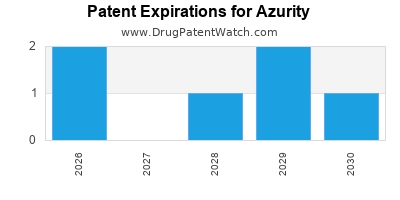
Drugs and US Patents for Azurity
| Applicant | Tradename | Generic Name | Dosage | NDA | Approval Date | TE | Type | RLD | RS | Patent No. | Patent Expiration | Product | Substance | Delist Req. | Exclusivity Expiration |
|---|---|---|---|---|---|---|---|---|---|---|---|---|---|---|---|
| Azurity | KONVOMEP | omeprazole; sodium bicarbonate | FOR SUSPENSION;ORAL | 213593-001 | Aug 30, 2022 | RX | Yes | Yes | 11,771,686 | ⤷ Start Trial | ⤷ Start Trial | ||||
| Azurity | ONZETRA XSAIL | sumatriptan succinate | POWDER;NASAL | 206099-001 | Jan 27, 2016 | RX | Yes | Yes | 9,649,456 | ⤷ Start Trial | Y | ⤷ Start Trial | |||
| Azurity | QBRELIS | lisinopril | SOLUTION;ORAL | 208401-001 | Jul 29, 2016 | RX | Yes | Yes | 11,771,733 | ⤷ Start Trial | Y | ⤷ Start Trial | |||
| Azurity | ERYTHROCIN STEARATE | erythromycin stearate | TABLET;ORAL | 060359-002 | Approved Prior to Jan 1, 1982 | DISCN | No | No | ⤷ Start Trial | ⤷ Start Trial | |||||
| Azurity | PREVDUO | glycopyrrolate; neostigmine methylsulfate | SOLUTION;INTRAVENOUS | 216903-001 | Feb 23, 2023 | DISCN | Yes | No | 12,151,020 | ⤷ Start Trial | Y | ⤷ Start Trial | |||
| Azurity | WIDAPLIK | amlodipine besylate; indapamide; telmisartan | TABLET;ORAL | 219423-003 | Jun 5, 2025 | DISCN | Yes | No | ⤷ Start Trial | ⤷ Start Trial | |||||
| >Applicant | >Tradename | >Generic Name | >Dosage | >NDA | >Approval Date | >TE | >Type | >RLD | >RS | >Patent No. | >Patent Expiration | >Product | >Substance | >Delist Req. | >Exclusivity Expiration |
Expired US Patents for Azurity
| Applicant | Tradename | Generic Name | Dosage | NDA | Approval Date | Patent No. | Patent Expiration |
|---|---|---|---|---|---|---|---|
| Azurity | TUDORZA PRESSAIR | aclidinium bromide | POWDER, METERED;INHALATION | 202450-001 | Jul 23, 2012 | 10,588,895 | ⤷ Start Trial |
| Azurity | TUDORZA PRESSAIR | aclidinium bromide | POWDER, METERED;INHALATION | 202450-001 | Jul 23, 2012 | 10,034,867 | ⤷ Start Trial |
| Azurity | HORIZANT | gabapentin enacarbil | TABLET, EXTENDED RELEASE;ORAL | 022399-002 | Dec 13, 2011 | 8,114,909 | ⤷ Start Trial |
| Azurity | EDARBYCLOR | azilsartan kamedoxomil; chlorthalidone | TABLET;ORAL | 202331-002 | Dec 20, 2011 | 5,583,141 | ⤷ Start Trial |
| Azurity | EDARBI | azilsartan kamedoxomil | TABLET;ORAL | 200796-002 | Feb 25, 2011 | 5,958,961 | ⤷ Start Trial |
| Azurity | FERAHEME | ferumoxytol | SOLUTION;INTRAVENOUS | 022180-001 | Jun 30, 2009 | 8,591,864 | ⤷ Start Trial |
| >Applicant | >Tradename | >Generic Name | >Dosage | >NDA | >Approval Date | >Patent No. | >Patent Expiration |
Paragraph IV (Patent) Challenges for AZURITY drugs
| Drugname | Dosage | Strength | Tradename | Submissiondate |
|---|---|---|---|---|
| ➤ Subscribe | Extended-release Tablets | 8.5 mg and 17 mg | ➤ Subscribe | 2009-03-02 |
| ➤ Subscribe | Extended-release Tablets | 100 mg and 200 mg | ➤ Subscribe | 2006-07-20 |
| ➤ Subscribe | Powder for Oral Solution | 1 mg/mL | ➤ Subscribe | 2016-06-21 |
| ➤ Subscribe | Oral Solution | 1 mg/mL | ➤ Subscribe | 2018-08-31 |
| ➤ Subscribe | Nasal Spray | 250 mcg | ➤ Subscribe | 2012-02-13 |
| ➤ Subscribe | Extended-release Tablets | 20 mg and 30 mg | ➤ Subscribe | 2007-11-07 |
| ➤ Subscribe | Extended-release Tablets | 40 mg | ➤ Subscribe | 2007-06-11 |
| ➤ Subscribe | Extended-release Tablets | 300 mg | ➤ Subscribe | 2006-05-19 |
| ➤ Subscribe | Injection | 30 mg/mL, 17 mL single-use vials | ➤ Subscribe | 2015-12-04 |
| ➤ Subscribe | Oral Solution | 17.5 g/3.13 g/1.6 g per bottle | ➤ Subscribe | 2010-11-08 |
| ➤ Subscribe | Extended-release Tablets | 8 mg/90 mg | ➤ Subscribe | 2015-03-12 |
| ➤ Subscribe | Extended-release Tablets | 25.5 mg and 34 mg | ➤ Subscribe | 2008-11-28 |
International Patents for Azurity Drugs
| Country | Patent Number | Estimated Expiration |
|---|---|---|
| European Patent Office | 2061448 | ⤷ Start Trial |
| Japan | 2023063282 | ⤷ Start Trial |
| New Zealand | 545989 | ⤷ Start Trial |
| San Marino | T202500290 | ⤷ Start Trial |
| Peru | 20190406 | ⤷ Start Trial |
| Japan | 5856095 | ⤷ Start Trial |
| >Country | >Patent Number | >Estimated Expiration |
Supplementary Protection Certificates for Azurity Drugs
| Patent Number | Supplementary Protection Certificate | SPC Country | SPC Expiration | SPC Description |
|---|---|---|---|---|
| 2316456 | C201730057 | Spain | ⤷ Start Trial | PRODUCT NAME: NALTREXONA O UNA SAL FARMACEUTICAMENTE ACEPTABLE DE LA MISMA, EN PARTICULAR CLORHIDRATO DE NALTREXONA, Y BUPROPION O UNA SAL FARMACEUTICAMENTE ACEPTABLE DEL MISMO, EN PARTICULAR CLORHIDRATO DE BUPROPION.; NATIONAL AUTHORISATION NUMBER: EU/1/14/988; DATE OF AUTHORISATION: 20150326; NUMBER OF FIRST AUTHORISATION IN EUROPEAN ECONOMIC AREA (EEA): EU/1/14/988; DATE OF FIRST AUTHORISATION IN EEA: 20150326 |
| 1411900 | 1190013-1 | Sweden | ⤷ Start Trial | PRODUCT NAME: NAPROXEN OCH ESOMEPRAZOL; NAT. REG. NO/DATE: MTNR 43248 20101203; FIRST REG.: GB PL 17901/0263 20101105 |
| 0656775 | 28/2000 | Austria | ⤷ Start Trial | PRODUCT NAME: BUPROPION HYDROCHLORID; NAT. REGISTRATION NO/DATE: 1-23680 20000616; FIRST REGISTRATION: NL 24160 19991201 |
| 2316456 | 300918 | Netherlands | ⤷ Start Trial | PRODUCT NAME: NALTREXON OF EEN FARMACEUTISCH AANVAARDBAAR ZOUT DAARVAN, IN HET BIJZONDER NALTREXONHYDROCHLORIDE, EN BUPROPION OF EEN FARMACEUTISCH AANVAARDBAAR ZOUT DAARVAN, IN HET BIJZONDER BUPROPIONHYDROCHLORIDE; REGISTRATION NO/DATE: EU/1/14/988 20150330 |
| 1507558 | C300528 | Netherlands | ⤷ Start Trial | PRODUCT NAME: COMBINATIE VAN ALISKIREN OF EEN FARMACEUTISCH AANVAARDBAAR ZOUT DAARVAN, AMLODIPINE OF EEN FARMACEUTISCH AANVAARDBAAR ZOUT DAARVAN EN HYDROCHLOORTHIAZIDE OF EEN FARMACEUTISCH AANVAARDBAAR ZOUT DAARVAN; NATL. REGISTRATION NO/DATE: EU/1/11/730/001-060 20111122; FIRST REGISTRATION: CH 61678 01-05 20110705 |
| 0734381 | SPC/GB04/011 | United Kingdom | ⤷ Start Trial | PRODUCT NAME: APREPITANT, OPTIONALLY IN THE FORM OF A PHARMACEUTICALLY ACCEPTABLE SALT; REGISTERED: UK EU/1/03/262/001 20031113; UK EU/1/03/262/002 20031113; UK EU/1/03/262/003 20031113; UK EU/1/03/262/004 20031113; UK EU/1/03/262/005 20031113; UK EU/1/03/262/006 20031113 |
| >Patent Number | >Supplementary Protection Certificate | >SPC Country | >SPC Expiration | >SPC Description |
Similar Applicant Names
Applicants may be listed under multiple names.
Here is a list of applicants with similar names.
Here is a list of applicants with similar names.
