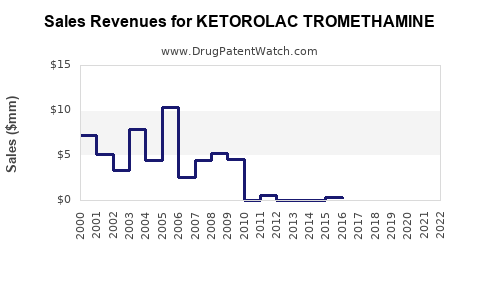
Last updated: August 11, 2026
Ketorolac tromethamine is a mature, off-patent nonsteroidal anti-inflammatory drug sold primarily as an injectable analgesic, oral tablet, and ophthalmic solution. Its commercial profile is defined by high generic competition, low unit prices, hospital procurement pressure, strict five-day systemic-use labeling, and episodic supply shortages rather than by branded pricing power.
The strongest remaining commercial positions are in sterile injectable manufacturing and ophthalmic distribution. The active ingredient has no meaningful U.S. composition-of-matter exclusivity, no current branded monopoly, and limited ability to support premium pricing. Financial performance depends on manufacturing reliability, contract awards, hospital channel access, regulatory compliance, and supply continuity.
What is ketorolac tromethamine used for?
Ketorolac tromethamine is a prescription NSAID used for short-term management of moderately severe acute pain. In the United States, systemic ketorolac is administered by injection and as oral tablets. The oral product is intended as continuation therapy after intravenous or intramuscular dosing and is not labeled for initial treatment.
The FDA label limits the combined duration of injection and oral therapy to five days in adults because of gastrointestinal bleeding, renal toxicity, cardiovascular risk, and other NSAID-related adverse events.[1]
Ketorolac ophthalmic products are used for ocular pain, inflammation, itching, and postoperative inflammation, depending on the specific strength and product label. Ophthalmic formulations include 0.4% and 0.5% solutions and preservative-free presentations.
| Product category |
Principal use |
Main commercial channel |
Pricing profile |
| Injectable ketorolac |
Acute moderate-to-severe pain |
Hospitals, ambulatory surgery centers, emergency departments |
Low-price generic, procurement-driven |
| Oral ketorolac tablets |
Short continuation therapy |
Retail and hospital outpatient pharmacies |
Low-price generic |
| Ketorolac ophthalmic solution |
Ocular pain, inflammation, and itching |
Ophthalmology and retail pharmacy |
Higher value per unit than systemic generic products |
| Combination ophthalmic products |
Postoperative inflammation and related symptoms |
Ophthalmology |
Product- and manufacturer-specific |
The injectable formulation has the largest strategic importance because hospital buyers require reliable sterile supply and may switch suppliers when shortages occur.
How large is the ketorolac tromethamine market?
No authoritative public source reports a consolidated global market revenue figure for ketorolac tromethamine across injections, tablets, and ophthalmic products. Manufacturers generally report ketorolac within broader generic pharmaceutical portfolios rather than as a separate product line.
Market value is fragmented across:
- Hospital injectable sales.
- Retail and institutional oral-tablet prescriptions.
- Ophthalmic generic sales.
- Private-label and contract-manufactured products.
- Non-U.S. branded and generic markets.
Prescription volume is a more useful indicator than revenue for systemic ketorolac. Generic competition has reduced prices substantially from the branded Toradol era. Ophthalmic ketorolac generates higher revenue per prescription than oral tablets in many markets, but the segment also has several generic and branded alternatives.
Public company filings can show exposure to injectable generics, ophthalmic products, or hospital pharmaceuticals, but they generally do not isolate ketorolac sales. As a result, company-level revenue attribution is usually unavailable without prescription, wholesaler, or tender data.
What patents protect ketorolac tromethamine?
The original ketorolac intellectual-property estate is expired in the United States. The product was commercialized under the Toradol brand, originally associated with Syntex, which was later acquired by Roche. The historical product and formulation patents do not provide current blocking exclusivity for standard ketorolac tromethamine injection, tablets, or ophthalmic solution.
The relevant commercial conclusion is that standard ketorolac products can be developed and marketed through abbreviated new drug application pathways, subject to FDA requirements and any product-specific regulatory barriers.
| IP category |
Current commercial effect |
| Original ketorolac compound protection |
Expired |
| Original systemic formulation protection |
Expired |
| Toradol brand rights |
No current monopoly over the active ingredient |
| Standard injection formulation |
Generally open to ANDA competition |
| Standard oral tablets |
Generally open to ANDA competition |
| Standard ophthalmic solution |
Open to generic competition, subject to product-specific approval requirements |
| Manufacturing know-how |
May remain valuable but is not equivalent to blocking patent exclusivity |
Later patents may cover particular delivery systems, packaging, preservative systems, concentrations, or combinations. Such patents do not necessarily block standard ketorolac products and must be assessed against the exact dosage form, strength, and label.
What is the Orange Book status of ketorolac tromethamine?
The FDA Orange Book identifies approved drug products, reference listed drugs, therapeutic equivalents, and applicable patents or exclusivity. For mature ketorolac products, the key regulatory fact is the absence of a live foundational patent estate that prevents ordinary generic entry.[2]
The Orange Book analysis must be performed by product rather than by active ingredient alone. Ketorolac injection, tablets, and ophthalmic solutions have different reference products, sponsors, dosage forms, and approval histories.
Important distinctions include:
- An approved generic product is not evidence that every ketorolac formulation is interchangeable.
- Ophthalmic products may require formulation-specific equivalence demonstrations.
- Preservative-free products can have different approval and manufacturing requirements.
- A product may have no patent obstacle but still face manufacturing, quality, or supply constraints.
- A discontinued brand can remain relevant as a reference product even when the commercial market is generic.
The absence of a blocking patent does not eliminate litigation risk. Generic manufacturers can still face claims involving formulation, device, process, labeling, trade dress, or manufacturing technology.
When did ketorolac lose exclusivity?
Ketorolac lost meaningful U.S. market exclusivity after the expiration of its original patent and the approval of generic competitors. Toradol generic competition became established decades ago. The drug is now in the mature generic phase of its lifecycle.
Ketorolac has no remaining U.S. new chemical entity exclusivity. It also has no biosimilar pathway because it is a small-molecule drug rather than a biologic.
| Exclusivity type |
Status |
| New chemical entity exclusivity |
Expired |
| Orphan-drug exclusivity |
Not applicable to standard ketorolac |
| Pediatric exclusivity |
No current commercial significance |
| Patent-based exclusivity |
Expired for the original drug estate |
| Biosimilar exclusivity |
Not applicable |
| Current branded exclusivity |
None for standard ketorolac products |
Which companies compete in ketorolac tromethamine?
Competition varies by dosage form and geography. U.S. injectable suppliers have included major generic and hospital-product manufacturers such as Fresenius Kabi, Hikma, Sagent Pharmaceuticals, Dr. Reddy’s Laboratories, Teva, and other approved suppliers. The active supplier set can change through discontinuations, acquisitions, manufacturing transfers, and shortage events.
Ophthalmic competition has included generic ophthalmic manufacturers and specialty pharmaceutical companies supplying ketorolac solution under their own labels or through contract arrangements. Bausch + Lomb, Akorn historically, Apotex, and other ophthalmic manufacturers have participated in related markets, although product availability and ownership have changed over time.
The competitive structure has four tiers:
- Large injectable manufacturers with established hospital contracts.
- Generic companies with approved but lower-volume products.
- Ophthalmic specialists with formulation and distribution capabilities.
- Contract manufacturers and private-label suppliers.
The strongest competitive advantage is often operational rather than patent-based. Reliable sterile manufacturing, validated supply chains, FDA-compliant facilities, and hospital-contract coverage can produce greater commercial value than ownership of an expired patent estate.
How does ketorolac compare with competing analgesics?
Ketorolac competes with opioids, acetaminophen, other NSAIDs, and local or regional anesthetic techniques. Hospitals often use it as part of multimodal analgesia to reduce opioid exposure.
| Product |
Relative strength |
Principal advantage |
Principal limitation |
| Ketorolac injection |
Strong non-opioid acute analgesia |
Established hospital use and low generic cost |
Five-day systemic-use limit; renal and bleeding risks |
| Ibuprofen injection |
Non-opioid analgesia |
Broad NSAID familiarity |
Formulation and dosing considerations |
| Acetaminophen injection |
Non-opioid analgesia |
Lower NSAID-specific bleeding and renal concerns |
Hepatic safety and dose limits |
| Morphine and other opioids |
Strong acute analgesia |
Broad clinical utility |
Respiratory depression, dependence, sedation |
| Diclofenac ophthalmic |
Ocular NSAID |
Established ophthalmic alternative |
Ocular tolerability and product-specific limitations |
| Nepafenac or bromfenac ophthalmic |
Ocular NSAID |
Often positioned for postoperative use |
Higher price and branded or specialty competition |
Ketorolac’s commercial durability comes from its low cost, familiar clinical profile, and role in opioid-sparing protocols. Its five-day systemic limit restricts chronic-use revenue and prevents the product from competing as a long-term pain medicine.
What formulations are protected by ketorolac patents?
Standard ketorolac products do not have a commercially meaningful active patent barrier. Potentially differentiated products may rely on formulation or delivery claims, including:
- Preservative-free ophthalmic solutions.
- Modified concentrations.
- Unit-dose containers.
- Novel ophthalmic delivery systems.
- Combination products.
- Improved stability or packaging systems.
- Alternative salts or excipient systems.
- Hospital-ready injection packaging.
These features can create regulatory or manufacturing advantages, but they do not automatically create durable market exclusivity. The commercial value depends on whether the formulation offers a clinically meaningful benefit, receives distinct regulatory protection, and is difficult for competitors to replicate.
For injectable products, container closure integrity, particulate control, sterility assurance, and extractables and leachables management can be more important than formulation patents. For ophthalmic products, sterility, drop size, preservative performance, viscosity, pH, and container design can affect approval and substitution.
Are there Paragraph IV challenges for ketorolac?
Paragraph IV litigation was most relevant during the original generic-entry period, when manufacturers challenged patents listed for Toradol or related products. That period has passed for the foundational ketorolac estate.
Current generic entry generally does not depend on defeating a live composition patent. A new ANDA applicant must still address:
- Reference listed drug selection.
- Bioequivalence or comparative performance.
- Labeling requirements.
- Manufacturing site compliance.
- Product-specific patent certifications.
- Any applicable ophthalmic equivalence requirements.
The lack of an active foundational patent reduces litigation risk but does not eliminate regulatory disputes. FDA approval, facility inspections, product recalls, and supply interruptions are more material current risks than classic Paragraph IV patent litigation.
What patent litigation affects ketorolac tromethamine?
No major active U.S. patent litigation involving the original ketorolac active ingredient defines the market. Historical disputes were linked to generic entry and the Toradol patent estate.
Current litigation exposure is more likely to arise from:
- Formulation patents covering ophthalmic products.
- Labeling disputes.
- Manufacturing-process claims.
- Product liability claims involving gastrointestinal, renal, cardiovascular, or bleeding events.
- Contract disputes involving hospital supply.
- Antitrust or market-allocation claims among generic suppliers.
For investors and licensors, the relevant diligence question is not whether ketorolac has an expired patent portfolio. It is whether a specific supplier has a defensible manufacturing process, a differentiated dosage form, or a commercial contract that is difficult to replace.
What FDA regulatory risks affect ketorolac?
The principal FDA risks are clinical labeling, sterile manufacturing, and shortage management.
Systemic ketorolac carries boxed warnings relating to gastrointestinal risk, cardiovascular thrombotic events, renal effects, bleeding, hypersensitivity, and use during labor and delivery. The FDA label also limits treatment duration to five days.[1]
Injectable manufacturers face elevated compliance risk because sterile products can be subject to:
- Aseptic-processing failures.
- Visible or subvisible particulate contamination.
- Container closure defects.
- Microbial contamination.
- Facility warning letters.
- Product recalls.
- Manufacturing-site changes.
- Raw-material or glass-vial shortages.
The FDA Drug Shortages database has historically included ketorolac injection among products affected by supply constraints or manufacturer disruptions.[3] Shortages can temporarily improve pricing and hospital-contract opportunities for suppliers with available inventory, but they can also increase regulatory scrutiny and supply obligations.
What generic entry risks exist for ketorolac?
Generic entry risk is high for standard tablets and ordinary injectable products because the market is mature and the original patent estate is expired. The principal risk is price erosion rather than patent invalidation.
A new entrant may face:
- Low reimbursement and limited room for price competition.
- Established hospital contracts.
- High manufacturing costs for sterile injection.
- FDA inspection and remediation risk.
- Limited wholesaler access.
- Low annual revenue per product.
- Product liability exposure.
- Difficulty maintaining profitable production during normal supply conditions.
Ophthalmic ketorolac has somewhat better differentiation potential than tablets, particularly where a supplier has preservative-free packaging, a recognized ophthalmic sales force, or reliable postoperative-care distribution. Even this segment remains exposed to generic substitution and competing NSAID products.
How does ketorolac generate financial value without patent exclusivity?
Ketorolac generates value through volume, manufacturing efficiency, and channel position. The drug does not support the pricing model of a protected specialty pharmaceutical.
Revenue drivers
- High hospital utilization for acute postoperative and emergency pain.
- Low-cost positioning in multimodal analgesia.
- Recurring institutional demand.
- Ophthalmic prescriptions after cataract and other eye procedures.
- Private-label and contract-manufacturing arrangements.
- Temporary pricing power during shortages.
Margin pressures
- Multiple approved generic suppliers.
- Hospital group purchasing organization negotiations.
- Reimbursement compression.
- Commodity-like active pharmaceutical ingredient economics.
- Sterile manufacturing overhead.
- Inventory and expiry risk.
- Substitution by ibuprofen, acetaminophen, opioids, and other ophthalmic NSAIDs.
The injectable segment can produce better strategic value than the tablet segment because sterile production capacity is harder to replace. A supplier with an approved facility and consistent delivery can retain contracts even when the product itself has no patent protection.
What is the financial trajectory for ketorolac tromethamine?
The long-term trajectory is stable-to-declining in nominal pricing, with intermittent upward movements during shortages. Volume is likely to remain resilient where ketorolac is embedded in hospital order sets and postoperative protocols, but revenue growth is constrained by generic substitution and limited therapeutic expansion.
| Period |
Market condition |
Financial implication |
| Original branded period |
Toradol-led market with product protection |
Higher pricing and branded margins |
| Early generic period |
Rapid supplier entry |
Sharp price and share erosion |
| Mature generic period |
Stable demand and multiple suppliers |
Low prices, volume-based economics |
| Shortage periods |
Reduced supply and hospital switching |
Temporary price improvement for reliable suppliers |
| Long-term outlook |
Continued generic competition |
Flat or declining revenue unless differentiated |
A reasonable base case is low-growth or declining revenue for undifferentiated systemic products. The most favorable scenario is a supply-constrained injectable market in which a compliant manufacturer gains share through reliable availability. The weakest scenario is continued price erosion combined with facility remediation, raw-material disruption, or loss of a hospital contract.
What licensing deals and commercial partnerships matter?
Ketorolac licensing activity is unlikely to resemble licensing in oncology, rare disease, or biologics. The original value was tied to development and commercialization of Toradol. Current commercial arrangements are more likely to involve:
- Contract manufacturing.
- Private-label supply.
- Hospital and group-purchasing contracts.
- Regional distribution rights.
- Ophthalmic commercialization partnerships.
- Manufacturing-site transfers after acquisitions or portfolio rationalization.
The most valuable contractual asset is often a stable supply agreement rather than a patent license. A licensing transaction involving a differentiated ophthalmic formulation could command more strategic value than a standard tablet product, but the value would depend on regulatory status, geographic scope, manufacturing economics, and substitution risk.
What geographic markets offer the strongest opportunity?
The United States has a large and mature generic market, but price competition is intense. Hospital injectable supply can be attractive when few manufacturers remain active.
Europe has extensive generic penetration and national or regional tendering. Price pressure is high, while regulatory and reimbursement systems vary by country.
Emerging markets may offer stronger unit growth, but local registration, tender access, reimbursement, and distribution requirements determine commercial success. Ketorolac’s established clinical history supports broad recognition, but local products may compete on price.
| Region |
Opportunity |
Main constraint |
| United States |
Hospital injectables and ophthalmic generics |
Severe price competition and procurement pressure |
| Europe |
Institutional and retail generic demand |
Tender-driven pricing |
| Latin America |
Acute-care and ophthalmic use |
Registration and distribution fragmentation |
| Asia-Pacific |
Volume growth and local manufacturing |
Local competition and price sensitivity |
| Middle East and Africa |
Hospital supply opportunities |
Tender access and supply-chain complexity |
How strong is the ketorolac patent estate?
The patent estate is weak as a source of current exclusivity and moderate as a source of historical technical knowledge. It does not provide a durable barrier for standard ketorolac products.
| Strength factor |
Assessment |
| Composition-of-matter protection |
Expired |
| Current Orange Book blocking position |
Limited or absent for standard products |
| Generic entry barrier |
Low for tablets; moderate for sterile injectables |
| Formulation differentiation |
Possible in ophthalmic and delivery systems |
| Manufacturing barrier |
Meaningful for sterile products |
| Regulatory barrier |
Moderate, especially for injectables |
| Litigation protection |
Low |
| Commercial durability |
Dependent on supply, contracts, and cost control |
Key Takeaways
- Ketorolac tromethamine is a mature, off-patent generic NSAID.
- Toradol-era patent protection no longer supports a U.S. monopoly.
- No biosimilar risk exists because ketorolac is a small-molecule drug.
- Injectable ketorolac has the strongest commercial position because sterile manufacturing and hospital supply are difficult to replace.
- Ophthalmic ketorolac offers more formulation and channel differentiation than tablets.
- Paragraph IV litigation is no longer the principal market risk.
- FDA compliance, sterile manufacturing, shortages, hospital contracts, and price erosion drive financial performance.
- Standalone product revenue is generally not disclosed by manufacturers.
- The long-term base case is stable demand with declining or flat unit economics.
- Temporary revenue and margin expansion can occur when supply disruptions reduce the number of available suppliers.
FAQs
Is ketorolac tromethamine still profitable for generic manufacturers?
It can be profitable when manufacturing costs are low, supply is reliable, and the product is included in hospital contracts. Standard tablets generally have limited margin potential. Injectable and ophthalmic products can offer better economics.
Can a company obtain new patents on ketorolac tromethamine?
A company may seek patents covering a new formulation, delivery system, packaging design, combination, or manufacturing process. A new patent would not restore exclusivity to the original ketorolac molecule.
Is ketorolac tromethamine an opioid replacement product?
Ketorolac is a non-opioid NSAID. Hospitals use it as part of multimodal analgesia and may use it to reduce opioid requirements, but it cannot replace opioids in every acute-pain setting.
Why do ketorolac injection shortages affect prices more than tablet shortages?
Injectable production requires sterile facilities, validated processes, and specialized quality controls. Fewer qualified suppliers can therefore create greater supply concentration and temporary pricing power.
What is the best commercial entry point in the ketorolac market?
A differentiated ophthalmic product or a reliably supplied injectable product is generally more attractive than a standard oral tablet. The commercial case depends on regulatory approval, manufacturing cost, distribution access, and contract coverage.
References
- U.S. Food and Drug Administration. (2013). Ketorolac tromethamine injection prescribing information. FDA.
- U.S. Food and Drug Administration. (n.d.). Approved drug products with therapeutic equivalence evaluations: Orange Book. FDA.
- U.S. Food and Drug Administration. (n.d.). Drug shortages database. FDA.
- U.S. Food and Drug Administration. (n.d.). Drugs@FDA: FDA-approved drugs. FDA.
- U.S. Food and Drug Administration. (2011). Acular and ketorolac tromethamine ophthalmic solution labeling. FDA.