You're using a free limited version of DrugPatentWatch: Upgrade for Complete Access

Last Updated: December 31, 2025

ACULAR Drug Patent Profile


✉ Email this page to a colleague

« Back to Dashboard


When do Acular patents expire, and what generic alternatives are available?

Acular is a drug marketed by Abbvie and Allergan and is included in three NDAs. There is one patent protecting this drug.

The generic ingredient in ACULAR is ketorolac tromethamine. There are eighteen drug master file entries for this compound. Sixty-four suppliers are listed for this compound. Additional details are available on the ketorolac tromethamine profile page.

AI Deep Research
Questions you can ask:
  • What is the 5 year forecast for ACULAR?
  • What are the global sales for ACULAR?
  • What is Average Wholesale Price for ACULAR?
Summary for ACULAR
Drug patent expirations by year for ACULAR
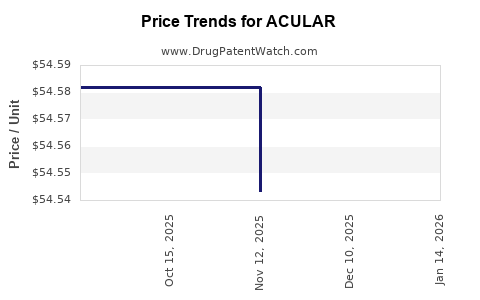
Drug Prices for ACULAR

See drug prices for ACULAR

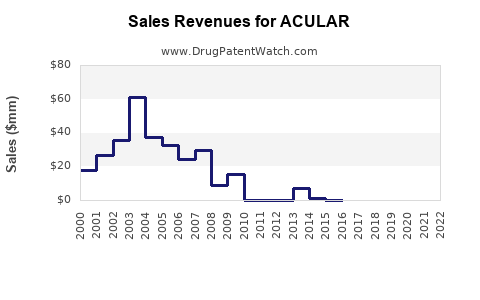
Drug Sales Revenue Trends for ACULAR

See drug sales revenues for ACULAR

Recent Clinical Trials for ACULAR

Identify potential brand extensions & 505(b)(2) entrants

SponsorPhase
Emory UniversityEarly Phase 1
University of LouisvillePhase 4
Arthroplasty Foundation, Inc.Phase 4

See all ACULAR clinical trials

Pharmacology for ACULAR

US Patents and Regulatory Information for ACULAR

Applicant Tradename Generic Name Dosage NDA Approval Date TE Type RLD RS Patent No. Patent Expiration Product Substance Delist Req. Exclusivity Expiration
Abbvie ACULAR ketorolac tromethamine SOLUTION/DROPS;OPHTHALMIC 019700-001 Nov 9, 1992 AT RX Yes Yes ⤷  Get Started Free ⤷  Get Started Free ⤷  Get Started Free
Abbvie ACULAR LS ketorolac tromethamine SOLUTION/DROPS;OPHTHALMIC 021528-001 May 30, 2003 AT RX Yes Yes 8,008,338*PED ⤷  Get Started Free Y ⤷  Get Started Free
Allergan ACULAR PRESERVATIVE FREE ketorolac tromethamine SOLUTION/DROPS;OPHTHALMIC 020811-001 Nov 3, 1997 DISCN No No ⤷  Get Started Free ⤷  Get Started Free ⤷  Get Started Free
>Applicant >Tradename >Generic Name >Dosage >NDA >Approval Date >TE >Type >RLD >RS >Patent No. >Patent Expiration >Product >Substance >Delist Req. >Exclusivity Expiration

Expired US Patents for ACULAR

Applicant Tradename Generic Name Dosage NDA Approval Date Patent No. Patent Expiration
Abbvie ACULAR ketorolac tromethamine SOLUTION/DROPS;OPHTHALMIC 019700-001 Nov 9, 1992 4,089,969 ⤷  Get Started Free
Abbvie ACULAR ketorolac tromethamine SOLUTION/DROPS;OPHTHALMIC 019700-001 Nov 9, 1992 4,454,151*PED ⤷  Get Started Free
Abbvie ACULAR ketorolac tromethamine SOLUTION/DROPS;OPHTHALMIC 019700-001 Nov 9, 1992 5,110,493*PED ⤷  Get Started Free
>Applicant >Tradename >Generic Name >Dosage >NDA >Approval Date >Patent No. >Patent Expiration

International Patents for ACULAR

See the table below for patents covering ACULAR around the world.

Country Patent Number Title Estimated Expiration
Denmark 151335 ⤷  Get Started Free
Germany 2760330 ⤷  Get Started Free
Germany 3310079 ⤷  Get Started Free
Japan 2954642 ⤷  Get Started Free
Germany 2731678 ⤷  Get Started Free
European Patent Office 0390071 ⤷  Get Started Free
Slovenia 7711721 PROCESS FOR OBTAINING 5-AROYL-1,2 DEHYDRO-3H-PYRROLO (1,2-A)PYRROL-1-CARBOXYLIC DERIVATIVES ⤷  Get Started Free
>Country >Patent Number >Title >Estimated Expiration

Supplementary Protection Certificates for ACULAR

Patent Number Supplementary Protection Certificate SPC Country SPC Expiration SPC Description
1534313 C 2015 055 Romania ⤷  Get Started Free PRODUCT NAME: COMBINATIE DE FENILEFRINA SAU O SARE ACCEPTABILAFARMACEUTIC A ACESTEIA SI KETOROLAC SATIONAL AUTHORISATION: 20150728; NUMBER OF FIRST AUTHORISATION IN EUROPEAN ECONOMIC AREA (EEA): EU/1/15/1018; DATE OF FIRST AUTHORISATION IN EEA: 20150728 U O SARE ACCEPTABILA FARMACEUTIC AACESTUIA; NATIONAL AUTHORISATION NUMBER: EU/1/15/1018; DATE OF NA
1534313 300784 Netherlands ⤷  Get Started Free PRODUCT NAME: KETOROLAC, OF HET TROMETAMOLZOUT ERVAN, EN FENYLEFRINE, OF HET HYDROCHLORIDEZOUT ERVAN; REGISTRATION NO/DATE: EU/1/15/1018 20150730
1534313 CA 2015 00072 Denmark ⤷  Get Started Free PRODUCT NAME: OKULAER SKYLLEVAESKE OMFATTENDE PHENYLEPHRIN ELLER ET FARMACEUTISK ACCEPTABELT SALT DERAF, HERUNDER HYDROCHLORID OG KETOROLAC ELLER ET FARMACEUTISK ACCEPTABELT SALT DERAF, HERUNDER KETOROLACTROMETAMOL; REG. NO/DATE: EU/1/15/1018 20150730
1534313 CR 2015 00072 Denmark ⤷  Get Started Free PRODUCT NAME: PHENYLEPHRIN, HERUNDER PHENYLEPHRINHYDROCHLORID OG KETOROLAC, HERUNDER KETOROLACTROMETAMOL; REG. NO/DATE: EU/1/15/1018 20150730
1534313 122015000111 Germany ⤷  Get Started Free PRODUCT NAME: PHENYLEPHRIN UND KETOROLAC; REGISTRATION NO/DATE: EU/1/15/1018 20150728
1534313 2015/071 Ireland ⤷  Get Started Free PRODUCT NAME: AN OCULAR IRRIGATION SOLUTION COMPRISING PHENYLEPHRINE OR A PHARMACEUTICALLY ACCEPTABLE SALT THEREOF AND KETOROLAC OR A PHARMACEUTICALLY ACCEPTABLE SALT THEREOF; REGISTRATION NO/DATE: EU/1/15/1018 20150728
1534313 76/2015 Austria ⤷  Get Started Free PRODUCT NAME: PHENYLEPHRIN, ODER EIN PHARMAZEUTISCH ANNEHMBARES SALZ DAVON, UND KETOROLAC, ODER EIN PHARMAZEUTISCH ANNEHMBARES SALZ DAVON; REGISTRATION NO/DATE: EU/1/15/1018 (MITTEILUNG) 20150730
>Patent Number >Supplementary Protection Certificate >SPC Country >SPC Expiration >SPC Description

Market Dynamics and Financial Trajectory for the Pharmaceutical Drug: ACULAR

Last updated: July 29, 2025

Introduction

ACULAR, a trademarked formulation of ketorolac tromethamine, is a nonsteroidal anti-inflammatory drug (NSAID) primarily employed as an ophthalmic solution for managing post-operative ocular inflammation and pain. Since its approval, ACULAR has established itself within the ophthalmology segment, experiencing fluctuating market dynamics influenced by competitive innovations, regulatory changes, and shifting clinical practices. This analysis endeavors to elucidate the current market landscape for ACULAR, examine their financial trajectories, and project future trends based on pivotal industry and regulatory factors.

Market Overview

Product Profile and Therapeutic Positioning

ACULAR’s core indication revolves around alleviating ocular pain and inflammation following corneal refractive surgery and other ocular procedures (e.g., cataract extraction). Its mechanism involves inhibiting prostaglandin synthesis, thereby reducing inflammation and related discomfort. The drug’s safety profile and efficacy have historically contributed to its widespread adoption in ophthalmic clinics worldwide.

Market Penetration and Adoption

As a product approved in multiple regions (notably the U.S., Europe, and Asia), ACULAR benefits from established prescribing habits among ophthalmologists. Its market penetration is strongest in developed countries, where surgical volumes for cataract and refractive procedures are substantial. However, in emerging markets, lower penetration exists due to limited access and local regulatory hurdles.

Key Competitors and Substitutes

The ophthalmic NSAID landscape includes competitors like bromsite (bromfenac), nevanac (nepafenac), and other corticosteroid alternatives. Recent entries offering enhanced formulations, such as preservative-free options and extended-release devices, challenge ACULAR’s market share, necessitating continuous differentiation and innovation.

Market Dynamics

Regulatory Environment and Patent Landscape

ACULAR’s original patents have expired or are nearing expiration in several jurisdictions, opening pathways for generics and biosimilars to enter the market. The entrance of generics generally precipitates price erosion, impacting profit margins. However, regulatory barriers, such as formulation-specific patents and clinical data exclusivity, can influence the pace of generic penetration.

Pricing Strategies and Reimbursement Policies

Pricing strategies for ACULAR have historically aligned with the premium ophthalmic NSAID segment, supported by positive clinical outcomes. Reimbursement policies, especially in managed healthcare systems, heavily influence patient access and prescribing patterns. In countries with strict cost-control measures, off-label use reductions and formulary restrictions can diminish market volume.

Emerging Trends: Preservative-Free and Combination Formulations

Innovations like preservative-free versions enhance safety profiles, appealing to clinics focused on patient comfort and safety. Combination therapies, blending NSAIDs with corticosteroids, are gaining popularity, potentially reducing demand for monotherapy such as ACULAR.

Impact of the COVID-19 Pandemic

The COVID-19 pandemic temporarily suppressed elective surgeries, reducing overall ophthalmic procedural volumes and thus ACULAR’s consumption. Conversely, adoption of tele-ophthalmology has increased, influencing outpatient prescription practices and potentially delaying or accelerating the drug’s market recovery depending on healthcare system adaptations.

Financial Trajectory Analysis

Historical Revenue Performance

ACULAR’s revenue has shown initial steady growth, driven by increasing surgical volumes, particularly in cataract and refractive surgeries. Subsequent patent expirations and market saturation led to a slowdown, compounded by the emergence of generics.

Current Financial Position

In recent years, the revenue trajectory has plateaued or slightly declined in mature markets, offsetting gains from newer regional markets. Cost diversification, such as investments in advanced formulations and targeted marketing, have maintained profitability margins.

Forecasting Future Revenue Streams

  1. Patent and Market Exclusivity Outlook: Expiry of key patents within the next 2-3 years in major markets is projected to lead to significant generic competition, reducing unit prices and overall revenue.

  2. Regional Growth Opportunities: Emerging markets present a lucrative expansion opportunity, particularly in Asia-Pacific, where surgical volumes are rising sharply. Regulatory approvals and local manufacturing bolster market entry prospects.

  3. Product Innovation and Differentiation: Investment in preservative-free or combination therapies could secure premium pricing and capture shifted patient preferences.

  4. Digital and Data-Driven Strategies: Adoption of telemedicine protocols and precise market analytics can optimize distribution channels, reducing costs and enhancing revenue.

Risks and Challenges

  • Drastic pricing reductions due to generic entry threaten profit margins.
  • Increasing competition from newer formulations and alternative therapies.
  • Regulatory delays or restrictions impacting market expansion.
  • Pricing pressures in healthcare systems emphasizing cost-effectiveness.

Market Growth Drivers and Constraints

Drivers Constraints
Rising global ophthalmic surgical procedures Patent expirations leading to generic competition
Innovation in preservative-free formulations Market saturation in mature regions
Increasing awareness and early intervention Cost constraints in emerging markets
Expansion into emerging markets Stringent regulatory environments

Concluding Insights

The trajectory of ACULAR’s market and financial performance is tightly intertwined with patent status, evolving clinical practices, and regional healthcare policies. While current revenue streams face pressure from generic competition, opportunities in emerging markets and product diversification offer pathways for stability. Strategic investments in formulation innovation, market expansion, and digital health solutions can bolster ACULAR’s market position amid a competitive landscape.


Key Takeaways

  • Patent Expiry and Generic Competition: The imminent expiration of key patents will drive significant generics entry, potentially reducing prices and revenues.
  • Regional Market Expansion: High-growth opportunities exist in Asia-Pacific and Latin America, driven by increasing surgical procedures.
  • Product Innovation: Development of preservative-free and combination therapies can sustain premium pricing and patient adherence.
  • Regulatory and Pricing Strategies: Navigating diverse regulatory frameworks and reimbursement policies is critical for market continuity.
  • Digital Transformation: Tele-ophthalmology and data analytics can optimize market access and operational efficiencies.

FAQs

1. How does patent expiration generally impact ACULAR’s market share?
Patent expiration opens the door for generic manufacturers to produce cost-effective alternatives, usually leading to substantial price reductions and a decrease in brand-specific market share unless the original manufacturer innovates or differentiates.

2. What are the primary competitors to ACULAR in the ophthalmic NSAID segment?
Major competitors include bromfenac-based drugs (Bromsite), nepafenac formulations (Nevanac, I.instill), and newer combination medications that target post-operative ocular pain and inflammation.

3. Are there ongoing innovations that could extend ACULAR’s market longevity?
Yes, preservative-free formulations, sustained-release delivery systems, and combination therapies are under development, aimed at improving efficacy, safety, and patient adherence.

4. Which regional markets are expected to drive future growth for ACULAR?
The Asia-Pacific region, notably China and India, offers significant growth potential due to expanding ophthalmic surgery volumes and improving healthcare infrastructure.

5. How has COVID-19 affected the sales of ACULAR?
The pandemic caused a temporary decline in elective ocular surgeries, leading to reduced demand. However, as healthcare systems recover, procedural volumes are rebounding, stabilizing sales trajectories.


References

  1. [1] Market data on ophthalmic NSAIDs, Ophthalmology Times, 2022.
  2. [2] Regulatory filings for ketorolac ophthalmic formulations, FDA and EMA databases, 2023.
  3. [3] Industry analysis reports on generic drug market dynamics, IQVIA, 2022.
  4. [4] Patent landscape for ophthalmic NSAIDs, World Intellectual Property Organization, 2023.
  5. [5] Emerging trends in ophthalmic drug delivery, Journal of Ophthalmology, 2021.

More… ↓

⤷  Get Started Free

Make Better Decisions: Try a trial or see plans & pricing

Drugs may be covered by multiple patents or regulatory protections. All trademarks and applicant names are the property of their respective owners or licensors. Although great care is taken in the proper and correct provision of this service, thinkBiotech LLC does not accept any responsibility for possible consequences of errors or omissions in the provided data. The data presented herein is for information purposes only. There is no warranty that the data contained herein is error free. We do not provide individual investment advice. This service is not registered with any financial regulatory agency. The information we publish is educational only and based on our opinions plus our models. By using DrugPatentWatch you acknowledge that we do not provide personalized recommendations or advice. thinkBiotech performs no independent verification of facts as provided by public sources nor are attempts made to provide legal or investing advice. Any reliance on data provided herein is done solely at the discretion of the user. Users of this service are advised to seek professional advice and independent confirmation before considering acting on any of the provided information. thinkBiotech LLC reserves the right to amend, extend or withdraw any part or all of the offered service without notice.