Msd Sub Merck Company Profile
✉ Email this page to a colleague
What is the competitive landscape for MSD SUB MERCK
MSD SUB MERCK has fourteen approved drugs.
There are seventeen US patents protecting MSD SUB MERCK drugs.
Summary for Msd Sub Merck
| US Patents: | 17 |
| Tradenames: | 13 |
| Ingredients: | 11 |
| NDAs: | 14 |
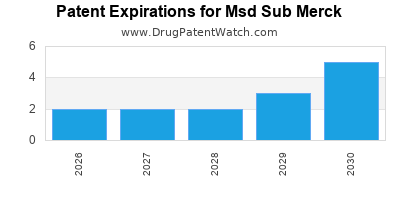
Drugs and US Patents for Msd Sub Merck
| Applicant | Tradename | Generic Name | Dosage | NDA | Approval Date | TE | Type | RLD | RS | Patent No. | Patent Expiration | Product | Substance | Delist Req. | Exclusivity Expiration |
|---|---|---|---|---|---|---|---|---|---|---|---|---|---|---|---|
| Msd Sub Merck | SEGLUROMET | ertugliflozin; metformin hydrochloride | TABLET;ORAL | 209806-001 | Dec 19, 2017 | RX | Yes | No | 8,080,580 | ⤷ Start Trial | Y | Y | ⤷ Start Trial | ||
| Msd Sub Merck | BRIDION | sugammadex sodium | SOLUTION;INTRAVENOUS | 022225-002 | Dec 15, 2015 | AP | RX | Yes | Yes | ⤷ Start Trial | ⤷ Start Trial | ||||
| Msd Sub Merck | ZEPATIER | elbasvir; grazoprevir | TABLET;ORAL | 208261-001 | Jan 28, 2016 | DISCN | Yes | No | 8,871,759 | ⤷ Start Trial | Y | Y | ⤷ Start Trial | ||
| Msd Sub Merck | JANUMET | metformin hydrochloride; sitagliptin phosphate | TABLET;ORAL | 022044-001 | Mar 30, 2007 | AB | RX | Yes | No | 8,414,921*PED | ⤷ Start Trial | Y | ⤷ Start Trial | ||
| Msd Sub Merck | SEGLUROMET | ertugliflozin; metformin hydrochloride | TABLET;ORAL | 209806-003 | Dec 19, 2017 | RX | Yes | No | 9,308,204 | ⤷ Start Trial | Y | ⤷ Start Trial | |||
| >Applicant | >Tradename | >Generic Name | >Dosage | >NDA | >Approval Date | >TE | >Type | >RLD | >RS | >Patent No. | >Patent Expiration | >Product | >Substance | >Delist Req. | >Exclusivity Expiration |
Expired US Patents for Msd Sub Merck
| Applicant | Tradename | Generic Name | Dosage | NDA | Approval Date | Patent No. | Patent Expiration |
|---|---|---|---|---|---|---|---|
| Msd Sub Merck | JANUMET XR | metformin hydrochloride; sitagliptin phosphate | TABLET, EXTENDED RELEASE;ORAL | 202270-003 | Feb 2, 2012 | 6,303,661 | ⤷ Start Trial |
| Msd Sub Merck | JANUMET XR | metformin hydrochloride; sitagliptin phosphate | TABLET, EXTENDED RELEASE;ORAL | 202270-002 | Feb 2, 2012 | 7,459,428 | ⤷ Start Trial |
| Msd Sub Merck | STEGLUJAN | ertugliflozin; sitagliptin phosphate | TABLET;ORAL | 209805-001 | Dec 19, 2017 | 7,078,381 | ⤷ Start Trial |
| Msd Sub Merck | STEGLUJAN | ertugliflozin; sitagliptin phosphate | TABLET;ORAL | 209805-002 | Dec 19, 2017 | 7,078,381 | ⤷ Start Trial |
| Msd Sub Merck | STEGLUJAN | ertugliflozin; sitagliptin phosphate | TABLET;ORAL | 209805-001 | Dec 19, 2017 | 7,459,428 | ⤷ Start Trial |
| >Applicant | >Tradename | >Generic Name | >Dosage | >NDA | >Approval Date | >Patent No. | >Patent Expiration |
Paragraph IV (Patent) Challenges for MSD SUB MERCK drugs
| Drugname | Dosage | Strength | Tradename | Submissiondate |
|---|---|---|---|---|
| ➤ Subscribe | Injection | 0.75 mg/mL, 100 mL vial | ➤ Subscribe | 2009-06-05 |
| ➤ Subscribe | Tablets | 400 mg | ➤ Subscribe | 2011-10-12 |
| ➤ Subscribe | Extended-release Capsules | 50 mg/500 mg and 50 mg/1000 mg | ➤ Subscribe | 2012-03-16 |
| ➤ Subscribe | Tablets | 50 mg/500 mg and 50 mg/1000 mg | ➤ Subscribe | 2010-10-18 |
| ➤ Subscribe | Injection | 2 mg/mL, 100 mL vial | ➤ Subscribe | 2008-12-18 |
| ➤ Subscribe | Injection | 1 g/vial | ➤ Subscribe | 2013-06-20 |
| ➤ Subscribe | Ophthalmic Solution | 2% | ➤ Subscribe | 2005-10-11 |
| ➤ Subscribe | Extended-release Tablets | 100 mg/1000 mg | ➤ Subscribe | 2012-10-22 |
| ➤ Subscribe | Injection | 2 mg/mL, 10 mL vial | ➤ Subscribe | 2008-09-30 |
International Patents for Msd Sub Merck Drugs
| Country | Patent Number | Estimated Expiration |
|---|---|---|
| Malaysia | 169311 | ⤷ Start Trial |
| Spain | 2375788 | ⤷ Start Trial |
| Argentina | 026605 | ⤷ Start Trial |
| Portugal | 1259550 | ⤷ Start Trial |
| Israel | 172563 | ⤷ Start Trial |
| >Country | >Patent Number | >Estimated Expiration |
Supplementary Protection Certificates for Msd Sub Merck Drugs
| Patent Number | Supplementary Protection Certificate | SPC Country | SPC Expiration | SPC Description |
|---|---|---|---|---|
| 1441735 | SZ 30/2008 | Austria | ⤷ Start Trial | PRODUCT NAME: RALTEGRAVIR ODER DESSEN PHARMAZEUTISCH ANNEHMBAREN SALZE, INSBESONDERE DAS KALIUMSALZ |
| 1261586 | 15/2012 | Austria | ⤷ Start Trial | PRODUCT NAME: KOMBINATIONSPRODUKT VON SAXAGLIPTIN UND METFORMIN UND PHARMAZEUTISCH VERTRAEGLICHE SALZE DAVON, BEINHALTEND DIE HYDROCHLORIDSALZE VON SAXAGLIPTIN UND METFORMIN; REGISTRATION NO/DATE: EU/1/11/731/001-EU/1/11/731/012 20111124 |
| 2310095 | C02310095/01 | Switzerland | ⤷ Start Trial | PRODUCT NAME: GRAZOPREVIR; REGISTRATION NO/DATE: SWISSMEDIC-ZULASSUNG 65861 01.04.2016 |
| 1441735 | PA2008007 | Lithuania | ⤷ Start Trial | PRODUCT NAME: RALTEGRAVIRUM; REG. NO/DATE: EU/1/07/436/001-002 20071220 |
| 2310095 | CA 2016 00070 | Denmark | ⤷ Start Trial | PRODUCT NAME: GRAZOPREVIR OR A PHARMACEUTICALLY ACCEPTABLE SALT THEREOF; REG. NO/DATE: EU/1/16/1119 20160726 |
| >Patent Number | >Supplementary Protection Certificate | >SPC Country | >SPC Expiration | >SPC Description |
Similar Applicant Names
Applicants may be listed under multiple names.
Here is a list of applicants with similar names.
Here is a list of applicants with similar names.
