You're using a free limited version of DrugPatentWatch: Upgrade for Complete Access

Last Updated: March 26, 2026

BRIDION Drug Patent Profile


✉ Email this page to a colleague

« Back to Dashboard


When do Bridion patents expire, and when can generic versions of Bridion launch?

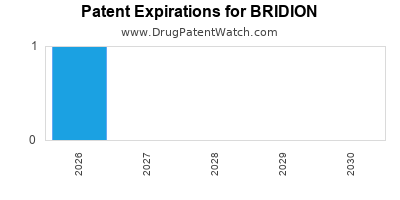
Bridion is a drug marketed by Msd Sub Merck and is included in one NDA. There is one patent protecting this drug and one Paragraph IV challenge.

This drug has forty-two patent family members in thirty countries.

The generic ingredient in BRIDION is sugammadex sodium. There are two drug master file entries for this compound. Three suppliers are listed for this compound. Additional details are available on the sugammadex sodium profile page.

DrugPatentWatch® Litigation and Generic Entry Outlook for Bridion

A generic version of BRIDION was approved as sugammadex sodium by ASPIRO on June 9th, 2023.

  Start Trial

AI Deep Research
Questions you can ask:
  • What is the 5 year forecast for BRIDION?
  • What are the global sales for BRIDION?
  • What is Average Wholesale Price for BRIDION?
Drug patent expirations by year for BRIDION
Drug Prices for BRIDION

See drug prices for BRIDION

Recent Clinical Trials for BRIDION

Identify potential brand extensions & 505(b)(2) entrants

SponsorPhase
Tamas Vegh, MDPHASE4
Korea University Ansan HospitalPhase 4
Seoul National University HospitalN/A

See all BRIDION clinical trials

Pharmacology for BRIDION
Paragraph IV (Patent) Challenges for BRIDION
Tradename Dosage Ingredient Strength NDA ANDAs Submitted Submissiondate
BRIDION Injection sugammadex sodium 200 mg/2 mL and 500 mg/5 mL 022225 14 2019-12-16

US Patents and Regulatory Information for BRIDION

BRIDION is protected by one US patents and two FDA Regulatory Exclusivities.

Applicant Tradename Generic Name Dosage NDA Approval Date TE Type RLD RS Patent No. Patent Expiration Product Substance Delist Req. Exclusivity Expiration
Msd Sub Merck BRIDION sugammadex sodium SOLUTION;INTRAVENOUS 022225-002 Dec 15, 2015 AP RX Yes No RE44733*PED ⤷  Start Trial Y ⤷  Start Trial
Msd Sub Merck BRIDION sugammadex sodium SOLUTION;INTRAVENOUS 022225-001 Dec 15, 2015 AP RX Yes Yes RE44733*PED ⤷  Start Trial Y ⤷  Start Trial
Msd Sub Merck BRIDION sugammadex sodium SOLUTION;INTRAVENOUS 022225-002 Dec 15, 2015 AP RX Yes No ⤷  Start Trial ⤷  Start Trial ⤷  Start Trial
Msd Sub Merck BRIDION sugammadex sodium SOLUTION;INTRAVENOUS 022225-001 Dec 15, 2015 AP RX Yes Yes ⤷  Start Trial ⤷  Start Trial ⤷  Start Trial
>Applicant >Tradename >Generic Name >Dosage >NDA >Approval Date >TE >Type >RLD >RS >Patent No. >Patent Expiration >Product >Substance >Delist Req. >Exclusivity Expiration

Expired US Patents for BRIDION

Applicant Tradename Generic Name Dosage NDA Approval Date Patent No. Patent Expiration
Msd Sub Merck BRIDION sugammadex sodium SOLUTION;INTRAVENOUS 022225-001 Dec 15, 2015 7,265,099 ⤷  Start Trial
Msd Sub Merck BRIDION sugammadex sodium SOLUTION;INTRAVENOUS 022225-002 Dec 15, 2015 6,949,527 ⤷  Start Trial
Msd Sub Merck BRIDION sugammadex sodium SOLUTION;INTRAVENOUS 022225-001 Dec 15, 2015 6,949,527 ⤷  Start Trial
Msd Sub Merck BRIDION sugammadex sodium SOLUTION;INTRAVENOUS 022225-001 Dec 15, 2015 7,265,009 ⤷  Start Trial
Msd Sub Merck BRIDION sugammadex sodium SOLUTION;INTRAVENOUS 022225-002 Dec 15, 2015 7,265,009 ⤷  Start Trial
Msd Sub Merck BRIDION sugammadex sodium SOLUTION;INTRAVENOUS 022225-002 Dec 15, 2015 7,265,099 ⤷  Start Trial
>Applicant >Tradename >Generic Name >Dosage >NDA >Approval Date >Patent No. >Patent Expiration

International Patents for BRIDION

See the table below for patents covering BRIDION around the world.

Country Patent Number Title Estimated Expiration
Poland 356097 ⤷  Start Trial
Spain 2237496 ⤷  Start Trial
Australia 7508900 ⤷  Start Trial
Slovakia 286282 ⤷  Start Trial
Japan 2003507335 ⤷  Start Trial
Mexico PA02004940 DERIVADOS DE 6-MERCAPTO-CICLODEXTRIN: AGENTES DE REVERTIMIENTO PARA BLOQUEO NEUROMUSCULAR INDUCIDO POR FARMACOS. (6 MERCAPTO CYCLODEXTRIN DERIVATIVES: REVERSAL AGENTS FOR DRUG INDUCED NEUROMUSCULAR BLOCK.) ⤷  Start Trial
Argentina 026605 UN DERIVADO DE 6-MERCAPTO-CICLODEXTRINA, SU USO, UNA COMPOSICION FARMACEUTICA QUE LO COMPRENDE, UN KIT PARA PROPORCIONAR BLOQUEO NEUROMUSCULAR Y SUREVERSION, Y UN METODO PARA LA REVERSION DEL BLOQUEO NEUROMUSCULAR INDUCIDO POR FARMACOS ⤷  Start Trial
>Country >Patent Number >Title >Estimated Expiration

Supplementary Protection Certificates for BRIDION

Patent Number Supplementary Protection Certificate SPC Country SPC Expiration SPC Description
1259550 340 Finland ⤷  Start Trial
1259550 91501 Luxembourg ⤷  Start Trial 91501, EXPIRES: 20230725
1259550 47/2008 Austria ⤷  Start Trial PRODUCT NAME: SUGAMMADEX; 6-PER-DEOXY-6-PER-(2-CARBOXYETHYL) THIO-Y-CYCLODEXTRIN UND PHARMAZEUTISCH VERTRAEGLICHES SALZ HIERVON; REGISTRATION NO/DATE: EU/1/08/466/001-002 20080725
1259550 SZ 47/2008 Austria ⤷  Start Trial PRODUCT NAME: SUGAMMADEX; 6-PER-DEOXY-6-PER-(2-CARBOXYETHYL) THIO-Y-CYCLODEXTRIN UND PHARMAZEUTISCH VERTRÄGLICHES SALZ HIERVON
1259550 SPC031/2008 Ireland ⤷  Start Trial SPC031/2008: 20090428, EXPIRES: 20230724
1259550 2008C/047 Belgium ⤷  Start Trial PRODUCT NAME: SUGAMMADEX SODIQUE; AUTHORISATION NUMBER AND DATE: EU/1/08/466001 20080729
1259550 C01259550/01 Switzerland ⤷  Start Trial FUSION; FORMER OWNER: ORGANON BIO SCIENCES NEDERLAND B.V., NL
>Patent Number >Supplementary Protection Certificate >SPC Country >SPC Expiration >SPC Description

BRIDION (Sugammadex) Market Dynamics and Financial Trajectory

Last updated: February 19, 2026

BRIDION (sugammadex), a selective relaxant binding agent, has established a significant market presence in the perioperative setting. Its unique mechanism of action, which encapsulates and inactivates neuromuscular blocking agents (NMBAs) rocuronium and vecuronium, offers a distinct advantage in reversing neuromuscular blockade, thereby reducing the risk of postoperative residual curarization (PORC). This has translated into substantial revenue generation for Merck & Co., Inc., the drug’s manufacturer.

What is the Current Market Position of BRIDION?

BRIDION is the sole marketed drug with a specific mechanism for encapsulating steroid-based NMBAs. This leads to a near-complete reversal of neuromuscular blockade, a critical factor in patient safety and hospital efficiency. The drug is indicated for the reversal of neuromuscular blockade induced by rocuronium bromide or vecuronium bromide in adults. Its market adoption has been driven by the need for predictable and rapid reversal, especially in procedures requiring deep neuromuscular blockade.

Geographic Market Penetration

BRIDION has achieved broad international market penetration. Key markets include the United States, Europe, and Japan. Regulatory approvals have been secured across major pharmaceutical markets, facilitating its global distribution and sales.

  • United States: FDA approval was granted in 2015.
  • European Union: EMA approval was obtained in 2008.
  • Japan: PMDA approval was received in 2010.

Market penetration is influenced by local healthcare reimbursement policies and the prevalence of specific anesthetic practices.

Competitive Landscape

The competitive landscape for BRIDION is characterized by the absence of direct therapeutic equivalents. Indirect competition exists from:

  • Cholinesterase inhibitors (e.g., neostigmine, pyridostigmine): These drugs reverse blockade by increasing acetylcholine levels, but their efficacy is limited with deeper blockade and they carry a higher risk of muscarinic side effects.
  • Spontaneous recovery: Relying on the body’s natural metabolism of NMBAs can lead to unpredictable and prolonged recovery times, increasing the risk of PORC.
  • Newer NMBA reversal agents: Research and development are ongoing for novel reversal agents, but none currently offer the specific encapsulating mechanism of sugammadex.

The absence of a direct competitor with a similar binding mechanism positions BRIDION favorably.

What Has Been BRIDION's Financial Performance?

BRIDION has demonstrated consistent and strong financial performance since its market launch. Its revenue generation has been a significant contributor to Merck’s overall pharmaceutical portfolio.

Revenue Trajectory and Growth

BRIDION's revenue has seen a steady upward trend, reflecting its increasing adoption and value proposition.

  • 2016: $425 million in global sales.
  • 2017: $647 million in global sales.
  • 2018: $803 million in global sales.
  • 2019: $901 million in global sales.
  • 2020: $1.01 billion in global sales.
  • 2021: $1.14 billion in global sales.
  • 2022: $1.27 billion in global sales.
  • 2023: $1.37 billion in global sales.

This consistent growth indicates sustained demand and successful market penetration. The drug has achieved blockbuster status, surpassing $1 billion in annual sales.

Factors Driving Revenue

Several factors contribute to BRIDION’s strong revenue performance:

  • Clinical efficacy and safety: The predictable and rapid reversal of neuromuscular blockade translates to improved patient outcomes and potentially shorter hospital stays.
  • Addressing a significant unmet need: The risk of PORC is a persistent concern in anesthesia, and BRIDION provides a definitive solution.
  • Healthcare professional adoption: Anesthesiologists and other perioperative clinicians recognize the benefits of BRIDION for enhancing patient safety.
  • Pricing strategy: Merck’s pricing strategy reflects the drug’s unique value proposition and its contribution to improved healthcare economics through reduced complications and length of stay.
  • Global market expansion: Continued regulatory approvals and market access initiatives in new territories contribute to revenue growth.

What are the Key Patent Expirations and Their Implications?

The patent landscape for BRIDION is crucial for understanding its future market exclusivity and the potential for generic competition.

Core Patents

The primary patents protecting sugammadex have been the subject of significant legal challenges and eventual expiration.

  • US Patent No. 7,563,777: This patent, related to sugammadex and its use, expired in the United States in 2020.
  • European Patent EP1535940: This patent, covering sugammadex and its pharmaceutical compositions, also faced expiration.

The expiration of these core patents opens the door for generic manufacturers to seek approval and market entry.

Implications of Patent Expiration

The expiration of key patents has several implications for BRIDION's market and financial trajectory:

  • Increased Generic Competition: Following patent expiration, generic versions of sugammadex can be developed and submitted for regulatory approval. The first generic entrants can capture a significant portion of the market share by offering a lower-priced alternative.
  • Price Erosion: The introduction of generics typically leads to substantial price reductions for the branded drug. This will directly impact BRIDION's revenue.
  • Market Share Dynamics: While BRIDION may retain a portion of the market due to brand loyalty, established clinical relationships, and potential differentiation through specific formulations or services, generic products will likely gain market share.
  • Merck's Mitigation Strategies: Merck has likely implemented strategies to mitigate the impact of patent expiration, which may include:
    • Lifecycle management: Development of new formulations or indications for sugammadex that may be independently patentable.
    • Supply chain management: Ensuring continued availability and competitive pricing of the branded product.
    • Focus on value-added services: Enhancing customer support, educational programs, and potentially combination therapies.
    • Portfolio diversification: Shifting focus and investment to other drugs in Merck’s pipeline or existing portfolio.

Timeline of Expirations and Generic Entry

The timeline for generic entry is dependent on several factors, including regulatory review periods and any ongoing patent litigation.

  • 2020: Expiration of key US patents. This marked the beginning of the period where generic applications could be filed and potentially approved.
  • Post-2020: Generic manufacturers have been actively pursuing approvals for sugammadex generics. Successful launches of these generics will directly compete with BRIDION.

The exact timing and impact of specific generic launches will depend on individual company strategies and regulatory hurdles.

What is the Future Outlook for BRIDION?

The future outlook for BRIDION will be shaped by the interplay of its established market position and the impending impact of generic competition.

Sustained Demand vs. Generic Penetration

While BRIDION has a strong clinical track record and a well-established user base, the price advantage of generics will be a significant factor. The rate of generic penetration will determine the pace of revenue decline for the branded product. Factors influencing this include:

  • Reimbursement policies: Payer policies may favor generics, accelerating adoption.
  • Physician prescribing habits: Inertia and preference for a known, effective agent may slow generic uptake among some prescribers.
  • Generic manufacturer strategies: Aggressive pricing and marketing by generic companies can hasten market share erosion.

Potential for New Indications or Formulations

Merck may explore strategies to extend BRIDION's market exclusivity and revenue stream.

  • New Indications: Research into the potential use of sugammadex for other clinical applications beyond immediate NMBA reversal could lead to new approvals and associated patent protection.
  • Improved Formulations: Development of new formulations, such as extended-release versions or improved administration methods, could also be patentable. However, the current formulation is already optimized for rapid reversal, limiting obvious formulation improvements.

Long-Term Revenue Projections

Long-term revenue projections for BRIDION will likely show a decline following significant generic entry. The magnitude of this decline will depend on the competitive dynamics of the generic market and Merck’s ability to retain a premium segment of the market.

  • Short to Medium Term (1-3 years post-generic entry): Significant revenue decline expected as generics gain traction.
  • Long Term (3+ years post-generic entry): Revenue will likely stabilize at a lower level, representing the continued sales of the branded product to a specific market segment and potentially any remaining market exclusivity from new indications or formulations.

Merck's Strategic Response

Merck’s strategic response to generic competition will be critical. This may involve:

  • Aggressive defense of existing patents: Challenging any potentially infringing generic products.
  • Focus on innovation: Accelerating the development of next-generation therapies or new indications for sugammadex.
  • Portfolio management: Reallocating resources from BRIDION to other high-growth areas within Merck’s pipeline.

The market for BRIDION is transitioning from a period of robust growth and exclusivity to one of increasing competition. The drug’s unique mechanism and established efficacy provide a strong foundation, but patent expirations will necessitate strategic adaptation by Merck and create opportunities for generic manufacturers.


Key Takeaways

  • BRIDION (sugammadex) is the sole agent offering specific encapsulation and reversal of rocuronium and vecuronium, creating a dominant position in its niche.
  • The drug has achieved blockbuster status, exceeding $1 billion in annual sales, driven by its clinical efficacy, safety profile, and addressing a critical need in perioperative care.
  • Key patents protecting BRIDION have expired or are nearing expiration in major markets, paving the way for generic competition.
  • Generic entry is expected to lead to significant price erosion and market share loss for the branded product.
  • Merck's future strategy for BRIDION will involve managing the impact of generics, potentially through lifecycle management, exploring new indications, or shifting investment to other pipeline assets.

Frequently Asked Questions

  1. What is the primary mechanism of action of BRIDION? BRIDION, sugammadex, selectively encapsulates and inactivates the neuromuscular blocking agents rocuronium and vecuronium by forming a complex with the NMBA molecules. This reduces the concentration of free NMBA in the bloodstream, leading to rapid reversal of neuromuscular blockade.

  2. When did the primary US patents for BRIDION expire? The primary US patents related to BRIDION and its use, including US Patent No. 7,563,777, expired in 2020.

  3. What are the potential implications of BRIDION's patent expiration for the market? Patent expiration allows generic manufacturers to seek regulatory approval for their versions of sugammadex. This will introduce competition, likely leading to significant price reductions for the drug and a potential erosion of BRIDION's market share.

  4. Are there any direct competitors to BRIDION currently on the market? As of the current analysis, there are no direct therapeutic equivalents on the market that utilize the same selective encapsulating mechanism for steroid-based NMBAs as sugammadex. Indirect competition comes from cholinesterase inhibitors and reliance on spontaneous recovery.

  5. What revenue has BRIDION generated in recent years? BRIDION generated $1.37 billion in global sales in 2023. Prior years' revenues include $1.27 billion in 2022 and $1.14 billion in 2021.


Citations

[1] Merck & Co., Inc. (2024). Annual Reports and Financial Filings. (Specific report titles and dates vary; data compiled from publicly available investor relations reports). [2] U.S. Food & Drug Administration. (n.d.). Drug Approvals Database. Retrieved from https://www.fda.gov/drugs/development-approval-process-drugs (Data for BRIDION approval date). [3] European Medicines Agency. (n.d.). EudraGMDP Database. Retrieved from https://www.ema.europa.eu/ (Data for BRIDION approval date). [4] Japan's Pharmaceuticals and Medical Devices Agency. (n.d.). Official Website. Retrieved from https://www.pmda.go.jp/english/ (Data for BRIDION approval date). [5] United States Patent and Trademark Office. (n.d.). Patent Full-Text and Image Databases. Retrieved from https://www.uspto.gov/patents/search (Information regarding patent numbers and expiration dates is publicly accessible).

More… ↓

⤷  Start Trial

Make Better Decisions: Try a trial or see plans & pricing

Drugs may be covered by multiple patents or regulatory protections. All trademarks and applicant names are the property of their respective owners or licensors. Although great care is taken in the proper and correct provision of this service, thinkBiotech LLC does not accept any responsibility for possible consequences of errors or omissions in the provided data. The data presented herein is for information purposes only. There is no warranty that the data contained herein is error free. We do not provide individual investment advice. This service is not registered with any financial regulatory agency. The information we publish is educational only and based on our opinions plus our models. By using DrugPatentWatch you acknowledge that we do not provide personalized recommendations or advice. thinkBiotech performs no independent verification of facts as provided by public sources nor are attempts made to provide legal or investing advice. Any reliance on data provided herein is done solely at the discretion of the user. Users of this service are advised to seek professional advice and independent confirmation before considering acting on any of the provided information. thinkBiotech LLC reserves the right to amend, extend or withdraw any part or all of the offered service without notice.