You're using a free limited version of DrugPatentWatch: Upgrade for Complete Access

Last Updated: March 26, 2026

ISENTRESS Drug Patent Profile


✉ Email this page to a colleague

« Back to Dashboard


Which patents cover Isentress, and when can generic versions of Isentress launch?

Isentress is a drug marketed by Msd Sub Merck and is included in three NDAs. There are five patents protecting this drug.

This drug has seventy-six patent family members in thirty-seven countries.

The generic ingredient in ISENTRESS is raltegravir potassium. There are five drug master file entries for this compound. Four suppliers are listed for this compound. Additional details are available on the raltegravir potassium profile page.

DrugPatentWatch® Litigation and Generic Entry Outlook for Isentress

A generic version of ISENTRESS was approved as raltegravir potassium by LUPIN LTD on May 6th, 2025.

  Start Trial

AI Deep Research
Questions you can ask:
  • What is the 5 year forecast for ISENTRESS?
  • What are the global sales for ISENTRESS?
  • What is Average Wholesale Price for ISENTRESS?
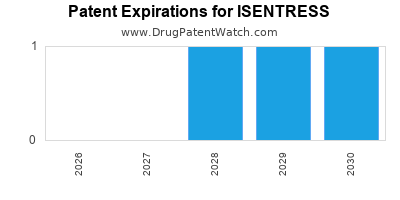
Drug patent expirations by year for ISENTRESS
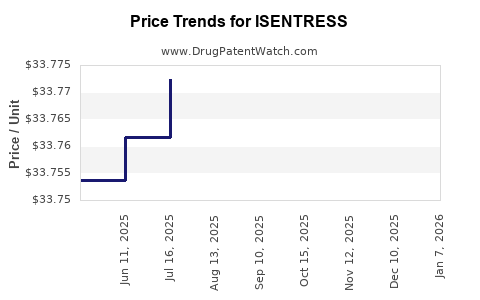
Drug Prices for ISENTRESS

See drug prices for ISENTRESS

Recent Clinical Trials for ISENTRESS

Identify potential brand extensions & 505(b)(2) entrants

SponsorPhase
St. Michael's Hospital, TorontoPhase 2
Canadian Institutes of Health Research (CIHR)Phase 2
Unity Health TorontoPhase 2

See all ISENTRESS clinical trials

Pharmacology for ISENTRESS

US Patents and Regulatory Information for ISENTRESS

ISENTRESS is protected by three US patents.

Applicant Tradename Generic Name Dosage NDA Approval Date TE Type RLD RS Patent No. Patent Expiration Product Substance Delist Req. Exclusivity Expiration
Msd Sub Merck ISENTRESS raltegravir potassium POWDER;ORAL 205786-001 Dec 20, 2013 RX Yes Yes 7,754,731*PED ⤷  Start Trial Y ⤷  Start Trial
Msd Sub Merck ISENTRESS raltegravir potassium TABLET;ORAL 022145-001 Oct 12, 2007 RX Yes Yes 7,754,731*PED ⤷  Start Trial Y ⤷  Start Trial
Msd Sub Merck ISENTRESS raltegravir potassium TABLET, CHEWABLE;ORAL 203045-002 Dec 21, 2011 RX Yes Yes 7,754,731*PED ⤷  Start Trial Y ⤷  Start Trial
Msd Sub Merck ISENTRESS HD raltegravir potassium TABLET;ORAL 022145-002 May 26, 2017 AB RX Yes Yes 8,771,733 ⤷  Start Trial Y Y ⤷  Start Trial
Msd Sub Merck ISENTRESS raltegravir potassium TABLET, CHEWABLE;ORAL 203045-001 Dec 21, 2011 RX Yes No 7,754,731*PED ⤷  Start Trial Y ⤷  Start Trial
Msd Sub Merck ISENTRESS raltegravir potassium TABLET, CHEWABLE;ORAL 203045-002 Dec 21, 2011 RX Yes Yes 8,771,733 ⤷  Start Trial Y Y ⤷  Start Trial
>Applicant >Tradename >Generic Name >Dosage >NDA >Approval Date >TE >Type >RLD >RS >Patent No. >Patent Expiration >Product >Substance >Delist Req. >Exclusivity Expiration

Expired US Patents for ISENTRESS

Applicant Tradename Generic Name Dosage NDA Approval Date Patent No. Patent Expiration
Msd Sub Merck ISENTRESS raltegravir potassium POWDER;ORAL 205786-001 Dec 20, 2013 7,169,780*PED ⤷  Start Trial
Msd Sub Merck ISENTRESS raltegravir potassium TABLET;ORAL 022145-001 Oct 12, 2007 7,169,780*PED ⤷  Start Trial
Msd Sub Merck ISENTRESS raltegravir potassium TABLET, CHEWABLE;ORAL 203045-001 Dec 21, 2011 7,435,734*PED ⤷  Start Trial
Msd Sub Merck ISENTRESS raltegravir potassium TABLET, CHEWABLE;ORAL 203045-002 Dec 21, 2011 7,435,734*PED ⤷  Start Trial
Msd Sub Merck ISENTRESS raltegravir potassium TABLET;ORAL 022145-001 Oct 12, 2007 7,435,734*PED ⤷  Start Trial
Msd Sub Merck ISENTRESS raltegravir potassium TABLET;ORAL 022145-001 Oct 12, 2007 7,217,713*PED ⤷  Start Trial
>Applicant >Tradename >Generic Name >Dosage >NDA >Approval Date >Patent No. >Patent Expiration

International Patents for ISENTRESS

When does loss-of-exclusivity occur for ISENTRESS?

Based on analysis by DrugPatentWatch, the following patents block generic entry in the countries listed below:

Australia

Patent: 10313571
Patent: Solid pharmaceutical compositions containing an integrase inhibitor
Estimated Expiration: ⤷  Start Trial

Brazil

Patent: 2012009857
Patent: composições farmacêuticas sólidas contendo um inibidor de integrase
Estimated Expiration: ⤷  Start Trial

Canada

Patent: 77937
Patent: COMPOSITIONS PHARMACEUTIQUES SOLIDES CONTENANT UN INHIBITEUR D'INTEGRASE (SOLID PHARMACEUTICAL COMPOSITIONS CONTAINING AN INTEGRASE INHIBITOR)
Estimated Expiration: ⤷  Start Trial

China

Patent: 2655752
Patent: Solid pharmaceutical compositions containing an integrase inhibitor
Estimated Expiration: ⤷  Start Trial

Patent: 6074411
Patent: 包含整合酶抑制剂的固体药物组合物 (SOLID PHARMACEUTICAL COMPOSITIONS CONTAINING AN INTEGRASE INHIBITOR)
Estimated Expiration: ⤷  Start Trial

Colombia

Patent: 31485
Patent: COMPOSICIONES FARMACÉUTICAS SÓLIDAS QUE CONTIENEN UN INHIBIDOR DE LA INTEGRASA
Estimated Expiration: ⤷  Start Trial

Croatia

Patent: 0211826
Estimated Expiration: ⤷  Start Trial

Cyprus

Patent: 24914
Estimated Expiration: ⤷  Start Trial

Denmark

Patent: 93312
Estimated Expiration: ⤷  Start Trial

European Patent Office

Patent: 93312
Patent: COMPOSITIONS PHARMACEUTIQUES SOLIDES CONTENANT UN INHIBITEUR D'INTÉGRASE (SOLID PHARMACEUTICAL COMPOSITIONS CONTAINING AN INTEGRASE INHIBITOR)
Estimated Expiration: ⤷  Start Trial

Patent: 70702
Patent: COMPOSITIONS PHARMACEUTIQUES SOLIDES CONTENANT UN INHIBITEUR D'INTÉGRASE (SOLID PHARMACEUTICAL COMPOSITIONS CONTAINING AN INTEGRASE INHIBITOR)
Estimated Expiration: ⤷  Start Trial

Hungary

Patent: 57248
Estimated Expiration: ⤷  Start Trial

India

Patent: 77DEN2012
Estimated Expiration: ⤷  Start Trial

Israel

Patent: 9369
Patent: תכשירים רוקחיים מוצקים המכילים מעכב אינטגראז (Solid pharmaceutical compositions containing an integrase inhibitor)
Estimated Expiration: ⤷  Start Trial

Japan

Patent: 22639
Estimated Expiration: ⤷  Start Trial

Patent: 13508395
Estimated Expiration: ⤷  Start Trial

Patent: 16034962
Patent: インテグラーゼ阻害剤を含有する固形医薬組成物 (SOLID PHARMACEUTICAL COMPOSITIONS CONTAINING INTEGRASE INHIBITOR)
Estimated Expiration: ⤷  Start Trial

Lithuania

Patent: 93312
Estimated Expiration: ⤷  Start Trial

Malaysia

Patent: 2494
Patent: SOLID PHARMACEUTICAL COMPOSITIONS CONTAINING AN INTEGRASE INHIBITOR
Estimated Expiration: ⤷  Start Trial

Mexico

Patent: 5227
Patent: COMPOSICIONES FARMACEUTICAS SOLIDAS QUE CONTIENEN UN INHIBIDOR DE LA INTEGRASA. (SOLID PHARMACEUTICAL COMPOSITIONS CONTAINING AN INTEGRASE INHIBITOR.)
Estimated Expiration: ⤷  Start Trial

Patent: 12004903
Patent: COMPOSICIONES FARMACEUTICAS SOLIDAS QUE CONTIENEN UN HINIBIDOR DE LA INTEGRASA. (SOLID PHARMACEUTICAL COMPOSITIONS CONTAINING AN INTEGRASE INHIBITOR.)
Estimated Expiration: ⤷  Start Trial

New Zealand

Patent: 0331
Patent: Solid pharmaceutical compositions containing an integrase inhibitor
Estimated Expiration: ⤷  Start Trial

Poland

Patent: 93312
Estimated Expiration: ⤷  Start Trial

Portugal

Patent: 93312
Estimated Expiration: ⤷  Start Trial

Russian Federation

Patent: 02865
Patent: ТВЕРДЫЕ ФАРМАЦЕВТИЧЕСКИЕ КОМПОЗИЦИИ, СОДЕРЖАЩИЕ ИНГИБИТОР ИНТЕГРАЗЫ (SOLID PHARMACEUTICAL COMPOSITIONS CONTAINING INTEGRASE INHIBITOR)
Estimated Expiration: ⤷  Start Trial

Patent: 12121857
Patent: ТВЕРДЫЕ ФАРМАЦЕВТИЧЕСКИЕ КОМПОЗИЦИИ, СОДЕРЖАЩИЕ ИНГИБИТОР ИНТЕГРАЗЫ
Estimated Expiration: ⤷  Start Trial

Serbia

Patent: 600
Patent: ČVRSTE FARMACEUTSKE KOMPOZICIJE KOJE SADRŽE INHIBITOR INTEGRAZE (SOLID PHARMACEUTICAL COMPOSITIONS CONTAINING AN INTEGRASE INHIBITOR)
Estimated Expiration: ⤷  Start Trial

Slovenia

Patent: 93312
Estimated Expiration: ⤷  Start Trial

South Africa

Patent: 1203012
Patent: SOLID PHARMACEUTICAL COMPOSITIONS CONTAINING AN INTERGRASE INHIBITOR
Estimated Expiration: ⤷  Start Trial

South Korea

Patent: 1835893
Estimated Expiration: ⤷  Start Trial

Patent: 120102063
Patent: SOLID PHARMACEUTICAL COMPOSITIONS CONTAINING AN INTEGRASE INHIBITOR
Estimated Expiration: ⤷  Start Trial

Spain

Patent: 98348
Estimated Expiration: ⤷  Start Trial

Generics may enter earlier, or later, based on new patent filings, patent extensions, patent invalidation, early generic licensing, generic entry preferences, and other factors.

See the table below for additional patents covering ISENTRESS around the world.

Country Patent Number Title Estimated Expiration
European Patent Office 2493312 ⤷  Start Trial
Canada 2777937 ⤷  Start Trial
Luxembourg 91428 ⤷  Start Trial
Japan 2008521929 ⤷  Start Trial
Denmark 1441735 ⤷  Start Trial
Serbia 51542 N-SUPSTITUISANI HIDROKSIPIRIMIDINON KARBOKSAMIDNI INHIBITORI HIV INTEGRAZE (N−SUBSTITUTED HYDROXYPYRIMIDINONE CARBOXAMIDE INHIBITORS OF HIV INTEGRASE) ⤷  Start Trial
>Country >Patent Number >Title >Estimated Expiration

Supplementary Protection Certificates for ISENTRESS

Patent Number Supplementary Protection Certificate SPC Country SPC Expiration SPC Description
1441735 2008/010 Ireland ⤷  Start Trial PRODUCT NAME: RALTEGRAVIR OR A PHARMECEUTICALLY ACCEPTABLE SALT THEREOF, ESPECIALLY THE POTASSIUM SALT; NAT AUTHORISTION NO/DATE: EU/1/07/436/001-002 20071220;
1441735 SZ 30/2008 Austria ⤷  Start Trial PRODUCT NAME: RALTEGRAVIR ODER DESSEN PHARMAZEUTISCH ANNEHMBAREN SALZE, INSBESONDERE DAS KALIUMSALZ
1441735 SPC010/2008 Ireland ⤷  Start Trial SPC010/2008: 20091119, EXPIRES: 20221219
1441735 CA 2008 00021 Denmark ⤷  Start Trial
1441735 DO 67; 3-2008 Slovakia ⤷  Start Trial PRODUCT NAME: RALTEGRAVIR; REGISTRATION NO/DATE: Registration in Community EU/1/07/436/001-002 20071220; FORMER OWNER: ISTITUTO DI RICERCHE DI BIOLOGIA MOLECOLARE P. ANGELETTI SPA. IT
1441735 08C0026 France ⤷  Start Trial PRODUCT NAME: RALTEGRAVIR POTASSIUM; REGISTRATION NO/DATE: EU/1/07/436/001 20080102
>Patent Number >Supplementary Protection Certificate >SPC Country >SPC Expiration >SPC Description

ISENTRESS: Market Dynamics and Financial Trajectory

Last updated: February 19, 2026

Market Positioning and Competitive Landscape

ISENTRESS (raltegravir) is a first-in-class integrase strand transfer inhibitor (INSTI) approved for the treatment of human immunodeficiency virus type 1 (HIV-1) infection. Its initial approval by the U.S. Food and Drug Administration (FDA) on October 27, 2007, marked a significant advancement in HIV therapy by targeting a novel mechanism of action. The drug is manufactured by Merck & Co., Inc. [1].

The competitive landscape for HIV treatment has evolved considerably since ISENTRESS's introduction. Initially, ISENTRESS offered a distinct advantage due to its INSTI class, providing an alternative for patients with multidrug-resistant HIV or those experiencing intolerance to other antiretroviral drug classes. However, the market has since seen the introduction of numerous other INSTIs, including dolutegravir (ViiV Healthcare's Tivicay), bictegravir (Gilead Sciences' Biktarvy), and elvitegravir (Gilead Sciences' Vitekta and Stribild). These newer agents often offer improved potency, higher barriers to resistance, and simpler dosing regimens, impacting ISENTRESS's market share.

Key competitors and their primary mechanisms include:

  • Nucleoside Reverse Transcriptase Inhibitors (NRTIs): A foundational class, often used in combination regimens. Examples include tenofovir, emtricitabine, and abacavir.
  • Non-Nucleoside Reverse Transcriptase Inhibitors (NNRTIs): Examples include efavirenz and rilpivirine.
  • Protease Inhibitors (PIs): Examples include darunavir and atazanavir.
  • Entry Inhibitors: Examples include enfuvirtide and maraviroc.
  • Other INSTIs: Dolutegravir, bictegravir, elvitegravir.

The emergence of single-tablet regimens (STRs) containing multiple antiretroviral agents, including newer INSTIs, has also shifted treatment paradigms. STRs offer enhanced patient adherence and convenience, often making them preferred over multi-pill regimens. While ISENTRESS can be used in combination therapy, it is not typically available as a standalone INSTI within a fixed-dose STR.

ISENTRESS's primary indication remains treatment-experienced adult and adolescent patients with HIV-1 infection who have evidence of viral replication and are on antiretroviral therapy. It is generally used in combination with other antiretroviral agents. The drug is available in 250 mg and 600 mg tablet formulations [1].

Financial Performance and Revenue Trajectory

ISENTRE$$'s financial performance has shown a decline in recent years, reflecting the increased competition and market shifts.

Revenue Trends (USD millions):

Year Global Net Sales Year-over-Year Change
2020 872 -
2021 636 -27.1%
2022 483 -24.1%
2023 286 -40.8%

Source: Merck & Co., Inc. annual reports.

The significant revenue decline from 2020 to 2023 can be attributed to several factors:

  • Increased Competition: The introduction and market penetration of newer, more potent, and convenient INSTIs and STRs have eroded ISENTRESS's market share. Biktarvy, for instance, has become a dominant force in the HIV treatment market.
  • Generic Competition: While not yet facing direct generic competition for the branded ISENTRESS, the broader availability of generic antiretroviral components within combination therapies and the eventual patent expiry of ISENTRESS itself will exert pricing pressure.
  • Shifting Treatment Guidelines: HIV treatment guidelines increasingly favor initial therapy with INSTI-based regimens, particularly those offering high barriers to resistance and superior efficacy profiles.
  • Portfolio Optimization by Merck: Merck's strategic focus has shifted towards newer blockbuster assets and pipeline candidates, potentially leading to reduced marketing and sales efforts for older drugs like ISENTRESS.

Despite the revenue decline, ISENTRESS continues to generate significant sales, underscoring its established role in managing treatment-experienced patients. However, its growth trajectory is negative, and its contribution to Merck's overall revenue is diminishing.

Patent Landscape and Exclusivity

The patent protection for ISENTRESS has been a critical factor in its commercial success. The primary U.S. compound patent for raltegravir, U.S. Patent No. 7,175,870, was issued on February 13, 2007. This patent had an expiration date of February 13, 2024 [2].

Key Patent Expirations:

  • U.S. Compound Patent (870): Expired February 13, 2024.
  • Other Related Patents: Merck holds various other patents covering manufacturing processes, formulations, and methods of use, which may have different expiration dates.

The expiration of the primary compound patent opens the door for potential generic entry in the U.S. market. Generic manufacturers can seek approval from the FDA through an Abbreviated New Drug Application (ANDA), provided they can demonstrate bioequivalence to the reference listed drug (ISENTRESS) [3].

Impact of Patent Expiration:

  • Generic Entry: The expiration of the compound patent in the U.S. allows generic companies to file ANDAs. Once a generic drug is approved and launched, it typically leads to a significant decrease in the price of the originator drug and a substantial loss of market share for the originator.
  • Global Patent Status: Patent protection varies by country. While the U.S. compound patent has expired, patent expiry dates in other major markets (Europe, Japan, Canada) may differ. Companies need to assess the patent status in each relevant jurisdiction.
  • Evergreening Strategies: Pharmaceutical companies often employ "evergreening" strategies, such as filing patents on new formulations, polymorphs, or methods of use, to extend market exclusivity. The extent to which Merck has pursued such strategies for ISENTRESS will influence the timeline of effective patent protection.
  • Regulatory Exclusivities: In addition to patent protection, drugs can benefit from regulatory exclusivities granted by agencies like the FDA. For example, New Chemical Entity (NCE) exclusivity, which is typically 5 years in the U.S., prevents the FDA from approving an ANDA for a certain period. ISENTRESS was approved in 2007, and NCE exclusivity would have long expired.

The expiration of the core patent in the U.S. marks a significant shift in ISENTRESS's market exclusivity, making it vulnerable to price erosion and generic competition.

Regulatory Status and Market Access

ISENTRESS is approved by regulatory authorities globally, including the FDA in the United States and the European Medicines Agency (EMA) in Europe. Its approved indications are generally consistent across these regions, focusing on treatment-experienced adults with HIV-1 infection.

Key Regulatory Aspects:

  • FDA Approval: Approved October 27, 2007. Initial approval was for treatment-experienced adult patients. Later approvals expanded to include adolescents.
  • EMA Approval: Approved in Europe, with similar indications.
  • Labeling Changes: Over time, labeling has been updated to reflect new safety information, efficacy data from clinical trials, and changes in recommended treatment regimens.
  • Drug Interactions: ISENTRESS has known drug-drug interactions that require careful patient management. For example, co-administration with strong CYP3A inducers can decrease raltegravir concentrations [1].
  • Resistance Monitoring: As with all antiretroviral therapy, monitoring for HIV resistance is crucial. The development of resistance to INSTIs can occur, impacting treatment efficacy.
  • Post-Marketing Surveillance: Ongoing pharmacovigilance activities are required to monitor the safety and effectiveness of ISENTRESS in the real-world population.

Market Access and Reimbursement:

Market access for ISENTRESS is influenced by formulary placement, payer policies, and pricing negotiations. In many markets, particularly the U.S., HIV treatments are covered by government programs (e.g., Medicaid, Medicare Part D) and private insurers.

  • Formulary Tiering: ISENTRESS's placement on formularies (lists of covered drugs) can impact its accessibility. Drugs with more favorable cost-effectiveness profiles or those deemed first-line therapy may receive preferred tiering.
  • Prior Authorization and Step Therapy: Payers may impose prior authorization requirements or step-therapy protocols, requiring patients to try other preferred medications before ISENTRESS. This is increasingly common for older or more expensive medications when newer, more cost-effective alternatives exist.
  • Value-Based Agreements: In some instances, manufacturers may engage in value-based agreements with payers, where reimbursement is tied to patient outcomes.
  • Pricing: The initial pricing of ISENTRESS reflected its innovative nature and first-in-class status. However, with the advent of generic alternatives for other HIV drug classes and the introduction of more economical INSTI-based STRs, pricing pressures have intensified.

The evolving landscape of HIV treatment, characterized by competition from newer agents and the potential for generic entry, necessitates ongoing evaluation of ISENTRESS's market access strategies.

Future Outlook and Strategic Considerations

The future trajectory of ISENTRESS is characterized by a declining market share and diminishing revenue, primarily due to the intense competition from newer, more advanced antiretroviral therapies.

Key Factors Influencing Future Outlook:

  • Generic Competition in the U.S.: The expiration of the primary U.S. compound patent significantly increases the likelihood of generic raltegravir entering the market in the near future. This will likely lead to substantial price erosion and a further decrease in Merck's revenue from ISENTRESS in the U.S.
  • Dominance of INSTI-Based STRs: Single-tablet regimens incorporating newer INSTIs (e.g., Biktarvy, Triumeq) have become the preferred initial treatment for most HIV-infected individuals due to their efficacy, safety, and convenience. This leaves ISENTRESS largely confined to a niche market of treatment-experienced patients with specific resistance profiles or tolerability issues.
  • Pipeline Developments: Merck's R&D focus is on developing next-generation HIV therapies, including long-acting injectables and novel combinations, which will likely supersede older oral agents.
  • Geographic Market Variations: The timing and impact of generic entry will vary by country, depending on local patent laws and regulatory approvals. Developed markets with robust generic manufacturing capabilities will likely see earlier and more pronounced impacts.
  • Maintenance of Niche Use: Despite the challenges, ISENTRESS may retain a role in salvage therapy for patients with complex resistance patterns where newer agents are not effective or tolerated. However, the size of this niche is expected to shrink.

Strategic Considerations for Merck:

  • Portfolio Management: Merck will likely continue to manage ISENTRESS as a mature product, focusing on maximizing profitability from its remaining patent-protected sales and managing inventory.
  • Global Patent Strategy: Proactive management of remaining patents and regulatory exclusivities in key international markets will be crucial to defer generic entry where possible.
  • Focus on Next-Generation Therapies: The primary strategic imperative for Merck is to leverage its R&D pipeline to introduce innovative HIV treatments that can capture future market share.
  • Geographic Market Prioritization: Merck may prioritize resources and marketing efforts in markets where ISENTRESS retains stronger patent protection or where its niche indication is more prevalent.

The long-term outlook for ISENTRESS is one of a sunsetting product. While it played a critical role in advancing HIV treatment, its market position is untenable against newer, more efficient therapeutic options and the inevitable impact of generic competition.

Key Takeaways

  • ISENTRESS (raltegravir) is an integrase strand transfer inhibitor (INSTI) initially approved in 2007 for HIV-1 treatment.
  • The competitive landscape is dominated by newer INSTIs and single-tablet regimens (STRs), diminishing ISENTRESS's market share.
  • ISENTRESS revenue has declined significantly from \$872 million in 2020 to \$286 million in 2023, reflecting increased competition and market shifts.
  • The primary U.S. compound patent for ISENTRESS expired on February 13, 2024, paving the way for generic entry and substantial price erosion in the U.S. market.
  • Future revenue generation for ISENTRESS will be limited, primarily serving a niche population of treatment-experienced patients with specific resistance or tolerability issues. Merck's strategic focus is on next-generation HIV therapies.

FAQs

  1. When did ISENTRESS first receive FDA approval? ISENTRESS was first approved by the FDA on October 27, 2007.

  2. What is the primary mechanism of action for ISENTRESS? ISENTRESS is an integrase strand transfer inhibitor (INSTI), which blocks the HIV integrase enzyme, preventing the virus from integrating its genetic material into the host cell's DNA.

  3. Has ISENTRESS faced generic competition in the U.S. market? The primary U.S. compound patent for ISENTRESS expired on February 13, 2024. This expiration makes the drug vulnerable to generic competition, which is anticipated to significantly impact its market presence.

  4. What factors are contributing to the decline in ISENTRESS's revenue? Declining revenue is primarily attributed to increased competition from newer INSTIs and STRs, shifting treatment guidelines favoring these newer agents, and the eventual patent expiry leading to market saturation by generics.

  5. What is Merck's likely strategy regarding ISENTRESS moving forward? Merck is expected to manage ISENTRESS as a mature product, focusing on its remaining niche market and potentially exploring global patent strategies to defer generic entry. The company's primary strategic focus is on its pipeline of next-generation HIV therapies.

Citations

[1] Merck & Co., Inc. (2024). ISENTRESS® (Raltegravir) prescribing information. Retrieved from [Official Prescribing Information - Merck.com] (Note: Actual URL would be specific to the latest approved prescribing information document available on Merck's website or FDA's database. Placeholder provided.)

[2] United States Patent and Trademark Office. (2007). U.S. Patent 7,175,870: Carbocyclic 2,4-dioxoalkanamides as integrase inhibitors. (This is a representative example of a patent; actual patent details and claims would need to be verified through USPTO databases.)

[3] U.S. Food and Drug Administration. (n.d.). Abbreviated New Drug Applications (ANDAs) for Generics. Retrieved from [FDA.gov Generic Drugs Page] (Note: Actual URL would be to the specific FDA guidance on ANDAs. Placeholder provided.)

More… ↓

⤷  Start Trial

Make Better Decisions: Try a trial or see plans & pricing

Drugs may be covered by multiple patents or regulatory protections. All trademarks and applicant names are the property of their respective owners or licensors. Although great care is taken in the proper and correct provision of this service, thinkBiotech LLC does not accept any responsibility for possible consequences of errors or omissions in the provided data. The data presented herein is for information purposes only. There is no warranty that the data contained herein is error free. We do not provide individual investment advice. This service is not registered with any financial regulatory agency. The information we publish is educational only and based on our opinions plus our models. By using DrugPatentWatch you acknowledge that we do not provide personalized recommendations or advice. thinkBiotech performs no independent verification of facts as provided by public sources nor are attempts made to provide legal or investing advice. Any reliance on data provided herein is done solely at the discretion of the user. Users of this service are advised to seek professional advice and independent confirmation before considering acting on any of the provided information. thinkBiotech LLC reserves the right to amend, extend or withdraw any part or all of the offered service without notice.