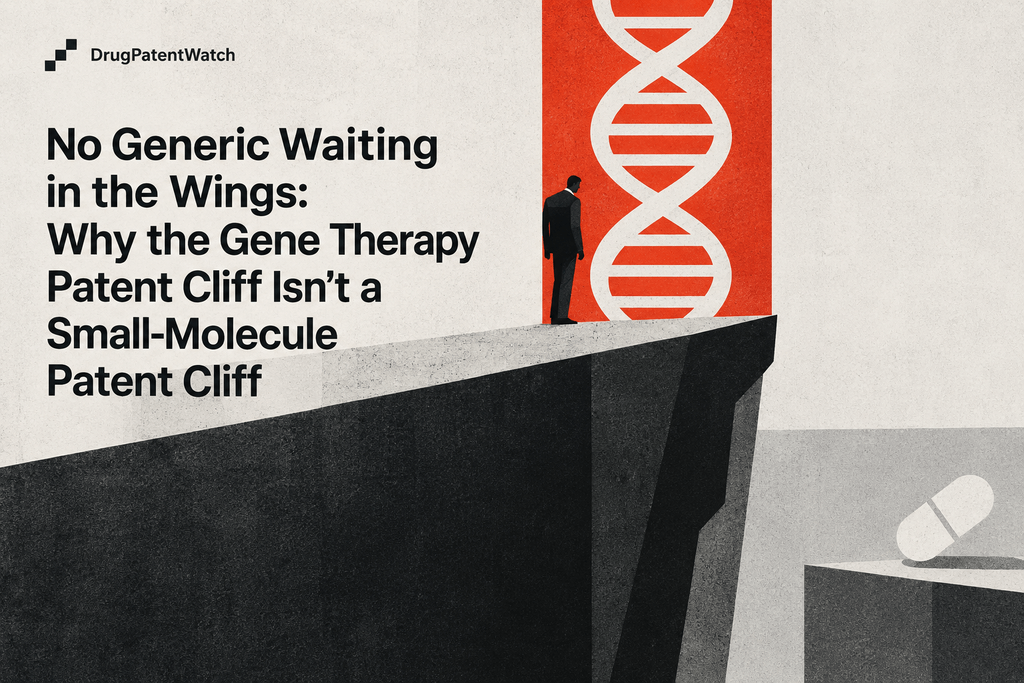
Casgevy lists for $2.2 million a dose. Lyfgenia lists for $3.1 million. Lenmeldy launched at roughly $4.25 million, the highest list price of any drug in US history at the time [1]. None of these products will ever face a generic competitor in the way Lipitor or Plavix did. The reason has nothing to do with how novel the science is. It has to do with which statute governs the product.
Small-molecule drugs lose exclusivity through the Hatch-Waxman Act of 1984 and its Abbreviated New Drug Application (ANDA) pathway [2]. Gene therapies are biologics, licensed under a Biologics License Application (BLA) and, in theory, exposed to competition through the Biologics Price Competition and Innovation Act of 2009 (BPCIA) and its 351(k) biosimilar pathway [3]. The two frameworks share a common goal: let a follow-on product enter once the innovator’s protected period ends. They do not share a common mechanism, a common evidentiary standard, or, so far, a common outcome. As of mid-2024, the FDA had approved 38 cell and gene therapies (CGTs), and not one biosimilar application has ever been filed against any of them [4].
The Short Answer
A small-molecule patent cliff works because a generic manufacturer only has to prove bioequivalence, a fixed chemical structure, and a public patent list in the Orange Book that generics must certify against before launch. A gene therapy patent cliff does not work the same way because a biosimilar applicant has to prove analytical similarity to a product whose potency depends on a proprietary, often trade-secret-protected manufacturing process, layered under patents on the viral vector and the delivery platform, on top of orphan drug exclusivity and BPCIA reference-product exclusivity that most small molecules never carry. Every one of those obstacles is optional or absent for a small-molecule ANDA filer. Every one of them applies to a gene therapy biosimilar filer.
Five Findings That Matter
Zero biosimilar applications have been filed against any of the 38 FDA-approved cell and gene therapies as of the most recent published survey [4].
REGENXBIO’s AAV vector patent portfolio, the NAV Technology Platform, covers more than 100 vectors and has generated two separate infringement suits against Sarepta over the manufacture of Elevidys, one of which the Federal Circuit revived on appeal after a Delaware court had invalidated the patent [5][6].
The PTAB reaffirmed on March 26, 2026, on remand from the Federal Circuit, that the Broad Institute holds priority over the University of California in the core CRISPR-Cas9 eukaryotic-cell interference, a dispute that has now run more than a decade [7].
Two gene therapies, Pfizer’s Beqvez and BioMarin’s Roctavian, were withdrawn from the US market in 2025, with BioMarin taking a roughly $240 million charge after Roctavian generated only $36 million in 2025 sales [8].
bluebird bio, the company that once carried a market valuation above $10 billion and held three approved gene therapies, sold itself to Carlyle and SK Capital in mid-2025 for as little as $3.00 per share in cash plus a contingent value right, or $5.00 per share outright [9][10].
Two Different Statutes, Two Different Cliffs
Every discussion of a “patent cliff” implicitly borrows the small-molecule model, because that is the model that built the generic drug industry. It does not transfer to gene therapy without translation.
How the Small-Molecule Patent Cliff Works: Hatch-Waxman and the ANDA
The Drug Price Competition and Patent Term Restoration Act of 1984, known as Hatch-Waxman, created the Abbreviated New Drug Application under Section 505(j) of the Food, Drug, and Cosmetic Act [2]. A generic applicant does not repeat the brand’s clinical trials. It shows that its product is pharmaceutically equivalent and bioequivalent, meaning the same active ingredient, dosage form, strength, and route of administration, with a comparable rate and extent of absorption [11]. The FDA lists every patent the brand company believes covers the drug in the Orange Book, and an ANDA filer must certify against each one before it can launch [2].
The Paragraph IV Mechanism and 180-Day Exclusivity
If a generic filer believes a listed patent is invalid or not infringed, it files a Paragraph IV certification. That filing is treated by statute as an artificial act of infringement, which lets the patent dispute get resolved in court before the generic ever reaches a pharmacy shelf, and it triggers an automatic 30-month stay on FDA approval if the brand sues within 45 days [2]. The first filer to submit a substantially complete Paragraph IV application is rewarded with 180 days of exclusivity against every other generic. This entire mechanism, certification, artificial infringement, the stay, the 180-day reward, exists only because Hatch-Waxman built it into the small-molecule statute. Nothing like it exists for biologics.
How the Biologic Patent Cliff Is Supposed to Work: BPCIA and the 351(k) Pathway
The Biologics Price Competition and Innovation Act of 2009 created a parallel but architecturally distinct pathway. A biosimilar applicant files a 351(k) application under the Public Health Service Act, showing that its product is “highly similar to the reference product notwithstanding minor differences in clinically inactive components,” with no meaningful clinical differences from the reference product in safety, purity, and potency [12]. There is no Orange Book equivalent that biosimilar filers must certify against as a precondition of the application. Instead, the BPCIA created an optional information-exchange process nicknamed the “patent dance,” in which the reference-product sponsor and the biosimilar applicant can, but are not required to, exchange patent lists and negotiate which patents will be litigated before launch [3].
The 12-Year Exclusivity Clock and the 4-Year Filing Window
Section 351(k)(7) of the PHS Act bars the FDA from approving any biosimilar application until 12 years after the reference product’s first licensure, and bars the agency from even accepting a biosimilar application for review until 4 years after that date [13][14]. There is no equivalent floor for small-molecule ANDAs, which can be filed and even approved before patent expiration, subject to the patent litigation the Paragraph IV framework resolves. The 12-year clock is a regulatory exclusivity, not a patent right. It runs regardless of whether the innovator holds a single valid patent [15].
Why Gene Therapies Sit on the Biologic Side of the Line
A gene therapy, whether it delivers a functional gene copy through an adeno-associated virus (AAV) vector, corrects a mutation with CRISPR-Cas9, or reprograms a patient’s own cells, is licensed under Section 351(a) of the PHS Act as a biologic, not under Section 505 as a drug. That single classification decision routes every one of these products through BPCIA mechanics rather than Hatch-Waxman mechanics, permanently. DrugPatentWatch’s exclusivity-tracking data reflects this split directly: gene therapies never appear in the Orange Book, only in the FDA’s Purple Book of licensed biological products and their exclusivity determinations [16].
The Bioequivalence Standard vs. the Biosimilarity Standard
Even setting the statutory architecture aside, the underlying scientific test a follow-on product has to pass is not the same test.
Bioequivalence: Same Molecule, Different Factory
A small-molecule active ingredient is a fixed chemical entity. Atorvastatin made by Pfizer and atorvastatin made by a generic manufacturer in a different plant, using a different synthesis route, are the identical molecule. Bioequivalence testing confirms that the generic version reaches the bloodstream at a comparable rate and extent, not that the molecule itself is comparable, because the molecule cannot vary [11]. This is why generic approval timelines run 18 to 36 months and generic development costs run in the low millions of dollars [17].
Biosimilarity: “Highly Similar,” Not Identical
Biologics, including gene therapies, are made in living systems, and living systems introduce variation that a chemical synthesis route does not. The FDA’s own guidance states plainly that a biosimilar “cannot be structurally identical to the originator” because differences in the manufacturing process alter the end product, so the standard is not identity but an overall evidentiary judgment of high similarity with no clinically meaningful difference [18]. That evidentiary burden starts with a comprehensive analytical characterization comparing structural and functional attributes against the reference product, then layers on animal and clinical data as needed [19][20].
Why “The Process Is the Product” Breaks Down for Viral Vectors
Regulatory guidance for biologics manufacturing uses a specific phrase for this problem: “the process is the product,” meaning any change in the manufacturing process can produce a fundamental change in the molecule itself, with consequences for safety and efficacy [21]. For a monoclonal antibody, this is already a serious analytical challenge. For a recombinant AAV vector carrying a therapeutic transgene, it is substantially harder. The reference product is not one molecule, it is a viral capsid, a packaged genome, an empty-to-full particle ratio, and a manufacturing cell line, all of which must be reproduced within the same high-similarity tolerance.
Batch Variability in AAV Capsid Manufacturing
Research from the Duke-Margolis Institute for Health Policy found that gene therapies are, in principle, better biosimilar candidates than cell therapies, because biosimilarity is achievable when a gene therapy biosimilar contains the same genetic sequence as the reference product and the vector’s variability meets the high-similarity standard [4]. That “in principle” carries weight: the same research identified the lack of standardized manufacturing platforms, high production costs, and process complexity as significant obstacles, and noted that demonstrating biosimilarity may require showing comparability within the manufacturing process itself, not only in the finished product [4].
What the Orange Book Does That the Purple Book Cannot
Patent Certification Is Mandatory. The BPCIA “Patent Dance” Is Optional.
An ANDA filer cannot get FDA approval without certifying against every patent the brand has listed in the Orange Book for that drug. This mandatory certification step is precisely what triggers the Paragraph IV litigation sequence that resolves patent disputes before launch [2]. A biosimilar applicant faces no equivalent obligation. The BPCIA’s information exchange is voluntary, and either side can decline to participate, in which case the reference sponsor’s only recourse is an ordinary patent infringement suit under 35 U.S.C. § 271(e)(2) once the biosimilar application is filed [3].
No Gene Therapy Has an Orange Book Listing At All
Because gene therapies are approved under BLAs, not NDAs, they carry no Orange Book listing and no Orange Book patent certification requirement, ever. Their relevant exclusivity and patent information live instead in the Purple Book, which functions differently: it records the FDA’s reference-product exclusivity determination, when one has been made, but does not require a biosimilar applicant to certify against a public patent list before it can even submit its application [15]. A patent dispute over a gene therapy, such as REGENXBIO’s suits against Sarepta, unfolds as conventional infringement litigation over manufacturing methods and vector composition, not as a Hatch-Waxman certification dispute [5][6].
The Exclusivity Stack: Orphan Drug Protection Layered on Top of BPCIA
Seven Years of Orphan Exclusivity, Stacked With 12 Years of Reference Product Exclusivity
Most approved gene therapies treat rare diseases and qualify for orphan drug designation, which carries its own 7-year period during which the FDA cannot approve another application for the same drug for the same indication, extendable by six months under certain pediatric-study circumstances [22][23]. This orphan exclusivity is legally separate from, and runs alongside, the BPCIA’s 12-year reference-product exclusivity. A gene therapy sponsor therefore holds two independent regulatory clocks, plus whatever patent term its vector, manufacturing, and formulation patents still carry, plus manufacturing trade secrets that never expire on their own. A small-molecule brand typically holds one regulatory exclusivity period, five years of New Chemical Entity exclusivity at most, plus its patents.
Calculated Timeline: When Regulatory Exclusivity Ends for Ten Approved Gene Therapies
The dates below are calculated by DrugChatter from each product’s confirmed FDA approval date, applying the 7-year orphan exclusivity period and the 12-year BPCIA reference-product exclusivity period as written in the statute. They are estimates of the earliest date the FDA’s own regulatory bars would lift, not confirmed Purple Book determinations; the FDA does not automatically publish a first-licensure determination for every product; and a product’s actual patent protection may extend well past these dates [15][24].
Gene therapy
Company
FDA approval
List price
Orphan exclusivity ends (calc.)
BPCIA exclusivity ends (calc.)
Luxturna
Spark Therapeutics / Roche
Dec. 2017
$850,000 ($425,000/eye) [25]
2024
2029
Zolgensma
Novartis / AveXis
May 2019
$2.125 million [1]
2026
2031
Zynteglo
bluebird bio
Aug. 2022
$2.8 million [1]
2029
2034
Hemgenix
CSL Behring
Nov. 2022
$3.5 million [1]
2029
2034
Elevidys
Sarepta / Roche
June 2023
$3.2 million [1]
2030
2035
Roctavian (withdrawn 2025)
BioMarin
June 2023
$2.9 million [1]
2030*
2035*
Casgevy
Vertex / CRISPR Therapeutics
Dec. 2023
$2.2 million [26][27]
2030
2035
Lyfgenia
bluebird bio
Dec. 2023
$3.1 million [26][28]
2030
2035
Lenmeldy
Orchard Therapeutics / Kyowa Kirin
Mar. 2024
$4.25 million [1]
2031
2036
Beqvez (withdrawn 2025)
Pfizer
Apr. 2024
$3.5 million [1]
2031*
2036*
*Roctavian and Beqvez were withdrawn from the US market in 2025; a regulatory exclusivity period is not meaningful protection once a product is no longer sold.
Why Most Gene Therapy Indications Qualify for Orphan Status by Default
The Orphan Drug Act applies to conditions affecting fewer than 200,000 people in the United States [22]. Nearly every currently approved gene therapy treats a disease that clears that bar by a wide margin: spinal muscular atrophy, biallelic RPE65 mutations, beta-thalassemia, cerebral adrenoleukodystrophy, hemophilia B, Duchenne muscular dystrophy, sickle cell disease, and metachromatic leukodystrophy are all rare-disease indications. This is not a coincidence of company strategy so much as a reflection of where gene therapy is scientifically and commercially viable today: diseases caused by a single, well-characterized gene defect tend to be rare by definition. That means the orphan exclusivity layer is close to automatic for this category of product, in a way it is not for most small-molecule blockbusters.
Zero Biosimilars Have Ever Been Filed Against a Cell or Gene Therapy
“As of August 2, 2024, the FDA has approved 38 CGTs for various conditions.” [4]
What the Duke-Margolis Research Found
A 2024 study published in the Journal of Law and the Biosciences by researchers at the Duke-Margolis Institute for Health Policy set out to analyze the potential for future biosimilar competition in cell and gene therapy, based on interviews with regulatory, manufacturing, and legal experts [4]. The researchers’ framing itself is telling: the article studies a hypothetical future market, because no biosimilar application against any cell or gene therapy exists to study today. Their interviews identified four categories of obstacle: the difficulty of meeting the high-similarity, no-clinically-meaningful-difference standard for products this complex, manufacturing challenges from a lack of standardized platforms, intellectual property barriers spanning patents and trade secrecy, and the risk that curative one-time treatments shrink their own addressable patient pool too quickly to support a second entrant [4].
Gene Therapies Are Better Biosimilar Candidates Than Cell Therapies, and Still No One Has Tried
The same research draws a useful internal distinction: in-vivo gene therapies, which deliver a defined genetic sequence through a vector, are more amenable to biosimilar development than autologous cell therapies like CAR-T, where the starting material is the patient’s own cells and no two batches can ever be identical by definition [4]. That distinction matters for this article specifically, because it means the small-molecule-style patent cliff is theoretically closer to reachable for AAV-vector gene therapies than for cell therapies. Yet even in that more favorable category, filing activity is at zero. The manufacturing, IP, and market-size obstacles have proven sufficient, on their own, to keep every single gene therapy sponsor from attempting what became routine for insulin, filgrastim, and monoclonal antibody biosimilars within a decade of BPCIA’s passage.
The AAV Capsid Patent Thicket REGENXBIO Built
The NAV Technology Platform and Its 100-Plus Licensed Vectors
REGENXBIO holds exclusive rights, licensed from the University of Pennsylvania, to more than 100 novel AAV vectors, including AAV7, AAV8, and AAV9, under what it calls the NAV Technology Platform [29]. This is not a patent on any single drug. It is a platform patent portfolio that multiple, unrelated gene therapy developers must license or design around before they can manufacture a product at all, regardless of what disease that product treats. A small-molecule generic manufacturer never encounters an equivalent gatekeeper, because small-molecule synthesis routes are not, as a category, locked up by one company’s platform patents the way viral vector manufacturing can be.
Why a Platform Patent Behaves Differently From a Drug-Specific Patent
A small-molecule composition-of-matter patent covers one drug. Once that patent expires or is invalidated, its effect on the rest of the industry ends. A platform vector patent like REGENXBIO’s covers a manufacturing building block that dozens of unrelated developers, working on unrelated diseases, may all need to use. Litigation over that single platform patent can therefore affect the launch timeline and cost structure of many different products at once, in a way no single small-molecule patent dispute does.
REGENXBIO v. Sarepta: Two Lawsuits, One Reversal
REGENXBIO and Penn have sued Sarepta twice over the manufacturing of Elevidys, Sarepta’s AAVrh74-based gene therapy for Duchenne muscular dystrophy.
The ‘617 Patent: Summary Judgment, Then a Federal Circuit Reversal
The first suit, filed in Delaware in September 2020, asserted US Patent No. 10,526,617, covering cultured host cell technology used to manufacture AAV vectors [30]. In January 2024, the district court granted Sarepta summary judgment that the patent was invalid, on the theory that its claims covered naturally occurring AAV sequences and merely identified them, rather than inventing anything new [31]. REGENXBIO appealed. A federal appeals court reversed, finding that the lower court’s invalidity ruling had taken an unduly narrow view of the invention, reviving the dispute [32][33].
The ‘274 Patent: Stayed Pending an IPR
REGENXBIO and Penn filed a second suit in June 2023, this time against Sarepta and its manufacturing partner Catalent, asserting US Patent No. 11,680,274, which covers Sarepta’s AAVrh74-based vector products directly, including Elevidys, with a term running to October 2027 [34][35]. That case was stayed once the Patent Trial and Appeal Board granted institution of an inter partes review that Sarepta filed challenging the patent’s validity [36].
Why This Kind of Litigation Doesn’t Happen to Small-Molecule Generics
Notice what these two suits are not about. They are not disputes over whether a generic copy of Elevidys infringes a patent listed against Elevidys itself, the way a Paragraph IV suit works. They are disputes over the manufacturing method Sarepta used to make its own, brand-name product, brought by a platform-technology licensor that has no product of its own on the market for this indication. A small-molecule ANDA filer does not typically face a suit from the owner of the chemical synthesis method the brand used to manufacture its own drug, because that synthesis method is rarely a live patent dispute by the time the ANDA is filed, and because the ANDA filer is not required to replicate the brand’s proprietary process, only its bioequivalent output. A gene therapy manufacturer cannot make that separation. The process and the platform patent are inseparable from the product.
The Gene-Editing Layer: CRISPR’s Unsettled Priority Fight
Broad v. CVC, Briefly: Where the Interference Stands in 2026
Casgevy, the first FDA-approved CRISPR-Cas9 therapy, sits on top of a patent dispute that predates the drug’s approval by more than a decade. The Regents of the University of California, the University of Vienna, and Emmanuelle Charpentier, referred to collectively as CVC, have contested since 2012 which side, CVC or the Broad Institute, Harvard, and MIT, first invented the use of CRISPR-Cas9 in eukaryotic cells [37]. The Federal Circuit vacated and remanded the PTAB’s decision on this question in May 2025, instructing the board to apply a proper legal standard for conception [38][39]. On remand, on March 26, 2026, the PTAB again found that Broad has priority [7]. CVC can still seek rehearing or further appeal. The dispute is not resolved. It has simply reaffirmed the same outcome twice under two different standards.
How Vertex Paid Its Way Around the Dispute
Rather than wait for that fight to end, Vertex Pharmaceuticals paid Editas Medicine up to $100 million, plus additional contingent and licensing payments, for a non-exclusive license to Editas’ Cas9 gene-editing patent estate covering Casgevy’s use of the technology, a deal signed after Casgevy’s FDA approval [40][41]. Editas is the exclusive licensee of the Broad and Harvard Cas9 estate for human therapeutics and, under the deal, shares a percentage of what it collects from Vertex with Broad and Harvard [41][42]. This licensing structure illustrates the fourth layer of protection surrounding gene-edited therapies specifically: even after a company clears manufacturing patents and regulatory exclusivity, it may still need to license the underlying editing technology itself from whichever side of an unresolved priority fight controls commercial rights in its market.
Manufacturing Know-How as an Invisible Patent
Trade Secrets, Not Just Patents, Block Biosimilar Entry
The Duke-Margolis researchers flagged trade secrecy, alongside patents and regulatory exclusivity, as a distinct intellectual property barrier to future cell and gene therapy biosimilars [4]. A patent expires and becomes public. A trade secret does not expire on its own; it only becomes worthless if someone else discovers or independently develops the same information. Viral vector manufacturing, cell line development, and purification processes carry enormous amounts of unpatented, undisclosed process knowledge, precisely because publishing that knowledge in a patent application would let a competitor read it.
Why a Generic-Drug Chemist Can Reverse-Engineer a Pill and a Cell Therapist Cannot Reverse-Engineer a Vector Lot
A small-molecule generic manufacturer can analyze a brand pill, identify its active ingredient through standard chemical analysis, and synthesize an equivalent using any of several publicly known synthesis routes, because organic chemistry does not hide its own structure from analytical instruments. A biosimilar developer analyzing a vial of AAV vector faces a much harder reverse-engineering problem: the finished product’s potency and safety depend on upstream choices, cell line, plasmid design, transfection method, purification steps, that leave only indirect fingerprints on the final product and are not fully recoverable through analytical testing of the vial alone. That gap is exactly what the process-is-the-product principle described earlier illustrates, and it is significantly wider for a viral vector than for a monoclonal antibody, let alone a small molecule [21].
Trade Secrets Do Not Run on a Statutory Clock
A utility patent runs 20 years from its filing date. Orphan exclusivity runs 7 years from approval. BPCIA reference-product exclusivity runs 12 years from first licensure. Every one of those periods is fixed and public, which is exactly why a small-molecule or biosimilar filer can calculate a launch date years in advance. A trade secret carries no such clock. It lasts exactly as long as the manufacturer keeps it confidential and no one else independently develops the same process, which means the manufacturing know-how behind a gene therapy can outlast every regulatory exclusivity and every patent covering it.
Why Nobody Would Build a Biosimilar to a Product That Might Get Pulled From the Market
Beqvez and Roctavian: Two Withdrawals in 2025
Pfizer withdrew Beqvez, its hemophilia B gene therapy, from the US market in 2025, citing a lack of commercial demand [1]. BioMarin withdrew Roctavian, its hemophilia A gene therapy, in the fourth quarter of 2025 after 2025 US sales totaled only $36 million, taking a roughly $240 million charge, made up of a $119 million inventory write-off and a $118 million impairment, once efforts to find a buyer for the product failed [1]. Both products had launched at multimillion-dollar list prices only two to three years earlier. Neither ever generated enough revenue to justify continued manufacturing and commercial investment, let alone to attract a would-be biosimilar competitor willing to spend years and tens of millions of dollars building a follow-on.
Elevidys’ Boxed Warning and Narrowed Label
Elevidys, Sarepta’s AAVrh74 gene therapy for Duchenne muscular dystrophy, faced its own setback in 2025. In June, the FDA issued a safety communication after two non-ambulatory pediatric patients died of acute liver failure following treatment, and Sarepta voluntarily paused distribution to non-ambulatory patients [43]. A third death, in a patient treated with an investigational Sarepta gene therapy using the same AAVrh74 serotype, followed later in 2025 [44]. On November 14, 2025, the FDA approved a revised label adding a Boxed Warning, the agency’s most serious safety designation, for acute liver injury and acute liver failure, and removed the indication for non-ambulatory patients entirely, narrowing Elevidys to ambulatory patients aged four and older [45][46]. The agency also required a new postmarketing observational study following roughly 200 patients for at least 12 months with periodic liver monitoring [45].
The Denominator Problem: Curative, One-Time Dosing Shrinks the Market Every Year
A small-molecule blockbuster generates a stable or growing prescription base for years, which is exactly what makes generic entry lucrative: the market a generic filer is racing to capture is large and roughly steady. A curative, one-time gene therapy consumes its own eligible patient pool. Every patient successfully treated with Casgevy or Lyfgenia is, in principle, cured, and is no longer part of the addressable market for a future competing product treating the same root cause in the same population. The Duke-Margolis researchers identified this directly as a market-size risk specific to curative CGTs, one that a small-molecule generic filer never has to underwrite [4]. Combine that shrinking-denominator economics with the real 2025 example of two multimillion-dollar gene therapies failing commercially within roughly two years of launch, and the case for investing in a biosimilar to any single approved gene therapy gets weaker with each passing year, not stronger, unlike a small-molecule blockbuster approaching its patent cliff.
How This Differs From a Chronic Small-Molecule Orphan Drug
A chronic orphan small molecule, taken daily for a patient’s lifetime, keeps generating revenue from the same patient year after year, so its addressable market stays roughly stable even as new patients are diagnosed and treated. A curative, one-time gene therapy does the opposite: every successfully treated patient exits the addressable market permanently. That structural difference means the commercial window for a gene therapy biosimilar narrows every year exclusivity remains in force, while the commercial window for a chronic small-molecule generic generally does not.
What Happens When the Exclusivity Clock Actually Runs Out
The First Wave of BPCIA Expirations, 2029 to 2036
Based on the calculated timeline above, the earliest wave of BPCIA reference-product exclusivity expirations for currently approved gene therapies runs from roughly 2029, for Luxturna’s orphan exclusivity and the first BPCIA windows opening for the 2022 approvals, through 2036, for the most recently approved products in this table. That is a genuine cliff on the calendar. Whether it produces genuine competition is a separate question entirely.
A Biosimilar Filing Is Not the Same as a Biosimilar Approval
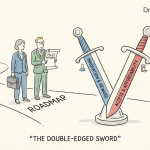
Every obstacle described in this article, the analytical similarity standard, the platform vector patents, the unresolved CRISPR priority fight, the manufacturing trade secrets, the shrinking patient denominator, operates independently of the regulatory exclusivity clock. The clock running out removes one barrier. It does not remove any of the others. A small-molecule patent cliff produces generic entry reliably because, once the clock and the patents both clear, the remaining barrier, proving bioequivalence of an identical chemical entity, is comparatively cheap and fast to clear. A gene therapy patent cliff removes the regulatory clock and leaves every other barrier standing.
What Would Have to Change for a Biosimilar Gene Therapy to Actually Launch
Based on the obstacles identified across the sources in this article, four things would plausibly need to happen before a first gene therapy biosimilar reaches the market: a resolved and licensable vector-platform patent landscape, so a biosimilar developer is not simultaneously fighting REGENXBIO-style litigation and FDA review; FDA guidance specific to analytical comparability for viral vectors, since current biosimilar guidance was written primarily with recombinant proteins in mind; a large enough eligible patient population that a curative one-time product has not already exhausted its own market by the time exclusivity lapses, which favors more prevalent conditions over today’s ultra-rare indications; and at least one approved gene therapy still commercially viable, rather than withdrawn, by the time its exclusivity clock runs out. None of the four conditions is close to being met for any currently approved product.
What This Means for Payers, Manufacturers, and Patent Strategists
For Payers: Don’t Budget for Post-Exclusivity Price Drops the Way You Do for Small Molecules
A health plan modeling long-term drug spend on the assumption that every product eventually falls to generic or biosimilar pricing after its exclusivity period is using a small-molecule model that gene therapy does not currently support. The multimillion-dollar list prices attached to gene therapies are underwritten, in part, on the assumption of a durable monopoly that outlasts the nominal exclusivity period, because the practical barriers to a biosimilar are larger than the regulatory ones.
A Formulary Modeling Checklist
Treat the BPCIA and orphan exclusivity end dates as the earliest possible competition date, not the expected one.
Weight platform-patent litigation, trade secrecy, and addressable-population size as independent barriers that can each outlast the regulatory clock on their own.
Track commercial performance, not just exclusivity status, since a product can lose its market before it loses its exclusivity, as Beqvez and Roctavian did in 2025.
For Brand Manufacturers: The Patent Thicket Still Matters, Just Not the Way It Used To
REGENXBIO’s litigation against Sarepta shows that, for a gene therapy manufacturer, the more urgent intellectual property risk is not a future biosimilar filer, it is a platform-technology licensor asserting patents over the manufacturing method used today, on the drug already on the market [5][6]. That risk profile looks more like industrial process litigation between two operating companies than the Paragraph IV playbook small-molecule brands are built to defend against.
For Generic and Biosimilar Developers: The Opportunity Is in Platform Licensing, Not Reference-Product Copying
Given the barriers described throughout this article, the more realistic near-term competitive dynamic in gene therapy is not one company building a biosimilar to a specific approved product, but multiple companies licensing the same underlying vector or editing platform, the way Editas licenses Cas9 rights to multiple developers, and racing to bring differentiated, next-generation products to market before the first mover’s exclusivity even becomes relevant [40][41]. That is platform competition, not reference-product substitution, and it produces a very different cliff, if it produces one at all.
Methodology
The exclusivity timeline table was built from confirmed FDA approval dates for each listed product, drawn from FDA press materials, company SEC filings, and contemporaneous news coverage cited in the references. The 7-year orphan exclusivity figure and the 12-year BPCIA reference-product exclusivity figure are applied as written in the Orphan Drug Act and Section 351(k)(7) of the PHS Act, respectively [13][14][22][23]. These are calculated projections of the earliest date the stated statutory bar would lift, not confirmed FDA Purple Book determinations; the FDA does not automatically publish a first-licensure determination for every biologic, and pediatric exclusivity extensions, patent term extensions, and additional patents not covered in this article could extend actual market protection well beyond these dates [15][24]. List prices reflect launch-year wholesale acquisition cost or list price as reported in contemporaneous coverage and may not reflect net prices after rebates or outcomes-based agreements.
Key Takeaways
Gene therapies are biologics under BLAs, so they fall under the BPCIA’s 351(k) biosimilar pathway, not the Hatch-Waxman ANDA pathway that governs small-molecule generics.
No biosimilar application has ever been filed against any of the 38 FDA-approved cell and gene therapies as of the most recent published analysis [4].
REGENXBIO’s AAV vector platform patents have produced two separate suits against Sarepta over Elevidys manufacturing, with a Federal Circuit reversal reviving one of them in 2026 [5][6].
Regulatory exclusivity for gene therapies stacks 7 years of orphan protection with 12 years of BPCIA reference-product exclusivity, a combination most small-molecule drugs never carry.
Two approved gene therapies, Beqvez and Roctavian, were withdrawn from the US market in 2025, and Elevidys received a Boxed Warning and a narrowed label the same year, undercutting the commercial case for any future biosimilar competitor.
FAQ
Is a gene therapy ever going to have a generic version? Not under the ANDA pathway that produces small-molecule generics, because gene therapies are licensed as biologics. Their only statutory route to a lower-cost copy is a BPCIA biosimilar, and no biosimilar has been filed against any approved gene therapy to date [4].
What is the difference between a generic drug and a biosimilar? A generic drug must be bioequivalent to a chemically identical active ingredient and is approved through an ANDA under Hatch-Waxman. A biosimilar must be shown to be highly similar, with no clinically meaningful differences, to a reference biologic, and is approved through a 351(k) BLA under the BPCIA [11][12].
Why hasn’t anyone filed a biosimilar for Zolgensma or Luxturna, even though their BPCIA exclusivity is close to expiring? Both products’ patient populations are small and largely treated already, their manufacturing processes carry significant trade-secret protection, and the analytical burden of proving high similarity for an AAV vector is far heavier than for a typical recombinant protein biosimilar [4][21].
Does REGENXBIO’s patent litigation against Sarepta affect Elevidys’ price or availability? The litigation concerns the manufacturing method REGENXBIO and the University of Pennsylvania say Sarepta used to make Elevidys, not Elevidys’ regulatory approval status. As of the most recent public filings, the ‘617 patent dispute has been revived on appeal and the ‘274 patent dispute is stayed pending an inter partes review [32][33][36].
What is the Purple Book, and how is it different from the Orange Book? The Orange Book lists small-molecule drug patents that ANDA filers must certify against before launch. The Purple Book lists licensed biological products, including gene therapies, along with FDA reference-product exclusivity determinations, but does not require biosimilar applicants to certify against a public patent list before filing [2][15].
How long does BPCIA exclusivity last for a gene therapy? Twelve years from the reference product’s first licensure under Section 351(a), during which the FDA cannot approve a biosimilar, plus a bar on even accepting a biosimilar application for the first four years [13][14].
Can a gene therapy get both orphan drug exclusivity and BPCIA exclusivity at the same time? Yes. The two exclusivities arise under different statutes, the Orphan Drug Act and the BPCIA, and run independently. Most approved gene therapies, including Zynteglo, Skysona, and Lyfgenia, hold both [22][23].
Why did Pfizer and BioMarin pull their hemophilia gene therapies off the market? Pfizer withdrew Beqvez in 2025 citing insufficient commercial demand. BioMarin withdrew Roctavian in the fourth quarter of 2025 after US sales reached only $36 million that year, and took a roughly $240 million charge after failing to find a buyer for the product [1].
What happened to bluebird bio? Carlyle and SK Capital acquired bluebird bio in a tender offer that closed on June 2, 2025. Stockholders could elect $3.00 per share in cash plus a contingent value right worth up to $6.84 per share, or a flat $5.00 per share, a steep decline from a company once valued above $10 billion [9][10].
Is Casgevy’s CRISPR technology fully licensed, or is the underlying patent dispute still open? Vertex licensed Cas9 rights from Editas Medicine for up to $100 million to commercialize Casgevy, but the underlying Broad-versus-CVC priority interference over who first invented CRISPR-Cas9 gene editing in eukaryotic cells is still active. The PTAB most recently reaffirmed Broad’s priority on March 26, 2026, on remand from the Federal Circuit [7][40][41].
References
IntuitionLabs. (2026, April 24). Gene therapy pricing: The economics of million-dollar cures. https://intuitionlabs.ai/articles/gene-therapy-pricing-economics
Congressional Research Service. (2025, June 12). Pharmaceutical patent disputes: Generic entry for small-molecule drugs under the Hatch-Waxman Act (IF13028). Congress.gov. https://www.congress.gov/crs-product/IF13028
Big Molecule Watch. (n.d.). Regenxbio and Trustees of the University of Pennsylvania v. Sarepta Therapeutics and Catalent. https://www.bigmoleculewatch.com/litigation/regenxbio-and-trustees-of-the-university-of-pennsylvania-v-sarepta-therapeutics-and-catalent/
Canter, B., Sussman, S., Colvill, S., Arad, N., Staton, E., & Rai, A. (2024). Introducing biosimilar competition for cell and gene therapy products. Journal of Law and the Biosciences, 11(2), lsae015. https://doi.org/10.1093/jlb/lsae015
Goodwin. (2024, January 9). District court grants summary judgment and invalidates patent in REGENXBIO v. Sarepta litigation. https://www.goodwinlaw.com/en/insights/blogs/2024/01/district-court-grants-summary-judgment-and-invalidates-patent-in-regenxbio-v-sarepta-litigation
BioSpace. (2026, February 20). Regenxbio secures legal win in gene therapy patent battle vs. Sarepta. https://www.biospace.com/policy/regenxbio-secures-legal-win-in-gene-therapy-patent-battle-vs-sarepta
IntuitionLabs. (2025, October 8). Most expensive drugs in the US: A 2025 price list. https://intuitionlabs.ai/articles/most-expensive-drugs-usa-2025
bluebird bio, Inc. (2025, March 7). Offer to purchase all outstanding shares of common stock of bluebird bio, Inc. [SEC Schedule TO-T]. U.S. Securities and Exchange Commission. https://www.sec.gov/Archives/edgar/data/1293971/000119312525049127/d922652dex99a1c.htm
Investing.com. (2025, May 30). Carlyle and SK Capital to acquire bluebird bio. https://www.investing.com/news/company-news/carlyle-and-sk-capital-to-acquire-bluebird-bio-93CH-4072752
Congressional Research Service. (2026, July 27). “Skinny labels” for generic drugs under Hatch-Waxman (IF12700). Congress.gov. https://www.congress.gov/crs-product/IF12700
U.S. Food and Drug Administration. (2021, September). Questions and answers on biosimilar development and the BPCI Act. https://www.fda.gov/media/119258/download
Sterne, Kessler, Goldstein & Fox. (2014, August 15). FDA releases guidelines for 12-year period of reference product exclusivity for Section 351(a) biologics. The National Law Review. https://natlawreview.com/article/fda-releases-guidelines-12-year-period-reference-product-exclusivity-section-351a-bi
Alston & Bird. (2026, January 26). Biological products regulation part 3: Unlocking reference product exclusivity: What sponsors need to know. https://www.alston.com/en/insights/publications/2026/01/biological-products-regulation-rpe
DrugPatentWatch. (2026, May 25). The $500B biologic patent fortress: How Humira, Enbrel, and Keytruda built monopolies that last decades. https://www.drugpatentwatch.com/blog/a-strategic-guide-to-biologic-patent-exclusivity-and-competitive-advantage/
Fish & Richardson. (2024, April 15). Hatch-Waxman 101. https://www.fr.com/insights/thought-leadership/blogs/hatch-waxman-101-3/
Cuenca, D., et al. (2013). Biosimilars: Part 1: Proposed regulatory criteria for FDA approval. PMC. https://pmc.ncbi.nlm.nih.gov/articles/PMC3737980/
U.S. Food and Drug Administration. (2024). Biosimilars info sheet. https://www.fda.gov/media/182186/download
U.S. Food and Drug Administration. (n.d.). Biosimilar regulatory approval pathway. https://www.fda.gov/media/154914/download
NIH SEED Office. (2024, July). Manufacturing scale-up of drugs and biologics. https://seed.nih.gov/sites/default/files/2024-07/Manufacturing-Scale-Up-Drugs-and-Biologics.pdf
bluebird bio, Inc. (2025). Form 10-K for fiscal year 2024 [SEC filing]. U.S. Securities and Exchange Commission. https://www.sec.gov/Archives/edgar/data/1293971/000129397125000009/blue-20241231.htm
Spark Therapeutics, Inc. (2018). Form 10-Q for fiscal year 2018 [SEC filing]. U.S. Securities and Exchange Commission. https://www.sec.gov/Archives/edgar/data/0001609351/000160935118000076/spark-201893010xq.htm
U.S. Food and Drug Administration. (n.d.). Reference product exclusivity for biological products filed under Section 351(a) of the PHS Act. https://www.fda.gov/regulatory-information/search-fda-guidance-documents/reference-product-exclusivity-biological-products-filed-under-section-351a-phs-act
Yahoo Finance. (2024, August 29). The most expensive drugs in the US. https://finance.yahoo.com/news/most-expensive-drugs-us-081214248.html
BioPharma Dive. (2023, December 8). Pricey new gene therapies for sickle cell pose access test. https://www.biopharmadive.com/news/crispr-sickle-cell-price-millions-gene-therapy-vertex-bluebird/702066/
BioSpace. (2024, March 27). Analysts predict slower rollout but ultimate victory for Casgevy in race with Lyfgenia. https://www.biospace.com/analysts-predict-slower-rollout-but-ultimate-victory-for-casgevy-in-race-with-lyfgenia
Fierce Pharma. (2023, December 14). Bluebird’s sickle cell gene therapy comes with safety warning and higher price. Can Lyfgenia overcome CRISPR’s halo? https://www.fiercepharma.com/pharma/fda-approves-bluebird-sickle-cell-disease-gene-therapy-can-lyfgenia-overcome-crisprs-halo
REGENXBIO Inc. (2024, January 8). U.S. District Court issues decision on REGENXBIO and University of Pennsylvania NAV Technology patent infringement lawsuit [Press release]. https://ir.regenxbio.com/news-releases/news-release-details/us-district-court-issues-decision-regenxbio-and-university/
Precision Medicine Online. (2024, January 9). Sarepta defeats gene therapy patent infringement claims from Regenxbio, UPenn. https://www.precisionmedicineonline.com/business-news/sarepta-defeats-gene-therapy-patent-infringement-claims-regenxbio-upenn
Goodwin. (2024, January 9). District court grants summary judgment and invalidates patent in REGENXBIO v. Sarepta litigation. https://www.goodwinlaw.com/en/insights/blogs/2024/01/district-court-grants-summary-judgment-and-invalidates-patent-in-regenxbio-v-sarepta-litigation
Seeking Alpha. (2026, February 20). Regenxbio dealt win by appeals court in patent spat with Sarepta. https://seekingalpha.com/news/4554765-regenxbio-dealt-win-by-appeals-court-patent-spat-sarepta
BioSpace. (2026, May 14). REGENXBIO secures legal win in gene therapy patent battle vs. Sarepta. https://www.biospace.com/policy/regenxbio-secures-legal-win-in-gene-therapy-patent-battle-vs-sarepta
TipRanks. (n.d.). Regenxbio files second patent infringement suit against Sarepta. https://www.tipranks.com/news/the-fly/regenxbio-files-second-patent-infringement-suit-against-sarepta
Big Molecule Watch. (n.d.). Regenxbio and Trustees of the University of Pennsylvania v. Sarepta Therapeutics and Catalent. https://www.bigmoleculewatch.com/litigation/regenxbio-and-trustees-of-the-university-of-pennsylvania-v-sarepta-therapeutics-and-catalent/
Big Molecule Watch. (n.d.). Regenxbio and Trustees of the University of Pennsylvania v. Sarepta Therapeutics and Catalent [IPR institution update]. https://www.bigmoleculewatch.com/litigation/regenxbio-and-trustees-of-the-university-of-pennsylvania-v-sarepta-therapeutics-and-catalent/
UC Berkeley News. (2025, May 12). Federal appeals court sends CRISPR-Cas9 patent case back to patent office for reconsideration. https://news.berkeley.edu/2025/05/12/federal-appeals-court-sends-crispr-cas9-patent-case-back-to-patent-office-for-reconsideration/
White & Case. (2025, May 27). Federal Circuit clarifies standard for patent conception in ongoing CRISPR dispute. https://www.whitecase.com/insight-alert/federal-circuit-clarifies-standard-patent-conception-ongoing-crispr-dispute
Wilson Sonsini. (2025, May 16). Federal Circuit revives CRISPR-Cas9 patent priority dispute. https://www.wsgr.com/en/insights/federal-circuit-revives-crispr-cas9-patent-priority-dispute.html
Fierce Biotech. (2023, December 13). After long-running patent battle, Vertex pays $100M to license Editas’ gene-editing tech. https://www.fiercebiotech.com/biotech/after-long-standing-patent-battle-vertex-pays-100m-license-editas-gene-editing-tech
Editas Medicine. (2023, December 12). Editas Medicine and Vertex Pharmaceuticals enter into non-exclusive license agreement for Cas9 [Press release]. https://ir.editasmedicine.com/news-releases/news-release-details/editas-medicine-and-vertex-pharmaceuticals-enter-non-exclusive
BioPharma Dive. (2023, December 14). Editas cashes in on CRISPR patent with Vertex deal. https://www.biopharmadive.com/news/editas-vertex-crispr-patent-deal-gene-editing/702499/
U.S. Food and Drug Administration. (2025). FDA takes action on new boxed warning for acute serious liver injury and acute liver failure following treatment with Elevidys and revised indication that is limited to ambulatory Duchenne muscular dystrophy patients. https://www.fda.gov/vaccines-blood-biologics/safety-availability-biologics/fda-takes-action-new-boxed-warning-acute-serious-liver-injury-and-acute-liver-failure-following
CGTLive. (2026, June 18). Sarepta’s Elevidys gets boxed warning for ALI and ALF. https://www.cgtlive.com/view/sarepta-elevidys-gets-boxed-warning-ali-alf
U.S. Food and Drug Administration. (2025, November 14). FDA approves new safety warning and revised indication that limits use for Elevidys following reports of fatal liver injury [Press release]. https://www.fda.gov/news-events/press-announcements/fda-approves-new-safety-warning-and-revised-indication-limits-use-elevidys-following-reports-fatal
Parent Project Muscular Dystrophy. (2025, November 25). FDA approves new safety warning and revised indication for ELEVIDYS. https://www.parentprojectmd.org/fda-approves-new-safety-warning-and-revised-indication-for-elevidys/