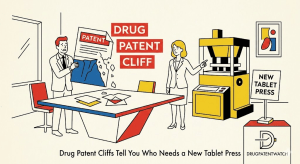
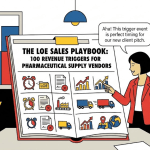
How Drug Patent LOE forecasting gives equipment suppliers a 24-month head start on their competitors
Every year, branded pharmaceutical companies lose billions in revenue as drug patents expire. Those revenues do not disappear. They migrate into the generic manufacturing ecosystem, and with them comes a predictable, data-driven surge in demand for tablet presses, capsule fillers, film coaters, granulators, and the full stack of solid-dose manufacturing equipment.
Equipment suppliers and their business development teams are largely ignoring this signal. They prospect reactively, respond to RFPs, and attend trade shows hoping to catch customers at the right moment. Meanwhile, the data needed to predict exactly who will buy a tablet press – and when – sits in public patent databases, FDA filings, and pharmaceutical intelligence platforms like DrugPatentWatch.
This article is for business development professionals, regional sales managers, and commercial strategy leads at pharmaceutical equipment and manufacturing technology companies. It makes a specific argument: loss of exclusivity (LOE) forecasting is the most reliable demand signal available for solid-dose equipment, and the suppliers who build a systematic approach to reading it will outperform those who do not.
The opportunity is not theoretical. The global generic drug market was valued at $481.7 billion in 2023 and is projected to reach $693.5 billion by 2030, growing at a compound annual growth rate of 5.4% [1]. Behind every dollar of that growth sits a solid-dose manufacturing line that someone needs to build, expand, or upgrade.
Why Equipment Suppliers Are Leaving Money on the Table
The default approach to business development in pharmaceutical equipment sales relies on three inputs: customer relationships, trade show intelligence, and occasional cold prospecting from published ANDA filing data. All three are lagging indicators.
By the time a generic manufacturer publishes a tender for a tablet press, they have already selected their top vendor candidates. Capital expenditure approvals in pharmaceutical manufacturing take 12-18 months from initial engineering studies to purchase order. If a sales team first learns about a need when the RFP lands, they are almost certainly too late to influence the specification, build the relationship, or displace an incumbent.
LOE forecasting inverts this timeline. Patent expiry data is public, structured, and available years in advance. The FDA Orange Book publishes every patent protecting a listed drug, along with expiry dates, and databases like DrugPatentWatch aggregate that data into queryable, filterable formats that map patent cliffs to commercial revenue at risk.
A business development team that monitors LOE data systematically can identify which generic manufacturers are likely to enter a market 30-36 months before the equipment purchase order hits the sales desk. That window is enough time to build a relationship, customize a technical proposal, invite a prospect to a demonstration facility, and become the preferred vendor before competitors realize there is a sale to be won.
The failure to do this is not a technology problem. It is a process problem. Most equipment suppliers have marketing teams capable of purchasing a DrugPatentWatch subscription and building a prospecting list from LOE forecasts. The ones that do not are treating their BD function as reactive customer service rather than revenue intelligence.
How Loss of Exclusivity Works – and Why It Predicts Equipment Demand
The Patent Cliff Mechanism
A branded drug manufacturer typically protects a small-molecule drug through a combination of composition-of-matter patents, formulation patents, and method-of-use patents. Under the Hatch-Waxman Act of 1984, generic manufacturers can file Abbreviated New Drug Applications (ANDAs) referencing the branded product’s clinical data, without repeating full safety and efficacy trials [2]. Once the relevant patents expire, or are invalidated through litigation, any approved ANDA holder can enter the market.
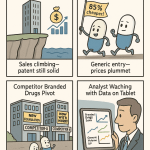
The moment a branded drug loses patent protection, its price collapses. Studies consistently show that generic entry reduces prices by 20-30% after the first generic enters, and by up to 80-90% once six or more generics compete in the same market [3]. For the branded company, this is a revenue cliff. For generic manufacturers, it is the green light to produce at volume.
Generic drugs do not manufacture themselves. Every ANDA approval that corresponds to a tablet or capsule requires a validated manufacturing line: a granulation step, a compaction step (the tablet press), often a film coating process, and packaging. For controlled-release formulations, the equipment requirements are more specialized – multi-layer presses, pelletizing systems, and modified-release coating equipment.
When multiple ANDA holders receive approval for the same product, they each need their own validated manufacturing capacity. A brand drug with six approved ANDA holders means six manufacturers, each running some version of a solid-dose manufacturing line. If three of those manufacturers were previously producing the drug under risk before final patent expiry and three are new entrants, that is at minimum three new manufacturing lines to equip.
Now multiply that by the volume of patent expirations in any given two-year window. The FDA received 1,277 ANDA submissions in fiscal year 2023 alone [4]. Not all of those correspond to tablet-form drugs, but a substantial majority do. Solid-dose forms – tablets, capsules, and related forms – represent roughly 70% of all pharmaceutical dosage forms manufactured [5]. The aggregate demand signal is enormous. The per-company demand signal is knowable in advance.
The LOE-to-Tablet-Press Demand Chain
From Patent Expiry to Purchase Order
The pathway from patent expiry to equipment purchase follows a predictable sequence. Generic manufacturers monitor LOE timelines and file ANDAs 30-36 months before expected patent expiry, triggering the Hatch-Waxman 30-month stay if a Paragraph IV certification is filed. During the stay period, the manufacturer prepares a manufacturing site, either repurposing existing capacity or building a new line. Engineering and procurement decisions for major equipment are made 18-24 months before the anticipated market entry date. Capital expenditure approvals are finalized 12-18 months out. Equipment purchase orders are issued 9-15 months before product launch, to allow for installation, validation (IQ/OQ/PQ), and process qualification.
This sequence means that the commercially visible purchase decision – the one a reactive sales team encounters – occurs roughly 12 months before market entry. But the LOE event that triggers the entire chain occurs 30-36 months before that. The equipment supplier who tracks LOE data is engaging 18-24 months before the purchase order, not 3 months.
Volume, Dosage Form, and the Equipment Decision
Not every patent expiry generates tablet press demand. The relevant filter is whether the drug is a solid-dose oral formulation (tablet, capsule, or modified-release tablet) and a sufficient commercial volume to justify dedicated manufacturing capacity, as opposed to contract manufacturing.
Drugs with annual US revenues above $500 million at patent expiry almost always trigger new manufacturing capacity decisions by generic entrants, because the volume economics justify the capital expenditure. Drugs below $50 million at LOE are more likely to be manufactured on shared or contract manufacturing lines, generating demand for CMOs and CDMOs rather than for in-house equipment purchases that drive direct equipment sales.
The sweet spot for equipment suppliers is drugs with LOE revenues between $200 million and $2 billion. These are large enough to justify dedicated capacity but not so dominant that the market is immediately captured by one or two large generic manufacturers with existing infrastructure.
Reading LOE Data Like a Sales Intelligence Tool
What DrugPatentWatch Reveals That Your Competitors Miss
DrugPatentWatch is a pharmaceutical patent intelligence platform that aggregates data from the FDA Orange Book, USPTO patent records, and ANDA filings. For equipment suppliers, it is the closest thing to a real-time demand map for generic manufacturing infrastructure.
The platform allows users to search by drug, active ingredient, patent expiry date, and ANDA filing status. A business development team can construct a query like: “Show me all oral solid-dose drugs with US revenue above $300 million and LOE dates in the next 24-36 months, sorted by number of ANDA filers.” The resulting list is, functionally, a prioritized prospect list for tablet press sales.
The insight here is not about any single drug. It is about reading the aggregate pipeline. When DrugPatentWatch shows 12 major oral solid-dose drugs coming off patent in a 24-month window, with a combined US revenue at risk exceeding $8 billion, the equipment demand implication is measurable. Even if only 40% of that market is served by manufacturers who need new capacity, the procurement signal is significant.
Four Metrics That Signal Equipment Need
Market Revenue at Risk
This is the primary filter. Revenue at LOE directly determines market attractiveness for generic entrants and, by extension, the number of manufacturers who will compete. Use US annual revenue from sources like IQVIA or CMS drug spending data as a proxy for market size. Revenue data is available through public sources including the Medicare Part D drug spending dashboards for broadly used drugs.
ANDA Filer Count
The number of ANDA filers for a given drug, available through DrugPatentWatch and the FDA’s ANDA database, is the strongest proxy for competitive equipment demand. Each approved ANDA holder is a potential equipment buyer. A drug with 12 ANDA filers is generating demand across 12 manufacturing organizations, even if several of those use CMOs. Track both pending and approved ANDAs – pending filers are the forward-looking demand signal.
Dosage Form and Tablet Complexity
Simple immediate-release tablets generate demand for standard high-speed rotary presses. Modified-release, bilayer, or coated tablets require more specialized equipment and therefore carry higher capital expenditure per line. When a drug with an extended-release formulation comes off patent, equipment suppliers who specialize in modified-release compression and coating have a specific commercial opportunity with a narrower field of capable competitors.
API Controlled-Release Profile
Some APIs require specialized tablet press configurations due to powder flow characteristics, compressibility, or sensitivity to heat and pressure during compaction. These technical requirements narrow the vendor pool and create a stronger case for early engagement, since the customer needs both the equipment and the application expertise. APIs with challenging compressibility profiles – notoriously statins, some antivirals, and certain kinase inhibitors – are cases where technical differentiation matters at the equipment selection stage.
The Patent Cliff Calendar: Your 36-Month Sales Runway
30-36 Months Before LOE: Strategic Positioning
At this stage, the generic manufacturer has filed or is about to file an ANDA. They know the drug. They know the timeline. They are beginning internal discussions about whether to build, borrow, or buy manufacturing capacity. An equipment supplier with a relationship at this stage is in the room during the capacity planning conversation, not competing in a bid process that has already been shaped by a competitor.
The right actions for equipment suppliers at this stage are to identify manufacturers with ANDA filings for the relevant drug using DrugPatentWatch, map those manufacturers’ existing manufacturing infrastructure using 483 observation records and site inspection history, and initiate technical dialogue rather than a product pitch. The right conversation at 30 months out is: “We have worked with several companies scaling similar formulations – here is what we have seen at commercial scale.”
18-24 Months Before LOE: Active Prospecting
Engineering decisions are beginning. Internal champions at the generic manufacturer are building their capex case. This is the window for demonstrations, technical workshops, and site visits to the supplier’s manufacturing facility. Equipment suppliers who move from general relationship-building to specific technical proposals in this window are positioned to be included in the formal procurement process when it starts.
This is also the stage where the technical specification gets written. If a supplier has been part of the conversation, their equipment’s technical capabilities can influence that specification. If they are not in the conversation, they will receive a specification written around a competitor’s strengths.
6-12 Months Before LOE: Equipment Procurement Window
This is when purchase orders are issued. If a supplier is not already on the preferred vendor list by this stage, they are unlikely to win the business. Pricing, delivery timelines, installation support, and validation documentation are the decision criteria at this stage. The relationship and technical trust have already been established – or not. Suppliers who arrive at this stage without prior engagement are competing on price alone, which is a structurally weaker position.
Post-LOE: Capacity Expansion Opportunities
The first 12-18 months after LOE create a secondary demand wave. Generic manufacturers who entered the market with one or two lines discover actual volume demand and need to expand. Manufacturers who gained more market share than their initial forecast assumed need to add capacity quickly. This is also the window where brand companies that have authorized generic programs need to build or expand their own generics manufacturing, and where CMOs face their most acute capacity pressure.
Three Case Studies in LOE-Driven Equipment Demand
Lipitor and the Generic Atorvastatin Wave
Atorvastatin (Lipitor) lost exclusivity in November 2011 after generating peak US annual revenues exceeding $5 billion. The generic entry triggered one of the largest capacity-building episodes in generic manufacturing history. Pfizer itself launched an authorized generic through its Greenstone subsidiary. Ranbaxy had the 180-day exclusivity period, but quickly faced competition from Watson, Mylan, Teva, and others.
The equipment demand implications were visible in advance. DrugPatentWatch and equivalent resources available in 2009-2010 showed the LOE date clearly, the ANDA filing count was well documented, and the revenue at risk was the largest single LOE event of that decade. Equipment suppliers who were positioned with India-based generic manufacturers, who held the majority of ANDA filings, in the 2009-2011 window captured a disproportionate share of the resulting tablet press orders. Those who were not engaged with Indian manufacturers at the time largely missed the opportunity, regardless of their product quality.
Metformin Extended-Release and the Complexity Premium
Extended-release metformin products – branded as Fortamet, Glumetza, and Glucophage XR – came off patent on different schedules between 2010 and 2020. Each LOE event triggered demand for modified-release tablet press configurations and extended-release coating equipment, not standard immediate-release presses.
Generic manufacturers entering the XR market needed different equipment than those already making standard metformin IR. This created a specific opportunity for equipment suppliers with modified-release application expertise. The companies that won that business were not necessarily the largest press manufacturers – they were the ones who could demonstrate a validated process for the specific controlled-release mechanism and were in the room early enough to co-develop the process with the customer. The technical complexity of the formulation became a competitive moat for a subset of equipment suppliers.
The Eliquis Opportunity: What Is Coming
Apixaban (Eliquis), the Bristol-Myers Squibb and Pfizer anticoagulant, generated over $12 billion in combined US revenue in 2023 [6]. Its core composition-of-matter patent expired in 2023, though ongoing litigation and licensing agreements have delayed full generic competition in the US market. Based on current litigation trajectories tracked through DrugPatentWatch, multiple ANDA filers are positioned to launch as early as 2026-2028.
Apixaban is a film-coated tablet manufactured at high volume. The manufacturing scale required for a drug of this commercial size is significant, and the number of ANDA filers exceeds 30 [7]. Equipment suppliers who have already engaged the top ANDA filers are building the relationships that will translate into purchase orders when litigation resolves. Those waiting for certainty before making contact are optimizing for comfort at the expense of market position. The litigation resolution date is unknowable; the equipment buying cycle is not.
Building a Working Demand Model
The Formula Your BD Team Can Use Today
A practical LOE-based demand model does not require a data science team. It requires four data inputs and a consistent process:
Pull the LOE list. Query DrugPatentWatch for all oral solid-dose drugs with patent expiry dates 18-36 months from now and US revenue above your minimum commercial threshold (e.g., $200 million).
Score by ANDA count. Rank by number of ANDA filers. This is the primary demand multiplier – each filer is a potential buyer or influencer of an equipment decision. Weight pending ANDAs alongside approved ones.
Filter by dosage form. Flag modified-release, bilayer, and coated formulations separately. These carry higher equipment value per line and a narrower pool of capable suppliers.
Cross-reference with your existing customer base. If you already sell to three of the top ten ANDA filers for a given drug, you have warm leads. If you sell to none, you have cold prospecting targets that need qualification before outreach.
The output is a tiered list of near-term commercial opportunities, ranked by revenue at risk, ANDA count, and your existing account penetration. Run this exercise quarterly and you have a living pipeline built on objective data.
Adjusting for Market Concentration
Not all markets distribute equipment demand evenly. Some LOE events are dominated by two or three manufacturers who have 80% of the relevant manufacturing infrastructure already in place and will simply add capacity on existing equipment platforms. Others are fragmented across dozens of smaller ANDA holders, each representing a company that may need a new line.
Market concentration data is available from prescription tracking services like IQVIA, which publish generic market share by manufacturer for most major molecules. When combined with LOE forecasts, this tells you whether the upcoming demand wave will be shared among many manufacturers, which suits a broad sales effort, or concentrated among a few large ones, which requires a focused key account strategy. The tactical implication differs: broad markets favor marketing-driven lead generation; concentrated markets favor direct executive relationship investment.
“The U.S. generic drug market saves the healthcare system approximately $373 billion annually in drug spending.” – Association for Accessible Medicines, 2023 Generic Drug & Biosimilar Access & Savings in the U.S. Report [10]
The equipment demand embedded in that $373 billion figure is not a rounding error. It is a manufacturing reality that requires presses, granulators, coaters, and the support infrastructure of process engineers, validation services, and aftermarket parts programs. Whoever manufactures those drugs bought that equipment from someone. The only question is whether that sale was predicted or stumbled into.
How to Execute the BD Strategy
Setting Up LOE Monitoring
The practical starting point is a DrugPatentWatch subscription configured with alerts for patent expirations in your relevant dosage form categories. Set the alert window at 36 months forward, not 12. At 12 months you are reacting; at 36 months you are planning. Most equipment suppliers who use any form of patent data monitoring are looking at a 12-month horizon, which means the 36-month window is an uncontested space.
Supplement DrugPatentWatch data with FDA ANDA approval lists (published monthly at FDA.gov), IQVIA or SMSDC revenue data for market sizing, FDA Establishment Inspection Reports for manufacturing site intelligence, and company investor presentations for capex signals. Generic manufacturers often telegraph manufacturing investment intentions in earnings calls and investor day presentations 12-18 months before purchase orders are issued.
Assign ownership of LOE monitoring to a specific commercial intelligence function, not to individual sales reps. Sales reps will not maintain the analytical discipline required. A commercial analyst who owns a weekly LOE report and routes qualified leads to the appropriate regional managers is the right organizational model. The cost of that function is a fraction of a single tablet press sale.
Qualifying Generic Manufacturers as Prospects
Not every ANDA filer is a relevant prospect for a tablet press sale. The qualification criteria are whether the manufacturer does internal manufacturing or uses CMOs (in-house manufacturers buy equipment; pure ANDA holders often do not), what the manufacturer’s existing capacity utilization is (a manufacturer running at 90% utilization on current lines needs new equipment; one at 60% utilization may add the new product to existing capacity), and what the manufacturer’s geographic location means for installation and service logistics.
Site inspection records from the FDA – Form 483 observations and Establishment Inspection Reports – are publicly available and reveal a great deal about a manufacturer’s current equipment state. A company with repeated 483 observations on tablet compression related to force uniformity or blend uniformity probably has older or poorly maintained equipment and is a stronger prospect for a press upgrade than one with a clean inspection history. Reading FDA inspection data is not standard BD practice in equipment sales. That is precisely why it is valuable.
The Pitch That Wins
The BD pitch for LOE-driven equipment is not a brochure presentation. It is a technical conversation that starts with the molecule, not the machine. The opening framing that works: “We have seen several companies scale this formulation type. The key manufacturing challenges at commercial scale have been X and Y. We have application data we can share. Can we schedule a technical review?”
This approach positions the equipment supplier as a formulation and process partner, not a hardware vendor. It creates a reason to meet before the procurement process starts and a basis for the technical relationship that will matter during vendor selection. It also implicitly communicates that the supplier has done their homework on the drug and the formulation challenge – which is a signal of genuine commercial interest that distinguishes the outreach from generic cold contact.
The Generics Ecosystem Is the Growth Market
The narrative around pharmaceutical manufacturing investment tends to focus on biologics, cell and gene therapy, and mRNA platforms. These are growing categories, but they are not where the volume is. More than 9 in 10 prescriptions dispensed in the United States are filled with generic drugs [9]. The manufacturing infrastructure behind that volume is solid-dose oral, and it is renewed and expanded continuously as new drugs come off patent.
For equipment suppliers, this is a structural advantage. The branded drug industry produces a predictable stream of patent expirations. The generic industry converts those expirations into manufacturing activity. The equipment supply chain converts that manufacturing activity into capital expenditure. The chain is long but it is visible from end to end – if you are reading the right data.
The suppliers who will lead this market in five years are not necessarily the ones with the best tablet press technology today. They are the ones building the most systematic commercial intelligence programs right now – monitoring LOE events, qualifying prospects early, and engaging with formulation expertise before their competitors know the opportunity exists.
Risks You Must Account For
Patent Litigation and 180-Day Exclusivity
LOE dates are forecasts, not certainties. Branded manufacturers routinely file patent infringement suits against Paragraph IV ANDA filers, triggering the automatic 30-month stay. Some litigation extends beyond the stay period, delaying generic entry by years beyond the original LOE date. In high-revenue markets, branded companies have strong financial incentives to pursue every available litigation and regulatory pathway.
The 180-day exclusivity period, awarded to the first ANDA filer to submit a Paragraph IV certification, concentrates early market share. In the first 180 days, only one generic manufacturer can sell the product in the US. Equipment suppliers engaged only with the first filer are exposed to the concentration risk of that single relationship. Those engaged with the second and third wave of ANDA holders, who enter at day 181, have a broader and more durable commercial base. Track litigation status through DrugPatentWatch or the PACER court filing system. A district court ruling against a branded manufacturer’s patent is the signal to accelerate commercial engagement with all ANDA filers, not just the first-to-file.
API Sourcing Constraints
Generic entry requires not just manufacturing equipment but active pharmaceutical ingredient supply. For some molecules, API supply is controlled by a small number of producers, often in India and China, and supply constraints can delay market entry even after equipment is in place and ANDA approval is secured. A prospecting strategy built on LOE forecasts should include a basic API supply assessment – if the API supply chain is restricted or dominated by one producer, manufacturing capacity expansion may not materialize at the anticipated scale or timeline.
Regulatory Delays
The FDA’s ANDA review timelines have improved since the Generic Drug User Fee Amendments (GDUFA) program was implemented, but first-cycle approval rates remain below 30% for many ANDA submissions [8]. A manufacturer with a pending ANDA for a drug at LOE may not receive approval on the schedule a demand model assumes. Build a buffer of 6-12 months into timeline projections for ANDA approval uncertainty, particularly for ANDAs with novel formulations or manufacturers with limited FDA approval track records.
Key Takeaways
LOE forecasting is the most reliable 24-36 month demand signal for solid-dose pharmaceutical equipment. Most suppliers are not using it systematically, which means the window is open for those who do.
DrugPatentWatch and the FDA Orange Book provide the raw data needed to build a prospect list ranked by revenue at risk, ANDA filer count, and dosage form complexity. The data is public. The analysis is not difficult. The execution is.
The 30-36 month pre-LOE window is when manufacturing decisions are being made. Equipment suppliers who engage then are helping to set specifications. Those who engage at 12 months are competing on price.
Modified-release formulations at LOE represent a higher equipment value opportunity than standard immediate-release drugs and should be weighted accordingly in any demand model. They also carry a narrower competitive field for suppliers with relevant application expertise.
Litigation risk, 180-day exclusivity concentration, and ANDA approval timing are the primary variables that can shift demand timing by 12-24 months. Build timeline buffers into demand forecasts and monitor litigation developments through DrugPatentWatch.
The Eliquis (apixaban) LOE wave is the largest near-term solid-dose equipment demand event on the horizon. More than 30 ANDA filers are tracking this market. Equipment suppliers who have not already begun commercial engagement with the top filers are behind.
FAQ
Q1: How is LOE different from patent expiry?
Patent expiry and LOE (Loss of Exclusivity) describe slightly different events. Patent expiry is the termination of a specific patent’s legal protection. LOE is the moment when a branded drug actually faces generic competition. A drug’s last relevant patent may expire, but if the branded manufacturer retains non-patent exclusivities, such as the FDA’s New Chemical Entity 5-year exclusivity, pediatric exclusivity, or orphan drug exclusivity, generic competition remains blocked. LOE is the operative date for generic entry, and it is the date that drives manufacturing activity. DrugPatentWatch accounts for both patent and non-patent exclusivities in its LOE forecasts, making it the more reliable source for BD planning than raw patent expiry dates from the USPTO.
Q2: Should equipment suppliers target brand manufacturers or generic manufacturers in an LOE-based BD strategy?
Both, but with different timing and value propositions. Generic manufacturers are the primary equipment buyers in the pre-LOE window – they are building capacity to enter the market. Brand manufacturers become relevant after LOE for two reasons: first, many large brand companies launch authorized generics through subsidiaries (Pfizer’s Greenstone, AstraZeneca’s generics business), and they need manufacturing capacity for those products. Second, some brand manufacturers pivot to contract manufacturing of off-patent APIs and need expanded solid-dose capacity. The higher-volume opportunity in the immediate LOE window is with generic manufacturers, but brand company relationships should not be neglected.
Q3: How do CMOs fit into an LOE-based demand model?
Contract Manufacturing Organizations are both buyers and displacement risks. When a generic manufacturer lacks in-house solid-dose capacity, they contract production to a CMO. The CMO then buys the equipment. Identifying which ANDA holders are likely to use CMOs versus build in-house is an important qualification step – it tells you whether to pursue the ANDA holder directly or target the CMOs they are likely to use. Large CMOs with existing capacity often respond to LOE-driven volume increases by adding lines rather than building entirely new facilities, making them a recurrent equipment buyer with predictable upgrade cycles. Penetrating the top five or six solid-dose CMOs with a strong service relationship is a durable strategy independent of any specific LOE event.
Q4: What dosage forms beyond tablets should equipment suppliers track in LOE forecasts?
Capsules are the obvious adjacent category – hard gelatin and HPMC capsule filling equipment follows the same LOE-to-procurement timeline logic as tablet press demand. Sachets and oral dispersible formulations are a growing category, particularly for pediatric reformulations of off-patent drugs, where the FDA has created specific incentive programs. Orally disintegrating tablets require specialized tooling and press configurations. Equipment suppliers with a broader solid-dose portfolio should filter LOE forecasts by dosage form and route those leads to the relevant product specialist, rather than treating all solid-dose LOE events as equivalent commercial opportunities.
Q5: How should smaller equipment suppliers prioritize LOE intelligence given limited BD resources?
Smaller suppliers should apply a tighter filter rather than monitoring all oral solid-dose LOE events. Focus on drugs where your specific equipment type has a demonstrable competitive advantage – for example, if your press technology excels at highly compressible APIs or at high-speed continuous manufacturing, filter for drugs with those API profiles or volume requirements. Apply a revenue threshold appropriate to your deal size: a company selling $500,000 tablet presses should focus on LOE events generating enough manufacturing demand to justify three or more new lines, roughly $300 million or more in US LOE revenue. Use DrugPatentWatch to identify three to five LOE events per year that meet your specific technical and commercial criteria, and pursue them deeply rather than spreading BD resources across a list too long to service properly.
References
[1] Grand View Research. (2024). Generic drugs market size, share & trends analysis report. Grand View Research. https://www.grandviewresearch.com/industry-analysis/generic-drugs-market
[2] Drug Price Competition and Patent Term Restoration Act of 1984 (Hatch-Waxman Act), Pub. L. No. 98-417, 98 Stat. 1585.
[3] Congressional Budget Office. (1998). How increased competition from generic drugs has affected prices and returns in the pharmaceutical industry. U.S. Congressional Budget Office. https://www.cbo.gov/publication/10938
[4] U.S. Food and Drug Administration. (2024). ANDA submissions – fiscal year 2023. U.S. Department of Health and Human Services. https://www.fda.gov/drugs/abbreviated-new-drug-application-anda/anda-submissions-fiscal-years
[5] Pharmaceutical Research and Manufacturers of America. (2023). 2023 PhRMA annual report. PhRMA. https://www.phrma.org/en/resource-center/topics/biopharmaceuticals/2023-phrma-annual-report
[8] U.S. Food and Drug Administration. (2024). GDUFA performance reports. U.S. Department of Health and Human Services. https://www.fda.gov/drugs/generic-drugs/gdufa-performance-reports
[9] Association for Accessible Medicines. (2023). 2023 generic drug & biosimilar access & savings in the U.S. report. AAM. https://accessiblemeds.org/sites/default/files/2023-10/AAM-2023-Generic-Drug-and-Biosimilar-Access-and-Savings-Report.pdf
[10] Association for Accessible Medicines. (2023). 2023 generic drug & biosimilar access & savings in the U.S. report. AAM. https://accessiblemeds.org/sites/default/files/2023-10/AAM-2023-Generic-Drug-and-Biosimilar-Access-and-Savings-Report.pdf