Last updated: September 8, 2026
Travoprost is a mature prostaglandin analog used to lower elevated intraocular pressure in open-angle glaucoma and ocular hypertension. Its commercial value has shifted from a branded-product market led by Alcon’s Travatan and Travatan Z to a price-competitive generic market. Revenue has declined as U.S. and international generic versions entered, while preservative-free and combination formulations have retained narrower commercial opportunities.
What is the current market position of travoprost?
Travoprost is marketed primarily as an ophthalmic solution administered once daily. The principal products are:
| Product |
Active ingredient |
Company or originator |
Formulation |
Market status |
| Travatan |
Travoprost 0.004% |
Alcon |
Benzalkonium chloride-preserved solution |
Mature, largely displaced by generic products |
| Travatan Z |
Travoprost 0.004% |
Alcon |
SofZia-preserved solution |
Branded niche and generic competition |
| Izba |
Travoprost 0.003% |
Alcon |
Lower-concentration solution |
Branded product with differentiated dosing concentration |
| Generic travoprost |
Travoprost 0.004% |
Multiple manufacturers |
Primarily ophthalmic solution |
Main volume driver in price-sensitive markets |
| DuoTrav |
Travoprost plus timolol |
Alcon |
Fixed-dose combination |
Combination-product niche |
| Generic travoprost/timolol |
Travoprost plus timolol |
Multiple manufacturers |
Ophthalmic solution |
Competitive combination segment |
The product is clinically established but commercially mature. Its principal competitive set includes latanoprost, bimatoprost, tafluprost, and fixed-dose prostaglandin combinations with timolol.
Travoprost’s clinical differentiation is limited because all major prostaglandin analogs share the same broad treatment role: reducing intraocular pressure by increasing uveoscleral outflow. Preservative systems, tolerability, price, formulary position, and physician familiarity are more important commercial variables than molecule-level efficacy differences.
When did travoprost lose market exclusivity?
Travoprost lost meaningful U.S. exclusivity in stages rather than on one date. The original Travatan franchise was protected by compound, formulation, and regulatory exclusivities, but those protections did not prevent long-term generic entry.
The FDA approved Travatan in 2001 and Travatan Z in 2004. FDA records identify Alcon as the original sponsor for travoprost ophthalmic products. Generic travoprost products subsequently received abbreviated new drug application approvals, creating direct substitution pressure in pharmacies and managed-care formularies (U.S. Food and Drug Administration, n.d.-a).
The practical exclusivity timeline is:
| Period |
Commercial event |
Financial effect |
| 2001-2004 |
Travatan and Travatan Z launches |
Branded price and formulary control |
| Mid-to-late 2000s |
Expansion of prostaglandin analog use |
Volume growth across the class |
| 2010s |
Maturing branded franchise and increasing payer pressure |
Slower branded growth |
| 2014 |
Izba approval at 0.003% concentration |
Limited lifecycle-management opportunity |
| Mid-to-late 2010s |
Generic travoprost availability expands |
Rapid erosion of branded volume and price |
| 2020s |
Generic-dominated market |
Low unit economics and fragmented suppliers |
There is no current broad market exclusivity comparable to the exclusivity period available to a newly approved ophthalmic drug. Any remaining commercial protection depends on brand loyalty, preservative-free or alternative-preservative positioning, supply reliability, and channel contracting.
What patents protect travoprost products?
Travoprost protection historically included several patent categories:
- The travoprost active ingredient and related prostaglandin analog chemistry.
- Ophthalmic compositions containing travoprost.
- Preservative systems and pH-controlled formulations.
- Manufacturing and purification processes.
- Fixed-dose combinations containing travoprost and timolol.
- Method-of-use claims for reducing intraocular pressure.
The most commercially relevant formulation distinction is Travatan Z’s SofZia preservative system. The product was positioned as an alternative to benzalkonium chloride, a preservative associated with ocular-surface tolerability concerns in some patients. That differentiation supported premium branding, but formulation patents did not prevent eventual generic pressure across the underlying therapy class.
How strong is the travoprost patent estate?
The estate is commercially weak as a platform for blocking generic entry because the core product is old, multiple generic versions are approved, and clinical substitution is easy. Formulation patents may have retained value for specific branded presentations, but they do not restore broad molecule-level exclusivity.
The strongest remaining intellectual-property positions are likely to involve:
- Specific preservative systems.
- Low-concentration or modified formulations.
- Fixed-dose combinations.
- Manufacturing processes that improve stability or impurity control.
- Device or container configurations.
These rights generally have narrower infringement scope than a composition-of-matter patent. They can support differentiated products but are less likely to sustain monopoly pricing for standard travoprost 0.004% ophthalmic solution.
What is the FDA regulatory status of travoprost?
Travoprost is FDA-approved for the reduction of elevated intraocular pressure in patients with open-angle glaucoma or ocular hypertension. The original products are prescription ophthalmic solutions. Generic products are approved through the ANDA pathway when they demonstrate pharmaceutical equivalence and bioequivalence under FDA requirements.
The main regulatory characteristics are:
| Regulatory issue |
Travoprost position |
| FDA approval pathway |
Original NDA followed by ANDA generic approvals |
| Therapeutic category |
Ophthalmic prostaglandin analog |
| Primary indications |
Open-angle glaucoma and ocular hypertension |
| Dosage |
Once daily, generally in the evening |
| Pediatric use |
Not a major commercial growth driver |
| Biosimilar exposure |
None; travoprost is a small-molecule drug |
| Regulatory risk |
Low for the established active ingredient; manufacturing and supply quality remain relevant |
Travoprost is not exposed to biosimilar competition. Unlike biologic ophthalmic products, it does not require biosimilar interchangeability analysis. Its competitive threat comes from conventional generics and therapeutic alternatives.
What is the Orange Book status of travoprost?
The FDA Orange Book historically listed patents and exclusivity information for Travatan and Travatan Z. As patent terms expired and ANDA approvals expanded, the Orange Book’s practical relevance shifted from identifying a barrier to entry toward documenting the historical basis for abbreviated-approval litigation.
A generic applicant could challenge listed patents through a Paragraph IV certification. The commercial significance of those certifications was greatest before generic approvals became widespread. Today, the market has already moved beyond the central Paragraph IV risk period for the underlying travoprost product.
No broad, current Paragraph IV event is required to explain generic availability. The key market fact is that generic travoprost has entered the U.S. market and has reduced the originator’s ability to sustain premium pricing.
Which companies compete in the travoprost market?
The market has two competitive layers: molecule-level competitors and manufacturer-level suppliers.
Molecule-level competitors
- Latanoprost, including generic latanoprost.
- Bimatoprost, including generic bimatoprost and Lumigan.
- Tafluprost, including preservative-free products in selected markets.
- Travoprost/timolol combinations.
- Latanoprost/timolol and bimatoprost/timolol combinations.
- Non-prostaglandin therapies such as timolol, brimonidine, dorzolamide, and brinzolamide.
Latanoprost is the most important comparator because it entered the market earlier, has broad generic availability, and is widely used as first-line therapy. Bimatoprost competes on efficacy and branded positioning but can carry greater ocular-surface and cosmetic side-effect concerns. Tafluprost competes through preservative-free positioning in markets where that formulation is available.
Manufacturer-level competition
The supply base includes Alcon as the originator, large generic manufacturers, regional ophthalmic companies, and contract manufacturers. Generic supplier names vary by country and over time because ANDA ownership, marketing rights, and supply contracts change.
In the United States, commercial competition is shaped by:
- Wholesale acquisition cost.
- Medicaid and managed-care rebates.
- Pharmacy benefit manager formulary placement.
- Product availability and back-order performance.
- Packaging and bottle technology.
- Sterile manufacturing capacity.
- State substitution rules.
A supplier with a lower nominal price can lose share if it has unreliable sterile-product supply. Ophthalmic manufacturing creates a higher operational barrier than many oral solid-dose generics because the product must meet sterility, particulate, container-closure, and fill-finish requirements.
What financial trajectory has travoprost followed?
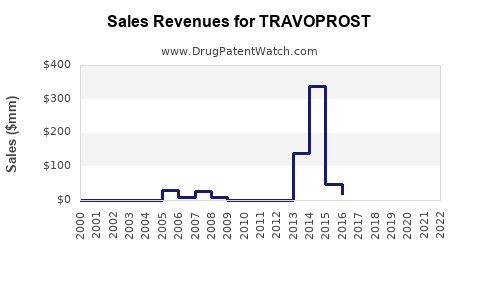
Travoprost followed a conventional branded-to-generic trajectory:
- Initial growth after launch as prostaglandin analogs expanded in glaucoma treatment.
- Peak commercial contribution during the branded Travatan and Travatan Z period.
- Revenue erosion from therapeutic competition and payer control.
- Accelerated decline after generic travoprost entry.
- Residual revenue from branded products, differentiated formulations, international markets, and combination products.
Alcon does not generally disclose travoprost revenue as a standalone line item in its public financial reporting. Travoprost is reported within broader pharmaceutical or prescription-product categories, which prevents a precise public estimate of annual product revenue. The company’s reporting shows the strategic importance of ophthalmology but does not provide a reliable current Travatan Z revenue series (Alcon Inc., 2024).
The economic profile is therefore different from a still-exclusive branded drug:
| Financial driver |
Effect on travoprost |
| Generic substitution |
Reduces branded volume and price |
| Established clinical use |
Supports stable total market demand |
| Once-daily dosing |
Preserves adherence and category relevance |
| Preservative differentiation |
Supports limited branded premium |
| Multiple therapeutic substitutes |
Limits pricing power |
| Mature glaucoma population |
Provides recurring but low-growth demand |
| Sterile manufacturing requirements |
Raises barriers for some suppliers |
| Combination products |
Creates incremental but limited lifecycle value |
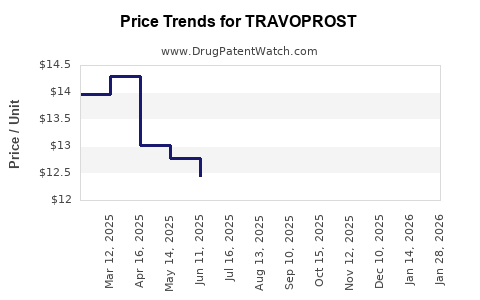
For Alcon, travoprost is more likely to be a portfolio-supporting product than a major growth engine. The company’s long-term pharmaceutical growth priorities have included newer ophthalmic medicines and products with stronger differentiation, while mature glaucoma products face generic erosion.
What generic entry risks exist for travoprost?
Generic entry risk is high for standard travoprost 0.004% solution because:
- The active ingredient is well characterized.
- The indication is established.
- Physician familiarity is high.
- Generic substitution is straightforward.
- Multiple alternative prostaglandins are available.
- Payers have an incentive to move patients to lower-cost products.
The main barriers are technical rather than legal. A generic manufacturer must maintain sterile production, consistent droplet delivery, chemical stability, and acceptable container-closure performance. Preservative-system differences can complicate direct commercial substitution, particularly where physicians prescribe a branded formulation for ocular-surface reasons.
Generic launch scenarios are therefore differentiated by product type:
| Product type |
Generic-entry risk |
Expected pricing pressure |
| Standard travoprost 0.004% |
Very high |
Severe |
| Preservative-system differentiated product |
High |
Moderate to severe |
| Travoprost/timolol combination |
High |
Moderate |
| New device or delivery system |
Medium |
Depends on device claims |
| Preservative-free travoprost |
Medium to high |
Potential premium if supply is limited |
What patent litigation and settlements affect travoprost?
Travoprost’s major litigation risk was concentrated around the period when ANDA applicants sought approval before or near expiration of listed patents. Paragraph IV litigation could delay approval under the Hatch-Waxman framework, but a 30-month stay could not create permanent market protection.
Publicly visible market conditions indicate that the central exclusivity disputes have been overtaken by generic availability. Any historical settlement agreements would need to be assessed against the specific ANDA applicant, patent number, court docket, and launch date. They do not change the current conclusion that standard travoprost is a genericized product.
No biosimilar litigation affects travoprost. No biologic reference-product exclusivity applies.
How does travoprost compare with latanoprost and bimatoprost?
| Attribute |
Travoprost |
Latanoprost |
Bimatoprost |
| Drug class |
Prostaglandin analog |
Prostaglandin analog |
Prostaglandin analog |
| Generic status |
Broadly genericized |
Broadly genericized |
Generic plus branded Lumigan |
| Main commercial differentiator |
Preservative and concentration options |
Low cost and high familiarity |
Efficacy and branded positioning |
| Pricing power |
Low |
Very low |
Low to moderate in branded segment |
| Patent strength |
Mature and limited |
Mature and limited |
Mature, with branded formulation value |
| Market role |
Established alternative |
Common first-line benchmark |
Premium or escalation option in some settings |
Travoprost does not have a clear cost or efficacy advantage sufficient to dominate the class. Its commercial value is strongest where a prescriber prefers its tolerability profile, where a payer has favorable contracting, or where a fixed-dose combination is needed.
What geographic markets remain attractive for travoprost?
The largest commercial opportunity remains recurring demand in established glaucoma markets, but geographic economics differ.
United States
The U.S. market has the highest generic substitution pressure and the strongest payer control. Branded growth is limited. Revenue depends on product differentiation, channel contracts, and supply reliability.
Europe
European markets are highly price-sensitive and often use centralized or national reimbursement systems. Generic penetration is substantial, but preservative-free products can retain value in selected countries.
Japan
Japan has an established glaucoma-treatment market and a strong preference for ophthalmic products with local regulatory and physician acceptance. Pricing and reimbursement controls constrain branded returns.
Emerging markets
Volume growth can continue as diagnosis and treatment expand. The primary risks are tender pricing, local competitors, parallel trade, regulatory variation, and inconsistent reimbursement. Generic travoprost can be commercially viable even where branded products have limited premium value.
What manufacturing and intellectual-property barriers remain?
The remaining barriers are operational:
- Sterile fill-finish capacity.
- Validated ophthalmic manufacturing lines.
- Preservative and stability control.
- Low extractables and leachables from packaging.
- Consistent drop size.
- Supply-chain resilience.
- Regulatory compliance across multiple jurisdictions.
These barriers can reduce the number of reliable suppliers even when patent barriers are low. They can also create short-term price increases during manufacturing disruptions. They do not, however, recreate durable exclusivity for the active ingredient.
Key Takeaways
- Travoprost is a mature prostaglandin analog with broad generic competition.
- Alcon’s Travatan and Travatan Z franchise has moved from exclusivity-driven growth to residual branded demand.
- Standard travoprost 0.004% has high generic-entry and substitution risk.
- Preservative systems, concentration, combination products, and delivery technology provide the main remaining differentiation.
- Travoprost is not exposed to biosimilar competition.
- The core patent estate is commercially weak against standard generic entry; formulation rights have narrower value.
- Public financial disclosures do not isolate current travoprost revenue, so product-level revenue estimates should not be treated as reported company figures.
- The market remains commercially relevant because glaucoma treatment is chronic, but growth is concentrated in volume expansion, emerging markets, combination products, and differentiated ophthalmic formulations.
- Manufacturing quality and supply reliability are more important barriers than core patent protection.
FAQs About Travoprost Market and Patent Risk
Is travoprost still protected by patents?
Core travoprost protection has expired or lost practical blocking power in major markets. Narrower formulation, combination, manufacturing, or device patents may remain relevant for specific products.
Is Travatan Z still commercially important?
Travatan Z can retain a branded niche through its preservative system and physician familiarity, but generic competition limits volume and pricing power.
Does travoprost have biosimilar risk?
No. Travoprost is a small-molecule drug. Its competitive risk comes from generic drugs, therapeutic substitutes, and combination products.
Can a new travoprost formulation support premium pricing?
Yes, but only if it provides a clinically meaningful benefit, such as improved ocular-surface tolerability, preservative-free delivery, better adherence, or a useful fixed-dose combination.
Is travoprost a strong licensing asset?
Standard travoprost is a weak licensing asset because of genericization and limited patent exclusivity. A differentiated delivery system or combination product could have greater licensing value if supported by enforceable intellectual property and clinical evidence.
References
-
Alcon Inc. (2024). Annual report for the fiscal year ended December 31, 2023. Alcon Inc.
-
U.S. Food and Drug Administration. (n.d.-a). Drugs@FDA: FDA-approved drugs. U.S. Department of Health and Human Services.
-
U.S. Food and Drug Administration. (n.d.-b). Approved drug products with therapeutic equivalence evaluations: Orange Book. U.S. Department of Health and Human Services.
-
U.S. Food and Drug Administration. (2001). Travatan ophthalmic solution prescribing information. U.S. Department of Health and Human Services.
-
U.S. Food and Drug Administration. (2004). Travatan Z ophthalmic solution prescribing information. U.S. Department of Health and Human Services.
-
U.S. Food and Drug Administration. (2014). Izba ophthalmic solution prescribing information. U.S. Department of Health and Human Services.