Last updated: August 17, 2026
TRAVATAN Z is a mature, declining ophthalmic product containing travoprost 0.004%, a prostaglandin analogue used to reduce elevated intraocular pressure in patients with open-angle glaucoma or ocular hypertension. Its commercial position is supported by a benzalkonium chloride-free formulation, but generic travoprost competition, lower-cost latanoprost, and limited product-level disclosure constrain growth.
Alcon is the current commercial owner of the TRAVATAN Z franchise. The product no longer has meaningful new-drug exclusivity, and generic entry risk is established rather than prospective. Alcon does not separately report TRAVATAN Z revenue, so the financial trajectory must be inferred from product maturity, generic erosion, glaucoma-market competition, and the company’s broader ophthalmic portfolio.
What is TRAVATAN Z and how does it compete?
TRAVATAN Z is travoprost ophthalmic solution 0.004%. It is administered once daily and indicated for lowering elevated intraocular pressure in adults with open-angle glaucoma or ocular hypertension. The formulation uses Alcon’s SofZia ionic-buffered preservative system instead of benzalkonium chloride, commonly abbreviated BAK. [1]
How does TRAVATAN Z compare with competing glaucoma drugs?
| Product |
Active ingredient |
Drug class |
Preservative position |
Commercial status |
| TRAVATAN Z |
Travoprost 0.004% |
Prostaglandin analogue |
BAK-free SofZia system |
Branded mature product |
| Generic travoprost |
Travoprost 0.004% |
Prostaglandin analogue |
Varies by manufacturer |
Generic competition |
| Xalatan and generic latanoprost |
Latanoprost 0.005% |
Prostaglandin analogue |
Product-dependent |
Large generic market |
| Lumigan |
Bimatoprost 0.01% or 0.03% |
Prostaglandin analogue |
Product-dependent |
Branded and generic competition |
| Zioptan |
Tafluprost 0.0015% |
Prostaglandin analogue |
Preservative-free unit dose |
Branded niche product |
| Rocklatan |
Netarsudil/latanoprost |
ROCK inhibitor plus prostaglandin |
Product-dependent |
Combination therapy |
| Vyzulta |
Latanoprostene bunod |
Prostaglandin analogue plus nitric oxide donor |
Product-dependent |
Branded differentiated product |
TRAVATAN Z’s main commercial differentiation is tolerability positioning for patients who may experience ocular-surface irritation from BAK-containing products. The product competes against both premium preservative-free therapies and much cheaper generic prostaglandin analogues.
Clinical prescribing is affected by formulary tiering, copay levels, adherence, bottle convenience, physician familiarity, and payer preference. The therapeutic category is mature, and most volume is generated by established prostaglandin analogues rather than by rapid market expansion.
When did TRAVATAN Z lose exclusivity?
TRAVATAN Z has no remaining meaningful period of FDA new-drug exclusivity. Travoprost was approved in the United States in 2001 under NDA 021994, while TRAVATAN Z was subsequently approved as the BAK-free formulation of the same active ingredient. [1,2]
The five-year new chemical entity exclusivity associated with travoprost has expired. Any pediatric exclusivity or other regulatory exclusivity linked to the original product would also have expired years ago. The product’s current commercial protection depends on brand recognition, formulation differentiation, manufacturing know-how, and market access rather than regulatory exclusivity.
What is the FDA regulatory status of TRAVATAN Z?
| Regulatory item |
Status |
| Active ingredient |
Travoprost |
| Strength |
0.004% |
| Dosage form |
Ophthalmic solution |
| Route |
Topical ophthalmic |
| FDA application |
NDA 021994 |
| Indications |
Open-angle glaucoma and ocular hypertension |
| Current regulatory category |
Approved mature branded product |
| NCE exclusivity |
Expired |
| Biosimilar pathway |
Not applicable |
| Generic pathway |
ANDA pathway applicable |
Travoprost is a small molecule, so competitors use abbreviated new drug applications rather than biosimilar applications. The relevant regulatory issue is therapeutic-equivalence approval, not biologic interchangeability.
What patents protect TRAVATAN Z?
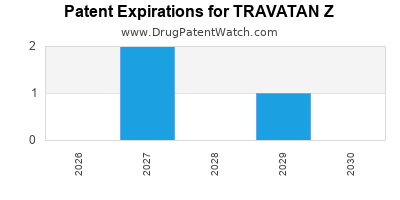
The original travoprost composition and use patents are expired or commercially exhausted. Public patent records identify the early travoprost patent estate as including U.S. Patent No. 5,631,287, which covered prostaglandin derivatives and related ophthalmic uses. The patent’s term ended in the 2010s. [3]
The most commercially relevant later protection concerned the formulation, particularly the use of a non-BAK ionic-buffered system. Formulation claims can remain relevant after the active-ingredient patent expires, but their ability to block generic entry depends on the exact claims, Orange Book listing status, patent-term calculations, and whether an ANDA applicant certifies against them.
What formulations are protected by TRAVATAN Z patents?
TRAVATAN Z’s formulation value comes from three technical attributes:
- Travoprost at 0.004%.
- A BAK-free preservative system based on SofZia technology.
- An aqueous ophthalmic solution designed to maintain chemical stability and sterility.
The BAK-free formulation is commercially important because chronic glaucoma therapy can expose patients to long-term ocular-surface effects. That differentiation supports physician and patient preference in selected segments, but it does not prevent generic competition where generic manufacturers offer equivalent or therapeutically substitutable products.
What is the Orange Book status of TRAVATAN Z?
The FDA Orange Book is the controlling source for current listed patents, expiration dates, and use codes. Orange Book status must be evaluated at the NDA and specific product level because patents may cover the active ingredient, formulation, method of use, or another aspect of the approved product. [2]
For commercial analysis, the key conclusion is that TRAVATAN Z is not protected by an active compound patent capable of preserving branded exclusivity. Any remaining listed formulation or method-of-use patents would have narrower scope and would not restore the market position the product held before generic travoprost became available.
Which companies are challenging TRAVATAN Z?
Generic manufacturers have challenged the travoprost market through ANDA filings and commercial launches. The competitive set has included manufacturers of generic travoprost ophthalmic solution and suppliers with broader ophthalmic portfolios.
The most important competitive threat is not a single litigation event. It is the cumulative effect of multiple approved generic suppliers, pharmacy substitution, payer preference, and the low switching cost between prostaglandin analogue products.
What Paragraph IV challenges affect TRAVATAN Z?
Paragraph IV certifications are relevant when an ANDA applicant asserts that an Orange Book-listed patent is invalid, unenforceable, or will not be infringed. The approval and launch of generic travoprost products demonstrate that the relevant patent barriers did not prevent generic market access.
A complete historical Paragraph IV docket requires matching each ANDA to the patents listed against NDA 021994 and reviewing district-court and Federal Circuit records. The business implication is clear: Paragraph IV risk has converted TRAVATAN Z from an exclusivity-protected product into a brand competing on formulation and franchise economics.
What generic entry risks exist for TRAVATAN Z?
Generic entry risk is high and already realized.
Generic launch scenarios
| Scenario |
Market effect |
Probability assessment |
| Continued generic substitution |
Ongoing erosion of branded volume and price |
High |
| Additional generic suppliers |
Further net-price compression |
Moderate to high |
| Generic product with differentiated preservative profile |
Greater pressure on the BAK-free segment |
Moderate |
| Brand retention in selected patients |
Residual branded demand based on tolerability or physician preference |
High |
| Reimbursement-driven formulary exclusion |
Sharp decline in branded utilization |
Moderate |
TRAVATAN Z can retain a premium in patients who require or prefer a BAK-free product, but that premium is vulnerable if generic or alternative preservative-free options receive favorable formulary placement.
Generic competition affects revenue through four channels:
- Lower prescriptions for the branded product.
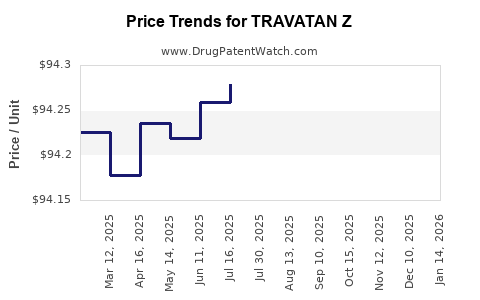
- Lower net price after rebates and discounts.
- Increased payer restrictions.
- Reduced physician willingness to initiate treatment with the branded product.
How strong is the TRAVATAN Z patent estate?
The patent estate is weak as a barrier to market entry and moderate as a source of residual product differentiation.
| Patent-estate dimension |
Assessment |
| Active-ingredient protection |
Expired |
| New-drug exclusivity |
Expired |
| Formulation protection |
Narrow and time-limited |
| Method-of-use protection |
Limited commercial blocking value |
| Manufacturing know-how |
Potentially relevant but difficult to quantify publicly |
| Generic substitution defense |
Weak |
| BAK-free brand differentiation |
Moderate |
| Litigation leverage |
Limited compared with an on-patent product |
The remaining value lies in formulation know-how, quality systems, sterility controls, supply reliability, trademark recognition, and prescriber familiarity. These assets can slow erosion but cannot replicate patent exclusivity.
What is the financial trajectory for TRAVATAN Z?
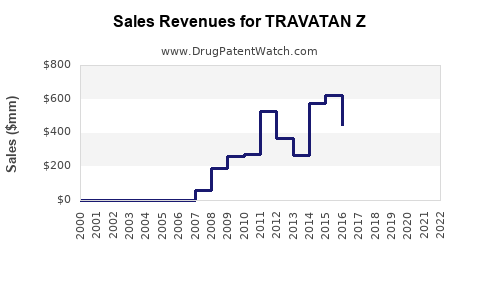
Alcon does not separately disclose TRAVATAN Z revenue, gross margin, prescription volume, or operating profit. The product is reported within broader ophthalmic pharmaceutical or surgical franchise disclosures, which prevents a reliable standalone revenue series. [4]
The expected financial trajectory is:
| Period |
Financial condition |
| 2000s |
Growth supported by launch adoption and branded prostaglandin demand |
| Early-to-mid 2010s |
Peak or near-peak maturity before broad generic erosion |
| Late 2010s |
Declining branded volume and pricing pressure |
| 2020s |
Mature legacy revenue with residual BAK-free positioning |
| Forward outlook |
Low-growth to declining sales, with margin pressure from price concessions |
TRAVATAN Z is unlikely to be a major growth driver for Alcon. Its financial contribution is more likely to be measured as a residual cash-generating brand within the ophthalmic medicines portfolio.
What drives residual revenue?
Residual revenue can persist where:
- Physicians prefer the branded formulation for patients with ocular-surface sensitivity.
- Patients are stable on TRAVATAN Z and resist switching.
- Payers reimburse the product without aggressive step edits.
- The product is available through established distribution channels.
- Generic alternatives differ in preservative system, bottle design, or patient experience.
Revenue quality is weaker than revenue from a protected product because the brand must defend both volume and price. Rebates may preserve access while reducing net sales, and gross-to-net exposure can increase as payers and pharmacy benefit managers negotiate against generic alternatives.
How does TRAVATAN Z compare with Xalatan and Lumigan?
TRAVATAN Z versus generic latanoprost
Generic latanoprost has the strongest cost position in the class. Its broad use and established formulary status make it the principal economic benchmark for TRAVATAN Z. TRAVATAN Z can command a premium only where its formulation or patient-specific tolerability is valued.
TRAVATAN Z versus Lumigan
Lumigan competes on branded efficacy, physician familiarity, and bimatoprost differentiation. It has faced the same structural pressures from generic prostaglandin analogues. The two brands compete for patients who remain on branded therapy despite payer pressure.
TRAVATAN Z versus Zioptan
Zioptan is preservative-free and therefore overlaps with TRAVATAN Z’s ocular-surface positioning. Its unit-dose format creates a different cost and convenience profile. TRAVATAN Z has the advantage of a multidose bottle, while Zioptan offers a stronger preservative-free claim.
What patent litigation affects TRAVATAN Z?
The material litigation risk is historical generic-entry litigation rather than a current high-value patent dispute capable of extending exclusivity. Early disputes involving travoprost and its formulation patents shaped the timing of generic competition. Once generic products gained market access, the commercial question shifted from launch prevention to residual brand economics.
No biosimilar litigation applies because TRAVATAN Z is a small-molecule ophthalmic drug. Current legal exposure is more likely to involve ordinary product liability, manufacturing, labeling, trademark, or commercial-contract issues than a dispute over a surviving compound patent.
What licensing deals support TRAVATAN Z?
Travoprost originated from research associated with Alcon and its ophthalmic development operations. The product was part of Novartis’s ophthalmic portfolio before Alcon became an independent public company in 2019. [4,5]
The Alcon separation transferred the commercial franchise into Alcon’s standalone ophthalmology business. Public company disclosures do not identify a current third-party royalty stream that materially changes TRAVATAN Z’s economics. The commercial value is therefore primarily tied to Alcon’s ownership, manufacturing, distribution, and brand management.
What manufacturing and geographic barriers remain?
Manufacturing barriers are lower than they were during exclusivity but remain relevant. Ophthalmic solutions require sterile production, validated filling, container-closure integrity, impurity control, stability data, and reliable preservative performance. These requirements can limit the number of successful suppliers, but they generally do not prevent ANDA competition after patent expiry.
Geographic protection is also limited. U.S. protection has expired at the core compound level, and international markets have experienced comparable generic pressure, subject to local patent terms, regulatory approvals, reimbursement systems, and trademark rights. Alcon’s global distribution network provides commercial scale but does not create patent exclusivity.
Key Takeaways
- TRAVATAN Z is a mature travoprost ophthalmic product with a BAK-free SofZia formulation.
- Its U.S. compound patent and new-drug exclusivity have expired.
- Generic travoprost and low-cost latanoprost create high substitution and pricing risk.
- The product has no biosimilar risk because travoprost is a small molecule.
- Residual brand value comes from ocular-surface positioning, physician familiarity, patient stability, and distribution.
- Alcon does not separately report TRAVATAN Z revenue, so product-level financial estimates are not publicly verifiable.
- The expected trajectory is declining or low-growth revenue with increasing price and formulary pressure.
- The patent estate is weak as an entry barrier and moderate as a source of formulation differentiation.
- The most credible commercial strategy is to preserve a premium BAK-free niche rather than pursue broad market growth.
FAQs About TRAVATAN Z Patents, Generics, and Revenue
Is TRAVATAN Z still under patent protection?
The core travoprost protection has expired. Any remaining formulation or use claims would have narrower scope and would not recreate the original branded exclusivity position.
Can patients switch from TRAVATAN Z to generic travoprost?
Generic travoprost products contain the same active ingredient and strength, but excipients, preservative systems, bottle design, and tolerability may differ. Substitution depends on the product, prescription, payer rules, and applicable state law.
Is TRAVATAN Z more valuable than generic latanoprost?
TRAVATAN Z may have greater value for selected patients who prefer a BAK-free formulation. Generic latanoprost generally has the stronger cost and formulary position.
Does TRAVATAN Z have pediatric exclusivity?
Any pediatric exclusivity associated with the original FDA approval is no longer commercially relevant because the product was approved more than a decade ago and its core exclusivity periods have expired.
What would increase TRAVATAN Z revenue?
Revenue could improve through stronger BAK-free prescribing, favorable reimbursement, supply disruptions affecting competitors, or expanded use in patients with ocular-surface intolerance. These factors would more likely stabilize sales than create sustained growth.
References
- U.S. Food and Drug Administration. (2006). TRAVATAN Z prescribing information.
- U.S. Food and Drug Administration. (n.d.). Approved drug products with therapeutic equivalence evaluations: Orange Book.
- U.S. Patent and Trademark Office. (1997). U.S. Patent No. 5,631,287: Prostaglandin derivatives.
- Alcon Inc. (2024). Annual report for the fiscal year ended December 31, 2023.
- Novartis AG. (2019). Completion of the spinoff of Alcon.