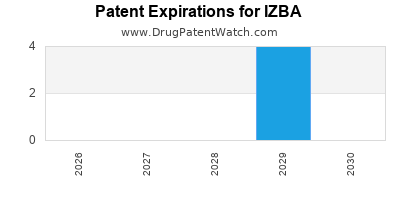
Last updated: September 20, 2026
IZBA is travoprost 0.024% ophthalmic solution, a once-daily prostaglandin analog for reducing elevated intraocular pressure in patients with ocular hypertension or open-angle glaucoma. The product is marketed by Alcon after its 2019 separation from Novartis. Its commercial position depends on differentiation from generic travoprost 0.004%, latanoprost, bimatoprost, and newer branded glaucoma therapies.
Alcon does not publicly report IZBA revenue as a standalone product. Its financial statements group IZBA within broader pharmaceutical or ophthalmic categories, preventing a reliable product-level sales estimate from public filings. The available evidence supports a mature, specialty ophthalmology product with continuing revenue potential but high generic and payer pressure.
What is IZBA and how does it compete in glaucoma treatment?
IZBA contains travoprost, a prostaglandin F2α analog. It is administered once daily and is indicated for lowering elevated intraocular pressure in adults with ocular hypertension or open-angle glaucoma.[1]
| Product attribute |
IZBA |
| Active ingredient |
Travoprost |
| Strength |
0.024% |
| Dosage form |
Ophthalmic solution |
| Administration |
One drop once daily |
| FDA application |
NDA 204200 |
| Initial FDA approval |
2014 |
| Therapeutic class |
Prostaglandin analog |
| Primary indications |
Open-angle glaucoma and ocular hypertension |
| Current commercial owner |
Alcon |
| Biosimilar exposure |
None |
| Primary competitive risk |
Generic ophthalmic glaucoma products |
IZBA’s commercial proposition is based on a lower travoprost concentration than Travatan Z, which contains travoprost 0.004%, while retaining the prostaglandin-class mechanism. The formulation uses a proprietary excipient system rather than the conventional benzalkonium chloride preservation approach used in some ophthalmic products.[1]
The product competes in a treatment class in which physicians and payers often prioritize established efficacy, low acquisition cost, formulary placement, and patient persistence. Those factors favor generic latanoprost and generic travoprost in price-sensitive channels.
When did IZBA lose FDA regulatory exclusivity?
IZBA’s five-year new chemical entity exclusivity would have ended in 2019, assuming the FDA did not grant a later qualifying exclusivity period. The product is therefore a mature NDA product rather than a product protected by active NCE exclusivity.
| Regulatory milestone |
Date or status |
| FDA approval |
2014 |
| Standard NCE exclusivity |
Expected to end in 2019 |
| Pediatric exclusivity |
No publicly established IZBA-specific extension |
| Orphan exclusivity |
Not applicable |
| Current regulatory status |
Approved NDA product |
| Follow-on pathway |
ANDA or other abbreviated pathway may be available, subject to FDA records and listed patents |
Regulatory exclusivity and patent protection are separate. The end of NCE exclusivity did not automatically authorize a generic if relevant patents remained listed or enforceable. Conversely, an active patent does not restore regulatory exclusivity.
What patents protect IZBA?
The public record must be separated into three categories: patents covering travoprost itself, formulation patents, and use or delivery patents.
The core active ingredient is not a new chemical entity for current commercial purposes. Travoprost has been marketed for many years, and composition-of-matter protection associated with the original molecule is not the principal barrier to generic competition today.
Potentially relevant protection may include:
- Ophthalmic formulation patents
- Preservative-system patents
- Concentration and dosing patents
- Container or dispensing-system patents
- Method-of-use patents for reducing intraocular pressure
- Manufacturing and stability patents
The FDA Orange Book is the controlling public source for patents listed against NDA 204200. A current freedom-to-operate analysis should distinguish patents listed specifically against IZBA from patents associated with Travatan or other travoprost products. Patent-family ownership may also have changed following Alcon’s separation from Novartis.
No reliable product-level conclusion should be drawn from the existence of a travoprost patent alone. A patent must be analyzed for claim scope, expiration, terminal disclaimers, prosecution history, and whether an ANDA applicant has certified against it.
What is the Orange Book status of IZBA?
IZBA is an FDA-approved prescription ophthalmic product associated with NDA 204200. Orange Book status is commercially important because an ANDA applicant may need to file a Paragraph IV certification against any listed patent that claims the drug, formulation, or approved method of use.[2]
The relevant regulatory scenarios are:
| Orange Book issue |
Commercial effect |
| No listed patents |
Generic approval can proceed under ordinary FDA review |
| Listed formulation patent |
ANDA approval may face a patent certification dispute |
| Listed method-of-use patent |
The applicant may use a Section viii carve-out if legally available |
| Paragraph IV certification |
Brand owner may sue within 45 days |
| Patent litigation |
FDA approval can be stayed for up to 30 months, subject to statutory exceptions |
| No litigation after Paragraph IV |
FDA approval timing may proceed based on review status |
An Orange Book listing does not prove that a patent is valid or infringed. It establishes the regulatory patent-certification framework.
Which companies challenge IZBA and its market position?
Competition comes from several groups rather than a single direct challenger.
Generic prostaglandin manufacturers
Generic manufacturers of latanoprost, travoprost, and bimatoprost exert the strongest price pressure. Common participants in the U.S. ophthalmic generic market have included large manufacturers such as Apotex, Sandoz, Mylan/Viatris, Teva, and Hikma, although participation varies by product, period, and FDA approval status.
Generic travoprost is the closest pharmacologic competitor. Generic latanoprost is often a larger commercial threat because of broad formulary coverage, physician familiarity, and lower pricing.
Branded glaucoma competitors
IZBA also competes with:
- Travatan Z, another travoprost product
- Xalatan and generic latanoprost
- Lumigan and generic bimatoprost
- Vyzulta, a nitric oxide-donating prostaglandin analog
- Rocklatan, a fixed combination of netarsudil and latanoprost
- Rhopressa, netarsudil
- Durysta, an intracameral bimatoprost implant
These products compete for patients who need additional intraocular-pressure reduction, improved adherence, preservative reduction, or alternative tolerability profiles.
How strong is the IZBA patent estate?
IZBA’s patent estate should be classified as moderate at most from a commercial-risk perspective, unless active formulation or delivery patents remain enforceable and difficult to design around.
The product’s main structural weaknesses are:
- The active ingredient is an established prostaglandin analog.
- The therapeutic use is broad and difficult to defend as a new indication.
- The product is administered through a conventional ophthalmic solution.
- Generic competitors can potentially target the same clinical market through different formulations.
- Price competition is strong even when exact formulation equivalence is not established.
The potentially stronger elements are formulation-specific claims, particularly those covering preservative systems, concentration ranges, stability, and container closure. Their value depends on claim breadth and whether a generic applicant can avoid the claims through a different excipient system or concentration.
A strong patent position would require enforceable claims that read directly on the commercial product and cannot be readily designed around. Public approval data alone do not establish that level of strength.
What formulation patents protect IZBA?
IZBA’s formulation differentiation is commercially more relevant than the travoprost molecule itself. The product uses a low-concentration travoprost formulation designed for once-daily administration.
Relevant formulation variables include:
- Travoprost concentration
- pH range
- Osmolality
- Surfactants and solubilizing agents
- Preservative or preservative-free system
- Container material
- Drop uniformity
- Chemical stability
- Storage requirements
Formulation patents can delay or complicate generic entry when they claim a narrow but commercially necessary combination. Their defensive value declines when a generic can demonstrate pharmaceutical equivalence using a different inactive-ingredient profile.
A generic product does not necessarily need to duplicate every inactive ingredient in IZBA. FDA review focuses on the applicable ANDA requirements, including pharmaceutical equivalence, bioequivalence, quality, and labeling. The formulation therefore creates a possible barrier, not an automatic barrier.
What is the financial trajectory for IZBA?
Alcon does not disclose IZBA net sales separately in its annual reports. Public financial reporting generally aggregates ophthalmic pharmaceutical products within broader business categories. Product-level revenue, prescription volume, gross margin, and geographic sales are therefore unavailable from company filings.[3]
The likely financial trajectory is:
| Period |
Commercial condition |
Financial implication |
| 2014-2016 |
Launch and physician adoption |
Revenue build from branded prescribing |
| 2017-2019 |
Mature branded growth |
Expansion limited by class competition and payer controls |
| 2020 onward |
Post-exclusivity mature product |
Greater formulary and generic pressure |
| Current phase |
Portfolio product within Alcon pharmaceuticals |
Revenue likely stable or declining absent price, volume, or geographic gains |
IZBA’s financial value is likely greater as part of Alcon’s glaucoma portfolio than as a standalone growth asset. The product can generate recurring revenue from chronic therapy, but glaucoma treatment is subject to prescription substitution, rebates, managed-care restrictions, and generic use.
Revenue exposure is also moderated by the size of the total Alcon portfolio. Even a material decline in IZBA sales would likely have a limited effect on consolidated Alcon revenue unless the product has a larger internal contribution than disclosed filings indicate.
What generic launch risks exist for IZBA?
The main generic launch scenarios are:
Early launch after patent resolution
A generic applicant could launch before all theoretical patent expiration dates if litigation ends through a settlement, invalidity ruling, non-infringement finding, or licensing arrangement.
At-risk launch
An ANDA applicant could launch before final resolution of patent litigation. This creates potential damages exposure and an injunction risk. The commercial incentive depends on expected launch timing, market size, and the probability of patent success.
Authorized generic or brand price response
Alcon could respond through price reductions, contracting, rebates, channel-specific discounts, or an authorized generic strategy. These actions can reduce the revenue available to independent generic entrants.
Limited substitution
Because generic travoprost 0.004% is not necessarily identical to IZBA 0.024%, substitution may depend on FDA-approved labeling, state substitution rules, payer policy, and physician prescribing. This can slow conversion but does not eliminate class-level pricing pressure.
Has Alcon disclosed licensing deals or settlements involving IZBA?
No major IZBA-specific licensing transaction or settlement can be established from the core public corporate disclosures available for this analysis. Alcon’s 2019 separation from Novartis transferred the relevant ophthalmology business into Alcon, but that transaction was a corporate separation rather than an IZBA-specific licensing deal.[4]
Any Paragraph IV settlement would need to be confirmed through court records, FDA patent listings, or a Federal Trade Commission agreement filing. A commercial settlement could include:
- A delayed generic entry date
- A license to manufacture or distribute
- An authorized generic arrangement
- Supply obligations
- A no-challenge provision
- Restrictions on launch strength or formulation
The absence of a publicly identified settlement does not establish that no agreement exists. It means the available record does not support a product-specific conclusion.
How does IZBA compare with competing glaucoma products?
| Product |
Primary differentiation |
Generic pressure |
Commercial position |
| IZBA |
Travoprost 0.024%, once daily |
High at class level |
Mature branded product |
| Generic latanoprost |
Low price and broad use |
Already genericized |
Strong payer position |
| Generic travoprost |
Same active ingredient class |
High |
Direct price competitor |
| Lumigan |
Bimatoprost efficacy and brand history |
High to moderate |
Branded/generic competition |
| Vyzulta |
Nitric oxide plus prostaglandin activity |
Lower than older agents |
Premium branded option |
| Rocklatan |
Fixed combination therapy |
Lower direct substitution |
Escalation therapy |
| Durysta |
Intracameral implant |
Limited direct substitution |
Procedure-based alternative |
IZBA’s strongest commercial argument is formulation and tolerability differentiation. Its weakest point is exposure to low-cost products that address the same disease and treatment goal.
What geographic markets matter for IZBA?
The United States is the most important market for Orange Book, ANDA, and Paragraph IV analysis. Other jurisdictions use different regulatory and patent systems.
Key differences include:
- Canada: Health Canada approval and Canadian patent listing rules
- European Union: national and regional market authorization, with country-specific reimbursement
- Japan: PMDA review and local reimbursement controls
- Emerging markets: greater price sensitivity and variable enforcement of formulation patents
Patent expiry and generic entry timing can differ by country. A U.S. patent challenge does not determine European or Asian launch rights.
Key Takeaways
- IZBA is Alcon’s travoprost 0.024% ophthalmic solution for ocular hypertension and open-angle glaucoma.
- FDA approval dates to 2014, and standard NCE exclusivity would have ended in 2019.
- The product has no biosimilar risk because it is a small-molecule ophthalmic drug.
- Its primary commercial risks are generic travoprost, generic latanoprost, payer controls, and branded glaucoma alternatives.
- Formulation and delivery patents matter more than active-ingredient protection.
- Alcon does not separately disclose IZBA revenue, so product-level sales and margin estimates cannot be validated from public filings.
- IZBA is best viewed as a mature portfolio product with recurring chronic-use revenue rather than a major standalone growth driver.
- The critical diligence items are current Orange Book listings, ANDA Paragraph IV certifications, patent litigation, and any generic-entry settlement.
FAQs
Is IZBA the same as Travatan Z?
No. Both contain travoprost, but IZBA is travoprost 0.024%, while Travatan Z is travoprost 0.004%. Their formulations and labeling are not identical.
Is IZBA preservative-free?
IZBA is not equivalent to a fully preservative-free ophthalmic product. Its formulation uses a preservation system identified in the FDA-approved labeling.[1]
Can generic latanoprost automatically substitute for IZBA?
No. Generic latanoprost and IZBA contain different active ingredients. Substitution depends on physician prescribing, FDA-approved product status, payer rules, and applicable state pharmacy law.
Does IZBA have pediatric exclusivity?
No publicly established IZBA-specific pediatric exclusivity extension is identified in the core FDA approval information reviewed for this analysis.
Is IZBA a high-growth pharmaceutical product?
IZBA is more likely a mature specialty ophthalmology product than a high-growth asset. Its chronic-use market supports recurring demand, but generic competition and reimbursement pressure constrain long-term pricing and volume expansion.
References
- U.S. Food and Drug Administration. (2014). IZBA (travoprost ophthalmic solution) prescribing information.
- U.S. Food and Drug Administration. (2024). Approved drug products with therapeutic equivalence evaluations: Orange Book.
- Alcon Inc. (2024). Annual report for the fiscal year ended December 31, 2023.
- Novartis AG. (2019). Completion of the Alcon spin-off and commencement of independent operations.