Last updated: August 6, 2026
Hydroxyzine is a mature, low-cost generic antihistamine and anxiolytic with no meaningful remaining U.S. composition-patent protection. Its commercial market is driven by prescription volume, generic supply availability, dosage-form mix, and reimbursement rather than branded pricing power. Hydroxyzine hydrochloride and hydroxyzine pamoate remain widely available in oral formulations, while injectable hydroxyzine hydrochloride serves a smaller institutional market. No public company separately reports material hydroxyzine revenue.
What is hydroxyzine and how is it used?
Hydroxyzine is a first-generation antihistamine with sedative and anxiolytic activity. The FDA-approved uses include relief of anxiety, symptomatic management of pruritus, and use as a preoperative sedative. Hydroxyzine pamoate is marketed primarily in capsules, while hydroxyzine hydrochloride is available in tablets, oral solutions, and injectable products depending on manufacturer and market [1][2].
| Product form |
Active ingredient |
Common U.S. use |
Commercial position |
| Capsules |
Hydroxyzine pamoate |
Anxiety, pruritus |
High-volume generic prescription product |
| Tablets |
Hydroxyzine hydrochloride |
Anxiety, pruritus |
Generic oral market |
| Oral solution |
Hydroxyzine hydrochloride |
Pediatric or swallowing-related use |
Smaller, formulation-sensitive segment |
| Injection |
Hydroxyzine hydrochloride |
Preoperative sedation and acute institutional use |
Limited-volume hospital segment |
| Brand references |
Atarax, Vistaril |
Historical reference products |
Brand equity has limited current pricing impact |
Hydroxyzine is also used off-label for insomnia, nausea, and short-term symptomatic treatment of agitation. Off-label use expands demand but does not create separate regulatory exclusivity.
When did hydroxyzine lose patent and market exclusivity?
Hydroxyzine lost meaningful U.S. patent exclusivity decades ago. The drug was introduced in the 1950s, and the original branded products have long been exposed to generic competition. Current hydroxyzine products are approved through abbreviated new drug applications or legacy applications rather than protected by active composition patents [1][3].
The commercial exclusivity timeline is therefore distinct from newer small-molecule products:
| Exclusivity category |
Hydroxyzine status |
| New chemical entity exclusivity |
Expired |
| U.S. composition patent |
No material active protection identified for the marketed molecule |
| Formulation exclusivity |
No broad, commercially significant protection identified |
| Orphan-drug exclusivity |
Not applicable |
| Pediatric exclusivity |
Not commercially relevant to current market structure |
| Data exclusivity |
Expired |
| Brand exclusivity |
Defeated by long-standing generic competition |
Hydroxyzine does not have a current exclusivity event comparable to the loss of a modern branded drug patent. Generic competition is already established across the principal dosage forms.
What patents protect hydroxyzine products?
No active U.S. patent estate materially protects hydroxyzine as a molecule. The original active pharmaceutical ingredient and historical branded products are outside their patent terms. Current patent risk is therefore concentrated in product-specific issues rather than core molecule protection.
Potentially relevant patent categories include:
- Modified-release hydroxyzine formulations
- Combination products containing hydroxyzine
- Novel delivery systems
- Manufacturing processes or crystalline forms
- Device or packaging claims
- Patents covering a particular clinical method
These categories have limited relevance to the standard hydroxyzine capsules, tablets, oral solutions, and injections sold in the United States. A later formulation patent could restrict a particular product presentation without restoring exclusivity to conventional hydroxyzine.
What is the Orange Book status of hydroxyzine?
The Orange Book does not provide a current branded-exclusivity framework for hydroxyzine comparable to products such as extended-release therapies or newly approved specialty drugs. FDA-listed hydroxyzine products are primarily legacy products and generic equivalents. Relevant reference products include historical Atarax and Vistaril approvals, while current market supply is provided mainly by abbreviated new drug application holders and authorized generic manufacturers [3].
Orange Book implications are limited:
- A generic applicant can rely on the established reference product.
- Paragraph IV litigation risk is low because the core patent estate has expired.
- Any patent certification issue would likely relate to a specific formulation or method-of-use patent, not hydroxyzine itself.
- Approval competition is more likely to depend on bioequivalence, manufacturing capacity, and product availability.
How many patents cover hydroxyzine?
No commercially significant active U.S. patents appear to cover the standard hydroxyzine molecule or conventional immediate-release dosage forms. The meaningful patent count for the mainstream market is effectively zero at the active ingredient level.
That conclusion does not exclude isolated patents involving:
- A new dosage regimen
- A fixed-dose combination
- A controlled-release formulation
- A particular salt, polymorph, or manufacturing method
- A nonstandard delivery system
Such claims would need to be assessed product by product. They do not create a broad barrier to generic hydroxyzine.
Which companies manufacture hydroxyzine?
Hydroxyzine is supplied by multiple generic pharmaceutical companies. U.S. FDA labeling and DailyMed records identify products from manufacturers such as Amneal Pharmaceuticals, Hikma Pharmaceuticals, Major Pharmaceuticals, Par Pharmaceutical, Rising Pharmaceuticals, Sandoz, Solco Healthcare, and other suppliers, depending on dosage form and current product status [1][2].
The supplier base changes over time because manufacturers enter and exit low-margin generic categories. A company may maintain an approved product while having limited commercial distribution. Pharmacy availability is also affected by wholesaler contracting, National Drug Code status, production decisions, and hospital purchasing arrangements.
The market has no single dominant innovator. The most relevant competitive variables are:
- Active pharmaceutical ingredient sourcing
- FDA manufacturing compliance
- Ability to maintain multiple dosage strengths
- Retail pharmacy contracts
- Hospital group purchasing access
- Inventory management
- Price discipline during supply disruption
How large is the hydroxyzine market?
Public companies generally do not disclose hydroxyzine revenue separately. The product is usually grouped within broader generic pharmaceutical sales, making a precise global market value unavailable from issuer filings.
The market has several characteristics associated with a mature generic drug:
| Market variable |
Hydroxyzine condition |
| Prescription demand |
Established and recurring |
| Price level |
Low relative to branded medicines |
| Volume growth |
Likely tied to prescribing and population trends |
| Revenue growth |
Constrained by generic price erosion |
| Supplier concentration |
Fragmented, with potential concentration by dosage form |
| Switching barriers |
Low for standard oral products |
| Brand loyalty |
Limited |
| Reimbursement leverage |
High |
| Regulatory barriers |
Moderate for approval, low for commercial differentiation |
Demand is supported by anxiety treatment, pruritus management, and use in acute-care settings. Prescribing is also influenced by clinician concerns over sedation, anticholinergic burden, QT-related risks, and the availability of alternative therapies. Older adults are a particularly important safety-sensitive population because first-generation antihistamines can increase sedation and anticholinergic adverse effects [4].
What is the financial trajectory for hydroxyzine?
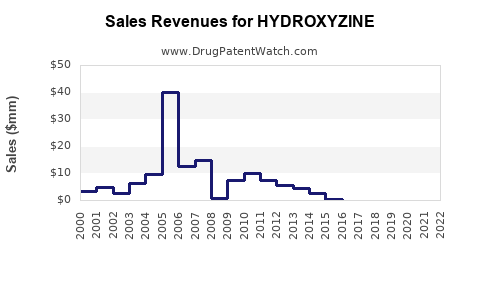
Hydroxyzine’s financial trajectory is best characterized as stable-volume, low-price, low-growth generic revenue.
The product’s revenue profile has moved through four phases:
Brand launch and early adoption
The original commercial opportunity was created by hydroxyzine’s approval for anxiety, pruritus, and preoperative sedation. At that stage, the market supported branded pricing and physician familiarity.
Generic conversion
After patent and exclusivity expiration, multiple manufacturers entered the market. Pricing power shifted from the product owner to generic suppliers, pharmacies, wholesalers, and payers.
Mature generic equilibrium
The current market generates recurring sales from established prescriptions but limited gross-margin expansion. Manufacturers compete through availability, contract pricing, and manufacturing efficiency. Standard capsules and tablets are highly substitutable.
Long-term low-growth market
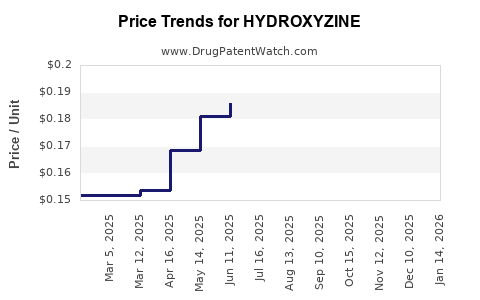
Future revenue is likely to track prescription utilization, population growth, clinical practice, and episodic supply changes. Unit prices are likely to remain under pressure because no active core patent protects the product and multiple suppliers can serve the market.
For manufacturers, hydroxyzine is more valuable as part of a broad generic portfolio than as a standalone growth asset. It can contribute predictable revenue and manufacturing utilization, but it is unlikely to be a material driver of corporate valuation unless a company has unusual exposure to a constrained dosage form or temporary supply imbalance.
What generic entry risks exist for hydroxyzine?
Conventional generic-entry risk is already realized. The main commercial risk is not a future first generic launch but continued price competition among existing suppliers.
Key risks include:
- Retail price erosion after additional manufacturers enter
- Margin compression from pharmacy benefit manager contracting
- Substitution between hydroxyzine pamoate and hydroxyzine hydrochloride where clinically and administratively acceptable
- Loss of preferred formulary placement
- API sourcing disruption
- Manufacturing observations or FDA enforcement action
- Discontinuation of low-volume strengths
- Hospital tender losses for injectable products
The injectable market has higher operational barriers than standard capsules because sterile manufacturing, validation, quality systems, and hospital supply requirements reduce the number of practical suppliers. That creates a stronger supply position for compliant manufacturers, although it does not create durable patent protection.
Are there Paragraph IV challenges or hydroxyzine patent lawsuits?
No major current U.S. Paragraph IV litigation campaign is associated with conventional hydroxyzine products. The core product has been generic for many years, and there is no modern branded patent dispute comparable to those affecting high-value specialty drugs.
A Paragraph IV filing would be commercially relevant only if a sponsor asserted an active patent covering a particular hydroxyzine formulation, method, or delivery system. Such litigation would concern the patent claim scope and the specific product, not the standard hydroxyzine market.
No material settlement agreement governing broad U.S. generic entry is publicly associated with the conventional hydroxyzine market. The absence of a major settlement reflects the product’s age, low commercial value, and lack of a current high-value patent barrier.
What FDA regulatory issues affect hydroxyzine sales?
Hydroxyzine products remain FDA-approved prescription medicines, but regulatory and clinical-use considerations affect demand. FDA-approved labeling warns about drowsiness and cautions regarding use with central nervous system depressants. Hydroxyzine has also been associated with QT prolongation and torsades de pointes risk, particularly in patients with risk factors or when combined with other QT-prolonging medicines [1][2].
These factors influence market dynamics in several ways:
- Lower use in elderly patients and patients with cardiac risk
- Substitution toward non-sedating antihistamines for allergy indications
- Monitoring of concurrent sedatives and alcohol use
- Continued use where rapid sedative or antipruritic effects are clinically desired
- Potential demand shifts as prescribing guidelines change
Regulatory risk is therefore more likely to affect utilization than approval status. A label change or safety communication could reduce demand without affecting the patent position.
How does hydroxyzine compare with competing drugs?
Hydroxyzine competes across separate therapeutic use cases rather than through a single direct substitute.
| Use case |
Hydroxyzine competitors |
Hydroxyzine position |
| Anxiety |
Buspirone, SSRIs, SNRIs, benzodiazepines |
Low-cost, sedating, often short-term or adjunctive |
| Pruritus |
Cetirizine, loratadine, fexofenadine, diphenhydramine |
More sedating than second-generation antihistamines |
| Insomnia |
Doxepin, trazodone, melatonin products, sedative-hypnotics |
Off-label use with low acquisition cost |
| Preoperative sedation |
Benzodiazepines and other sedatives |
Established but limited institutional segment |
| Pediatric symptomatic use |
Cetirizine and other antihistamines |
Formulation and tolerability determine selection |
Hydroxyzine’s competitive advantage is price, familiarity, and broad historical use. Its weaknesses are sedation, anticholinergic effects, cardiac safety considerations, and the absence of meaningful product differentiation.
What licensing deals affect hydroxyzine?
No major current licensing transaction appears to govern the conventional U.S. hydroxyzine market. The product is generally manufactured and distributed under generic supply, contract manufacturing, private-label, or wholesaler arrangements rather than through high-value intellectual-property licenses.
Any commercial agreement is more likely to involve:
- Contract manufacturing
- Authorized distribution
- Private-label supply
- API procurement
- Hospital purchasing
- Regional marketing rights
These arrangements can affect market share and availability, but they do not create a new exclusivity period for hydroxyzine.
What is the geographic coverage of hydroxyzine protection?
Hydroxyzine has broad geographic availability but little meaningful geographic patent protection. The product is marketed in the United States, Europe, and other international markets through generic and legacy branded products. Patent terms and regulatory status vary by jurisdiction, but the molecule’s age means that core patent protection has generally expired in major markets.
Commercial differences by region are more likely to reflect:
- Prescription classification
- Reimbursement policy
- National tendering
- Local manufacturing
- Brand persistence
- Availability of alternative antihistamines
- Hospital procurement practices
The United States has a highly genericized market. Some non-U.S. markets retain stronger brand recognition for historical products, but that does not necessarily translate into durable pricing power.
How strong is the hydroxyzine patent estate?
The patent estate is weak for standard products and commercially irrelevant as a barrier to generic entry. Hydroxyzine has:
- No meaningful active composition-patent protection
- No current branded exclusivity
- Broad generic availability
- Low switching costs for standard oral products
- Limited opportunity for patent-based price maintenance
The stronger business defenses are operational. A manufacturer with reliable sterile injectable capacity, a compliant API supply chain, and dependable pharmacy distribution can maintain share even in a weak patent environment.
What generic launch scenarios could affect hydroxyzine?
The likely scenarios are commercial rather than patent-driven.
Base case
Multiple generic suppliers remain active. Volumes are stable, prices remain low, and revenue grows slowly or declines in nominal terms because of continued reimbursement pressure.
Downside case
Additional suppliers enter, or purchasing organizations intensify price competition. Oral product prices fall, low-volume strengths are discontinued, and manufacturers reduce capacity.
Supply-constrained case
A manufacturing interruption or API shortage reduces the number of active suppliers. Remaining manufacturers gain temporary volume and pricing leverage, particularly for injectable or less commonly stocked formulations. This benefit would likely reverse when supply normalizes.
Formulation-specific case
A company introduces a differentiated liquid, combination, or delivery product. Commercial success would depend on clinical utility, reimbursement, and regulatory status because standard hydroxyzine remains inexpensive.
Key Takeaways
- Hydroxyzine is a mature, heavily genericized prescription drug.
- Its original patent and exclusivity periods expired decades ago.
- No active U.S. composition-patent estate materially protects standard hydroxyzine.
- Paragraph IV litigation and settlement risk are low for conventional products.
- Revenue is recurring but low value, with no separately disclosed major-company sales base.
- Standard capsules and tablets face intense price competition.
- Injectable hydroxyzine has higher manufacturing and supply barriers than oral products.
- Clinical safety concerns, particularly sedation, anticholinergic burden, and QT risk, constrain demand.
- Financial performance depends on volume, supply reliability, contract pricing, and dosage-form availability rather than intellectual property.
- Hydroxyzine is more relevant as a portfolio product for generic manufacturers than as a standalone investment or licensing asset.
FAQs
Is hydroxyzine still under patent in the United States?
No material U.S. patent protection remains for the standard hydroxyzine molecule or conventional immediate-release products. Any relevant patent would need to cover a specific formulation, combination, process, or delivery system.
Can a company obtain new exclusivity for a hydroxyzine product?
A company could potentially obtain regulatory or patent protection for a genuinely novel formulation or delivery system. That protection would apply to the specific product and would not remove generic competition for conventional hydroxyzine.
Why is hydroxyzine commercially available if its brand patents expired?
Hydroxyzine remains clinically useful and inexpensive to manufacture. Generic suppliers continue to sell it because recurring prescription demand can support production within a broad portfolio, even at low unit prices.
Does hydroxyzine have biosimilar competition?
No. Hydroxyzine is a chemically synthesized small molecule, not a biologic. The relevant competitors are generic versions, not biosimilars.
Which hydroxyzine dosage form has the greatest commercial defensibility?
Injectable hydroxyzine hydrochloride has greater operational defensibility because sterile manufacturing and hospital supply requirements limit practical suppliers. Oral capsules and tablets have weaker commercial defensibility because they are widely substitutable and supplied by multiple manufacturers.
References
-
U.S. National Library of Medicine. (n.d.). Hydroxyzine hydrochloride: Drug label information. DailyMed. https://dailymed.nlm.nih.gov/
-
U.S. National Library of Medicine. (n.d.). Hydroxyzine pamoate: Drug label information. DailyMed. https://dailymed.nlm.nih.gov/
-
U.S. Food and Drug Administration. (n.d.). Approved drug products with therapeutic equivalence evaluations. FDA Orange Book. https://www.accessdata.fda.gov/scripts/cder/ob/
-
American Geriatrics Society Beers Criteria Update Expert Panel. (2023). American Geriatrics Society 2023 updated AGS Beers Criteria for potentially inappropriate medication use in older adults. Journal of the American Geriatrics Society, 71(7), 2052-2081. https://doi.org/10.1111/jgs.18372