Share This Page
Drug Sales Trends for DOXYCYCLINE HYCLATE
✉ Email this page to a colleague
Payment Methods and Pharmacy Types for DOXYCYCLINE HYCLATE (2022)
Revenues by Pharmacy Type
Units Sold by Pharmacy Type
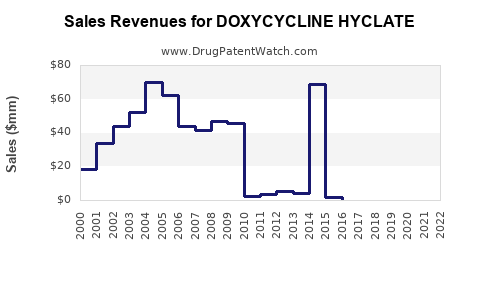
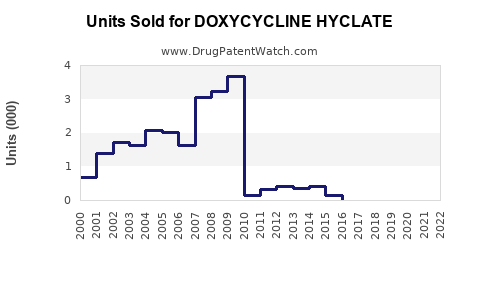
Annual Sales Revenues and Units Sold for DOXYCYCLINE HYCLATE
| Drug Name | Revenues (USD) | Units | Year |
|---|---|---|---|
| DOXYCYCLINE HYCLATE | ⤷ Start Trial | ⤷ Start Trial | 2022 |
| DOXYCYCLINE HYCLATE | ⤷ Start Trial | ⤷ Start Trial | 2021 |
| DOXYCYCLINE HYCLATE | ⤷ Start Trial | ⤷ Start Trial | 2020 |
| DOXYCYCLINE HYCLATE | ⤷ Start Trial | ⤷ Start Trial | 2019 |
| >Drug Name | >Revenues (USD) | >Units | >Year |
Doxycycline Hyclate Market Analysis, Sales Forecast, Patent Risk, and Generic Competition
Doxycycline hyclate is a mature, predominantly generic tetracycline antibiotic with high prescription volume and limited product-level pricing power. The U.S. market is driven by acne, rosacea, respiratory infections, sexually transmitted infections, tick-borne disease, malaria prophylaxis, and selected veterinary uses. Unit demand should remain stable to moderately higher through 2029, while dollar growth will depend on supply continuity, shortages, branded specialty formulations, and channel mix.
A reasonable U.S. human-use market estimate is approximately $350 million to $650 million in 2025 manufacturer-equivalent sales, excluding most veterinary revenue. Under a base-case model, the market reaches roughly $400 million to $750 million by 2029, representing annual dollar growth of about 2% to 4%. Volume growth is likely to be stronger than revenue growth because generic pricing remains highly competitive.
The primary commercial risks are generic price erosion, pharmacy substitution, limited differentiation among immediate-release products, and regulatory scrutiny of antimicrobial use. The principal growth opportunities are delayed-release formulations, dermatology-focused products, specialty pharmacy distribution, and supply contracts that reduce shortage exposure.
What is doxycycline hyclate and how is it used?
Doxycycline hyclate is a salt form of doxycycline, a broad-spectrum tetracycline antibiotic. It is available in oral tablets, capsules, delayed-release tablets and capsules, and injectable formulations. FDA-approved uses include bacterial infections, acne, rosacea, malaria prophylaxis, anthrax exposure, chlamydia-related infections, rickettsial disease, cholera, and other susceptible infections.[1]
Doxycycline hyclate competes with doxycycline monohydrate, which has similar clinical utility but different physical and formulation characteristics. The two forms are not identical products for regulatory, manufacturing, or intellectual-property purposes.
Main human-use indications
| Indication | Commercial importance | Demand characteristics |
|---|---|---|
| Acne vulgaris | High | Chronic or repeated courses; dermatology-driven |
| Rosacea | High for low-dose products | Supports specialty and branded formulations |
| Respiratory infections | High | Large volume but price-sensitive generic market |
| Chlamydia and other STIs | Moderate to high | Public-health and guideline-driven demand |
| Tick-borne and rickettsial disease | Moderate | Seasonal and geographically concentrated |
| Malaria prophylaxis | Moderate | Travel-related and episodic |
| Anthrax and biodefense | Low routine volume | Government stockpiling and preparedness contracts |
| Veterinary infections | High outside human market | Companion-animal and livestock demand |
The Centers for Disease Control and Prevention continues to identify doxycycline as a preferred or important treatment for multiple tick-borne and sexually transmitted infections.[2] That broad guideline positioning supports durable demand, although stewardship programs limit unnecessary use.
How large is the doxycycline hyclate market?
Public companies generally do not report doxycycline hyclate revenue as a separate product line. Sales are usually included in broad generic-antibiotic, dermatology, or contract-manufacturing categories. The market therefore requires a bottom-up estimate based on prescriptions, dosage-form mix, average net prices, and geographic scope.
Estimated U.S. human-use market
| Metric | 2024 estimate | 2025 estimate | 2029 base case |
|---|---|---|---|
| Prescriptions | 17 million-21 million | 17.5 million-21.5 million | 19 million-23 million |
| Manufacturer-equivalent sales | $325 million-$600 million | $350 million-$650 million | $400 million-$750 million |
| Volume CAGR | -1% to 3% | Base year | 1% to 2% |
| Revenue CAGR | -3% to 3% | Base year | 2% to 4% |
| Branded or differentiated share | 10%-20% | 10%-20% | 8%-18% |
| Generic share by volume | 80%-90% | 80%-90% | 82%-92% |
These figures are analytical estimates rather than a reported market total. The range reflects differences in whether market measurements include wholesaler gross sales, manufacturer net sales, branded dermatology products, hospital purchases, and delayed-release products.
Prescription activity remains substantial because doxycycline is used across primary care, dermatology, infectious disease, emergency medicine, travel medicine, and veterinary practice. IQVIA reported doxycycline among the highest-volume generic medicines in the United States, although public summaries do not consistently separate hyclate from monohydrate or identify the exact formulation mix.[3]
Global market outlook
The global market is larger than the U.S. human-use market but is harder to measure because doxycycline is supplied through government tenders, local manufacturers, hospital channels, retail pharmacies, and veterinary distributors.
| Region | 2025 commercial profile | Outlook through 2029 |
|---|---|---|
| United States | Mature generic market with high prescription volume | Low single-digit revenue growth |
| Europe | Generic and tender-driven; national reimbursement varies | Stable volume, low pricing growth |
| Latin America | Retail and private-market demand | Moderate volume growth |
| Asia-Pacific | Large population base and local manufacturing | Strongest volume expansion |
| Middle East and Africa | Public procurement and infectious-disease demand | Tender-driven, uneven growth |
| Global veterinary | Companion-animal and livestock demand | Faster growth than human generic market in selected countries |
A broad global human-use and veterinary estimate is approximately $1.0 billion to $1.8 billion in 2025, depending on the inclusion of veterinary products, local-market sales, and public procurement. The figure should not be compared directly with U.S. manufacturer net sales.
What are the sales projections for doxycycline hyclate?
The base-case forecast assumes stable prescribing, modest population growth, continued use in dermatology and infectious disease, no major safety-driven withdrawal, and persistent generic price competition.
Base-case sales projection
| Year | U.S. human-use sales | Global human and veterinary sales | Key assumption |
|---|---|---|---|
| 2025 | $350 million-$650 million | $1.0 billion-$1.8 billion | Stable generic demand |
| 2026 | $360 million-$670 million | $1.04 billion-$1.87 billion | 1%-3% volume growth |
| 2027 | $370 million-$690 million | $1.08 billion-$1.94 billion | Continued dermatology use |
| 2028 | $385 million-$720 million | $1.12 billion-$2.02 billion | Moderate international expansion |
| 2029 | $400 million-$750 million | $1.16 billion-$2.10 billion | 2%-4% annual revenue growth |
Scenario analysis
| Scenario | 2029 U.S. sales | Main drivers |
|---|---|---|
| Downside | $275 million-$450 million | Aggressive generic price cuts, lower prescription volume, fewer branded products |
| Base case | $400 million-$750 million | Stable volume and modest formulation growth |
| Upside | $750 million-$1.0 billion | Recurrent shortages, increased branded dermatology use, stronger veterinary demand |
The upside case is less likely to come from higher prices for standard immediate-release capsules. It would depend on supply disruptions, differentiated delivery systems, government procurement, or increased use of higher-priced dermatology products.
Which companies sell doxycycline hyclate?
The market is fragmented. FDA-approved products have historically been supplied by generic manufacturers, specialty pharmaceutical companies, contract manufacturers, and branded dermatology companies. Supplier participation changes frequently because approvals, discontinued products, acquisitions, and manufacturing transfers alter the competitive set.
Major competitive categories
| Category | Product examples | Competitive position |
|---|---|---|
| Immediate-release generic capsules and tablets | Doxycycline hyclate capsules and tablets | Largest volume; lowest price |
| Delayed-release products | Doryx and authorized or generic equivalents | Higher price; formulation differentiation |
| Dermatology products | Acticlate, Oracea-class products, generic equivalents | Brand recognition and specialty prescribing |
| Injectable products | Generic doxycycline hyclate injection | Hospital and institutional demand |
| Veterinary products | Multiple animal-health products | Separate distribution and regulatory channels |
Doryx has been associated with delayed-release doxycycline hyclate products and has competed on tolerability, dosing convenience, and reduced gastrointestinal irritation. Acticlate has been positioned as a branded doxycycline hyclate product for acne. Oracea is a low-dose doxycycline product based on doxycycline monohydrate rather than doxycycline hyclate and should not be counted as a direct hyclate product, although it competes for dermatology demand.
The market has no single dominant manufacturer across all dosage forms. Standard oral products are vulnerable to rapid substitution once multiple abbreviated new drug applications are approved.
What is the FDA regulatory status of doxycycline hyclate?
Doxycycline hyclate is an FDA-approved prescription drug sold through multiple new drug applications and abbreviated new drug applications. The FDA Orange Book lists approved doxycycline products by strength, dosage form, applicant, therapeutic-equivalence code, and patent or exclusivity information where applicable.[4]
Immediate-release generic doxycycline hyclate products are generally the most exposed to ANDA competition. Delayed-release products have more complex development requirements because approval may depend on formulation performance, dissolution, bioequivalence, and manufacturing controls.
Regulatory factors affecting market value
- FDA therapeutic-equivalence ratings determine whether pharmacists can substitute generic products.
- Drug shortages can temporarily improve manufacturer pricing and contract leverage.
- Manufacturing-site compliance issues can remove capacity from an already concentrated supply base.
- Formulation changes may require new bioequivalence studies and regulatory filings.
- Pediatric labeling, pregnancy warnings, and antimicrobial stewardship affect prescribing but do not eliminate broad clinical demand.
The FDA has identified doxycycline products in shortage and supply-monitoring contexts at different times, particularly when manufacturing disruptions or demand spikes affected specific strengths or dosage forms.[5] Shortage exposure is a material commercial variable because a generic manufacturer with available inventory can gain share without owning strong patent protection.
What patents protect doxycycline hyclate?
The original composition-of-matter and basic therapeutic patents for doxycycline are expired. Standard immediate-release doxycycline hyclate is therefore a mature generic product with no meaningful remaining basic patent barrier in the United States.
The relevant intellectual-property risks are narrower:
- Delayed-release or modified-release formulations.
- Particle-size, crystal-form, salt, or stabilization claims.
- Specific dosing regimens.
- Combination products.
- Manufacturing processes.
- Device or packaging claims.
- Method-of-use claims for dermatology or other narrowly defined indications.
Patent protection should be reviewed at the product level rather than at the active-ingredient level. A patent covering doxycycline hyclate generally does not prevent all doxycycline products from entering the market, and a method-of-use patent may not block an ANDA applicant that makes a valid section viii labeling carve-out.
Orange Book and patent status
The Orange Book is the primary source for FDA-listed patents and regulatory exclusivities associated with approved products.[4] For a mature molecule such as doxycycline hyclate, the commercial question is usually whether a specific delayed-release or branded product has unexpired formulation or method-of-use patents, not whether doxycycline itself remains patented.
Patent listings can change through expiration, delisting, litigation, court orders, and FDA administrative action. A current product-by-product Orange Book review is required before relying on a specific patent number or expiration date in a launch decision.
When does doxycycline hyclate lose exclusivity?
Doxycycline hyclate lost core exclusivity decades ago. Generic entry is already established for immediate-release capsules, tablets, and injectable products.
Exclusivity analysis now has three levels:
| Exclusivity layer | Current commercial status |
|---|---|
| Active ingredient | Expired |
| Immediate-release oral products | Generic competition established |
| Delayed-release or specialty products | Product-specific formulation and use patents may remain relevant |
| New indications | Possible three-year clinical-investigation exclusivity if statutory requirements are met |
| Pediatric exclusivity | Temporary and product-specific; does not create a durable market barrier |
A Paragraph IV challenge is most relevant to an ANDA applicant seeking approval before expiration of an unexpired patent listed for a delayed-release or specialty product. For standard doxycycline hyclate products, the main route to market is ordinary ANDA competition rather than a high-value patent challenge.
Which companies are challenging doxycycline hyclate patents?
There is no single active, molecule-wide Paragraph IV campaign comparable to litigation involving a recently launched branded medicine. Any relevant challenge is likely to involve a specific product, such as a delayed-release formulation, a branded dermatology product, or a narrowly defined method of use.
Potential challengers are typically large generic companies, specialty generics manufacturers, or contract-development organizations with ANDA capabilities. The commercial significance of a Paragraph IV filing depends on:
- Whether the patent is listed for the exact reference product.
- Whether the applicant seeks 180-day first-filer status.
- Whether the patent covers the product, formulation, or only a method of use.
- Whether the reference sponsor sues within 45 days.
- Whether a settlement delays launch.
- Whether the applicant can launch with a label carve-out.
A generic applicant may also wait for patent expiration rather than incur litigation expense when the expected market price is low.
What patent litigation and settlements affect the market?
The most relevant litigation risks concern branded delayed-release and specialty dermatology products rather than the doxycycline molecule itself. Litigation may involve infringement, patent validity, Orange Book listing disputes, regulatory stays, or settlement agreements.
A conventional Hatch-Waxman sequence can produce:
- ANDA filing with a Paragraph IV certification.
- Notice to the branded sponsor.
- Lawsuit within 45 days.
- Potential 30-month FDA approval stay.
- Discovery and claim-construction proceedings.
- Trial, settlement, or license.
- Launch upon patent expiration, court judgment, or settlement-defined date.
Settlement agreements can preserve commercial value for the incumbent if they provide a later generic entry date, authorized generic terms, or supply arrangements. They can also accelerate entry if the settlement permits launch before the asserted patent expires.
No broad patent settlement determines the entire doxycycline hyclate market. Each agreement should be analyzed against the affected reference product, strength, dosage form, and indication.
How strong is the doxycycline hyclate patent estate?
The patent estate is weak for immediate-release doxycycline hyclate and stronger, but still product-specific, for differentiated formulations.
| Patent category | Strength | Commercial effect |
|---|---|---|
| Core molecule | Very weak or expired | Does not restrict generic entry |
| Immediate-release formulation | Weak | Multiple suppliers and rapid price erosion |
| Delayed-release formulation | Moderate | May delay or complicate generic entry |
| Method of use | Weak to moderate | Often avoidable through label carve-outs |
| Manufacturing process | Moderate if difficult to design around | Can increase development cost |
| Packaging or device | Low to moderate | Usually limited to specific presentation |
Manufacturing capability can matter more than patent rights. Doxycycline production requires reliable API sourcing, impurity control, stability testing, dissolution performance, and validated facilities. For delayed-release products, coating technology and release-profile consistency create greater barriers than ordinary capsule filling.
What generic launch risks exist for doxycycline hyclate?
Generic launches are commercially attractive only when the addressable market supports adequate pricing after wholesaler discounts, rebates, litigation costs, regulatory fees, and manufacturing expenses.
Immediate-release launch
An immediate-release launch can occur in a crowded market with low technical risk but significant price pressure. The likely outcome is rapid share fragmentation and declining average selling prices.
Delayed-release launch
A delayed-release launch has greater value potential but requires:
- More complex formulation development.
- Product-specific bioequivalence work.
- Greater manufacturing validation.
- Patent and labeling analysis.
- More complex physician and payer positioning.
Shortage-driven launch
A supplier entering during a shortage may obtain temporary pricing leverage and contract wins. That advantage can disappear once incumbent manufacturers restore supply.
How does doxycycline hyclate compare with doxycycline monohydrate?
| Attribute | Doxycycline hyclate | Doxycycline monohydrate |
|---|---|---|
| Market status | Mature generic | Mature generic |
| Common use | Broad anti-infective and dermatology use | Broad anti-infective and dermatology use |
| Formulation profile | Common in capsules, tablets, delayed-release products | Common in tablets and specialty dermatology products |
| Commercial differentiation | More dependent on release technology | More associated with selected tolerability and low-dose products |
| Patent risk | Product-specific formulation patents | Product-specific formulation patents |
| Pricing | Low for standard generic products | Low to moderate for specialty products |
Substitution is not determined solely by the active moiety. Dosage form, release profile, strength, labeling, therapeutic-equivalence rating, and payer coverage determine the practical competitive relationship.
What is the revenue exposure for manufacturers and investors?
Doxycycline hyclate is unlikely to create large, durable revenue growth for a manufacturer through a standard generic launch. It can support a broader portfolio strategy when combined with dermatology products, hospital antibiotics, veterinary products, or differentiated oral delivery systems.
Revenue exposure by business model
| Business model | Revenue potential | Risk profile |
|---|---|---|
| Commodity immediate-release generic | Low to moderate | High price erosion |
| Delayed-release branded product | Moderate to high | Patent and clinical competition |
| Authorized generic | Moderate | Depends on reference-product economics |
| Hospital injectable supply | Moderate | Contract and shortage exposure |
| Veterinary portfolio | Moderate to high | Channel and species-specific demand |
| API manufacturing | Moderate | Quality, supply, and price risks |
For investors, doxycycline hyclate is primarily a volume and supply-chain asset rather than a patent-duration asset. Valuation should emphasize manufacturing reliability, customer concentration, shortage history, dosage-form mix, and net pricing.
Key Takeaways
- Doxycycline hyclate is a mature generic antibiotic with durable clinical demand.
- Estimated 2025 U.S. human-use sales are approximately $350 million to $650 million.
- Estimated global human and veterinary sales are approximately $1.0 billion to $1.8 billion in 2025.
- Base-case U.S. sales could reach $400 million to $750 million by 2029.
- Immediate-release products face intense generic competition and low pricing power.
- Delayed-release and dermatology products offer the strongest potential for differentiated revenue.
- Core doxycycline composition patents are expired.
- Current patent risks are concentrated in formulation, method-of-use, manufacturing, and product-specific claims.
- Generic entry is already established for standard doxycycline hyclate products.
- Supply continuity and FDA shortage conditions may have greater near-term commercial impact than patent litigation.
- Doxycycline monohydrate, including low-dose dermatology products, is a competitor but is not the same active-ingredient salt.
Frequently Asked Questions
Is doxycycline hyclate still under patent?
The original doxycycline molecule and basic doxycycline hyclate rights are no longer protected by an active core patent. Some branded or delayed-release products may have product-specific formulation or method-of-use patents.
Is doxycycline hyclate a profitable generic drug?
It can be profitable at scale, but standard immediate-release products usually have limited margins because multiple manufacturers compete on price. Profitability is stronger for differentiated formulations, hospital contracts, shortage supply, and veterinary distribution.
Does doxycycline hyclate have biosimilar competition?
No. Doxycycline hyclate is a small-molecule drug, so the relevant competitors are generic products approved through the ANDA pathway, not biosimilars approved under the biologics framework.
What is the main commercial difference between doxycycline hyclate and doxycycline monohydrate?
The salts have different formulation and physical properties. Commercial differences arise from dosage form, release profile, labeling, tolerability positioning, therapeutic equivalence, and patent coverage rather than from antibacterial activity alone.
Can a generic company launch doxycycline hyclate before all patents expire?
A launch may be possible through a Paragraph IV challenge, a section viii labeling carve-out, a court ruling, a settlement agreement, or expiration of the relevant patents. The answer depends on the specific reference product and listed patents.
References
-
U.S. Food and Drug Administration. (2024). Drugs@FDA: FDA-approved drug products and prescribing information for doxycycline products. https://www.accessdata.fda.gov/scripts/cder/daf/
-
Centers for Disease Control and Prevention. (2024). Sexually transmitted infections treatment guidelines, 2021: Doxycycline recommendations and updates. https://www.cdc.gov/std/treatment-guidelines/
-
IQVIA Institute for Human Data Science. (2024). The use of medicines in the U.S. 2024: Usage and spending trends and outlook to 2028. IQVIA.
-
U.S. Food and Drug Administration. (2024). Approved drug products with therapeutic equivalence evaluations: Orange Book. https://www.fda.gov/drugs/drug-approvals-and-databases/approved-drug-products-therapeutic-equivalence-evaluations-orange-book
-
U.S. Food and Drug Administration. (2024). Drug shortages database. https://www.accessdata.fda.gov/scripts/drugshortages/
More… ↓
