Last updated: October 24, 2026
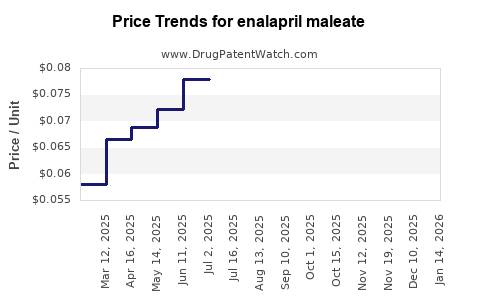
Enalapril maleate is a mature, low-cost ACE inhibitor with no meaningful U.S. composition-of-matter exclusivity remaining. The product has transitioned from an originator-led market around Merck’s Vasotec to a multi-supplier generic market. Demand remains durable because enalapril is an established treatment for hypertension and heart failure, but revenue growth is limited by low prices, therapeutic substitution toward ARBs and newer heart-failure therapies, and intense generic competition.
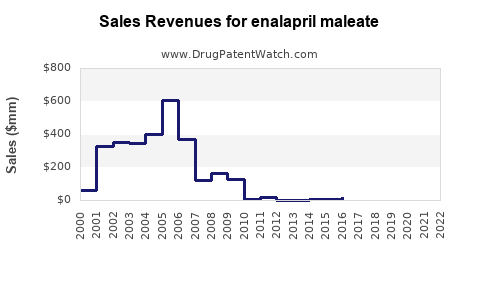
Standalone global revenue figures for enalapril maleate are not consistently disclosed because manufacturers report the product within broader generic cardiovascular portfolios. The commercial opportunity is therefore volume-driven rather than innovation-driven.
What is enalapril maleate and how is it used?
Enalapril maleate is the maleate salt of enalapril, an orally administered prodrug converted in vivo to enalaprilat, an angiotensin-converting enzyme inhibitor. It reduces angiotensin II formation and is used in cardiovascular disease management.
The principal approved and established uses include:
- Hypertension
- Symptomatic heart failure
- Reduction of mortality and hospitalization risk in selected patients with heart failure or left ventricular dysfunction
U.S. tablet strengths generally include 2.5 mg, 5 mg, 10 mg, and 20 mg. Enalapril maleate is also available in oral-solution products designed for pediatric and adult patients who cannot use tablets. FDA labeling identifies risks including hypotension, renal impairment, hyperkalemia, angioedema, and fetal toxicity during pregnancy. [1,2]
Enalapril maleate is a small-molecule product. Biosimilar regulation does not apply. Competitive entry occurs through abbreviated new drug applications, branded-generic launches, authorized generics, and, for liquid products, potentially differentiated formulation approvals.
When did enalapril maleate lose exclusivity?
Enalapril maleate lost meaningful U.S. market exclusivity decades ago. Merck’s Vasotec was approved by the FDA in 1985, and the underlying enalapril patent estate expired before the modern generic market became established. [3,4]
| Milestone |
Approximate date |
Commercial effect |
| Enalapril compound development and patenting |
Late 1970s to early 1980s |
Created the original Merck exclusivity position |
| U.S. patent issuance for enalapril-related compounds |
1983 |
Supported originator protection |
| Vasotec FDA approval |
1985 |
Established the branded U.S. market |
| Core U.S. patent expiry |
Late 1990s to around 2000 |
Opened broad generic competition |
| Generic enalapril tablets |
Early 2000s onward |
Shifted market economics to volume and procurement |
| Pediatric/liquid formulations |
Later product-specific approvals |
Created limited formulation differentiation |
The exact loss-of-exclusivity date depends on the patent, jurisdiction, pediatric extensions, and product presentation. No active U.S. composition-of-matter exclusivity protects standard enalapril maleate tablets.
What patents protect enalapril maleate?
The original patent estate covered enalapril-related compounds and pharmaceutical compositions. U.S. Patent No. 4,374,829 is commonly associated with Merck’s enalapril compound technology. Its term has expired. [4]
Current patent risk is concentrated in narrow areas rather than the active ingredient itself:
| Patent category |
Current relevance |
| Enalapril compound patents |
Expired |
| Standard tablet composition patents |
Generally expired or commercially non-blocking |
| Method-of-use patents for hypertension or heart failure |
Largely expired and difficult to enforce against label-compliant generic sales |
| Oral-solution formulation patents |
Potentially relevant for specific branded liquid products |
| Manufacturing-process patents |
May protect a particular route or impurity-control process but generally do not block ordinary generic supply |
| Device or packaging patents |
Relevant only to specific presentations |
The existence of a formulation or process patent does not necessarily prevent generic tablet entry. Generic applicants can design around a nonessential formulation claim, use an alternative manufacturing process, or submit a certification addressing the listed patent.
What is the Orange Book status of enalapril maleate?
Standard enalapril maleate tablets are established generic products with multiple FDA-approved abbreviated new drug applications. The original Vasotec product is no longer the principal commercial source of U.S. supply. FDA’s Orange Book identifies approved prescription drug products and, where applicable, patent and exclusivity information. [5]
The regulatory structure is commercially favorable to generic buyers:
- No remaining new-drug exclusivity for the core tablet product
- Multiple approved suppliers
- ANDA-based substitution at the pharmacy level, subject to state law
- Limited opportunity for premium pricing
- Product-specific supply risk if manufacturers exit or experience shortages
A liquid product has a different regulatory profile. Epaned, an enalapril maleate oral solution, was approved as a prescription product for patients who require liquid administration. [6] Liquid products can retain commercial differentiation through taste masking, concentration, excipients, dosing devices, stability, and pediatric-use positioning even when the active ingredient is fully genericized.
How many patents cover enalapril maleate?
No economically meaningful count of active U.S. patents covers the basic enalapril maleate tablet market. The relevant distinction is between expired foundational patents and narrow patents that may apply to a particular product.
For commercial diligence, the patent estate should be separated into four groups:
- Expired compound and use patents.
- Expired or nonblocking tablet formulation patents.
- Potentially active oral-solution or excipient patents.
- Manufacturing and process patents that may affect cost or supply but usually do not create broad market exclusivity.
A simple patent count would overstate protection. The standard tablet market has low patent barriers. The more important barriers are FDA approval, manufacturing economics, procurement qualification, quality compliance, and supply reliability.
Are there Paragraph IV challenges for enalapril maleate?
Paragraph IV litigation was most relevant when generic manufacturers first challenged the originator’s patents. Because the core enalapril patent estate expired long ago, new Paragraph IV activity is unlikely to materially affect standard tablet competition.
For a new oral solution, combination product, or reformulated presentation, a Paragraph IV certification could still arise if the reference product has an unexpired listed patent. The commercial significance would depend on:
- Whether the patent claims the active ingredient or only a formulation
- Whether the generic product uses the same excipients
- Whether the patent is listed in the Orange Book
- Whether the applicant launches “at risk”
- Whether a 30-month stay applies under the Hatch-Waxman framework
There is no equivalent biosimilar challenge pathway because enalapril maleate is not a biologic.
What is the competitive landscape for enalapril maleate?
The U.S. tablet market is fragmented among generic manufacturers and is typically supplied through wholesalers, retail pharmacies, hospitals, group purchasing organizations, and government procurement channels.
Competition includes:
- Generic enalapril maleate tablets
- Branded or authorized-generic products
- Enalapril maleate oral solution
- Other ACE inhibitors, including lisinopril, ramipril, captopril, and benazepril
- ARBs, including losartan, valsartan, and candesartan
- Angiotensin receptor-neprilysin inhibitors for selected heart-failure patients
- Mineralocorticoid receptor antagonists and other guideline-directed therapies
Lisinopril is usually the closest high-volume comparator in the ACE-inhibitor class because it has broad generic availability, once-daily dosing, and no prodrug conversion requirement. Losartan and other ARBs compete for patients who develop cough or intolerance with ACE inhibitors.
| Product |
Market position |
Main advantage |
Main constraint |
| Enalapril maleate |
Mature generic ACE inhibitor |
Long clinical history and low cost |
Generic price erosion and cough risk |
| Lisinopril |
High-volume generic ACE inhibitor |
Simple dosing and broad availability |
Similar ACE-inhibitor class limitations |
| Losartan |
Major generic ARB |
Lower cough incidence than ACE inhibitors |
Competitive pressure and class substitution |
| Ramipril |
Mature generic ACE inhibitor |
Strong cardiovascular evidence |
Lower volume than leading generic ACE inhibitors |
| Sacubitril/valsartan |
Branded and genericizing heart-failure therapy |
Disease-modifying heart-failure positioning |
Higher cost and narrower indicated population |
How does enalapril maleate compare with lisinopril and losartan?
Enalapril’s clinical value is stable, but its commercial position is weaker than the strongest generic competitors.
Lisinopril has a simpler manufacturing and prescribing profile and is often selected as a first-line ACE inhibitor. Losartan benefits from lower rates of ACE-inhibitor-associated cough and has strong substitution potential when patients discontinue enalapril or lisinopril.
Enalapril retains demand in:
- Patients stabilized on long-term therapy
- Heart-failure treatment protocols
- Pediatric patients requiring a liquid formulation
- Health systems prioritizing low acquisition cost
- Markets where local treatment guidelines continue to recommend ACE inhibitors
The product’s volume resilience is stronger than its pricing power. Physicians can continue prescribing enalapril, but manufacturers have limited ability to raise prices without risking substitution.
What FDA regulatory factors affect enalapril maleate revenue?
FDA approval for standard tablets is no longer a significant competitive barrier. Revenue is more sensitive to manufacturing quality and supply performance.
The main regulatory factors are:
- ANDA approval and therapeutic equivalence
- Current Good Manufacturing Practice compliance
- Stability and impurity control
- Nitrosamine and other contaminant controls where applicable
- Labeling requirements for pregnancy, renal impairment, and angioedema
- Drug-shortage reporting and manufacturing continuity
- Product-specific approval requirements for oral solutions
For generic suppliers, a manufacturing warning letter, import alert, recall, or shortage can eliminate revenue quickly. Conversely, a reliable supplier may win contracts even without patent differentiation.
What manufacturing and intellectual-property barriers exist?
Manufacturing barriers are modest for standard tablets but higher for liquid products.
Tablet economics depend on:
- Active pharmaceutical ingredient sourcing
- Scale of production
- Compression and coating efficiency
- Quality-control costs
- Packaging and serialization
- Procurement contracts
- Inventory and shortage management
Liquid formulations require tighter control of taste, microbial quality, preservative systems, dosing accuracy, container compatibility, and shelf life. Those requirements can reduce the number of credible suppliers and support a higher net price than standard tablets.
Process patents may protect an efficient synthesis, impurity profile, polymorph, or salt-handling method. Such patents generally create a cost or manufacturing advantage rather than broad market exclusivity. A competitor can often use a different route if it meets FDA quality requirements.
What is the financial trajectory for enalapril maleate?
Enalapril maleate’s financial trajectory is mature, stable, and low growth.
| Period |
Financial profile |
| Originator period |
High-margin branded sales supported by patent exclusivity |
| Initial generic entry |
Rapid price erosion and share loss for the originator |
| Mature generic period |
Low unit prices, fragmented suppliers, stable prescription demand |
| Current market |
Volume-led revenue with limited pricing power |
| Forward outlook |
Flat to modest decline for tablets; better niche prospects for liquid products and supply-constrained channels |
The principal revenue drivers are:
- Prescription volume
- Number of approved suppliers
- Contract wins with hospitals and government buyers
- API and manufacturing costs
- Product availability
- Patient persistence
- Use of liquid formulations
- Generic substitution rates
The main negative drivers are:
- Continued migration to lisinopril or ARBs
- Broader use of newer heart-failure therapies
- Pharmacy and payer purchasing pressure
- Supplier consolidation
- Price competition among generic manufacturers
- Clinical discontinuation caused by cough, hyperkalemia, renal effects, or hypotension
An originator-style valuation framework is inappropriate. Enalapril maleate is better assessed as a cash-flow product with limited differentiation. The strongest assets are usually manufacturing scale, low-cost API access, reliable FDA compliance, and contracted distribution.
Which companies are challenging enalapril maleate commercially?
Competition is primarily from generic manufacturers rather than patent challengers. FDA approval data identify multiple enalapril maleate ANDA holders, while commercial supply may come from a smaller set of active manufacturers, contract manufacturers, and distributors. The relevant competitive question is not simply how many approvals exist, but how many suppliers are currently shipping product at sustainable margins.
For investors and licensing teams, supplier diligence should examine:
- Active FDA approval status
- Recent manufacturing inspections
- Product listing and marketing status
- API source concentration
- Recall history
- Hospital and retail channel access
- Liquid-product capabilities
- Capacity for rapid volume replacement
What generic launch scenarios exist?
Three launch scenarios are commercially relevant.
Standard tablet launch
A new entrant would face low patent risk but severe price competition. Success would require a cost advantage, a supply contract, or a shortage-driven opportunity.
Oral-solution launch
A liquid entrant could obtain better pricing and face fewer direct competitors. The main risks would be formulation development, stability, taste, dosing-device performance, and any listed formulation patents.
Supply-disruption launch
A manufacturer may gain share when a competitor has a recall, shortage, plant shutdown, or API problem. Such gains can be temporary unless the entrant offers durable reliability and secures formulary or wholesaler contracts.
What patent litigation and settlement agreements affect enalapril maleate?
Historical disputes centered on the validity and scope of Merck’s enalapril patents during the transition to generic competition. Those disputes no longer create a meaningful barrier to standard tablet entry because the relevant core patent terms have expired.
No current settlement agreement is likely to provide broad commercial protection for ordinary enalapril maleate tablets. Any present settlement would be more likely to concern a specific oral solution, combination product, formulation patent, or manufacturing patent.
What is the geographic coverage of enalapril maleate protection?
Core patent protection has expired in major markets, but regulatory and commercial conditions differ by country.
| Region |
Current commercial position |
| United States |
Mature generic market with tablet competition and limited formulation differentiation |
| European Union |
Mature generic market; national reimbursement and substitution rules influence pricing |
| Japan |
Generic and branded-generic competition with local regulatory requirements |
| Emerging markets |
Continued demand, but pricing and procurement pressure are high |
| Low- and middle-income markets |
Essential-medicine value is stronger than margin potential |
International opportunity depends more on registration, local manufacturing, tender access, and pharmacovigilance obligations than on patent exclusivity.
Key Takeaways
- Enalapril maleate is a mature generic ACE inhibitor with no meaningful remaining U.S. core patent exclusivity.
- Standard tablets have low patent barriers and limited pricing power.
- The market is volume-driven and commercially fragmented.
- Lisinopril and losartan are the most important therapeutic competitors.
- Oral-solution products offer more differentiation than conventional tablets.
- Biosimilar risk does not apply because enalapril maleate is a small molecule.
- Current value is linked to manufacturing cost, FDA compliance, supply reliability, and distribution access.
- Tablet revenue is likely to remain stable to declining, while liquid formulations and shortage-driven supply can support higher margins.
- A patent count alone overstates the strength of the enalapril estate. The core commercial barrier is operational execution, not intellectual property.
FAQs
Is enalapril maleate still under patent?
No. The core U.S. patents covering enalapril-related compounds expired years ago. Narrow formulation or process patents may apply to specific products, but they do not broadly protect standard tablets.
Is enalapril maleate interchangeable with lisinopril?
No. Both are ACE inhibitors, but they are different active ingredients. FDA therapeutic-equivalence determinations apply to products containing the same active ingredient, not automatically across different ACE inhibitors.
Does enalapril maleate have biosimilar competition?
No. Biosimilars apply to biologic products. Enalapril maleate is a chemically synthesized small molecule and competes through generic-drug regulation.
Can a generic manufacturer still earn attractive margins on enalapril maleate?
Potentially, but usually only through low-cost production, supply contracts, shortage replacement, or differentiated liquid products. Conventional tablet sales are exposed to intense price competition.
What is the highest-value commercial opportunity in enalapril maleate?
The strongest opportunities are generally oral-solution supply, reliable hospital and government procurement, and manufacturing platforms that can replace disrupted suppliers. Standard tablet entry without a cost or distribution advantage has limited upside.
References
- U.S. Food and Drug Administration. (2024). Enalapril maleate prescribing information.
- DailyMed. (2024). Enalapril maleate tablet labeling. National Library of Medicine.
- U.S. Food and Drug Administration. (1985). Vasotec (enalapril maleate) approval information. Drugs@FDA.
- United States Patent and Trademark Office. (1983). U.S. Patent No. 4,374,829, enalapril-related compounds.
- U.S. Food and Drug Administration. (2024). Approved drug products with therapeutic equivalence evaluations: Orange Book.
- U.S. Food and Drug Administration. (2016). Epaned (enalapril maleate) oral solution approval information. Drugs@FDA.