Last updated: October 24, 2026
Vasotec, Merck's brand for enalapril maleate, is a mature ACE inhibitor with no meaningful current brand franchise in the United States. FDA approval began in 1985, while generic enalapril entered the market in the early 1990s. The principal compound patent expired around 2000, eliminating the product's U.S. exclusivity. Current commercial value resides in low-cost generic enalapril tablets and injection, not in Vasotec-branded sales. Merck does not report Vasotec as a separately material revenue line in recent filings. [1]-[4]
What is Vasotec and how large was its original market?
Vasotec contains enalapril maleate, a prodrug converted in vivo to enalaprilat, an angiotensin-converting enzyme inhibitor. FDA-approved indications have included hypertension, symptomatic heart failure, and reduction of mortality in patients with left ventricular dysfunction. Dosage forms historically included oral tablets and intravenous injection. [1]
Merck launched Vasotec in the mid-1980s after FDA approval of NDA 018998. The product entered a large cardiovascular market that included captopril, lisinopril, ramipril, quinapril, and other ACE inhibitors. Enalapril gained broad use because of its efficacy, once- or twice-daily dosing, low manufacturing complexity, and clinical familiarity.
Vasotec became one of Merck's major products during the late 1980s and 1990s. Public Merck annual reports from that period identified Vasotec among the company's leading products, although reported sales were not consistently presented in a manner that permits a clean, year-by-year standalone series. [3]
Vasotec commercial profile
| Metric |
Assessment |
| Active ingredient |
Enalapril maleate |
| Original sponsor |
Merck & Co. |
| U.S. FDA approval |
1985 |
| Primary therapeutic class |
ACE inhibitor |
| Main indications |
Hypertension and heart failure |
| Original protected market |
U.S. and international branded prescription market |
| Current U.S. market |
Predominantly generic |
| Current brand position |
Limited or discontinued commercial relevance |
| Revenue disclosure |
No separate material Vasotec line in recent Merck reporting |
When did Vasotec lose exclusivity?
Vasotec lost practical U.S. exclusivity in stages. The original enalapril compound patent was granted to Merck in the early 1980s, with commercial patent protection extending into approximately 2000. Generic enalapril approvals appeared before the compound patent's final expiration under the Hatch-Waxman framework, subject to patent certifications and litigation outcomes. [2], [4]
Vasotec exclusivity timeline
| Event |
Approximate date |
Commercial effect |
| Enalapril patent issued |
1983 |
Established core compound protection |
| FDA approval of Vasotec |
1985 |
Began branded U.S. commercialization |
| Generic enalapril approvals |
Early 1990s |
Initiated price and share pressure |
| Core patent expiry |
Around 2000 |
Removed principal compound barrier |
| Post-expiry period |
2000s onward |
Rapid generic substitution |
| Current status |
2020s |
Mature, multisource generic market |
The key commercial point is that Vasotec did not retain an effective patent moat after the late 1990s. Any residual protection associated with formulation, labeling, or specific use claims was not sufficient to preserve a meaningful branded market position.
What patents protect Vasotec and enalapril?
The principal historical patent was Merck's U.S. patent covering enalapril and related compounds, commonly identified as U.S. Patent No. 4,374,829. The patent issued in 1983 and formed the core of Vasotec's early U.S. exclusivity. [4]
The patent estate's value came from the active pharmaceutical ingredient rather than from a technically difficult delivery system. Enalapril maleate is a conventional small-molecule tablet product. Its formulation does not require an implant, complex device, controlled-release platform, biologic manufacturing process, or specialized administration technology.
Patent-estate assessment
| Patent category |
Historical importance |
Current barrier |
| Enalapril compound patent |
Very high |
Expired |
| Enalapril maleate salt protection |
Commercially relevant |
Expired or no longer exclusionary |
| Oral tablet formulation |
Limited incremental value |
No material current barrier |
| Intravenous formulation |
Narrow product protection |
No material current barrier |
| Method-of-use claims |
Potentially relevant for labeled indications |
Weak after broad generic labeling |
| Manufacturing process claims |
Possible process differentiation |
Does not block ordinary generic entry |
| Device or delivery-system patents |
Not central to Vasotec |
Not a meaningful barrier |
The current U.S. Orange Book does not provide a live patent barrier comparable to the estates surrounding newer branded drugs. FDA's Orange Book framework links listed patents to approved products, but an old product with expired core patents and no commercially meaningful active listings cannot support a modern branded-exclusivity strategy. [2]
What is the Orange Book status of Vasotec?
Vasotec's Orange Book significance is historical rather than strategic. The product's active ingredient, dosage forms, and approved indications are now represented by generic enalapril products. Orange Book listings for discontinued brand products must be distinguished from active commercial marketing.
The brand's regulatory status should not be confused with a safety withdrawal. A product may be listed as discontinued because the sponsor stopped marketing it, while generic versions remain approved. The FDA's Drugs@FDA database and Orange Book provide the relevant distinction between approval history, marketing status, and patent listings. [1], [2]
FDA regulatory position
- Vasotec was approved through an NDA held by Merck.
- Enalapril maleate remains an approved active ingredient in generic products.
- Generic tablets are approved through abbreviated new drug applications.
- Generic products rely on pharmaceutical equivalence and bioequivalence rather than new clinical-efficacy trials.
- The brand's reduced commercial presence does not remove the active ingredient from FDA-approved use.
- No current regulatory exclusivity is expected to protect Vasotec from generic substitution.
How many patents cover Vasotec today?
No active U.S. patent estate appears to create a material barrier to ordinary generic enalapril entry. The original compound protection has expired, and the product is not dependent on a current device, complex formulation, or manufacturing platform.
The practical answer is that Vasotec has no commercially important active U.S. patent position. Patent counting alone can overstate risk because expired patents, narrow process claims, and nonblocking claims do not prevent generic substitution.
Patent strength scorecard
| Factor |
Assessment |
| Core molecule |
Weak, expired |
| Formulation differentiation |
Weak |
| Method-of-use protection |
Weak after broad standard-of-care use |
| Manufacturing complexity |
Low |
| Freedom to operate for generic tablets |
Favorable |
| Freedom to operate for generic injection |
Generally favorable, subject to product-specific review |
| Litigation leverage |
Low |
| Licensing value |
Low |
Which companies challenge Vasotec's market position?
The principal challengers are generic manufacturers rather than branded competitors. Historical enalapril suppliers have included large generic companies and smaller contract manufacturers. FDA approval records should be used to identify the current approved ANDA sponsors because ownership and marketing status can change through acquisition, licensing, or supply agreements. [1]
The competitive structure is typical of an off-patent cardiovascular product:
- Multiple approved manufacturers compete for pharmacy and wholesaler contracts.
- Retail substitution shifts demand from Vasotec to generic enalapril.
- Prices decline as additional suppliers enter.
- Supply interruptions can temporarily increase pricing without restoring branded power.
- Hospitals and health plans generally favor the lowest-cost therapeutically equivalent product.
The market is therefore procurement-driven rather than innovation-driven. Manufacturer scale, reliable active pharmaceutical ingredient supply, manufacturing compliance, and contract access matter more than brand promotion.
What generic entry risks exist for Vasotec?
Generic entry risk is effectively realized rather than prospective. The key launch event occurred decades ago. A new entrant today would not be challenging a protected Vasotec franchise; it would be entering a mature generic market.
Generic launch scenarios
| Scenario |
Likely effect |
| New tablet supplier enters |
Incremental price pressure and share fragmentation |
| Existing supplier exits |
Temporary supply tightness and possible price recovery |
| Brand relaunch |
Low probability of durable reimbursement advantage |
| New combination product |
May capture a niche but would not restore Vasotec exclusivity |
| Authorized generic strategy |
Limited value unless tied to a distribution agreement |
| Injection shortage |
Potential short-term pricing volatility |
Paragraph IV litigation is no longer a central Vasotec risk issue because the core patent has expired. A Paragraph IV certification is commercially relevant when a generic applicant challenges a listed patent before expiry. For Vasotec, that phase has passed. Any current dispute would more likely involve manufacturing, supply, trademark, labeling, or a separate combination product than the original enalapril patent.
What patent litigation and settlements affected Vasotec?
Historical generic challenges to enalapril formed part of the broader first-wave ACE inhibitor patent environment. The commercial outcome was generic entry followed by erosion of brand share. No ongoing settlement structure appears to preserve a current Vasotec monopoly.
The absence of a live settlement barrier matters for investors and licensing teams. There is no apparent delayed-entry arrangement comparable to settlements involving newer blockbusters. Any historical litigation has limited relevance to present-day launch timing because the relevant patent term has ended.
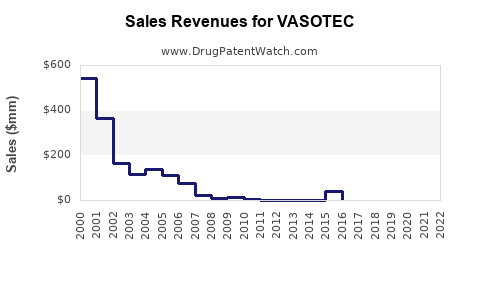
How did Vasotec revenue change after generic entry?
Vasotec's financial trajectory followed the standard blockbuster-to-generic pattern:
- Rapid adoption after launch in the 1980s.
- High branded revenue during the 1990s.
- Early erosion as generic enalapril became available.
- Steeper decline after core patent expiry around 2000.
- Loss of material standalone importance in Merck's portfolio.
- Replacement by newer products in Merck's financial reporting.
Merck's annual reports provide portfolio-level sales information, but recent filings do not identify Vasotec as a material separately reported product. [3] That reporting treatment indicates that Vasotec's contribution is immaterial relative to Merck's current revenue base, not that the active ingredient lacks clinical use.
Financial trajectory
| Period |
Revenue position |
Market driver |
| 1985-1989 |
Expansion |
New ACE inhibitor adoption |
| 1990-1995 |
Mature branded product |
Broad hypertension and heart-failure use |
| 1996-2000 |
Erosion begins |
Generic competition and patent expiry |
| 2001-2010 |
Sharp decline |
Multisource generic substitution |
| 2010s |
Minimal brand relevance |
Low-cost generic supply |
| 2020s |
No material standalone brand exposure |
Generic procurement market |
A precise current Vasotec revenue figure is not available from Merck's public segment reporting because the product is not separately disclosed as a material line. The appropriate valuation conclusion is that Vasotec has negligible direct brand revenue exposure for Merck. The broader enalapril market continues to generate generic sales, but those revenues are distributed across manufacturers and are not equivalent to Vasotec revenue.
How does Vasotec compare with lisinopril and other ACE inhibitors?
Vasotec's main commercial disadvantage is not clinical obsolescence but commoditization. Lisinopril, enalapril, ramipril, and related ACE inhibitors are all mature generic products. Lisinopril often has greater prescription visibility because it is widely used, does not require metabolic conversion to an active form, and is available from many suppliers.
| Product |
Active ingredient |
Current U.S. market |
Patent risk |
Commercial profile |
| Vasotec |
Enalapril maleate |
Brand largely inactive; generic dominant |
Very low |
Mature generic |
| Prinivil/Zestril |
Lisinopril |
Generic dominant |
Very low |
Larger generic franchise |
| Altace |
Ramipril |
Generic dominant |
Very low |
Mature generic |
| Accupril |
Quinapril |
Generic or limited availability |
Very low |
Smaller and more supply-sensitive |
| Capoten |
Captopril |
Generic dominant |
Very low |
Older ACE inhibitor |
Vasotec retains clinical relevance where prescribers prefer enalapril or where enalaprilat's pharmacology fits the treatment setting. That clinical relevance does not translate into significant branded pricing power.
What manufacturing and intellectual-property barriers remain?
Manufacturing barriers are modest for oral enalapril but higher for injectable enalaprilat because sterile manufacturing, fill-finish controls, stability, and regulatory compliance increase operational requirements. These are execution barriers rather than exclusionary intellectual-property rights.
Generic manufacturers must manage:
- Active pharmaceutical ingredient quality and supply.
- Control of degradation products and impurities.
- Tablet content uniformity and dissolution.
- Bioequivalence requirements.
- Sterile production for injectable products.
- FDA inspection and current good manufacturing practice compliance.
- Reliable distribution through wholesalers and institutional channels.
These factors can affect market share and supply reliability. They do not recreate Vasotec's former patent monopoly.
What licensing deals affect Vasotec?
No current high-value Vasotec licensing transaction is central to the product's market position. Historical commercial arrangements may have involved distribution, generic supply, or regional rights, but the product's patent expiration limits the economic value of exclusive licensing.
A license involving enalapril today would normally be assessed as a supply or portfolio transaction rather than an innovation-rights transaction. Key diligence points would include manufacturing rights, geographic territories, regulatory ownership, shortage exposure, and access to hospital contracts.
What is the outlook for the Vasotec market?
The U.S. Vasotec brand has little growth potential. The relevant market is generic enalapril, where demand is stable but pricing is constrained. Revenue opportunities depend on manufacturing efficiency, supply reliability, shortage management, and access to high-volume buyers.
International markets may retain branded enalapril products under different trade names, but geographic rights and patent positions must be evaluated country by country. The original U.S. patent expiration does not establish the legal status of every foreign market, although most major jurisdictions are also mature and genericized.
Key Takeaways
- Vasotec is Merck's former brand for enalapril maleate.
- FDA approval began in 1985.
- The core enalapril patent expired around 2000.
- Generic enalapril entered the U.S. market in the early 1990s.
- No material active U.S. patent estate protects the former Vasotec franchise.
- Paragraph IV litigation is no longer a meaningful barrier to generic enalapril.
- Merck does not separately report Vasotec as a material current revenue product.
- Current value is concentrated in generic tablets and, to a lesser extent, injectable enalaprilat.
- Manufacturing quality, sterile production, supply reliability, and contracting are more important than patent rights.
- Vasotec is commercially a mature generic market, not an active branded-growth asset.
FAQs
Is Vasotec still sold in the United States?
Generic enalapril remains available, but Vasotec-branded commercial activity is limited and may be discontinued depending on dosage form and market channel.
Does Vasotec have active Orange Book patents?
The original patent protection has expired, and no material active Orange Book patent barrier is expected to prevent generic enalapril competition.
Can a company launch a generic version of Vasotec?
Yes. A company would generally pursue an ANDA for the relevant enalapril dosage form and demonstrate pharmaceutical equivalence and bioequivalence.
Is enalapril still profitable for generic manufacturers?
It can be profitable at scale, particularly for suppliers with low manufacturing costs, reliable API sourcing, and strong wholesaler or institutional contracts. Margins are generally much lower than during the branded Vasotec period.
Does Vasotec face biosimilar competition?
No. Vasotec is a chemically synthesized small molecule, not a biologic. The relevant competitors are generic drugs, not biosimilars.
References
-
U.S. Food and Drug Administration. (n.d.). Drugs@FDA: FDA-approved drugs, Vasotec and enalapril maleate records. https://www.accessdata.fda.gov/scripts/cder/daf/
-
U.S. Food and Drug Administration. (2024). Approved drug products with therapeutic equivalence evaluations: Orange Book. https://www.fda.gov/drugs/drug-approvals-and-databases/approved-drug-products-therapeutic-equivalence-evaluations-orange-book
-
Merck & Co., Inc. (1985-2001). Annual reports and Form 10-K filings. https://www.merck.com/investor-relations/financial-information/
-
U.S. Patent and Trademark Office. (1983). U.S. Patent No. 4,374,829, enalapril compounds. https://patents.google.com/patent/US4374829A/en