Last updated: August 10, 2026
Loratadine is a mature, low-cost second-generation antihistamine with limited remaining patent leverage and highly fragmented generic competition. The branded Claritin franchise generated multibillion-dollar annual sales at its peak, but prescription-to-OTC conversion, U.S. patent expiry, retailer private labels, and global generic entry shifted value from the originator to manufacturers, distributors, and retailers. Current commercial value is concentrated in consumer-health brand equity, combination products, private-label supply, and high-volume manufacturing rather than exclusivity.
What is loratadine and how is it marketed?
Loratadine is an orally active, nonsedating H1 antihistamine used to treat allergic rhinitis and chronic urticaria. The active ingredient is marketed in tablets, orally disintegrating tablets, chewable tablets, capsules, and oral solutions.
| Attribute |
Loratadine |
| Drug class |
Second-generation H1 antihistamine |
| Original brand |
Claritin |
| Original developer |
Schering-Plough |
| U.S. prescription approval |
1993 |
| U.S. OTC switch |
2002 |
| Current commercial status |
Mature OTC and generic product |
| Primary competitors |
Cetirizine, levocetirizine, fexofenadine, diphenhydramine |
| Biosimilar exposure |
None |
| Core commercial markets |
United States, Europe, Latin America, Asia-Pacific |
The FDA approved Claritin tablets in 1993 for seasonal allergic rhinitis. The agency later approved the prescription-to-OTC switch, allowing loratadine products to be sold directly to consumers without a prescription. FDA labeling identifies loratadine as an antihistamine indicated for allergy symptoms and hives.[1]
When did loratadine lose exclusivity?
Loratadine lost meaningful U.S. small-molecule exclusivity in the early 2000s. The Claritin franchise then moved from a prescription product protected by originator patents to a broad OTC and generic market.
| Event |
Approximate timing |
Commercial effect |
| U.S. prescription approval |
1993 |
Established Claritin as a branded allergy therapy |
| Core U.S. patent expiry |
2002 |
Enabled direct generic competition |
| FDA OTC switch |
2002 |
Expanded consumer access and increased retail competition |
| Broad generic substitution |
2002 onward |
Reduced prescription and branded pricing power |
| Retail private-label expansion |
2000s onward |
Compressed prices across tablets and liquids |
| Current market |
2020s |
High-volume, low-exclusivity consumer-health category |
The FDA Orange Book historically listed patents associated with Claritin and loratadine products. Those patents no longer provide meaningful market protection in the United States. The core U.S. patent estate has expired, and current manufacturers compete primarily through price, distribution, packaging, formulation execution, and brand recognition rather than patent exclusivity.[2]
What patents protect loratadine today?
No active U.S. patent is generally regarded as the principal barrier to ordinary generic loratadine tablets. The original composition and product patents expired years ago.
Formulation patents
Potentially relevant protection can exist around:
- Orally disintegrating tablets
- Chewable tablets
- Liquid formulations
- Taste-masking systems
- Fixed-dose combinations
- Packaging and dosing devices
- Manufacturing processes
These rights usually have narrower commercial scope than the original active-ingredient patent. They may affect a specific dosage form or combination but do not prevent competitors from selling standard loratadine tablets.
A company seeking to launch a loratadine product must assess formulation-specific patents, trademarks, regulatory exclusivity, and product labeling. Those issues are distinct from the expired core compound patent.
Method-of-use patents
Loratadine has a long-established allergy indication. Broad method-of-use patents covering ordinary treatment of allergic rhinitis or urticaria are unlikely to create meaningful current market exclusivity because of age, disclosure history, and extensive generic use.
A new patent could theoretically cover a narrow population, dosing regimen, delivery system, or combination. Such a patent would need to withstand validity and infringement challenges and would not necessarily restrict ordinary generic loratadine products.
What is the FDA regulatory status of loratadine?
Loratadine is an FDA-approved small molecule and an established OTC active ingredient. It is not regulated through the biosimilar pathway.
FDA pathways
Generic loratadine tablets and capsules are approved through abbreviated new drug applications. Applicants generally demonstrate bioequivalence to a reference product rather than repeat the full clinical development program required for an innovative drug.
OTC products may be marketed under the applicable FDA monograph framework or through an approved application, depending on product formulation and regulatory history. Manufacturers must comply with labeling, current good manufacturing practice, stability, quality, and facility requirements.[1][3]
The main regulatory risks are operational:
- Manufacturing observations or warning letters
- Product recalls
- Labeling errors
- Dose-measurement problems in pediatric liquids
- Contamination or stability failures
- Supply interruptions involving active pharmaceutical ingredient or packaging
Clinical-development risk is low because loratadine is a well-established active ingredient.
How many companies sell loratadine?
The U.S. market includes the Claritin brand, retailer private labels, generic drug manufacturers, and combination-product suppliers. The precise number varies by dosage form, National Drug Code, country, and distribution channel.
Typical U.S. participants include:
- Bayer Consumer Health, owner of the Claritin brand
- Perrigo
- CVS Health private-label suppliers
- Walmart and other retailer brands
- Large generic manufacturers
- Regional OTC manufacturers
- Contract manufacturers serving private-label customers
The market is more concentrated at the brand and retail-distribution level than at the manufacturing level. A retailer may control consumer access and shelf placement while outsourcing production to a third-party manufacturer.
How does loratadine compare with competing antihistamines?
Loratadine competes in a mature therapeutic class where clinical differentiation is limited and consumers often switch between products based on price, perceived speed, sedation profile, and brand familiarity.
| Product |
Active ingredient |
Main commercial position |
Key competitive issue |
| Claritin |
Loratadine |
Established nonsedating allergy brand |
Mature brand with generic erosion |
| Zyrtec |
Cetirizine |
Strong allergy brand |
Perceived potency, possible drowsiness |
| Allegra |
Fexofenadine |
Nonsedating allergy brand |
Premium positioning and broad retail presence |
| Xyzal |
Levocetirizine |
Branded and generic allergy product |
Smaller franchise and price competition |
| Benadryl |
Diphenhydramine |
Older antihistamine brand |
Sedation and short-duration use |
Loratadine’s commercial advantages are broad consumer recognition, once-daily dosing, low manufacturing cost, and extensive retail availability. Its disadvantages are limited differentiation and intense substitution by cetirizine, fexofenadine, levocetirizine, and store brands.
What was the financial trajectory of Claritin and loratadine?
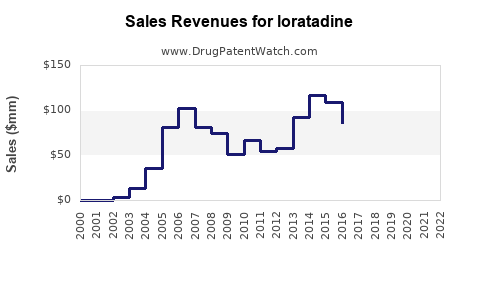
Claritin was one of the largest allergy brands in the world before generic entry and the OTC transition. Schering-Plough annual reports identified Claritin as a major revenue contributor during the late 1990s and early 2000s. Public filings described the brand as generating sales in the multibillion-dollar range at its peak, although reported figures varied based on geography, channel, product scope, and accounting treatment.[4]
The financial trajectory followed four stages.
1. Prescription growth
During the 1990s, Claritin benefited from:
- Once-daily dosing
- Lower perceived sedation than older antihistamines
- Heavy physician prescribing
- Expanding allergy diagnosis and treatment
- Strong direct-to-consumer promotion
Prescription status supported higher average selling prices and greater manufacturer control over distribution.
2. OTC expansion
The 2002 OTC switch expanded the addressable consumer market but changed the economics. The manufacturer gained access to self-pay consumers while losing prescription reimbursement economics and facing direct comparison with private-label alternatives.
The OTC launch also increased shelf competition. Retailers could place Claritin beside lower-priced loratadine products, making price differences visible at the point of purchase.
3. Patent and generic erosion
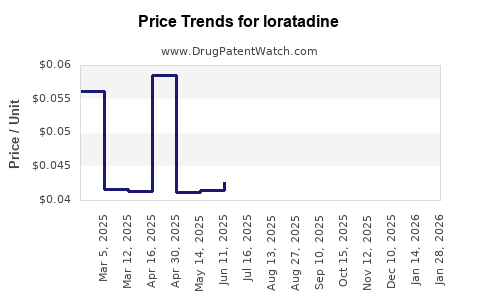
The expiry of core patent protection allowed generic manufacturers to enter with substantially lower prices. Prescription substitution reduced branded volume, while OTC consumers increasingly purchased store-brand loratadine.
The originator retained value through trademark recognition, advertising, pediatric products, liquids, and combination products. The economics shifted from monopoly pricing to brand-premium pricing.
4. Mature consumer-health franchise
Bayer acquired Merck’s consumer-care business in 2014, bringing Claritin into Bayer’s consumer-health portfolio.[5] Bayer continues to report Claritin as part of its consumer-health activities, but current public reporting does not provide a standalone global loratadine profit-and-loss statement.
Current financial value is therefore best assessed through:
- Claritin brand sales where disclosed
- Consumer-health segment performance
- Retail sell-through
- Market share by country
- Average selling price
- Seasonal allergy intensity
- Promotional spending
- Private-label share
- Manufacturing cost and capacity
What revenue exposure remains for manufacturers?
Loratadine is unlikely to represent a major high-margin growth asset for a diversified pharmaceutical company. It can still generate substantial aggregate revenue because allergy products sell in large volumes across many markets.
Revenue exposure is strongest for companies with:
- Large OTC distribution networks
- Retailer private-label contracts
- Low-cost tablet and liquid manufacturing
- Broad international registrations
- Combination-product portfolios
- Strong seasonal inventory planning
The largest risks are price compression, retailer bargaining power, low switching costs, and seasonal demand volatility. A manufacturer that loses a private-label contract can lose significant volume quickly even if the overall loratadine market remains stable.
What generic launch risks exist for loratadine?
Generic launch risk is moderate operationally and low legally for a standard tablet product.
Legal risk
A new generic applicant generally faces little risk from the expired core patent estate. The principal legal issues are more likely to involve:
- Product-specific formulation patents
- Trademark and trade-dress restrictions
- Labeling disputes
- Manufacturing know-how
- Contractual supply restrictions
- Competition-law issues involving distribution
Regulatory risk
Regulatory approval is comparatively predictable, but deficiencies in bioequivalence, dissolution, stability, manufacturing controls, or labeling can delay launch.
Commercial risk
Commercial risks are more material than patent risks:
- Incumbent generic price cuts
- Retailer private-label substitution
- Limited shelf access
- Seasonal overproduction
- Low margins after wholesaler and retailer deductions
- Customer concentration
- API supply disruptions
Which companies are challenging Claritin exclusivity?
The major challenge occurred when generic manufacturers entered after U.S. patent expiry in the early 2000s. The market is no longer defined by an active Paragraph IV battle over the basic loratadine molecule.
Paragraph IV litigation is relevant historically because generic applicants can challenge listed patents before expiry. For current standard loratadine products, the main commercial question is not whether a generic can enter but whether it can achieve sufficient scale and distribution at acceptable margins.
No biosimilar competition exists because loratadine is a chemically synthesized small molecule, not a biologic.
What is the Orange Book status of loratadine?
The Orange Book is relevant to approved prescription products and listed patents. It is less central to the current OTC market because many loratadine products are marketed through OTC regulatory mechanisms rather than an active prescription exclusivity strategy.
For due diligence, an analyst should distinguish:
- Historical Claritin patents.
- Current approved prescription products.
- OTC monograph products.
- Generic ANDA products.
- Combination products with separate formulation or labeling claims.
The expiration of historical patents does not eliminate the need to check current product-specific listings, trademarks, formulation rights, and regulatory status.[2]
How strong is the loratadine patent estate?
The patent estate is weak as a current exclusivity asset and strong only as historical evidence of successful lifecycle management.
| Dimension |
Assessment |
| Core compound protection |
Expired |
| Standard tablet protection |
Minimal current barrier |
| OTC regulatory exclusivity |
No meaningful current exclusivity |
| Formulation protection |
Potentially narrow and product-specific |
| Method-of-use protection |
Limited practical value for ordinary allergy use |
| Biosimilar protection |
Not applicable |
| Manufacturing barriers |
Moderate for quality-compliant, low-cost scale |
| Brand protection |
Material for Claritin trademark and consumer recognition |
What licensing deals affect loratadine?
The most important strategic transaction was Bayer’s acquisition of Merck’s consumer-care business, which included Claritin.[5] Loratadine does not have the licensing profile of a new specialty drug or biologic. Current commercial arrangements are more likely to involve:
- Private-label manufacturing
- Regional distribution
- Co-branding
- Retail supply agreements
- Contract manufacturing
- Combination-product commercialization
Public filings generally do not disclose all product-level supply agreements or economics.
What litigation and settlement agreements affect loratadine?
The major litigation period centered on generic entry and patent challenges surrounding Claritin before and around U.S. patent expiry. That litigation is no longer the principal market driver.
Current disputes are more likely to involve:
- Advertising claims
- Product liability
- Manufacturing quality
- Consumer labeling
- Trademark infringement
- Retail distribution
- Product recalls
No current settlement agreement is known to create meaningful U.S. exclusivity for ordinary loratadine products.
What generic entry scenarios exist?
Base case
Generic and private-label products maintain high unit share. Claritin preserves a price premium through brand recognition and distribution. Market growth tracks population, allergy prevalence, retail pricing, and seasonal conditions.
Downside case
Retailers expand private-label share, generic manufacturers reduce prices, and Claritin loses volume and premium pricing. This is the most likely pressure scenario in mature markets.
Upside case
Growth comes from international expansion, pediatric formats, liquid products, combination products, e-commerce, and premium packaging. This would increase revenue without restoring compound-level exclusivity.
What is the geographic outlook for loratadine?
The United States is highly mature and price competitive. Growth opportunities are more likely in emerging markets where formal allergy treatment, OTC access, and modern retail distribution continue to expand.
Geographic performance depends on:
- Local OTC classification
- Brand registration
- Retail pharmacy structure
- Generic manufacturing capacity
- Import requirements
- Local pricing controls
- Seasonal allergy prevalence
- Consumer familiarity with nonsedating antihistamines
A global manufacturer can still achieve scale, but country-level registrations and local supply economics are more important than patent protection.
Key Takeaways
- Loratadine is a mature, genericized second-generation antihistamine.
- Claritin was a multibillion-dollar brand at its historical peak.
- Core U.S. patent protection expired around the 2002 generic-entry and OTC-switch period.
- Current value comes from brand equity, retail distribution, private-label supply, combination products, and manufacturing scale.
- The drug has no biosimilar risk because it is a small molecule.
- Paragraph IV litigation is primarily historical for standard loratadine products.
- Formulation and method-of-use patents may affect individual products but do not restore broad market exclusivity.
- Bayer owns the Claritin consumer-health brand following its acquisition of Merck’s consumer-care business.
- Current commercial risk is driven more by price compression and retailer control than by patent litigation.
- Loratadine remains a durable volume product but is unlikely to be a high-margin, high-growth pharmaceutical asset.
FAQs
Is loratadine still profitable for pharmaceutical manufacturers?
Yes, but profitability depends on manufacturing cost, volume, private-label contracts, and distribution. Standard generic loratadine has limited pricing power.
Does Claritin still have patent protection?
The core patents that protected loratadine and the original Claritin franchise have expired. Trademark and product-specific rights may remain relevant.
Can a company launch a generic loratadine product without a Paragraph IV challenge?
Yes. For an expired-patent product, a generic applicant may file without relying on a new Paragraph IV challenge to a live core patent, subject to applicable regulatory requirements.
Is loratadine included in Medicare Part D?
OTC loratadine is generally not reimbursed as a standard Medicare Part D prescription benefit, although coverage can vary through specific plans, Medicaid programs, employer programs, or other channels.
Which antihistamine competes most directly with loratadine?
Cetirizine and fexofenadine are the closest large-scale competitors because they are also once-daily, second-generation antihistamines sold through prescription, OTC, generic, and branded channels.
References
-
U.S. Food and Drug Administration. (n.d.). Claritin approval history and prescribing information. Drugs@FDA. https://www.accessdata.fda.gov/scripts/cder/daf/
-
U.S. Food and Drug Administration. (n.d.). Approved drug products with therapeutic equivalence evaluations. Orange Book. https://www.accessdata.fda.gov/scripts/cder/ob/
-
U.S. Food and Drug Administration. (n.d.). Over-the-counter drug monograph system. https://www.fda.gov/drugs/over-counter-otc-nonprescription-drugs
-
Schering-Plough Corporation. (2002). Annual report. U.S. Securities and Exchange Commission. https://www.sec.gov/
-
Bayer AG. (2014). Bayer completes acquisition of Merck’s consumer care business. https://www.bayer.com/