Last updated: September 28, 2026
Diphenhydramine hydrochloride is a mature, low-cost first-generation antihistamine with broad OTC and generic availability. Its commercial base is durable because of established brand recognition, low manufacturing costs, and multiple indications, but volume growth is constrained by sedation, anticholinergic safety concerns, and substitution by newer antihistamines. The active ingredient has no meaningful remaining composition-of-matter exclusivity. Commercial protection depends mainly on trademarks, packaging, distribution, formulation execution, and regulatory compliance.
What is the current FDA status of diphenhydramine hydrochloride?
Diphenhydramine hydrochloride is an FDA-recognized OTC active ingredient for several uses, including temporary relief of allergy symptoms, common-cold symptoms, and occasional sleeplessness. It is sold as tablets, capsules, chewables, oral liquids, strips, topical products, and combination products.
The FDA regulates OTC diphenhydramine products under the OTC monograph framework rather than through a single modern product-specific approval. The relevant regulatory framework includes antihistamine and nighttime sleep-aid monograph requirements, as well as labeling and manufacturing rules under the Federal Food, Drug, and Cosmetic Act [1][2].
Prescription and hospital products also remain available, particularly injectable diphenhydramine hydrochloride. These products are used for acute allergic reactions, adjunctive treatment of anaphylaxis, drug reactions, and other clinical settings. Injectable products have different manufacturing, sterility, labeling, and supply-chain requirements from retail OTC products.
Key FDA-regulated product categories
| Product category |
Common use |
Commercial characteristics |
| Oral tablets and capsules |
Allergy relief, nighttime symptoms |
High generic competition and low unit prices |
| Oral liquids |
Pediatric and adult dosing |
Brand, private-label, and generic competition |
| Topical cream, gel, or spray |
Itching and minor skin reactions |
Competes with hydrocortisone and other topical products |
| Combination cold products |
Nighttime cold symptoms |
Reliant on brand architecture and retail placement |
| Sleep-aid products |
Occasional sleeplessness |
Faces safety scrutiny and competition from doxylamine and melatonin |
| Injection |
Acute allergic reactions and hospital use |
More sensitive to sterile manufacturing and supply continuity |
The FDA has warned against using diphenhydramine to induce sleep in children and has emphasized the risks of overdose, particularly in adolescents and young adults [3]. The agency has also warned about serious cardiac events associated with excessive doses.
How large is the diphenhydramine hydrochloride market?
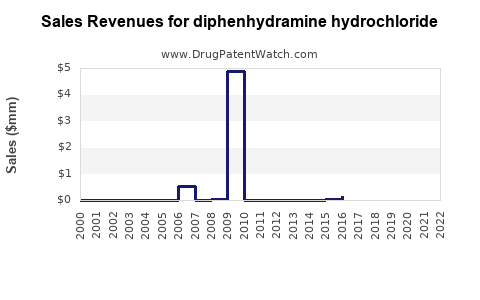
No public company reports global or U.S. revenue for diphenhydramine hydrochloride as a standalone product category. Sales are embedded in broader OTC, self-care, allergy, cold, sleep-aid, hospital, and generic pharmaceutical reporting segments.
The market is best understood as a fragmented mature-market category rather than a single branded franchise. Revenue is divided among:
- National consumer brands such as Benadryl.
- Retailer private-label products.
- Generic pharmaceutical manufacturers.
- Combination cold and nighttime products.
- Hospital and institutional suppliers.
- International brands and local manufacturers.
Retail sales are supported by high household awareness and broad distribution. Unit economics are weak because the active ingredient is inexpensive and numerous suppliers compete on price. Manufacturers can achieve better margins through brand positioning, specialty packaging, liquid formulations, combination products, and channel-specific products.
Revenue drivers
The strongest commercial drivers are:
- Seasonal allergy activity.
- Cold and influenza waves.
- Retail shelf placement.
- Household brand recognition.
- Demand for nighttime symptom relief.
- Hospital and emergency-department utilization.
- Private-label adoption during periods of consumer price sensitivity.
The principal constraints are generic substitution, low average selling prices, safety concerns, and consumer migration to less-sedating antihistamines.
What is the financial trajectory for diphenhydramine hydrochloride products?
The financial trajectory is mature to declining in long-term volume, with periodic seasonal or public-health-driven increases. Product-level revenue growth is more likely to come from price increases, mix changes, packaging, and channel expansion than from increased use of the active ingredient.
Kenvue, the owner of the Benadryl consumer-health business in the United States, reports financial results at broader segment levels and does not separately disclose Benadryl revenue in its public filings [4]. Generic manufacturers also generally report diphenhydramine within broader portfolios rather than as an individual revenue line.
Commercial trajectory by segment
| Segment |
Expected trajectory |
Main reason |
| Branded OTC allergy products |
Stable to modestly declining volume |
Strong awareness but substitution by newer antihistamines |
| Retail private label |
Stable or gaining share |
Lower price and retailer control |
| Generic oral products |
Stable volume, margin pressure |
Numerous suppliers and price competition |
| Nighttime sleep products |
Demand remains, but regulatory and safety pressure rises |
Sedation concerns and alternative sleep products |
| Injectable hospital products |
Stable, episodic demand |
Clinical utility and formulary use |
| Topical products |
Flat to declining |
Competition from non-antihistamine antipruritics |
| Combination cold products |
Seasonal and volatile |
Respiratory illness cycles and formulation restrictions |
A branded manufacturer can preserve dollar sales even when unit volume declines through list-price increases and premium packaging. That strategy has limits because consumers can switch quickly to store brands with the same active ingredient.
What companies compete with diphenhydramine hydrochloride?
Competition exists at both the active-ingredient level and the therapeutic-category level.
Direct competitors
Direct competitors include:
- Cetirizine hydrochloride, marketed in products such as Zyrtec.
- Loratadine, marketed in products such as Claritin.
- Fexofenadine hydrochloride, marketed in products such as Allegra.
- Doxylamine succinate in nighttime sleep products.
- Chlorpheniramine maleate in older antihistamine products.
- Hydroxyzine in prescription use.
- Promethazine in prescription and hospital use.
Cetirizine, loratadine, and fexofenadine have a commercial advantage in daytime allergy treatment because they are generally marketed as less sedating than first-generation antihistamines. Diphenhydramine retains a role where rapid symptom relief, nighttime sedation, low price, or clinical familiarity is valued.
For sleep, diphenhydramine competes with doxylamine, melatonin, behavioral products, prescription hypnotics, and non-drug sleep products. The category is commercially attractive but clinically sensitive because regular use of first-generation antihistamines is discouraged in many older adults.
How strong is the patent estate for diphenhydramine hydrochloride?
The patent estate is weak from an exclusivity perspective. Diphenhydramine was developed in the 1940s, and any original compound patents expired many decades ago. No active composition-of-matter patent prevents generic manufacture of diphenhydramine hydrochloride.
Patent protection by category
| Protection type |
Current commercial relevance |
| Composition-of-matter patent |
Expired |
| Original method-of-use patent |
Expired or commercially immaterial |
| Basic oral formulation patent |
Generally expired or avoidable |
| Modern formulation patent |
Possible for specific delivery systems, but narrow |
| Packaging patent |
Possible, usually low barrier |
| Trademark protection |
Important for branded products |
| Trade dress |
Potentially useful in consumer retail |
| Manufacturing know-how |
Relevant for quality, yield, and supply reliability |
| Regulatory exclusivity |
No meaningful current exclusivity for the mature active ingredient |
A manufacturer may hold patents covering liquid stability, flavoring, modified release, transdermal delivery, combination formulations, or specialized packaging. Such patents would protect a particular product configuration, not diphenhydramine hydrochloride generally.
What is the Orange Book status of diphenhydramine hydrochloride?
The Orange Book is primarily relevant to approved prescription drug products and their patent and exclusivity listings. Most OTC monograph diphenhydramine products do not rely on Orange Book-listed patents for market protection.
A prescription or approved drug product may appear in FDA databases depending on its regulatory pathway, dosage form, and application history. Orange Book presence, where applicable, does not create broad protection over OTC diphenhydramine products. Generic manufacturers can continue to market non-infringing products under the applicable OTC monograph or abbreviated approval pathway [5].
The principal barriers are therefore regulatory compliance, manufacturing quality, labeling, supply reliability, and commercial execution rather than Orange Book patent litigation.
When does diphenhydramine hydrochloride lose exclusivity?
Diphenhydramine hydrochloride lost meaningful molecule-level exclusivity decades ago. There is no expected future loss-of-exclusivity event comparable to a major branded prescription drug.
The commercial timeline is better described as follows:
| Period |
Event |
| 1940s |
Diphenhydramine introduced as an antihistamine |
| Following decades |
Broad adoption in allergy, cold, sleep, topical, and hospital products |
| Late 20th century |
Generic and private-label competition becomes extensive |
| 2000s onward |
Newer, less-sedating antihistamines gain allergy-market share |
| Current market |
Mature OTC and generic category with no molecule-level exclusivity |
The key competitive events are not patent expirations. They are retailer contracting decisions, regulatory label changes, supply disruptions, safety communications, and consumer migration to newer products.
Are there Paragraph IV challenges involving diphenhydramine hydrochloride?
Paragraph IV litigation is generally not a central risk for ordinary OTC diphenhydramine products because there is no major active patent estate blocking generic entry.
Paragraph IV certifications apply primarily to abbreviated new drug applications referencing listed patents in the Orange Book. A company developing a prescription diphenhydramine product with a listed formulation or delivery patent could create a Paragraph IV dispute, but that would concern the specific product patent rather than the active ingredient broadly.
For standard tablets, capsules, and oral liquids, the competitive threat is ordinary generic entry and price erosion, not a branded patent challenge.
What formulation patents protect diphenhydramine products?
Potentially protectable formulation areas include:
- Extended-release oral dosage forms.
- Pediatric liquid stability and taste-masking systems.
- Rapid-dissolving oral films.
- Low-sedation combination formulations.
- Transdermal or localized delivery systems.
- Unit-dose packaging.
- Preservative systems for multidose liquids.
- Combination products pairing diphenhydramine with analgesics, decongestants, or cough suppressants.
These patents face practical limitations. A formulation patent must be sufficiently differentiated to justify development costs, and manufacturers can often compete with conventional tablets or liquids. Consumer products also face a short payback period because retail prices remain low.
Manufacturing and supply barriers
The active ingredient itself is not a substantial manufacturing barrier. Competitive advantage can arise from:
- Reliable API sourcing.
- FDA-compliant manufacturing.
- Sterile injectable production.
- Control of impurities and degradation products.
- Liquid-product stability.
- Flavor and palatability.
- Capacity during seasonal demand spikes.
- Retailer service levels and inventory availability.
Injectable supply is more exposed to manufacturing disruptions because sterile production has fewer qualified facilities and higher compliance costs than conventional solid oral manufacturing.
What patent litigation affects diphenhydramine hydrochloride?
There is no major current patent-litigation profile comparable to leading branded prescription drugs. Litigation risk is more likely to involve:
- Product liability claims.
- False advertising or labeling disputes.
- Trademark infringement.
- Trade dress claims.
- OTC monograph compliance.
- Manufacturing and quality allegations.
- Distribution and supply agreements.
Safety-related litigation can have greater financial impact than patent litigation because the product is widely used, inexpensive, and sold across multiple channels. Claims may focus on overdose, pediatric exposure, impaired driving, misuse, or use in older adults.
How does diphenhydramine compare with newer antihistamines?
| Attribute |
Diphenhydramine |
Cetirizine |
Loratadine |
Fexofenadine |
| Generation |
First |
Second |
Second |
Second |
| Sedation risk |
Higher |
Lower, but possible |
Generally low |
Generally low |
| Typical use |
Allergy, nighttime symptoms, sleep |
Allergy |
Allergy |
Allergy |
| Price pressure |
Very high |
High |
High |
High |
| Brand differentiation |
Strong legacy brands |
Established brands |
Established brands |
Established brands |
| Long-term growth |
Limited |
More favorable |
Mature |
Mature |
| Older-adult suitability |
More concerns |
Product-specific |
Product-specific |
Product-specific |
The main strategic weakness of diphenhydramine is sedation and anticholinergic activity. The American Geriatrics Society lists first-generation antihistamines such as diphenhydramine as potentially inappropriate for many older adults because of risks including confusion, dry mouth, constipation, urinary retention, and falls [6].
What generic entry risks exist for diphenhydramine hydrochloride?
Generic entry risk is already realized rather than pending. The category has numerous suppliers, private-label offerings, and alternative dosage forms.
Risk profile for manufacturers
| Risk |
Assessment |
| New generic tablet entry |
High, but incremental impact is limited because competition is already broad |
| Private-label substitution |
High |
| Brand erosion |
High where consumers prioritize price |
| Patent-based launch blockage |
Low for conventional products |
| Supply disruption |
Moderate, higher for injectable products |
| Regulatory labeling change |
Moderate |
| Safety-driven demand decline |
Moderate to high over the long term |
| API price inflation |
Usually manageable because the ingredient is mature |
| Retailer delisting |
Moderate for weak brands |
A branded product can defend share through consumer trust, packaging, pediatric dosing systems, liquid formulation quality, and retailer relationships. It cannot rely on patent exclusivity for conventional diphenhydramine products.
What is the outlook for licensing and business development?
Large pharmaceutical licensing transactions centered on diphenhydramine hydrochloride are unlikely. The active ingredient lacks exclusivity and produces limited strategic value as a standalone asset.
Potential commercial transactions are more likely to involve:
- Private-label supply agreements.
- Contract manufacturing.
- Regional brand licensing.
- Hospital purchasing contracts.
- Combination cold products.
- Specialty delivery systems.
- International distribution rights.
- Acquisition of consumer-health brands rather than the molecule itself.
The most attractive assets are differentiated brands, retail contracts, sterile manufacturing capacity, and regulatory-ready product platforms. A license covering only conventional diphenhydramine tablets would have limited bargaining power.
What is the global and geographic market outlook?
The product is sold broadly across North America, Europe, Asia-Pacific, Latin America, and other regions, but regulatory treatment and brand ownership vary by country. Some markets emphasize prescription control, while others permit broad OTC distribution.
Geographic performance depends on:
- Local OTC scheduling.
- Retail pharmacy structure.
- Cold and allergy seasonality.
- Brand recognition.
- Pediatric-label restrictions.
- Import controls.
- Local manufacturing capacity.
- Consumer preference for newer antihistamines.
North America remains commercially important because of strong brand awareness and broad OTC distribution. Emerging markets can offer volume growth, but pricing is usually lower and local competition is intense.
Key Takeaways
- Diphenhydramine hydrochloride is a mature OTC and generic active ingredient with no meaningful remaining molecule-level exclusivity.
- Product-specific revenue is not publicly disclosed by major manufacturers.
- Long-term unit growth is constrained by sedation, anticholinergic concerns, and substitution by newer antihistamines.
- Benadryl and other branded products retain value through recognition, distribution, formulation quality, and retail execution.
- Private-label and generic competition create persistent price and margin pressure.
- Conventional products face little Paragraph IV or patent-litigation risk.
- Formulation, packaging, trademark, manufacturing, and sterile injectable capabilities are more relevant than active-ingredient patents.
- The strongest commercial risks are safety-driven demand erosion, retailer substitution, and product-liability exposure.
- Licensing value is concentrated in brands, distribution rights, specialty formulations, and manufacturing capacity.
- Injectable diphenhydramine has a more defensible supply position than standard tablets or liquids because sterile manufacturing is more complex.
FAQs About Diphenhydramine Hydrochloride Market Exclusivity and Commercial Risk
Is Benadryl protected by an active diphenhydramine patent?
No broad active patent protects diphenhydramine hydrochloride as an active ingredient. Benadryl’s principal commercial protections are its trademark, brand recognition, packaging, distribution, and product-specific rights.
Can a company launch a generic diphenhydramine tablet without a Paragraph IV challenge?
Yes. Conventional diphenhydramine tablets can generally enter through the applicable OTC or generic regulatory pathway without challenging a blocking composition-of-matter patent.
Why does diphenhydramine remain commercially important despite generic competition?
It has high consumer awareness, broad therapeutic familiarity, low manufacturing cost, multiple dosage forms, and established use in allergy, nighttime cold, sleep, topical, and hospital products.
Which diphenhydramine product has the strongest commercial defenses?
Branded products with strong retail distribution and trusted pediatric or liquid formulations have stronger defenses than commodity tablets. Sterile injectable products also have higher operational barriers because of manufacturing requirements.
Will newer antihistamines eliminate diphenhydramine demand?
No. They are likely to continue reducing diphenhydramine’s share of daytime allergy treatment, but nighttime use, hospital applications, legacy brand demand, and low-price purchasing will support continued sales.
References
-
U.S. Food and Drug Administration. (2024). Over-the-counter monograph system and OTC drug products. https://www.fda.gov/drugs/over-counter-otc-nonprescription-medicines
-
U.S. Food and Drug Administration. (2022). Code of Federal Regulations, Title 21, antihistamine and nighttime sleep-aid drug products. https://www.ecfr.gov
-
U.S. Food and Drug Administration. (2020). FDA warns about serious problems with high doses of the allergy medicine diphenhydramine. https://www.fda.gov
-
Kenvue Inc. (2024). Annual report and Form 10-K. https://investors.kenvue.com
-
U.S. Food and Drug Administration. (2024). Approved drug products with therapeutic equivalence evaluations. https://www.fda.gov/drugs/drug-approvals-and-databases/orange-book
-
American Geriatrics Society Beers Criteria Update Expert Panel. (2023). American Geriatrics Society 2023 updated Beers Criteria for potentially inappropriate medication use in older adults. Journal of the American Geriatrics Society, 71(7), 2052-2081.