Last updated: April 23, 2026
Diphenhydramine Hydrochloride: Market Dynamics and Financial Trajectory
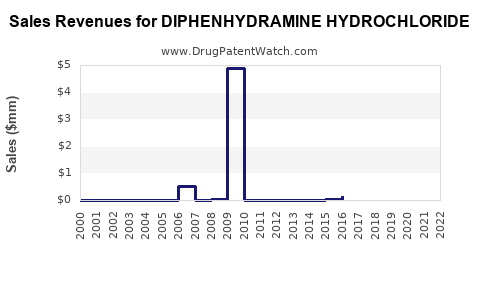
Diphenhydramine hydrochloride (DPH) is a first-generation antihistamine with broad, well-established demand across allergy and motion-sickness use cases. Commercial dynamics are dominated by generic availability, low pricing power, and high-volume retail distribution. Financial trajectory remains anchored to mature, patent-expired supply, with revenue growth largely tied to population and seasonal demand rather than new clinical differentiation.
What is the commercial market structure for diphenhydramine hydrochloride?
DPH is sold as a generic active ingredient in multiple dosage forms and pack sizes, typically through national and regional retail chains, club stores, and pharmacy channels. The market behaves like a commoditized, high-turnover OTC segment with:
- Generic-led supply (active ingredient is widely manufactured under generic compliance regimes).
- Seasonal demand patterns (spring/fall peaks for allergy products; year-round baseline for cold-related symptom relief and sleep aid use).
- Broad therapeutic breadth (allergic rhinitis, urticaria symptom relief, motion sickness, and sleep-aid use in some OTC lines).
- Retail pricing pressure (price competition across private label and branded-generic mixes).
- Substitution risk (consumers switch to newer OTC antihistamines when perceived to be less sedating).
This structure produces stable but limited unit-value growth. The commercial “action” is usually in formulation, packaging, and channel execution, not in fundamental molecule-level differentiation.
How does consumer demand translate into market dynamics?
DPH demand tracks symptom prevalence and retail conversion, with three measurable drivers in practice:
-
Allergy season intensity
- Higher seasonal symptom prevalence increases OTC allergy antihistamine velocity.
- DPH often competes on immediate availability and price rather than on onset claims.
-
Sedation and sleep-aid usage
- Consumer segments use DPH for nighttime symptom relief and OTC sleep-aid positioning.
- Sedation is a differentiator in some product lines and a liability in others, which affects substitution between DPH and less-sedating antihistamines.
-
Cold and flu-related symptom bundling
- DPH appears in some combination OTC cold product portfolios depending on regulatory labeling and product-specific formulations.
- When bundling expands a product’s retail shelf footprint, DPH can gain incremental distribution even if the underlying active ingredient demand is stable.
What does pricing power look like in DPH’s OTC-heavy market?
DPH’s financial profile is constrained by generic competition. The dominant pricing dynamics are:
- Price compression at launch-free intervals: With widespread generic availability, new entrants rarely sustain premium pricing.
- Promotion-driven revenue volatility: Retail promotions can lift unit volume while compressing net price.
- Private label substitution: Store brands exert downward pressure on branded-generic and national brand pricing.
- Channel mix effects: Club and mass channels typically support higher volumes at lower net pricing, while specialty pharmacy and direct-to-consumer are less central for OTC DPH.
Net effect: revenue is more volume-led than price-led.
How do manufacturing and supply-side forces affect availability and margins?
As a mature generic molecule, DPH’s supply chain is sensitive to:
- Bulk API and intermediate cost swings (though typically smaller than for patented specialty molecules).
- Regulatory and quality capacity constraints (generic markets can tighten supply during remediation or capacity exits).
- Packaging and distribution economics (OTC margin often depends on logistics and promotion agreements, not molecule IP).
For investors or R&D planners, the key supply-side takeaway is that sustainability of margins depends on manufacturing efficiency and channel execution, not on new exclusivity.
Where does revenue come from: indications and dosage-form segments?
DPH revenue is generated across multiple OTC use categories and forms. In practice, the economic mix is shaped by:
- Oral tablets/capsules for allergy symptom relief and related OTC use.
- Oral liquid for children and flexible dosing.
- Topical/transdermal combinations are less central to classic DPH economics (more often for combination topical antihistamine products, depending on jurisdiction).
- Nighttime/sleep-aid lines as a retail subsegment with stable baseline demand.
Because these products compete on retail placement and pack pricing, the financial trajectory often mirrors retail OTC category performance more than it mirrors pharmaceutical pipeline events.
What is the financial trajectory under generic competition?
For diphenhydramine hydrochloride, the financial trajectory typically follows a mature generic pattern:
- High baseline revenue scale driven by entrenched OTC demand and long-standing distribution.
- Limited margin expansion due to competition from multiple generics and private label.
- Revenue growth dependent on volume and assortments (new pack sizes, multi-packs, or combination products that expand retail shelf share).
- Occasional step changes from retail contract cycles and promotional intensity, not from clinical breakthroughs.
In practical terms, the model is:
- Unit growth comes from seasonality, distribution breadth, and packaging strategy.
- Value growth is capped by net price pressure.
What role does seasonality play in cash-flow timing?
OTC antihistamines show predictable demand surges:
- Spring allergy peak: higher conversion as pollen-driven allergy symptoms rise.
- Fall allergy peak: secondary seasonal surge.
- Winter cold season: demand can rise through cold and allergy symptom relief overlap, including combination OTC products.
Cash flow implications:
- Working capital needs rise before peak periods due to inventory build.
- Promotional calendars can shift quarterly revenue recognition without altering annual unit demand materially.
Regulatory and lifecycle dynamics: does DPH face major exclusivity shifts?
Diphenhydramine hydrochloride is not a molecule with meaningful ongoing patent-driven exclusivity in typical OTC use categories. The main lifecycle dynamics are instead:
- OTC monograph and labeling compliance across jurisdictions
- Generic substitution at the pharmacy and retail levels
- Product-specific format stability (tablets, liquids, and combination SKUs)
Business consequence: long-term financial trajectory is governed by OTC category economics and supply competitiveness rather than molecule-level exclusivity.
How do substitution dynamics affect the financial ceiling?
DPH faces substitution from newer antihistamines that are less sedating. The impact is not a total displacement dynamic; it is a segment migration effect:
- Some consumers and product lines prefer “non-drowsy” options.
- DPH retains share in price-sensitive segments and in nighttime use cases where sedation is acceptable or desired.
This supports a mature, stable revenue base but limits upside beyond routine retail category growth.
What are the likely investment-relevant KPIs for DPH producers?
Financial trajectory and risk monitoring for DPH producers typically centers on:
- Net sales per unit (price realization) under promotion and private label pressure.
- Gross margin stability linked to manufacturing yields and input costs.
- OTC velocity indicators (sell-through during seasonal peaks vs baseline).
- SKU and pack mix changes (multi-pack adoption, channel mix).
- Regulatory/quality events affecting supply continuity.
Key Takeaways
- Diphenhydramine hydrochloride is a mature, generic OTC antihistamine where revenue growth is primarily volume and channel execution driven, not pricing power driven.
- The market structure is commoditized, with seasonality and promotion cycles producing periodic quarter-to-quarter movement.
- Financial trajectory is typically stable but margin-constrained, with the primary levers being manufacturing efficiency, packaging strategy, and retail assortment control.
- Substitution from less sedating antihistamines caps long-run upside, while nighttime/sedating use segments and price-sensitive cohorts provide retention of demand.
FAQs
-
What drives diphenhydramine hydrochloride sales most consistently?
Seasonal allergy symptom prevalence plus year-round baseline OTC use, with quarterly fluctuations influenced by retail promotions and cold-season symptom overlap.
-
Why does pricing power remain limited for diphenhydramine hydrochloride?
Generic availability and private label substitution create persistent price competition in retail channels.
-
Does sedation improve commercial resilience for diphenhydramine hydrochloride?
Yes in nighttime/sleep-aid segments where drowsiness is acceptable, though it reduces attractiveness in “non-drowsy” preference segments.
-
What operational factor most affects margins in mature DPH markets?
Manufacturing cost efficiency and supply continuity, because revenue expansion is hard under price compression.
-
Is diphenhydramine hydrochloride’s financial trajectory tied to new clinical development?
No. The molecule is mature; financial outcomes depend on OTC demand, assortment, and channel execution rather than new efficacy claims.
References
[1] FDA. Orange Book: Approved Drug Products with Therapeutic Equivalence Evaluations. U.S. Food and Drug Administration.
[2] FDA. Over-the-Counter (OTC) Drug Products; Labeling and Monograph Resources. U.S. Food and Drug Administration.
[3] DrugBank. Diphenhydramine. DrugBank Online.
[4] PubChem. Diphenhydramine Hydrochloride. National Center for Biotechnology Information.