Last updated: February 14, 2026
Diphenhydramine hydrochloride (HCl) is an antihistamine used primarily for allergy relief, motion sickness, and sleep aid. As a mature, off-patent drug, its market dynamics are driven by generic manufacturers, over-the-counter (OTC) availability, and demand driven by allergy seasons and sleep aid trends.
Market Overview
Current Market Size
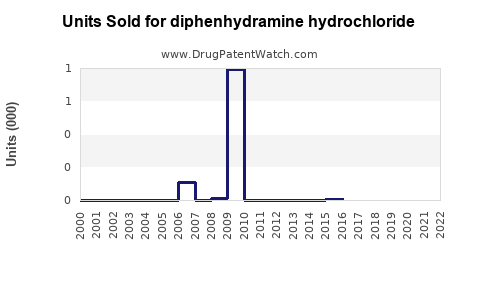
Global demand for diphenhydramine HCl is estimated at approximately 5 billion units annually, with the United States representing around 70% of this volume, driven by high OTC penetration. The drug's widespread OTC status in North America, Europe, and parts of Asia contributes to consistent sales.
Pricing and Revenue
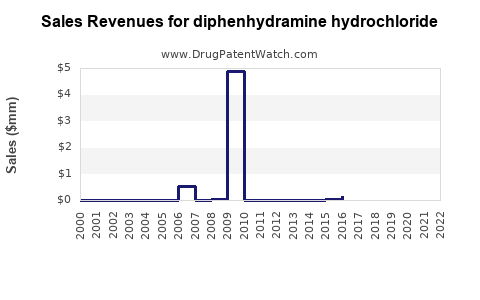
Average retail price per dose varies between $0.10 and $0.50, depending on formulation, packaging, and distribution channel. The U.S. retail sales revenue is estimated at $1.2 billion annually, according to IQVIA data [1].
Market Drivers
- Seasonal Allergy Incidence: Spring and fall increase the demand.
- Sleep Aid Market Growth: Consumer preference for OTC sleep aids sustained by awareness of non-addictive alternatives.
- Aging Population: Increased prevalence of allergy symptoms among older demographics.
- OTC Accessibility: No prescription needed shortens time-to-market for new formulations or generics.
Market Constraints
- Competition from alternative antihistamines (e.g., loratadine, cetirizine) with fewer sedative effects.
- Regulatory Scrutiny: Concerns over drowsiness-related accidents have prompted some restrictions.
- Consumer Shift: Preference toward newer, non-sedating antihistamines reduces demand for diphenhydramine.
Sales Projections (2023-2028)
Assumptions
- CAGR for global antihistamines (~3%) applies, but for diphenhydramine, considering market saturation and age-related demand, a conservative CAGR of 2% is forecasted.
- North America continues to dominate, with Asia-Pacific showing growth potential due to increasing OTC sales.
| Year |
Estimated Units Sold (Billions) |
Market Revenue (USD Billions) |
Notes |
| 2023 |
5.0 |
1.2 |
Baseline, current market size |
| 2024 |
5.1 |
1.24 |
Slight growth from increased allergy seasons |
| 2025 |
5.2 |
1.27 |
Steady demand, emerging markets start adopting OTC |
| 2026 |
5.3 |
1.30 |
Growth in Asia-Pacific, slight market share declines |
| 2027 |
5.4 |
1.33 |
Competition from non-sedating agents influences market share |
| 2028 |
5.5 |
1.37 |
Slight decline in growth rate due to market saturation |
Regional Breakdown – 2023 Estimates
- North America: 70% of sales, approximately 3.5 billion units, valued at USD 0.84 billion.
- Europe: 15%, approximately 0.75 billion units.
- Asia-Pacific: 10%, approximately 0.5 billion units.
- Rest of the world: 5%, approximately 0.25 billion units.
Competitive Landscape
Major generic/manufacturer players include Johnson & Johnson (Benadryl), Pfizer, and Teva. New entrants face barriers due to existing market saturation and regulation. Extensive OTC availability limits market expansion but stabilizes total market value.
Regulatory Environment Impact
Regulations differ by country:
- U.S.: OTC monographs approved; recent concerns over sedation effects have not led to major restrictions but could influence formulations.
- Europe: Some countries restrict sale for certain age groups.
- Asia-Pacific: Less regulation, higher growth potential but increasing regulatory oversight.
Future Outlook
The diphenhydramine market will likely maintain a steady but slow growth rate through 2028, influenced by the steady demand for OTC allergy and sleep aid products. Major shifts may result from increased consumer safety concerns leading to substitution with newer antihistamines or non-sedating formulations.
Key Takeaways
- Market size remains around USD 1.2 billion annually, with slow growth.
- North America dominates with a 70% share.
- Growth rate expected at approximately 2% CAGR to 2028.
- Competition from newer antihistamines and regulatory factors affect future sales.
- Asian markets offer opportunities for incremental growth, especially in OTC segments.
FAQs
1. How does diphenhydramine compare to newer antihistamines?
It causes sedation and has a shorter duration of action. Newer antihistamines (loratadine, cetirizine) are non-sedating and have less impact on daily activities, limiting diphenhydramine's competitive edge.
2. What regulatory challenges could impact sales?
Increased scrutiny over sedation-related safety concerns may lead to restrictions or age-based sales limits in some regions, affecting OTC sales volumes.
3. How much market share do generic manufacturers hold?
Almost 100%, as diphenhydramine is off-patent. Brand dominance remains with longstanding OTC brands like Benadryl.
4. What is the impact of COVID-19 on the market?
COVID-19 increased allergy-related symptoms and consumer demand for OTC remedies, temporarily boosting sales. Long-term impacts are steady, with a focus on broader health management.
5. What are the future growth prospects in developing regions?
Asia-Pacific presents growth potential due to expanding OTC markets and increased urbanization. However, regulatory oversight and local preferences influence market penetration.
Citations
[1] IQVIA. OTC Market Reports, 2022.