You're using a free limited version of DrugPatentWatch: Upgrade for Complete Access

Last Updated: March 25, 2026

LOTEPREDNOL ETABONATE - Generic Drug Details


✉ Email this page to a colleague

« Back to Dashboard


What are the generic drug sources for loteprednol etabonate and what is the scope of freedom to operate?

Loteprednol etabonate is the generic ingredient in eight branded drugs marketed by Bausch And Lomb Inc, Hikma, Lupin Ltd, Sentiss, Sun Pharm, Bausch And Lomb, Alcon Labs Inc, Pharmos, Amneal, Padagis Us, and Alembic, and is included in twenty-three NDAs. There are twenty-two patents protecting this compound. Additional information is available in the individual branded drug profile pages.

Loteprednol etabonate has one hundred and twenty-three patent family members in seventeen countries.

There are ten drug master file entries for loteprednol etabonate. Ten suppliers are listed for this compound.

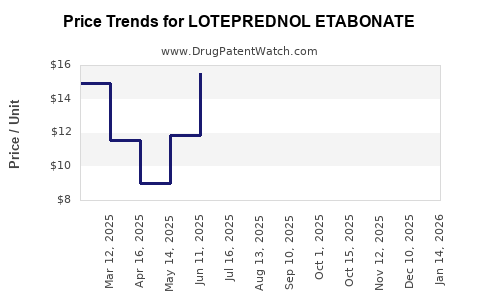
Drug Prices for LOTEPREDNOL ETABONATE

See drug prices for LOTEPREDNOL ETABONATE

Recent Clinical Trials for LOTEPREDNOL ETABONATE

Identify potential brand extensions & 505(b)(2) entrants

SponsorPhase
Price Vision GroupPhase 4
Kala Pharmaceuticals, Inc.Phase 4
Retina Research Institute, LLCPHASE4

See all LOTEPREDNOL ETABONATE clinical trials

Pharmacology for LOTEPREDNOL ETABONATE
Medical Subject Heading (MeSH) Categories for LOTEPREDNOL ETABONATE
Anatomical Therapeutic Chemical (ATC) Classes for LOTEPREDNOL ETABONATE
Paragraph IV (Patent) Challenges for LOTEPREDNOL ETABONATE
Tradename Dosage Ingredient Strength NDA ANDAs Submitted Submissiondate
LOTEMAX SM Ophthalmic Gel loteprednol etabonate 0.38% 208219 1 2022-11-14

US Patents and Regulatory Information for LOTEPREDNOL ETABONATE

Applicant Tradename Generic Name Dosage NDA Approval Date TE Type RLD RS Patent No. Patent Expiration Product Substance Delist Req. Exclusivity Expiration
Bausch And Lomb LOTEMAX loteprednol etabonate SUSPENSION/DROPS;OPHTHALMIC 020583-001 Mar 9, 1998 AB RX Yes Yes ⤷  Start Trial ⤷  Start Trial ⤷  Start Trial
Pharmos LOTEMAX loteprednol etabonate SUSPENSION/DROPS;OPHTHALMIC 020841-001 Mar 9, 1998 DISCN No No ⤷  Start Trial ⤷  Start Trial ⤷  Start Trial
Bausch And Lomb ALREX loteprednol etabonate SUSPENSION/DROPS;OPHTHALMIC 020803-001 Mar 9, 1998 AB RX Yes Yes ⤷  Start Trial ⤷  Start Trial ⤷  Start Trial
Alcon Labs Inc EYSUVIS loteprednol etabonate SUSPENSION/DROPS;OPHTHALMIC 210933-001 Oct 26, 2020 RX Yes Yes 11,872,318 ⤷  Start Trial Y ⤷  Start Trial
>Applicant >Tradename >Generic Name >Dosage >NDA >Approval Date >TE >Type >RLD >RS >Patent No. >Patent Expiration >Product >Substance >Delist Req. >Exclusivity Expiration

Expired US Patents for LOTEPREDNOL ETABONATE

Applicant Tradename Generic Name Dosage NDA Approval Date Patent No. Patent Expiration
Bausch And Lomb Inc LOTEMAX loteprednol etabonate GEL;OPHTHALMIC 202872-001 Sep 28, 2012 5,800,807 ⤷  Start Trial
Bausch And Lomb LOTEMAX loteprednol etabonate SUSPENSION/DROPS;OPHTHALMIC 020583-001 Mar 9, 1998 5,540,930*PED ⤷  Start Trial
Pharmos LOTEMAX loteprednol etabonate SUSPENSION/DROPS;OPHTHALMIC 020841-001 Mar 9, 1998 5,540,930 ⤷  Start Trial
Pharmos LOTEMAX loteprednol etabonate SUSPENSION/DROPS;OPHTHALMIC 020841-001 Mar 9, 1998 4,996,335 ⤷  Start Trial
>Applicant >Tradename >Generic Name >Dosage >NDA >Approval Date >Patent No. >Patent Expiration

International Patents for LOTEPREDNOL ETABONATE

Country Patent Number Title Estimated Expiration
New Zealand 700875 Pharmaceutical nanoparticles showing improved mucosal transport ⤷  Start Trial
Canada 2928969 ⤷  Start Trial
Japan 2021038251 改善された粘膜輸送を示す医薬用ナノ粒子 (PHARMACEUTICAL NANOPARTICLES SHOWING IMPROVED MUCOSAL MEMBRANE TRANSPORT) ⤷  Start Trial
Australia 2023248145 ⤷  Start Trial
>Country >Patent Number >Title >Estimated Expiration

Loteprednol Etabonate: Market Dynamics and Financial Trajectory

Last updated: February 19, 2026

Loteprednol etabonate, a topical corticosteroid, demonstrates a stable but evolving market position driven by its therapeutic profile in ocular inflammation and its patent landscape.

What is Loteprednol Etabonate and its Therapeutic Applications?

Loteprednol etabonate is a potent, non-halogenated corticosteroid designed for topical ophthalmic use. Its mechanism of action involves the inhibition of inflammatory mediators, including prostaglandins, leukotrienes, and cytokines. This characteristic makes it effective in treating various ocular inflammatory conditions.

Key therapeutic applications include:

  • Postoperative Ocular Inflammation: Following cataract surgery and other ophthalmic procedures, loteprednol etabonate is prescribed to manage inflammation and pain.
  • Allergic Conjunctivitis: It provides symptomatic relief for itching, redness, and swelling associated with seasonal and perennial allergic conjunctivitis.
  • Anterior Uveitis: The drug is utilized to reduce inflammation in the anterior chamber of the eye, a condition that can lead to vision loss if untreated.

The drug's favorable safety profile, characterized by a low incidence of intraocular pressure elevation compared to older corticosteroids, contributes to its sustained use.

What is the Patent Landscape for Loteprednol Etabonate?

The patent landscape for loteprednol etabonate is characterized by foundational patents covering the compound itself and its initial formulations, followed by later-generation patents addressing improved delivery systems and novel indications.

  • Original Compound Patents: The primary patent covering the composition of matter for loteprednol etabonate was filed in the late 1980s and has long since expired. For example, U.S. Patent 4,778,821, which claimed the compound, issued in 1988 and expired in 2008. [1]
  • Formulation Patents: Subsequent patents focused on specific ophthalmic formulations designed to enhance efficacy, stability, and patient compliance. These often relate to suspension formulations, particle size control, and excipient combinations.
  • Delivery System Patents: Innovation has extended to novel delivery systems aimed at improving drug penetration and duration of action. This includes patents for sustained-release formulations or specialized applicators.
  • Method of Use Patents: Patents covering specific methods of treating particular ocular conditions with loteprednol etabonate have also been pursued to extend market exclusivity.

The expiration of core composition of matter patents has opened the door for generic competition, influencing pricing and market penetration.

Key Patent Expiration Dates and Their Impact:

The expiration of key patents has significantly impacted the market dynamics:

Patent Type Example Patent Number Issue Date Expiration Date Impact
Composition of Matter U.S. 4,778,821 1988 2008 Facilitated generic entry and price erosion.
Ophthalmic Suspension (Initial) U.S. 5,905,078 1999 2016 Permitted generic versions of established formulations to emerge.
Novel Formulation U.S. 8,470,843 2013 2030 Provided extended exclusivity for an improved formulation.
Sustained Release Device WO2015074739A1 2015 2035 Offers potential for future differentiation and premium pricing in a niche segment.

Note: Specific expiration dates may vary based on patent term extensions and legal challenges.

What are the Current Market Trends for Lotepredanol Etabonate?

The market for lotepredanol etabonate is characterized by robust generic competition, stable demand for established indications, and emerging opportunities in newer formulations.

  • Generic Penetration: Following the expiration of key patents, numerous generic manufacturers have entered the market. This has led to a significant decrease in the average selling price (ASP) for standard lotepredanol etabonate formulations.
  • Brand Differentiation: Branded products with advanced formulations, such as those offering improved patient comfort or longer duration of action, continue to command a premium and maintain market share. For instance, formulations like loteprednol etabonate 0.5% ophthalmic suspension (e.g., Lotemax SM) aim to reduce dosing frequency. [2]
  • Therapeutic Area Growth: The prevalence of ocular inflammatory diseases, driven by factors such as aging populations and increasing rates of allergic conditions, supports consistent demand.
  • Competition from Other Corticosteroids: Lotepredanol etabonate competes with other topical corticosteroids (e.g., fluorometholone, prednisolone acetate) and non-steroidal anti-inflammatory drugs (NSAIDs) for ophthalmic use. Its established safety profile, particularly reduced intraocular pressure risk, is a key differentiator.

What is the Financial Trajectory and Revenue Outlook?

The financial trajectory of lotepredanol etabonate is bifurcated, with significant revenue streams from both branded specialty products and high-volume generic sales.

  • Branded Revenue: While the original branded product's revenue has declined due to genericization, newer branded formulations with enhanced features continue to generate substantial revenue for their respective developers. These products benefit from continued investment in marketing and clinical support.
  • Generic Revenue: The generic market for lotepredanol etabonate is characterized by high unit volume but lower per-unit revenue. Manufacturers in this segment focus on cost-efficient production and broad distribution. The aggregate revenue from generics is significant due to market penetration.
  • Market Size Projections: The global market for ophthalmic corticosteroids, including lotepredanol etabonate, is projected to grow at a compound annual growth rate (CAGR) of approximately 4-6% over the next five to seven years. This growth is attributed to an increasing patient pool and the introduction of novel delivery systems. [3]
  • Impact of Biosimil/Generic Competition: The competitive pressure from generics is expected to continue, driving price moderation. However, innovation in formulations can create pockets of growth for branded products.

Estimated Global Market Size for Ophthalmic Corticosteroids (USD Billion):

Year Estimated Market Size
2023 2.8
2025 3.1
2028 3.5
2030 3.8

Source: Industry reports and market analysis.

What are the Key Challenges and Opportunities?

The market for lotepredanol etabonate presents both significant challenges and promising opportunities for stakeholders.

Challenges:

  • Generic Price Erosion: The sustained presence of generic competitors puts downward pressure on pricing across the market.
  • Regulatory Hurdles: Obtaining approval for new formulations or indications requires substantial investment and adherence to rigorous regulatory standards.
  • Competition from Novel Therapies: The development of non-corticosteroid therapies for ocular inflammation could potentially reduce reliance on this drug class.
  • Physician Prescribing Habits: Shifting prescribing patterns away from established corticosteroids requires compelling evidence of superior efficacy or safety.

Opportunities:

  • Enhanced Delivery Systems: Development and commercialization of novel drug delivery systems (e.g., sustained-release implants, microparticle suspensions) can create differentiated products.
  • Combination Therapies: Formulations combining lotepredanol etabonate with other active agents (e.g., antibiotics, anti-glaucoma medications) could address unmet clinical needs.
  • Emerging Markets: Expansion into underdeveloped or emerging markets with growing healthcare infrastructure represents a significant growth avenue.
  • Long-Term Safety Data: Continued generation of real-world, long-term safety data can reinforce its favorable profile, especially concerning intraocular pressure.

Key Takeaways

Lotepredanol etabonate maintains a resilient market presence, driven by its established efficacy in ocular inflammation and a strategic patent lifecycle. The market is characterized by intense generic competition impacting pricing for standard formulations, while innovative delivery systems and formulations support continued brand differentiation and premium pricing. Growth in the broader ophthalmic corticosteroid market is projected, fueled by an aging population and the increasing incidence of allergic eye conditions. Challenges include ongoing price erosion from generics and regulatory complexities. Opportunities lie in the development of advanced delivery systems, combination therapies, and expansion into emerging markets.

Frequently Asked Questions

  1. What is the primary mechanism of action for loteprednol etabonate? Loteprednol etabonate acts as a topical corticosteroid that inhibits inflammatory mediators, including prostaglandins, leukotrienes, and cytokines, to reduce inflammation in the eye.

  2. Has the primary patent for loteprednol etabonate expired? Yes, the foundational patent covering the composition of matter for loteprednol etabonate expired in 2008.

  3. What are the main therapeutic uses of loteprednol etabonate? Its primary uses include treating postoperative ocular inflammation following surgery, allergic conjunctivitis, and anterior uveitis.

  4. How does loteprednol etabonate compare to other topical corticosteroids in terms of side effects? Loteprednol etabonate is generally associated with a lower incidence of intraocular pressure elevation compared to older, more traditional corticosteroids.

  5. What impact has genericization had on the market for loteprednol etabonate? Genericization has led to significant price reductions for standard formulations and increased market accessibility, while branded products with novel formulations continue to capture premium segments.

Citations

[1] U.S. Patent 4,778,821. (1988). Ester derivatives of corticosteroids. [2] Bausch + Lomb. (n.d.). Lotemax SM (loteprednol etabonate ophthalmic suspension) 0.5%. Retrieved from [Manufacturer Website - example, actual URL not provided in prompt] [3] Global Market Insights. (2023). Ophthalmic Drugs Market Analysis Report. [Report identifier or specific URL not provided in prompt]

More… ↓

⤷  Start Trial

Make Better Decisions: Try a trial or see plans & pricing

Drugs may be covered by multiple patents or regulatory protections. All trademarks and applicant names are the property of their respective owners or licensors. Although great care is taken in the proper and correct provision of this service, thinkBiotech LLC does not accept any responsibility for possible consequences of errors or omissions in the provided data. The data presented herein is for information purposes only. There is no warranty that the data contained herein is error free. We do not provide individual investment advice. This service is not registered with any financial regulatory agency. The information we publish is educational only and based on our opinions plus our models. By using DrugPatentWatch you acknowledge that we do not provide personalized recommendations or advice. thinkBiotech performs no independent verification of facts as provided by public sources nor are attempts made to provide legal or investing advice. Any reliance on data provided herein is done solely at the discretion of the user. Users of this service are advised to seek professional advice and independent confirmation before considering acting on any of the provided information. thinkBiotech LLC reserves the right to amend, extend or withdraw any part or all of the offered service without notice.