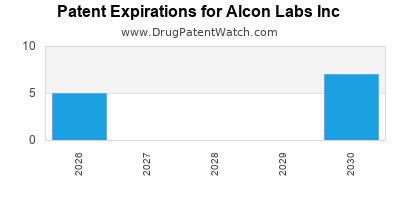
Last updated: August 1, 2026
Alcon is the largest pure-play eye-care company, with competitive positions in ophthalmic surgical equipment, intraocular lenses, contact lenses, and ocular-surface products. Its advantages are portfolio breadth, surgeon relationships, recurring consumables revenue, and a large installed base of surgical systems. Its principal risks are premium-product pricing pressure, dependence on elective procedures, contact-lens competition from Johnson & Johnson Vision, CooperVision, and Bausch + Lomb, and the gradual erosion of exclusivity for mature pharmaceutical and device products.
Alcon is primarily a medical-technology and ophthalmic-products company rather than a conventional pharmaceutical manufacturer. Its intellectual-property strategy therefore relies on a combination of utility patents, design patents, trademarks, trade secrets, regulatory exclusivities, surgeon training, manufacturing scale, and installed equipment. Patent risk is concentrated in product families such as intraocular lenses, surgical platforms, drug-delivery systems, contact lenses, and ophthalmic formulations.
What is Alcon’s market position in ophthalmology?
Alcon operates through two principal segments:
| Segment |
Main products |
Revenue model |
Competitive characteristics |
| Surgical |
Intraocular lenses, phacoemulsification systems, vitreoretinal systems, consumables, cataract and refractive equipment |
Capital equipment plus recurring procedure-based consumables |
High switching costs and surgeon workflow integration |
| Vision Care |
Contact lenses, solutions, ocular-health products |
Recurring consumer and professional-channel purchases |
High volume, brand-sensitive, and exposed to private-label competition |
Alcon reported 2023 net sales of approximately $9.4 billion, with Surgical contributing about $6.0 billion and Vision Care contributing about $3.4 billion (Alcon, 2024a). The company sells in more than 60 countries and distributes products in more than 140 markets.
Its strongest market position is in cataract surgery and premium intraocular lenses. Alcon’s AcrySof, Clareon, PanOptix, and Vivity product families compete in monofocal, multifocal, extended-depth-of-focus, and toric IOL categories. In Vision Care, DAILIES TOTAL1, TOTAL30, PRECISION1, and Air Optix address daily disposable, reusable, silicone hydrogel, and specialty contact-lens segments.
How does Alcon compare with Johnson & Johnson Vision, CooperVision, and Bausch + Lomb?
| Company |
Core strength |
Relative position versus Alcon |
| Alcon |
Cataract surgery, premium IOLs, ophthalmic equipment, contact lenses |
Broadest pure-play ophthalmology portfolio |
| Johnson & Johnson Vision |
Acuvue contact lenses and surgical products |
Strong consumer brand and contact-lens distribution |
| CooperVision |
Specialty and daily disposable contact lenses |
Strong position in toric, multifocal, and specialty lenses |
| Bausch + Lomb |
Contact lenses, ophthalmic pharmaceuticals, surgical products |
More diversified pharmaceutical exposure |
| Carl Zeiss Meditec |
Ophthalmic imaging, lasers, and surgical systems |
Strong technology position in diagnostics and refractive surgery |
| Johnson & Johnson MedTech |
Surgical devices and ophthalmic products |
Larger corporate resources but less concentrated in eye care |
Alcon’s differentiation is portfolio integration. A hospital or ambulatory surgery center can source the surgical machine, IOL, viscoelastic, tubing, and procedure consumables from one supplier. That structure supports account-level relationships and raises switching costs.
What are Alcon’s strongest competitive advantages?
Alcon’s primary strengths are commercial scale, surgeon adoption, product breadth, and recurring revenue.
Premium intraocular lens portfolio
PanOptix is a major revenue and margin driver in presbyopia-correcting IOLs. The product has benefited from premium adoption in cataract surgery and from patients’ willingness to pay for reduced spectacle dependence. Vivity competes in the extended-depth-of-focus segment and targets patients seeking a broader range of vision with a different visual profile from multifocal lenses.
The Clareon platform supports Alcon’s next-generation hydrophobic acrylic IOL strategy. Product improvements in material clarity, glistenings, optical performance, injector design, and delivery systems can extend commercial life even when earlier patent claims face expiration.
Installed surgical base
Alcon’s Centurion, Ngenuity, Constellation, and related systems create a platform relationship with hospitals and surgeons. Once a facility adopts a surgical system, procurement of compatible consumables and lenses becomes easier for the incumbent. This is a commercial barrier that may exceed the practical value of an individual composition or device patent.
Contact-lens innovation
Vision Care has a recurring-use model and a large installed consumer base. Daily disposable lenses, water-gradient materials, silicone hydrogel technology, and toric or multifocal designs support premium pricing. Alcon’s DAILIES TOTAL1 and TOTAL30 families compete directly with J&J Vision’s Acuvue Oasys MAX, CooperVision’s MyDay and Clariti platforms, and Bausch + Lomb’s INFUSE and Biotrue ONEday products.
Global distribution and regulatory infrastructure
Alcon has established regulatory, reimbursement, sales, and distribution capabilities across major ophthalmic markets. That infrastructure reduces launch friction for follow-on products and makes it difficult for smaller competitors to match commercial coverage.
What patents protect Alcon products?
Alcon’s products are protected by layered patent estates rather than a single patent per product. The principal patent categories are:
| Technology |
Typical patent claims |
Commercial purpose |
| IOL optics |
Optical geometry, diffractive structures, wavefront correction, depth-of-focus designs |
Protects premium visual performance |
| IOL materials |
Acrylic polymers, hydrophobicity, refractive index, surface chemistry |
Protects lens composition and handling |
| Delivery systems |
Injector geometry, cartridge design, preloaded systems |
Protects surgical workflow and ease of use |
| Surgical systems |
Fluidics, control software, imaging, handpieces, energy delivery |
Protects equipment performance |
| Contact lenses |
Polymer composition, water-gradient structures, surface treatment, lens geometry |
Protects comfort and wear performance |
| Ophthalmic formulations |
Active ingredient, concentration, preservative system, viscosity, dosing regimen |
Protects pharmaceutical products |
| Manufacturing |
Polymerization, molding, coating, sterilization, quality-control processes |
Protects production consistency and scale |
Alcon’s patent estate is strongest where patents cover the product architecture, material composition, manufacturing process, and delivery system at the same time. A single expired patent does not necessarily create immediate generic or device substitution risk.
How strong is Alcon’s patent estate?
Alcon’s patent estate is strongest for newer premium IOLs, advanced contact-lens materials, surgical platforms, and proprietary delivery systems. It is weaker for mature products that compete primarily on manufacturing scale, brand recognition, surgeon familiarity, and distribution.
Patent strength should be assessed across five dimensions:
- Remaining term, including patent-term adjustment and terminal disclaimers.
- Claim breadth covering the commercial product rather than an obsolete formulation or prototype.
- Freedom to design around the claims.
- Validity risk based on prior art and enablement requirements.
- Regulatory and commercial barriers that remain after patent expiry.
Because Alcon markets many medical devices, its patent profile cannot be evaluated solely through the FDA Orange Book. Device patents generally appear in USPTO and international patent databases rather than as Orange Book listings.
What is the Orange Book status of Alcon products?
Most Alcon surgical devices, IOLs, contact lenses, and lens-care products do not have conventional FDA Orange Book listings. The Orange Book primarily identifies approved drug products and associated patents submitted under the Hatch-Waxman framework (U.S. Food and Drug Administration, 2024a).
Alcon’s pharmaceutical exposure is narrower than its device exposure. Patents for ophthalmic drug products may be listed if the product is approved as a drug and the patent meets FDA listing requirements. By contrast, a surgical system, IOL, or contact lens generally relies on device clearance or approval, patent rights, trademarks, manufacturing know-how, and regulatory controls.
This distinction affects generic-entry analysis. A competitor may be unable to launch an exact equivalent of a device or combination product even when a relevant patent has expired because it still must obtain FDA clearance or approval, establish manufacturing quality, and demonstrate clinical or technical equivalence.
When do Alcon products lose exclusivity?
Alcon does not have one company-wide exclusivity date. Product exclusivity is asset-specific and depends on patents, regulatory status, and market category.
| Product category |
Main exclusivity drivers |
Typical competitive threat |
| Premium IOLs |
Utility and design patents, regulatory approval, surgeon preference, clinical data |
Competing premium IOLs and lower-priced branded alternatives |
| Surgical consoles |
System patents, software, installed base, service infrastructure |
New platforms and compatible third-party systems |
| Contact lenses |
Material and geometry patents, trademarks, fitting data, distribution |
Competing branded and private-label lenses |
| Ophthalmic drugs |
FDA exclusivity, Orange Book patents, formulation and method-of-use patents |
Generic drug or authorized-generic entry |
| Lens-care products |
Formulation patents, trademarks, distribution |
Private-label and branded substitution |
U.S. utility patents generally expire 20 years from the earliest effective nonprovisional filing date, subject to patent-term adjustment, patent-term extension, terminal disclaimers, and other statutory rules (U.S. Patent and Trademark Office, 2024). Design patents have separate term rules. International terms vary by jurisdiction.
For business planning, the relevant date is not simply the earliest patent expiration. Companies should track the last enforceable patent covering a commercially meaningful feature, the expected timing of regulatory clearance, and the probability that a competitor can manufacture at scale.
Which companies are challenging Alcon products?
Competitive pressure comes from several directions:
- Johnson & Johnson Vision competes in contact lenses and ophthalmic surgery.
- CooperVision competes heavily in daily disposable, toric, multifocal, and specialty lenses.
- Bausch + Lomb competes across contact lenses, lens care, pharmaceuticals, and surgery.
- Carl Zeiss Meditec competes in ophthalmic surgical and diagnostic equipment.
- Hoya and Rayner compete in intraocular lenses.
- Topcon, Heidelberg Engineering, and other diagnostics companies compete in adjacent ophthalmic technology.
- Generic-drug manufacturers can challenge qualifying Alcon ophthalmic pharmaceutical products through ANDA filings.
The threat differs by product. Contact lenses face continuous product substitution rather than a single patent cliff. Premium IOLs face clinical and surgeon-adoption competition. Surgical systems face lengthy equipment replacement cycles and installed-base economics.
What Paragraph IV challenges affect Alcon?
Paragraph IV challenges apply to eligible FDA-approved drugs, not ordinary surgical devices, contact lenses, or IOLs. An ANDA filer may certify that an Orange Book-listed patent is invalid, unenforceable, or not infringed. The certification can trigger litigation and a potential 30-month stay under the Hatch-Waxman framework (U.S. Food and Drug Administration, 2024b).
For Alcon, Paragraph IV risk is concentrated in ophthalmic pharmaceutical products and drug-device combinations that qualify for Orange Book patent listing. The risk profile should be analyzed at the product level:
| Risk indicator |
Business implication |
| Multiple listed patents |
More litigation and launch barriers |
| Method-of-use patents only |
Risk depends on labeling and induced-infringement theories |
| Formulation patents |
Often more relevant to substitutable generic products |
| Expiring compound patent |
Higher probability of generic entry |
| No listed patents |
Faster regulatory pathway, subject to approval requirements |
| Litigation settlement |
Entry date may be delayed or authorized under negotiated terms |
Publicly reported Alcon litigation should be verified through FDA Orange Book records, PACER, SEC filings, and court dockets before making an investment or launch decision. A general company-level litigation count is not a substitute for product-level analysis.
What patent litigation and settlements affect Alcon?
Alcon’s litigation exposure spans patent infringement, product liability, regulatory disputes, licensing, and commercial-contract matters. The most economically important cases are likely to involve:
- Premium IOL optical designs and materials.
- Contact-lens polymers and manufacturing methods.
- Ophthalmic pharmaceutical formulations.
- Surgical-machine components and software.
- Trade secrets involving production processes and quality control.
Settlement agreements can materially change market-entry timing. A settlement may permit entry before the final patent expiry, restrict product labeling, impose supply or licensing conditions, or create an authorized-generic structure. Contract terms are often confidential, so public case outcomes may not disclose the full commercial effect.
What manufacturing and intellectual-property barriers protect Alcon?
Manufacturing scale is a material barrier in both segments. IOLs and contact lenses require tight control over polymer chemistry, molding, sterilization, dimensional tolerances, optical quality, packaging, and shelf life. Small deviations can affect regulatory compliance and product performance.
Surgical systems require validated software, service networks, cybersecurity controls, component supply, and compatibility testing. These factors can delay a competitor even after patent expiry.
Trade secrets may be particularly important in:
- Polymerization and curing conditions.
- Lens surface treatment.
- Optical metrology and inspection.
- Sterilization validation.
- Injector assembly.
- Software calibration and fluidics control.
- Yield-improvement processes.
Trade-secret protection has no fixed expiration date, but it depends on continuing confidentiality and access controls.
What FDA regulatory status applies to Alcon products?
Alcon products use several FDA pathways:
| Product |
Likely FDA pathway |
| Contact lenses |
Premarket approval or applicable device pathway |
| Intraocular lenses |
Premarket approval and supplemental approvals |
| Surgical systems |
510(k), premarket approval, or de novo pathway depending on device |
| Ophthalmic drugs |
NDA, supplemental NDA, or ANDA for competitors |
| Drug-device combinations |
Product-specific combination-product review |
FDA approval does not grant indefinite market exclusivity. It establishes the legal basis to market the product. Patent rights and statutory exclusivities determine the commercial protection that remains after approval.
What generic entry risks exist for Alcon?
Generic entry risk is moderate at the company level but uneven across products.
Higher-risk areas
- Mature ophthalmic drug products with limited remaining patent life.
- Products with simple formulations and established generic precedent.
- Lens-care products with strong private-label substitution.
- Older IOLs competing primarily on price.
- Consumables where hospitals can qualify alternative suppliers.
Lower-risk areas
- Premium multifocal and extended-depth-of-focus IOLs.
- Complex surgical platforms requiring capital equipment.
- Proprietary contact-lens materials and manufacturing processes.
- Products with substantial surgeon training and clinical differentiation.
- Combination products with complex regulatory requirements.
A generic pharmaceutical launch could reduce price and volume for the affected product, but it would not directly undermine Alcon’s surgical-system franchise. The company’s diversified revenue base reduces the effect of any single product loss of exclusivity.
What is Alcon’s revenue exposure to patent expiry?
Alcon does not publicly disclose revenue by patent family or by remaining exclusivity period. Exposure should therefore be modeled by product class rather than by aggregate corporate sales.
| Exposure type |
Likely financial effect of loss of exclusivity |
| Mature ophthalmic drug |
Rapid price erosion and share loss after generic approval |
| Premium IOL |
Gradual pricing pressure; brand and surgeon preference may preserve share |
| Contact lens |
Substitution and promotional pressure rather than a single cliff |
| Surgical equipment |
Slower erosion due to replacement cycles and installed base |
| Procedure consumables |
Moderate risk if compatible alternatives are approved |
The largest strategic risk is a simultaneous decline in a high-margin premium IOL franchise and increased pricing pressure in contact lenses. Alcon’s pipeline, new product launches, and cross-selling across surgical accounts are intended to offset that risk.
What licensing deals and partnerships support Alcon’s strategy?
Alcon uses partnerships, acquisitions, distribution arrangements, and technology collaborations to expand its product portfolio. Its most significant historical transactions include the acquisition of WaveLight, which strengthened refractive-surgery technology, and the acquisition of Transcend Medical, which expanded its glaucoma-device portfolio.
The company’s licensing strategy is relevant in areas where it lacks internal technology or where access to a complementary platform accelerates regulatory commercialization. Key diligence points include:
- Field-of-use restrictions.
- Geographic rights.
- Royalty rates and minimum payments.
- Patent-prosecution control.
- Improvements ownership.
- Sublicensing rights.
- Termination provisions.
- Post-termination manufacturing rights.
Licensing can reduce development time, but it may also create royalty burdens and dependence on third-party patent validity.
How strong is Alcon’s competitive outlook?
Alcon has a durable position in ophthalmology because its competitive advantages extend beyond patents. The company combines premium IOLs, surgical equipment, procedure consumables, contact lenses, regulatory infrastructure, and global distribution.
Its most important strategic priorities are:
- Expanding premium IOL penetration.
- Converting surgeons and facilities to newer surgical platforms.
- Growing daily disposable and specialty contact lenses.
- Maintaining pricing in premium product categories.
- Developing next-generation ophthalmic pharmaceuticals and devices.
- Protecting manufacturing know-how and regulatory data.
- Managing generic exposure in qualifying drug products.
The main downside scenarios are slower elective cataract volumes, reimbursement pressure, delayed product launches, unfavorable patent litigation, quality issues, and intensified competition from CooperVision, Johnson & Johnson Vision, Bausch + Lomb, Carl Zeiss Meditec, Hoya, and Rayner.
Key Takeaways
- Alcon is the leading pure-play ophthalmology company, with a particularly strong position in cataract surgery and premium IOLs.
- Its business is more device- and consumables-oriented than pharmaceutical, so Orange Book and Paragraph IV analysis applies only to selected products.
- Patent protection is layered across IOL optics, materials, injectors, surgical systems, contact-lens polymers, formulations, and manufacturing methods.
- The strongest barriers are the installed surgical base, surgeon preference, regulatory complexity, manufacturing scale, and recurring consumables demand.
- Generic-drug risk is concentrated in ophthalmic pharmaceutical products; device and contact-lens risk is more likely to emerge through competing products and gradual price pressure.
- Alcon’s revenue exposure to any individual patent expiry is limited by portfolio diversification, but premium IOL erosion could affect margins disproportionately.
- Product-level patent, FDA, litigation, and settlement diligence is required for launch or investment decisions.
FAQs About Alcon’s Patent and Competitive Landscape
Does Alcon have pharmaceutical patents listed in the Orange Book?
Some qualifying Alcon ophthalmic drug products may have Orange Book-listed patents. Most Alcon IOLs, contact lenses, and surgical systems are regulated as medical devices and are not listed in the Orange Book.
Are Alcon intraocular lenses vulnerable to generic competition?
IOLs are not typically subject to conventional generic-drug substitution. Competitive risk comes from alternative approved lenses, lower-priced manufacturers, surgeon adoption, and hospital procurement decisions.
Which Alcon products have the highest commercial exclusivity?
Premium IOLs, advanced contact-lens materials, and newer surgical systems generally have the strongest combined protection from patents, regulatory barriers, manufacturing know-how, and customer switching costs.
Can a competitor launch after an Alcon patent expires?
Yes, but patent expiry does not eliminate regulatory, manufacturing, clinical, quality, distribution, and surgeon-adoption requirements. The practical launch date may occur after the legal expiry date.
Is Alcon exposed to biosimilar competition?
Alcon has limited direct biosimilar exposure because its core portfolio is not based on biologic medicines. Its primary competitive risks involve devices, contact lenses, ophthalmic formulations, and procedure-based products.
References
Alcon Inc. (2024a). 2023 annual report. https://www.alcon.com/investor-relations
Alcon Inc. (2024b). Form 10-K for the fiscal year ended December 31, 2023. U.S. Securities and Exchange Commission. https://www.sec.gov
U.S. Food and Drug Administration. (2024a). Approved drug products with therapeutic equivalence evaluations, Orange Book. https://www.fda.gov/drugs/drug-approvals-and-databases/orange-book
U.S. Food and Drug Administration. (2024b). Abbreviated new drug application approvals and patent certifications. https://www.fda.gov/drugs
U.S. Patent and Trademark Office. (2024). General information concerning patents. https://www.uspto.gov/patents/basics general information concerning patents