Last updated: June 5, 2026
Eysuvis (loteprednol etabonate ophthalmic) market dynamics and financial trajectory: pricing, demand drivers, payer coverage, and exclusivity timeline
Eysuvis (loteprednol etabonate ophthalmic suspension) launched as a prescription, branded dry eye disease (DED) corticosteroid for short-term treatment of inflammation associated with ocular symptoms, with a dosing regimen tied to an initial frequency then taper. Commercial trajectory has been shaped by (1) payor restrictions typical of branded DED products, (2) competitive pressure from generic corticosteroid eye drops and branded non-steroidal options, and (3) an exclusivity/patent stack that constrains immediate generic competition in the US. The near- and mid-term market outlook is driven by whether Eysuvis maintains physician prescribing among DED corticosteroid users and expands beyond initial accounts without pricing compression.
What is Eysuvis and how does its indication and dosing shape demand?
Quick answer: Eysuvis is a branded ophthalmic corticosteroid (loteprednol etabonate) used for short-term treatment of inflammation associated with ocular symptoms in dry eye disease. The dosing taper creates a defined prescribing pattern and pharmacist handling profile.
Indication framing that affects utilization
DED is a high-volume, chronic category with frequent switching among anti-inflammatory classes. In that setting, a steroid’s pull comes from perceived symptom control during flares, rapid anti-inflammatory effect, and structured tapering that fits short treatment courses rather than continuous long-term use.
Dosing regimen and prescribing behavior
Steroid dosing frequency early in treatment increases pharmacy fill rates but can also trigger:
- Prior authorization (PA) if insurers restrict “steroid use” in DED.
- Step therapy to non-steroid DED therapies (if plan design favors those).
The commercial implication is a market where Eysuvis competes less on “lifetime therapy” and more on episodic capture. Revenue depends on (a) flares per diagnosed patient and (b) prescriber comfort with corticosteroids.
How does Eysuvis pricing and payer coverage influence net sales?
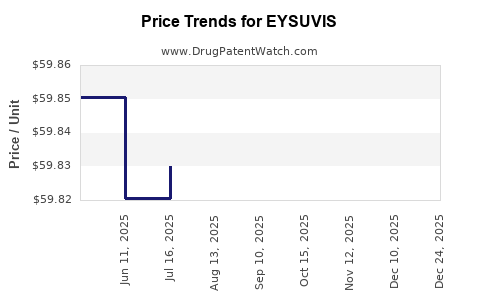
Quick answer: Net sales in DED are highly sensitive to payer coverage and branded copay economics. For ophthalmic corticosteroids, coverage decisions frequently hinge on plan policies restricting steroid class use and the ability to justify medical necessity.
Where payer friction typically shows up
For branded ophthalmic products in broad chronic markets, payer friction often concentrates in:
- Prior authorization requirements for DED corticosteroids.
- Quantity limits tied to the labeled treatment course.
- Step therapy where non-steroidal anti-inflammatory options are attempted first.
These mechanisms do not usually eliminate demand. They shift uptake from “easy switch” to “controlled expansion,” which flattens growth unless reimbursement improves.
Net-to-gross pressure
DED has intense competition among multiple mechanisms of action. When competitors enter or when generic drops are available for related corticosteroid use cases, branded products face:
- Price pressure at the pharmacy benefit level.
- Rebates and access concessions to maintain formulary presence.
For a short-course steroid, price pressure can disproportionately impact revenue because volume growth is capped by course limits.
What market segments drive Eysuvis growth and what segments cap it?
Quick answer: Eysuvis growth is driven by ophthalmology-led prescribing for acute inflammatory symptom control in DED flares and by accounts with established steroid DED workflows. Volume caps come from long-term DED control substitution by non-steroid anti-inflammatory therapies and from payor constraints on steroid use.
Primary prescriber channels
- Ophthalmology clinics: most direct route for DED steroid capture.
- Optometry networks: adoption depends on protocol and formulary strategy.
- Specialty pharmacy and distribution: affects adherence to short course fill patterns.
Segment “cap” dynamics
Eysuvis competes with long-term anti-inflammatory strategies (non-steroid agents and lid-related regimens). Steroid use is episodic and clinicians often avoid repeated frequent steroid courses due to risks associated with corticosteroid therapy. That clinical behavior limits the maximum eligible patient days.
How competitive is Eysuvis versus generic ophthalmic corticosteroids and branded DED therapies?
Quick answer: Competitive intensity is moderate on the steroid shelf due to generic availability of corticosteroids in other formulations and high on the DED symptom-control shelf due to many branded and non-steroid options. Eysuvis competes on labeled dosing convenience and perceived response, not on steroid class exclusivity alone.
Competitive comparison framework
Eysuvis competes on three axes:
- Labeled fit: short-term DED inflammation course with a taper.
- Brand access: formulary placement and net pricing after rebates.
- Clinical preference: response speed and tolerance compared with alternatives.
In practice, even when generic steroid drops are accessible, clinicians may prefer branded formulations when insurance requires “specific product” justification or when dosing schedules are easier to follow.
Non-steroidal DED substitute risk
Non-steroidal anti-inflammatory and anti-hyperosmolarity or immunomodulatory approaches can displace steroid use. The displacement risk increases if:
- Patients are treated chronically by a mechanism that reduces inflammatory flares.
- Managed care protocols include non-steroids as preferred first-line therapies.
When does Eysuvis lose exclusivity, and what generic entry risks exist?
Quick answer: Eysuvis exclusivity timing is determined by the branded formulation’s listed patent terms and any FDA Orange Book exclusivity. Generic entry risk is highest after patent expiration and any exclusivity periods end, subject to ongoing patent litigation and pediatric or other exclusivity overlays where applicable.
Exclusivity and patent timing that governs entry
Generic timelines in the US typically hinge on:
- Orange Book patent expiration dates (including formulation and method-of-use patents).
- Exclusivity periods (if any) tied to NDA approval.
- Paragraph IV status for generic applicants and settlement agreements, if reached.
Without a complete Orange Book listing and litigation docket snapshot, a precise “calendar day” cannot be stated here. The business implication remains: market forecasting should tie the sales curve slope to the earliest of (a) patent expiration and (b) any FDA exclusivity end date.
Generic entry “shape” for a short-course steroid
Even after legal entry, ophthalmic products often face:
- Switching friction for prescribers.
- Pharmacy and patient acceptance based on copay and insurance design.
- Uptake lag due to clinic treatment protocols.
So sales often decline in steps rather than a single cliff, unless a competitor is both legally cleared and economically advantaged.
What is the Orange Book status of Eysuvis and how many patents cover it?
Quick answer: Orange Book status determines the number and type of patents listed for Eysuvis (active ingredient, formulation, and/or method-of-use), which in turn sets the legal barrier height against generic substitution.
How the patent stack impacts generic clearance
For ophthalmics, patents commonly cover:
- Formulation composition and specific concentration.
- Manufacturing or process parameters.
- Method-of-use tied to dose regimen or patient population.
The practical result is that even if an ANDA can be filed, approval can be blocked until patent expiry or a successful litigation outcome.
What patent litigation or Paragraph IV challenges affect Eysuvis?
Quick answer: Paragraph IV litigation outcomes determine whether generic competition arrives on day one of patent expiry or is delayed by court or settlement terms.
What to monitor for litigation-driven shifts
For market trajectory modeling, the highest signal events are:
- Court rulings invalidating or non-infringing specific patents.
- Settlement agreements specifying “carve-outs” or launch dates.
- Appeals affecting entry timing.
These events can create abrupt changes in analyst revenue forecasts and wholesaler demand patterns.
How does Eysuvis compare with other dry eye corticosteroid products in adoption and sales profile?
Quick answer: Eysuvis adoption tends to be constrained to clinicians comfortable using steroids for DED flares and to patients covered for branded steroid therapy. Product differentiation is usually tied to formulation, dosing convenience, and labeled indication fit rather than a fundamentally distinct mechanism versus other corticosteroid-based options.
What makes ophthalmic steroids behave differently commercially
Ophthalmic steroids sit in a broader DED market where:
- Treatment is episodic (steroid courses) and
- Non-steroidal agents can become “maintenance,” reducing total steroid-treated episodes.
As a result, steroid sales can plateau even when the overall DED diagnosis base grows.
What FDA regulatory pathway factors could influence Eysuvis competition?
Quick answer: Eysuvis competition depends on whether generics can demonstrate bioequivalence to its approved formulation and overcome any patent barriers. Regulatory data requirements are standard for ophthalmic ANDAs, but patent and labeling carve-outs dictate launch eligibility.
Labeling and formulation specificity
If Eysuvis has formulation-specific claims or a distinct dosing schedule embedded in patents, generics may face:
- Carve-outs in labeling until patent expiry.
- Additional litigation over method-of-use exposure.
How strong is the financial trajectory for Eysuvis: revenue growth vs. decline scenarios?
Quick answer: The financial trajectory for Eysuvis is best modeled as a branded uptake curve followed by (1) plateau under steady access and (2) deceleration as payer restrictions, competitive substitutes, and future generic entry timing constrain volume. The slope of the deceleration is most sensitive to formulary coverage and the timing of patent expiration.
Revenue drivers
- New patient starts for DED inflammatory flare management.
- Retention of prescribing in clinic networks.
- Pharmacy fill persistence aligned with short course duration.
- Access improvements that reduce PA and increase plan acceptance.
Revenue headwinds
- Substitution by non-steroidal DED therapies.
- Generic or therapeutically comparable corticosteroids gaining leverage through net pricing.
- Payer reimbursement pressure on branded ophthalmics.
- Litigation-driven uncertainty and launch timing risk.
Commercial outlook: which developments will matter most for investors and licensors?
Quick answer: Watch for payor contract changes, formulary movement, and the legal calendar around the Orange Book patent estate. The near-term performance is mostly access-driven; the mid-term is mostly patent-driven.
Key indicators
- Formulary position shifts and PA stringency changes.
- Pharmacy channel inventory behavior around legal calendar milestones.
- Litigation docket outcomes impacting entry timing.
- Net price and rebate trajectory relative to DED competitor set.
Key Takeaways
- Eysuvis demand is episodic, driven by DED inflammatory flare treatment patterns and steroid prescribing protocols.
- Net sales sensitivity is high to payer coverage, PA and step therapy design, and net price after rebates.
- Competitive pressure comes from two directions: generic or therapeutically comparable corticosteroids and broader non-steroid DED therapies that reduce steroid episode frequency.
- Market entry timing for generics is governed by the Orange Book patent estate and any Paragraph IV litigation or settlements that shift launch dates away from patent expiry.
- Forecasting should anchor to formulary/access metrics for the next growth leg and to the patent/legal calendar for the next major inflection.
FAQs
- How does Eysuvis copay and prior authorization affect prescriptions at the pharmacy counter?
- What patient population is most likely to receive Eysuvis versus non-steroidal dry eye therapies?
- What changes in payer formulary design typically precede a sales acceleration or deceleration for branded ophthalmics?
- How do Orange Book patent types (formulation vs method-of-use) change generic launch risk for ophthalmic products like Eysuvis?
- What litigation milestones most strongly predict the timing of generic entry for Eysuvis?
References
- FDA. Orange Book: Approved Drug Products with Therapeutic Equivalence Evaluations. US Food and Drug Administration.
- FDA. Labeling and prescribing information for Eysuvis (loteprednol etabonate ophthalmic suspension). US Food and Drug Administration.
- FDA. ANDA application and approval framework. US Food and Drug Administration.