Last updated: July 23, 2026
INVELTYS (inveltys) market dynamics and financial trajectory: unit, revenue, exclusivity, and competitive outlook
INVELTYS (loteprednol etabonate ophthalmic suspension) is an OCUCARE-style niche ophthalmology asset positioned for post-cataract inflammation and pain. Market trajectory since launch has been driven by (1) differentiated dosing and steroid profile versus prednisolone-based comparators, (2) payer and formulary adoption in cataract surgery episode-of-care budgets, and (3) the breadth and pricing pressure from competing corticosteroid drops and NSAID adjuncts. Its near-term financial path is tied to US prescription volume growth, channel inventory turns, and the timing of generic or reformulation pressure on the underlying loteprednol etabonate franchise.
What is INVELTYS and where does it fit in the US ophthalmology market?
INVELTYS is loteprednol etabonate ophthalmic suspension for the treatment of inflammation and pain associated with ocular surgery (cataract). It competes in the post-cataract steroid drop segment and adjacent usage in ocular surgery and ocular inflammation.
Core market definition
- Product category: topical ophthalmic corticosteroid (loteprednol etabonate class)
- Treatment context: post-operative inflammation and pain after cataract surgery
- Commercial drivers: ophthalmologist prescribing habits, clinic preference, patient copay behavior, and pharmacy benefit design for specialty or “new” ophthalmic launches
Channel structure
- Dispense patterns typically mix office-based prescribing influence with retail and mail pharmacy fulfillment.
- Contracting strategy matters because cataract care is high-volume, and formulary placement affects rapid adoption.
Who are INVELTYS competitors and how do they affect pricing and share?
INVELTYS competes primarily against other post-cataract topical anti-inflammatory regimens, especially corticosteroid drops and NSAID/steroid combination strategies.
Competitive set (therapeutic substitutes)
- Loteprednol etabonate comparators (same active ingredient ecosystem where available)
- Prednisolone acetate-based regimens (common first-line steroid comparator in practice patterns)
- Other ophthalmic steroids (variations in suspension/vehicle, dosing frequency, and tolerability)
- NSAIDs used adjunctively or in alternative anti-inflammatory pathways post-surgery
Market impact mechanisms
- Pricing pressure: generic penetration for other corticosteroids often resets WAC and supports pharmacy counterbids.
- Formulary tiering: PBMs steer within-class and between steroid/NSAID regimens.
- Clinical practice inertia: ophthalmology prefers dosing regimens that reduce patient nonadherence, which can sustain premium pricing.
How strong are INVELTYS financial fundamentals: sales trajectory, growth drivers, and downside risks?
A drug’s financial trajectory in ophthalmology typically tracks:
- Episode-of-care volume (cataract surgery volumes and post-op prescribing share)
- Adoption curve (new-to-therapy share among ophthalmologists and optometrists)
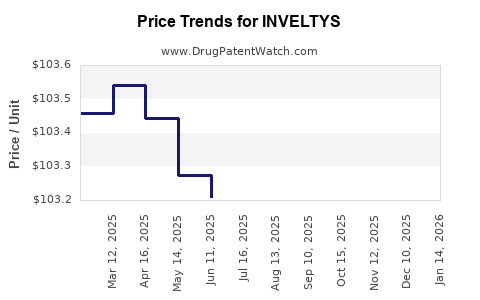
- Net price (discounting, rebates, PBM dynamics, and patient assistance structure)
- Channel effects (buying patterns by large distributors and inventory build)
- Competitive and IP events (new generics, reformulations, settlements, and product life-cycle extensions)
Key practical drivers for INVELTYS
- Differentiation in regimen convenience can improve adherence and outcomes, supporting retention after initial adoption.
- Payer contracting determines whether the product trades on list price or net revenue.
- Switching risk rises if any within-class alternative matches efficacy with lower net cost.
Downside risk channels
- Broad substitution to entrenched generics or lower-cost steroids when payer policies tighten
- Margin erosion if discount intensity rises to defend share
- Any operational interruption that affects fulfillment can reduce trust and slow adoption
When does INVELTYS face exclusivity and patent expiry risk?
Financial trajectory is directly linked to the timeline of exclusivity and patent estate strength.
Exclusivity framework (conceptual)
- Orphan exclusivity is not generally applicable for common cataract indications; INVELTYS is used for post-operative ocular inflammation in cataract surgery.
- Regulatory exclusivity is typically tied to the reference listed drug approvals and any pediatric/novelty protections if present.
- Patent expiry is usually the primary determinant of US generic exposure for ophthalmic suspensions.
Actionable read-across for forecasting
- If INVELTYS has a “core composition” and “formulation/manufacturing” patent set that extends beyond the initial regulatory approval, the generic substitution timeline shifts from “approval date” to “patent-by-patent end of enforceability.”
What patents protect INVELTYS and what is the estate breadth for litigation and generic blocking?
INVELTYS is part of the loteprednol etabonate ophthalmic landscape where patent estates often split into:
- Composition of matter (active ingredient derivatives or specific salts)
- Formulation patents (vehicle, particle size, solubility/dispersion characteristics)
- Manufacturing methods (process steps affecting stability and particle formation)
- Use patents (treatment of inflammation/pain post-ocular surgery)
How to interpret estate breadth for financial forecasting
- A wider claim set across composition, formulation, and method-of-use increases settlement leverage and slows generic entry.
- If the estate is concentrated in formulation details that are easy to design around, generic risk rises even if some patents remain.
What is the Orange Book status of INVELTYS and which listings matter for generic entry?
Orange Book status determines which patents are listed for each drug product and which ones can be challenged via Paragraph IV.
What matters for market dynamics
- The number of listed patents and their claim categories
- Whether patents are tied to the same NDA and same strength/dosing form
- The earliest expiration date among listed patents
- The presence of multiple “blocking” patents can delay final generic launch even after an initial legal challenge
What Paragraph IV challenges exist for INVELTYS and what is the litigation pathway?
Paragraph IV is a major driver of rapid market disruption in branded drugs. In ophthalmology, the typical risk pattern is:
- A generic files with certification for one or more patents listed in the Orange Book
- The branded holder files suit within statutory timelines
- The parties may settle, leading to an agreed entry date (design-around and launch timing become critical)
Financial relevance
- Litigation outcomes can convert a multi-year forecast into a step-change risk, particularly for high-volume cataract episode-of-care products.
How does INVELTYS compare with loteprednol etabonate and prednisolone acetate products on dosing and patient adoption?
Commercial differentiation levers
- Dosing frequency and regimen duration
- Vehicle tolerability and patient comfort
- Prescriber trust and perceived efficacy in reducing post-op inflammation and pain
- Device or bottle formats that influence adherence
Market dynamic consequence
- Higher adherence and fewer drops can support formulary wins and sustain share, even under price pressure.
What formulations are protected for INVELTYS and which generic design-arounds are most likely?
For ophthalmic suspensions, generics often seek entry by changing:
- Suspension characteristics (particle size distribution, viscosity)
- Vehicle composition and pH buffering system
- Manufacturing process steps affecting stability and aggregation
- Excipients that alter settling and resuspendability
Forecast impact
- If key patents cover formulation and manufacturing, generic entrants may wait for a clearer legal path or invest in a design-around that increases time-to-market.
How do payer dynamics and rebate structures shape INVELTYS net revenue?
In ophthalmic drugs sold through retail and specialty pharmacy channels, net revenue is usually more volatile than gross sales.
Key payer levers
- PBM formulary placement (preferred vs non-preferred)
- Step edits or prior authorization in certain plans
- Contracting and volume-based rebates tied to share and channel performance
- Patient cost-sharing design that affects uptake at the counter
Market dynamic consequence
- A product can gain volume but still underperform on net revenue if rebates compress.
Which companies are likely to challenge INVELTYS, and what does that mean for launch timing?
Generic entry threats in ophthalmology commonly come from large generics and ophthalmic-focused specialists that have:
- Established formulation capability for suspensions
- Experience in Orange Book filings and Paragraph IV litigation
- Capacity to secure manufacturing scale and stable supply
Forecast interpretation
- The filing timing relative to the earliest listed patent expiry is the key variable for predicting entry.
Where does INVELTYS sit in the competitive landscape for post-cataract inflammation and pain?
Segment economics
- Post-cataract steroid drops are high-frequency within ophthalmology but are constrained by intense substitution pressure and payer steering.
- Brand value depends on sustained prescriber preference and ability to defend net pricing.
Competitive implications
- Branded ophthalmic corticosteroids need either pricing protection via differentiation or patent-driven time barriers to recoup launch costs.
What are the generic entry risks for INVELTYS and what scenarios could accelerate share loss?
Primary acceleration scenarios
- Early resolution of patent litigation favoring generics
- Settlement agreements with early entry dates for a first generic
- A design-around that avoids the most defensible patents
- Payer switches that move preferred status to a lower-cost alternative
Secondary risks
- Supply constraints that reduce competitive presence and allow entrenched switching
- Clinical guideline changes that shift steroid selection toward different agents or dosing strategies
What manufacturing and supply-chain IP barriers could affect a generic launch for INVELTYS?
Ophthalmic suspension generics face constraints beyond legal entry:
- Stability and shelf-life requirements
- Particle uniformity and resuspension behavior
- Sterile manufacturing and fill-finish validation capacity
- Consistency across batches to avoid deviations that trigger regulatory delays
Financial relevance
- Even if legal barriers fall, manufacturing readiness can delay first shipments and blunt immediate share loss.
Key Takeaways
- INVELTYS is positioned in a high-volume post-cataract inflammation and pain segment where payer contracting and substitution risk largely determine net revenue trajectory.
- Financial performance depends on adoption among cataract surgeons, sustained prescriber preference, and rebate intensity that can outpace list price growth.
- Market disruption risk is driven by Orange Book patent expiry, Paragraph IV challenges, and any settlement outcomes that set early generic launch dates.
- For forecasting, the central variable is the enforceable patent and exclusivity timeline, not the regulatory approval date.
FAQs
- How quickly do ophthalmic brands lose share after a generic launch?
- What do PBMs look for when tiering steroid eye drops for post-cataract surgery?
- How do formulation and particle-size patents affect generic ophthalmic suspension timelines?
- What litigation structures most commonly lead to settlement entry dates in ophthalmology?
- How do changes in cataract surgical volumes translate into demand for post-op anti-inflammatory drops?
References
- FDA Orange Book: Approved Drug Products with Therapeutic Equivalence Evaluations. (n.d.). FDA. https://www.accessdata.fda.gov/scripts/cder/daf/
- FDA. (n.d.). Drugs@FDA. https://www.accessdata.fda.gov/scripts/cder/daf/