Last updated: August 18, 2026
Lotemax, the branded loteprednol etabonate ophthalmic corticosteroid franchise, has moved from an innovative branded product to a mature, multi-formulation ophthalmology business. Its commercial value now depends on formulation differentiation, prescriber familiarity, pharmacy coverage, and Bausch + Lomb’s ability to defend branded volume against generic loteprednol products.
The franchise has several products, including Lotemax ophthalmic suspension 0.5%, Lotemax gel 0.5%, Lotemax SM gel 0.38%, and Lotemax ophthalmic ointment 0.5%. The core market is postoperative ocular inflammation and pain, with related demand in steroid-responsive ocular surface disease. Product-level revenue is not separately reported by Bausch + Lomb, so Lotemax’s financial trajectory must be assessed through portfolio disclosures, market structure, product launches, generic competition, and ophthalmology segment performance.
What is Lotemax and how does it compete in ophthalmic corticosteroids?
Lotemax contains loteprednol etabonate, an ester-based corticosteroid designed to provide topical anti-inflammatory activity with a lower propensity for certain steroid-related adverse effects than some older ophthalmic corticosteroids. The product is used primarily for postoperative ocular inflammation and pain and, depending on formulation and label, other steroid-responsive ocular conditions.
| Product |
Strength |
Dosage form |
Commercial role |
| Lotemax ophthalmic suspension |
0.5% |
Suspension drops |
Original branded formulation |
| Lotemax gel |
0.5% |
Ophthalmic gel |
Improved retention and postoperative positioning |
| Lotemax SM |
0.38% |
Submicron gel |
Lower-strength, enhanced-delivery formulation |
| Lotemax ophthalmic ointment |
0.5% |
Ointment |
Longer ocular residence and nighttime use |
Lotemax competes with several categories:
- Generic loteprednol etabonate suspension, gel, and related presentations.
- Prednisolone acetate products, including Pred Forte and generics.
- Difluprednate, marketed as Durezol and available in generic form.
- Inveltys, a twice-daily loteprednol etabonate ophthalmic suspension.
- Eysuvis, a short-duration loteprednol etabonate product for dry-eye disease.
- Nonsteroidal anti-inflammatory ophthalmic products such as ketorolac, bromfenac, and nepafenac.
Lotemax’s main commercial advantage is physician familiarity combined with multiple delivery systems. Its principal weakness is that the active ingredient is no longer protected by meaningful basic-molecule exclusivity in the United States.
When did Lotemax receive FDA approval?
The original Lotemax ophthalmic suspension was approved by the U.S. Food and Drug Administration in 1998. Bausch + Lomb later expanded the franchise through new dosage forms and delivery technologies.
| FDA milestone |
Approximate timing |
Commercial significance |
| Lotemax 0.5% suspension approval |
1998 |
Established the branded loteprednol franchise |
| Lotemax gel 0.5% approval |
2012 |
Added a gel delivery system |
| Lotemax SM 0.38% approval |
2015 |
Added submicron gel technology and lower drug concentration |
| Generic loteprednol suspension approvals |
2018 onward |
Initiated direct generic price pressure |
| Lotemax ointment approval and commercialization |
Early 2020s |
Extended branded formulation coverage |
The original approval created a long commercial period before generic competition. Bausch + Lomb’s strategy shifted from reliance on the original suspension to lifecycle management through gels, submicron delivery, and ointment.
When does Lotemax lose exclusivity?
Lotemax’s core U.S. exclusivity has already expired. The original 1998 approval is far beyond the five-year new chemical entity exclusivity period, and generic loteprednol products have entered the market.
The current commercial question is not whether the active ingredient has exclusivity. It is whether individual branded formulations retain enough formulation, delivery, labeling, or market-access differentiation to support a premium.
How strong is the Lotemax patent estate?
The patent estate is materially weaker than it was during the original branded period because:
- The underlying active ingredient is mature.
- Generic loteprednol products have been approved.
- The original suspension is exposed to therapeutic substitution.
- Later formulation patents, where enforceable, protect narrower delivery technologies rather than the entire loteprednol market.
Formulation and delivery patents may continue to affect specific products, but they do not generally prevent competition across the entire class. A competitor can target the same active ingredient through a different dosage form, formulation, concentration, or manufacturing route.
Public product-level patent and expiry information can vary by presentation and Orange Book update. Commercial diligence should review the current FDA Orange Book entries for each Lotemax NDA rather than rely on the original product’s exclusivity history.
What is the Orange Book status of Lotemax?
Lotemax products are prescription ophthalmic drugs regulated under FDA new drug applications. The Orange Book is relevant for identifying listed patents, patent certifications, and the regulatory basis for abbreviated new drug applications.
The practical Orange Book analysis is presentation-specific:
- Lotemax suspension faces the highest generic exposure because it is the oldest and most readily substitutable product.
- Lotemax gel has greater formulation differentiation but remains exposed to generic gel development.
- Lotemax SM has a stronger delivery-based positioning than the original suspension, although its protection is narrower.
- Lotemax ointment has a newer commercial history and may have more recent formulation or use-related protection, but any such protection does not eliminate substitution risk in the broader loteprednol market.
The absence of product-level revenue disclosure makes it difficult to quantify how much of the franchise is tied to each Orange Book presentation.
Which companies are challenging Lotemax with generic products?
Generic competition comes from ophthalmic manufacturers and specialty generic companies that have received FDA approval for loteprednol etabonate products. Publicly identified participants in the broader loteprednol generic market have included companies such as Akorn, Amneal, Lupin, Taro, and other abbreviated new drug application holders, depending on product and market period.
The competitive structure has several layers:
| Competitive layer |
Main products |
Effect on Lotemax |
| Direct generic suspension |
Loteprednol etabonate 0.5% suspension |
Highest substitution pressure |
| Direct generic gel |
Loteprednol etabonate gel |
Pressures gel pricing and formulary status |
| Branded alternative |
Inveltys |
Competes on dosing convenience |
| Branded dry-eye steroid |
Eysuvis |
Expands loteprednol use into another indication |
| Older steroid generics |
Prednisolone acetate |
Creates low-cost therapeutic alternative |
| Potent branded/generic steroid |
Difluprednate |
Competes in postoperative inflammation |
Generic entry does not eliminate branded sales immediately. Ophthalmologists may continue prescribing branded products when they prefer a specific vehicle, device, package, tolerability profile, or pharmacy availability. Payers and pharmacies generally push the market toward lower-cost generic alternatives.
What formulations are protected by Lotemax?
The franchise’s principal differentiation comes from drug delivery rather than a new active pharmaceutical ingredient.
Lotemax suspension
The original suspension established the market but has the greatest exposure to generic substitution. Suspensions require shaking and can have dose-uniformity and settling characteristics that influence physician and patient preferences.
Lotemax gel
The gel formulation provides a different ocular delivery profile and may improve retention compared with a conventional suspension. Its commercial value depends on whether prescribers view the formulation as clinically distinct enough to justify a brand premium.
Lotemax SM
Lotemax SM uses submicron technology and a 0.38% concentration. The product was designed to support delivery and dosing characteristics while maintaining anti-inflammatory activity. Its differentiation is more defensible than the original suspension if the formulation produces meaningful clinical or practical advantages, but generic and competing branded products can still erode the category.
Lotemax ointment
The ointment provides prolonged ocular residence and may be used when a longer-acting topical vehicle is preferred. Ointments often occupy a narrower use case than drops because of temporary blurred vision and administration preferences.
How does Lotemax compare with Inveltys and Eysuvis?
Lotemax, Inveltys, and Eysuvis all use loteprednol etabonate but target different commercial opportunities.
| Product |
Active ingredient |
Primary positioning |
Market implication |
| Lotemax |
Loteprednol etabonate |
Broad branded ocular corticosteroid franchise |
Mature product with formulation-based defense |
| Inveltys |
Loteprednol etabonate 1% |
Twice-daily postoperative treatment |
Competes on dosing convenience |
| Eysuvis |
Loteprednol etabonate 0.25% |
Short-term treatment of dry-eye disease flares |
Extends the molecule into a distinct indication |
Inveltys is associated with Kala Pharmaceuticals, now part of Alcon’s broader commercial ecosystem following Alcon’s acquisition of Kala’s assets. Eysuvis is marketed by Kala Pharmaceuticals. These products do not simply replicate Lotemax’s market. They target different dosing schedules, concentrations, and indications.
The main strategic risk for Lotemax is internal and external fragmentation. Newer branded loteprednol products can capture high-value prescriptions while generic products reduce the price of the original franchise.
What generic launch risks exist for Lotemax?
The greatest generic launch risk is substitution in the 0.5% suspension segment. Generic manufacturers can compete through:
- Lower acquisition cost.
- Pharmacy substitution.
- Formulary preference.
- Payer-driven step edits.
- Hospital and ambulatory surgery center contracts.
- Broad distribution through retail and specialty pharmacies.
The risk is lower for newer presentations when generic availability is limited or when the branded product has a distinct device, vehicle, concentration, indication, or dosing schedule. That protection is commercial rather than absolute. Physicians can often switch patients to another loteprednol or corticosteroid formulation.
A likely launch pattern is gradual erosion rather than an immediate loss of all branded volume. Brand retention is strongest in patients with physician preference, prior treatment success, formulation sensitivity, or access through commercial copay programs.
What is the financial trajectory of Lotemax?
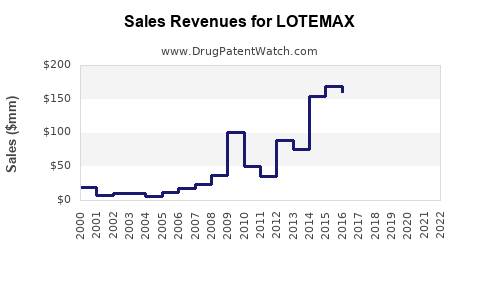
Bausch + Lomb does not separately disclose Lotemax revenue in its public financial reporting. The company reports revenue by broader business segment and product category, which prevents a precise calculation of Lotemax sales, margins, or year-over-year growth.
The commercial trajectory can be divided into four phases:
| Period |
Financial trajectory |
| 1998 to pre-generic period |
High-value branded growth supported by market establishment and limited direct substitution |
| Generic-entry period |
Declining price realization and pressure on original suspension volume |
| Formulation-defense period |
Revenue supported by gel, SM, ointment, and brand-prescription retention |
| Mature-franchise period |
More stable but lower-growth revenue, dependent on mix, pricing, and portfolio execution |
Bausch + Lomb generated approximately $4.1 billion in revenue in 2023 across its global vision-care, surgical, and pharmaceutical businesses. Lotemax is one component of the pharmaceutical portfolio, but the company does not identify its contribution separately in the annual report. The absence of disclosure means that investor models should avoid assigning a standalone Lotemax revenue figure without prescription, claims, or channel data. (Bausch + Lomb Corporation, 2024)
What factors determine Lotemax profitability?
Lotemax profitability depends on product mix more than unit volume alone.
Higher-value branded gel, SM, and ointment products can partially offset declines in the original suspension. Gross margin is affected by:
- Manufacturing cost of sterile ophthalmic dosage forms.
- Packaging and bottle technology.
- Royalty or licensing obligations.
- Trade discounts and rebates.
- Copay assistance.
- Generic price competition.
- Sales-force and physician-promotion costs.
- Regulatory maintenance requirements.
Sterile ophthalmic manufacturing is a barrier to rapid entry because products require validated aseptic processes, container-closure controls, stability data, and reliable supply. Those barriers support some branded pricing power, but they do not prevent competition from established generic manufacturers.
What licensing deals affect Lotemax?
Lotemax originated with Bausch + Lomb and is now part of Bausch + Lomb Corporation’s pharmaceutical portfolio after the company’s separation from the broader Bausch corporate structure. Public company filings should be reviewed for material royalty, licensing, or acquisition obligations associated with individual ophthalmic products.
The more important commercial relationship in the loteprednol market is the distinction between Lotemax and other branded loteprednol products. Lotemax, Inveltys, and Eysuvis may share the same active ingredient but are marketed under separate product strategies and ownership structures. Their competition is based on formulation, indication, dosing frequency, and payer positioning.
No public disclosure establishes a single licensing arrangement that controls the entire loteprednol market.
What patent litigation and settlement agreements affect Lotemax?
Lotemax’s major commercial patent risk is historical generic-entry litigation rather than a current dispute that blocks the entire market. Generic applicants may challenge listed patents through Paragraph IV certifications, triggering Hatch-Waxman litigation if the innovator files suit within the statutory period.
For a mature product such as Lotemax, possible litigation targets include:
- Formulation patents.
- Gel or submicron delivery patents.
- Concentration-specific claims.
- Method-of-use claims.
- Labeling-related claims.
- Manufacturing or particle-size claims.
A Paragraph IV challenge does not guarantee immediate generic launch. Entry can occur after settlement, expiration of the relevant patent, a court decision, or an at-risk launch. Product-specific litigation and settlement terms should be confirmed through FDA Orange Book records, federal court dockets, and company filings.
There is no basis to treat the original Lotemax approval as a current barrier to generic entry. The relevant legal issue is the enforceability and remaining term of specific listed patents for each formulation.
How large is the market opportunity for ophthalmic corticosteroids?
Ophthalmic corticosteroids are a mature but durable market. Demand is linked to cataract surgery, refractive procedures, corneal transplantation, ocular surface inflammation, allergic or inflammatory eye disease, and dry-eye treatment episodes.
Market growth is supported by:
- Rising global cataract procedure volumes.
- Growth in outpatient ophthalmic surgery.
- Increased treatment of postoperative inflammation.
- Expansion of specialty eye-care practices.
- New indications for established molecules.
Pricing growth is constrained by:
- Generic substitution.
- Payer controls.
- Low-cost prednisolone products.
- Increasing competition from branded delivery technologies.
- Short treatment durations in many indications.
The market is therefore attractive for differentiated products but less attractive for an undifferentiated branded steroid drop.
What is the outlook for Lotemax and generic loteprednol?
Lotemax is likely to remain commercially relevant as a branded ophthalmic steroid, but its growth profile is mature. The most probable outlook is:
- Continued erosion in the original suspension where generic substitution is available.
- Relative resilience in differentiated branded formulations.
- Greater pressure from Inveltys and other branded loteprednol products on high-value prescriptions.
- Stable demand from cataract and other ophthalmic procedures.
- Limited ability to raise prices without volume or mix consequences.
- Ongoing dependence on Bausch + Lomb’s distribution, contracting, and physician access strategy.
The franchise has manufacturing and brand barriers, but its basic-molecule patent position is no longer a meaningful source of exclusivity. Its remaining value is commercial and formulation-based.
Key Takeaways
- Lotemax is a mature loteprednol etabonate ophthalmic franchise owned and marketed by Bausch + Lomb.
- The original 0.5% suspension was approved in 1998 and is exposed to generic substitution.
- The franchise has been extended through gel, submicron gel, and ointment formulations.
- Product-level Lotemax revenue is not separately disclosed by Bausch + Lomb.
- Generic loteprednol creates the greatest pressure in the original suspension market.
- Lotemax SM, gel, and ointment have stronger formulation differentiation but narrower protection.
- Inveltys and Eysuvis expand competition among branded loteprednol products.
- Sterile ophthalmic manufacturing creates execution barriers but does not restore active-ingredient exclusivity.
- Future value depends on branded mix, payer access, formulation preference, and generic penetration.
FAQs About Lotemax Market and Exclusivity
Is Lotemax still patent protected?
The original Lotemax product is no longer protected by basic new chemical entity exclusivity. Specific formulation or method-of-use patents may apply to individual presentations, but generic loteprednol products are already marketed.
Is there a generic version of Lotemax gel?
Generic loteprednol products have entered the U.S. market, including presentations that compete with branded loteprednol formulations. Availability varies by dosage form, manufacturer, pharmacy, and time period.
Does Bausch + Lomb report Lotemax sales separately?
No. Bausch + Lomb reports results by broader business segments and does not provide a standalone Lotemax revenue line in its public annual reporting.
Is Lotemax used after cataract surgery?
Yes. Lotemax products are used to treat postoperative ocular inflammation and pain under their applicable FDA labeling. Cataract surgery is an important demand driver for ophthalmic corticosteroids.
Can Lotemax be replaced by prednisolone acetate?
In some clinical situations, physicians may use prednisolone acetate or another ophthalmic corticosteroid instead. Substitution depends on the indication, physician judgment, patient response, formulation preference, and payer coverage.
References
- Bausch + Lomb Corporation. (2024). 2023 annual report.
- U.S. Food and Drug Administration. (1998). Lotemax ophthalmic suspension 0.5% prescribing information.
- U.S. Food and Drug Administration. (2012). Lotemax ophthalmic gel 0.5% prescribing information.
- U.S. Food and Drug Administration. (2015). Lotemax SM ophthalmic gel 0.38% prescribing information.
- U.S. Food and Drug Administration. (n.d.). Approved drug products with therapeutic equivalence evaluations: Orange Book.
- U.S. Food and Drug Administration. (n.d.). Drugs@FDA: FDA-approved drugs database.